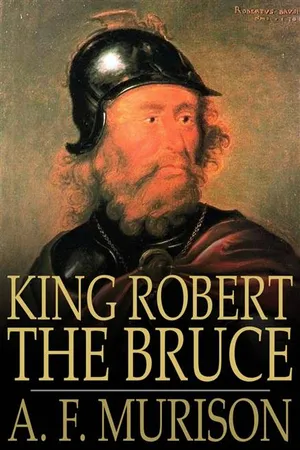
eBook - ePub
Information
Subtopic
European Medieval HistoryIndex
HistoryChapter I - The Ancestry of Bruce
*
When Sir William Wallace, the sole apparent hope of Scottish
independence, died at the foot of the gallows in Smithfield, and was
torn limb from limb, it seemed that at last 'the accursed nation' would
quietly submit to the English yoke. The spectacle of the bleaching
bones of the heroic Patriot would, it was anticipated, overawe such of
his countrymen as might yet cherish perverse aspirations after national
freedom. It was a delusive anticipation. In fifteen years of arduous
diplomacy and warfare, with an astounding expenditure of blood and
treasure, Edward I. had crushed the leaders and crippled the resources
of Scotland, but he had inadequately estimated the spirit of the
nation. Only six months, and Scotland was again in arms. It is of the
irony of fate that the very man destined to bring Edward's calculations
to naught had been his most zealous officer in his last campaign, and
had, in all probability, been present at the trial—it may be at the
execution—of Wallace, silently consenting to his death. That man of
destiny was Sir Robert de Brus, Lord of Annandale and Earl of Carrick.
*
The Bruces came over with the Conqueror. The theory of a Norse origin
in a follower of Rollo the Ganger, who established himself in the
diocese of Coutances in Manche, Normandy, though not improbable, is but
vaguely supported. The name is territorial; and the better opinion is
inclined to connect it with Brix, between Cherbourg and Valognes.
The first Robert de Brus on record was probably the leader of the
Brus contingent in the army of the Conqueror. His services must have
been conspicuous; he died (about 1094) in possession of some 40,000
acres, comprised in forty-three manors in the East and West Ridings of
Yorkshire, and fifty-one in the North Riding and in Durham. The chief
manor was Skelton in Cleveland.
The next Robert de Brus, son of the first, received a grant of
Annandale from David I., whose companion he had been at the English
court. This fief he renounced, probably in favour of his second son,
just before the Battle of the Standard (1138), on the failure of his
attempted mediation between David and the English barons. He died in
1141, leaving two sons, Adam and Robert.
This Robert may be regarded as the true founder of the Scottish branch.
He is said to have remained with David in the Battle of the Standard,
and, whether for this adherence or on some subsequent occasion, he was
established in possession of the Annandale fief, which was confirmed
to him by a charter of William the Lion (1166). He is said to have
received from his father the manor of Hert and the lands of Hertness in
Durham, 'to supply him with wheat, which did not grow in Annandale.' He
died after 1189.
The second Robert de Brus of Annandale, son of the preceding lord,
married (1183) Isabel, daughter of William the Lion, obtaining as her
dowry the manor of Haltwhistle in Tyndale. His widow married Robert de
Ros in 1191. The uncertainty as to the dates of his father's death and
his own has suggested a doubt whether he ever succeeded to the lordship.
William de Brus, a brother, the next lord, died in 1215.
The third Robert de Brus of Annandale, son of William, founded the
claim of his descendants to the crown by his marriage with Isabel,
second daughter of David, Earl of Huntingdon, younger brother of
William the Lion. He died in 1245.
The fourth Robert de Brus of Annandale, eldest son of the preceding
lord, was born in 1210. In 1244, he married Isabel, daughter of Gilbert
de Clare, Earl of Gloucester. Next year he succeeded to Annandale,
and, on his mother's death in 1251, he obtained ten knight's fees in
England, her share of the Earldom of Huntingdon. He took an active
part in public affairs. In 1249-50 he sat as a Justice of the King's
Bench, and in 1268 he became Chief Justice of England, but Edward, on
his accession (1272), did not reappoint him. He served as Sheriff of
Cumberland and Governor of Carlisle Castle in 1254-55, and in 1264 he
fought for Henry at Lewes, and was taken prisoner.
At the same time, de Brus was a prominent figure in the baronage of
Scotland. The alleged arrangement of 1238 whereby Alexander II., with
the consent of the Scots parliament, appointed de Brus his successor in
the event of his dying childless, was frustrated by the King's second
marriage (1239), and the birth of a son, Alexander III. (1241). As one
of the fifteen Regents (1255) during the minority of Alexander III.,
he headed the party that favoured an English alliance, cemented by the
young King's marriage with Margaret, daughter of Henry III. At the
Scone convention on February 5, 1283-84, he was one of the Scots lords
that recognised the right of Margaret of Norway. The sudden death of
Alexander III., however, in March 1285-86, and the helplessness of the
infant Queen, put him on the alert for the chances of his own elevation.
On September 20, 1286, de Brus met a number of his friends at Turnberry
Castle, the residence of his son, the Earl of Carrick. There fourteen
Scots nobles, including de Brus and the Earl of Carrick, joined in a
bond obliging them to give faithful adherence to Richard de Burgh,
Earl of Ulster, and Lord Thomas de Clare (de Brus's brother-in-law),
'in their affairs.' One of the clauses saved the fealty of the parties
to the King of England and to 'him that shall obtain the kingdom of
Scotland through blood-relationship with King Alexander of blessed
memory, according to the ancient customs in the kingdom of Scotland
approved and observed.' The disguise was very thin. The instrument
meant simply that the parties were to act together in support of de
Brus's pretensions to the crown when opportunity should serve. It
'united the chief influence of the West and South of Scotland against
the party of John de Balliol, Lord of Galloway, and the Comyns.' There
need be no difficulty in connecting this transaction with the outbreak
of 1287-88, which devastated Dumfries and Wigton shires. The party of
de Brus took the castles of Dumfries, Buittle and Wigton, killing and
driving out of the country many of the lieges. There remains nothing
to show by what means peace was restored, but it may be surmised that
Edward interfered to restrain his ambitious vassal.
For, by this time, Edward was full of his project for the marriage
of the young Queen with his eldest son, Prince Edward. The Salisbury
convention, at which de Brus was one of the Scottish commissioners,
and the Brigham conference, at which the project was openly declared,
seemed to strike a fatal blow at the aspirations of de Brus. But the
death of the Queen, reported early in October 1290, again opened up a
vista of hope.
When the news arrived, the Scots estates were in session. 'Sir Robert
de Brus, who before did not intend to come to the meeting,' wrote the
Bishop of St Andrews to Edward on October 7, 'came with great power,
to confer with some who were there; but what he intends to do, or
how to act, as yet we know not. But the Earls of Mar and Athol are
collecting their forces, and some other nobles of the land are drawing
to their party.' The Bishop went on to report a 'fear of a general
war,' to recommend Edward to deal wisely with Sir John de Balliol,
and to suggest that he should 'approach the March for the consolation
of the Scots people and the saving of bloodshed.' The alertness of de
Brus and his friends is conspicuously manifest, and the foremost of the
party of Balliol is privately stretching out his hands for the cautious
intervention of the English King.
The Earl of Fife had been assassinated; the Earl of Buchan was dead;
and the remaining four guardians divided their influence, the Bishop of
St Andrews and Sir John Comyn siding with Balliol, and the Bishop of
Glasgow and the Steward of Scotland with de Brus. Fordun thus describes
the balance of parties in the early part of 1291:
The nobles of the kingdom, with its guardians, often-times
discussed among themselves the question who should be made their
king; but they did not make bold to utter what they felt about
the right of succession, partly because it was a hard and knotty
matter, partly because different people felt differently about
such rights and wavered a good deal, partly because they justly
feared the power of the parties, which was great, and partly
because they had no superior that could, by his unbending power,
carry their award into execution or make the parties abide by
their decision.
The most prominent competitors were liegemen of Edward, and, whether
they appealed to warlike or to peaceful methods, the decision must
inevitably rest with him.
At the Norham meeting of June 1291, de Brus, as well as the other
competitors, fully acknowledged the paramount title of Edward. He had
no alternative; he had as large interests in England as in Scotland,
and armed opposition was out of the question. Availing himself of his
legal experience, he fought the case determinedly and astutely. If
Fordun correctly reports the reformation of the law of succession by
Malcolm, de Brus was, in literal technicality, 'the next descendant';
as son of David of Huntingdon's second daughter, he was nearer by one
degree than Balliol, grandson of David's eldest daughter. But the
modern reckoning prevailed. De Brus's plea that he had been recognised
both by Alexander II. and by Alexander III. was not supported by
documentary evidence, and his appeal to the recollection of living
witnesses does not seem to have been entertained. His third position,
that the crown estates were partible, was but a forlorn hope. He must
have seen, long before November 1292, that an adverse decision was a
foregone conclusion. He entered a futile protest. Already, in June,
he had concluded a secret agreement with the Count of Holland, a
competitor never in the running, but a great feudal figure, for mutual
aid and counsel; he had also an agreement with the Earl of Sutherland,
and, probably enough, with others. But an active dissent was beyond the
powers of a man of eighty-two. Accordingly, he resigned his claims in
favour of his son, the Earl of Carrick, and retired to Lochmaben, where
he died on March 31, 1295, at the age of eighty-five.
The fifth Robert de Brus of Annandale, the eldest son of the
Competitor, was born in 1253. On his return from the crusade of 1269,
on which he accompanied Prince Edward, afterwards Edward I., he married
Marjory (or Margaret), Countess of Carrick, and thus became by the
courtesy of Scotland Earl of Carrick. Marjory was the daughter and
heiress of Nigel, the Keltic (if Keltic be the right epithet) Earl of
Carrick, grandson of Gilbert, son of Fergus, Lord of Galloway, and
she was the widow of Adam of Kilconquhar, who had died on the recent
crusade. De Brus is said to have met her accidentally when she was out
hunting. Fordun gives the romance as follows:—
When greetings and kisses had been exchanged, as is the wont of
courtiers, she besought him to stay and hunt and walk about; and,
seeing that he was rather unwilling to do so, she by force, so
to speak, with her own hand made him pull up, and brought the
knight, though very loth, to her castle of Turnberry with her.
After dallying there with his followers for the space of fifteen
days or more, he clandestinely took the Countess to wife, the
friends and well-wishers of both parties knowing nothing about
it, and the King's consent not having been obtained. And so the
common belief of all the country was that she had seized—by
force, as it were—this youth for her husband. But when the
news came to the ears of King Alexander, he took the castle
of Turnberry and made all her other lands and possessions be
acknowledged as his lands, for the reason that she had wedded
with Robert de Brus without consulting his royal majesty. Through
the prayers of friends, however, and by a certain sum of money
agreed upon, this Robert gained the King's goodwill and the whole
domain.
It may be, of course, that the responsibility was thrown on the lady
in order to restrain the hand of the incensed king. But she was half
a dozen years older than de Brus, who was still in his teens and was
never distinguished for enterprise. In any case, she acted only with
the legitimate frankness of her time, and the marriage put a useful
dash of lively blood into the veins of the coming king.
In every important political step, de Brus followed with docility his
father's lead. He stood aloof from Balliol, and, in spite of marked
snubbing, steadily adhered to Edward. From October 1295, he was for two
years governor of Carlisle Castle. After the collapse of Balliol at
Dunbar, he is said to have plucked up courage to claim fulfilment of
a promise of Edward's, alleged to have been made in 1292 immediately
after the decision in favour of Balliol, to place his father eventually
on the Scottish throne. The testy reply of 'the old dodger' (ille
antiquus doli artifex), as reported by Fordun, is at any rate
characteristic: 'Have I nothing else to do but to win kingdoms to
give to you?' The story, though essentially probable, is discredited
by the chronicler's assertion that the promise was accompanied by an
acknowledgment on the part of Edward that his decision of the great
cause was an injustice to de Brus, the Competitor.
But while de Brus took nothing by his loyalty to Edward, he suffered
for his disloyalty to Balliol. He had, of course, ignored the summons
of Balliol 'to come in arms to resist the King of England,' and
consequently Balliol's council had declared him a public enemy and
deprived him of his lands of Annandale, giving them to Comyn, Earl of
Buchan. At the same time, and for the like reason, his son Robert was
deprived of the Earldom of Carrick, which de Brus had resigned to him
on November 11, 1292. Annandale, indeed, was restored to de Brus in
September 1296, but the state of Scotland was too disturbed for his
comfort, and he retired to his English possessions, where, for the most
part at least, he lived quietly till Edward had settled matters at
Strathord. He then set out for Annandale, but died on the way, about
Easter, 1304, and was buried at the Abbey of Holmcultram in Cumberland.
De Brus left a large family of sons and daughters, most of whom will
find conspicuous mention in the story of the eldest brother, Robert,
Earl of Carrick, the future King of Scotland.
Chapter II - Opportunist Vacillation
*
Robert Bruce, the sixth Robert de Brus of Annandale and the seventh de Brus of the Annandale line, was the eldest son of the preceding lord and a grandson of the Competitor. He was born on July 11, 1274. The place of his birth is uncertain—Ayrshire says Turnberry; Dumfriesshire says Lochmaben. Geoffrey le Baker calls him an Englishman (nacione Anglicus), and records that he was 'born in Essex,' to which another hand adds, 'at Writtle,' a manor of his father's. Geoffrey, it is true, like several other chroniclers, confuses Bruce with his grandfather, the Competitor; and he may mean the Competitor, though he says the King. Hemingburgh makes Bruce speak to his father's vassals before the Irvine episode as a Scotsman, at any rate by descent. In any case Bruce was essentially—by upbringing and associations—an Englishman. It was probably in, or at any rate about, the same year that Wallace was born. At the English invasion of 1296, they would both be vigorous young men of twenty-two, or thereabouts. During most part of the next decade Wallace fought and negotiated and died in his country's cause, and built himself an everlasting name. How was Bruce occupied during this national crisis?
Considering the large territorial possessions and wide social interlacings of the family in England, their English upbringing, their traditional service to the English King, their subordinate interest in Scottish affairs, the predominance of the rival house of Balliol, and the masterful character of Edward, it is not at all surprising that Robert Bruce should have preferred the English allegiance when it was necessary for him to choose between England and Scotland. On August 3, 1293, indeed, he offered homage to Balliol on succeeding to the Earldom of Carrick. But on March 25, 1296, at Wark—three days before Edward crossed the Tweed—he joined with his father and the Earls of March and Angus in a formal acknowledgment of the English King; and on August 28 he, as well as his father, followed the multitude of the principal Scots in doing homage to the conqueror at Berwick.
With this political subjection one is reluctant to associate a more sordid kind of obligation. Some six weeks later (October 15) it is recorded that 'the King, for the great esteem he has for the good service of Robert de Brus, Earl of Carrick, commands the barons to atterm his debts at the Exchequer in the easiest manner for him.' But the elder Bruce continued to be designated Earl of Carrick in English documents after he had resigned the earldom to his son, and it can hardly be doubted that the debts were his. It is a small matter, indeed, yet one would like to start Bruce without the burden.
Early in 1297, Scotland was heaving with unrest. Edward, while busily arranging 'to cross seas' to Flanders, was also pushing forward preparations for a 'Scottish War.' In May, Wallace and Douglas had summarily interrupted the severities of Ormsby, the English Justiciar, at Scone, and driven him home in headlong flight. About the same time, or somewhat later, Andrew de Moray took the field in Moray, Macduff rose in Fife, and Sir Alexander of Argyll set upon the adherents of Edward in the West. On May 24, Edward had addressed, from Portsmouth, a circular order to his chief liegemen north and south of Forth, requiring them to attend certain of his great officers to hear 'certain matters which he has much at heart,' and to act as directed. Bruce was ordered to attend Sir Hugh de Cressingham and Sir Osbert de Spaldington at Berwick. But before the order could have reached him, he must have heard of the expulsion of Ormsby, and had probably conceived dynastic hopes from the aspect of affairs. Indeed, he appears to have fallen under English suspicions. For, no sooner did the news from Scone reach Carlisle than the Bishop and his advisers—the Bishop was acting governor in the absence of the elder Bruce at Portsmouth—'fearing for the faithlessness and inconstancy of Sir Robert de Bruys the younger, Earl of Carrick, sent messengers to summon him to come on a day fixed to treat with them about the King's affairs, if so be that he still remained faithful to the King.'
Bruce duly appeared with a strong following of 'the people of Galloway,' and repeated the oath of fealty upon the consecrated Host and upon the sword of St Thomas (à Becket). What more could the Bishop want or do? But Bruce went a step further. He summoned his people, says Hemingburgh, and, 'in order to feign colour, he proceeded to the lands of Sir William de Douglas and burnt part of them with fire, and carried off his wife and children with him to Annandale.' For all that, he was already in secret conspiracy with the Bishop of Glasgow, the Steward of Scotland, and Sir John of Bonkill, the Steward's brother. Douglas, indeed, presently appears as one of the leaders in the rising; but his relations with Bruce would be subject to easy diplomatic adjustment.
When the time for open action arrived, Bruce appealed to his father's men of Annandale. He repudiated his oath at Carlisle as extorted by force and intimidation, and professed a compelling sense of patriotism. The Annandale men deferred reply till the morrow, and slipped away to their homes overnight. With his Carrick men, however, he joined the Bishop and the Steward, and began to slay and harry the English in the south-west.
Engrossed in the outfitting of his expedition, Edward delegated the suppression of the Scots to Warenne, Earl of Surrey, the Guardian of Scotland, who sent ahead his kinsman, Sir Henry de Percy, with a strong force. Percy advanced through Annandale to Ayr, and, two or three days later, stood face to face with the insurgents near Irvine. There was dissension in the Scots camp. Sir Richard Lundy went over to Percy, 'saying that he would no longer war in company with men in discord and at variance.' Besides, the English force was no doubt much superior. The insurgent leaders at once asked for terms. The provisional agreement was that 'their lives, limbs, lands, tenements, goods and chattels,' should be unharmed, that their offences should be condoned, and that they should furnish hostages. Such was the humiliating fiasco of July 7, 1297, at Irvine.
So far their skins were safe; and now, on the counsel of the Bishop, they appealed to Cressingham and Warenne to confirm the agreement, and to vouchsafe an active interest in their behalf with Edward. The full flavour of their pusillanimity can only be gathered from the text of their letter to Warenne.
They were afrai...
Table of contents
- KING ROBERT THE BRUCE
- Contents
- Almae Matri Vniversitati Aberdonensi
- Preface
- Chapter I - The Ancestry of Bruce
- Chapter II - Opportunist Vacillation
- Chapter III - The Coronation of Bruce
- Chapter IV - Defeat and Disaster: Methven and Kildrummy
- Chapter V - The King in Exile
- Chapter VI - The Turn of the Tide
- Chapter VII - Reconquest of Territory
- Chapter VIII - Recovery of Fortresses
- Chapter IX - The Battle of Bannockburn
- Chapter X - Invasion of England and Ireland
- Chapter XI - Conciliation Amid Conflict
- Chapter XII - Peace at the Sword's Point
- Chapter XIII - The Heart of the Bruce
- Endnotes
Trusted by 375,005 students
Access to over 1.5 million titles for a fair monthly price.
Study more efficiently using our study tools.
Frequently asked questions
Yes, you can cancel anytime from the Subscription tab in your account settings on the Perlego website. Your subscription will stay active until the end of your current billing period. Learn how to cancel your subscription
No, books cannot be downloaded as external files, such as PDFs, for use outside of Perlego. However, you can download books within the Perlego app for offline reading on mobile or tablet. Learn how to download books offline
Perlego offers two plans: Essential and Complete
- Essential is ideal for learners and professionals who enjoy exploring a wide range of subjects. Access the Essential Library with 800,000+ trusted titles and best-sellers across business, personal growth, and the humanities. Includes unlimited reading time and Standard Read Aloud voice.
- Complete: Perfect for advanced learners and researchers needing full, unrestricted access. Unlock 1.5M+ books across hundreds of subjects, including academic and specialized titles. The Complete Plan also includes advanced features like Premium Read Aloud and Research Assistant.
We are an online textbook subscription service, where you can get access to an entire online library for less than the price of a single book per month. With over 1.5 million books across 990+ topics, we’ve got you covered! Learn about our mission
Look out for the read-aloud symbol on your next book to see if you can listen to it. The read-aloud tool reads text aloud for you, highlighting the text as it is being read. You can pause it, speed it up and slow it down. Learn more about Read Aloud
Yes! You can use the Perlego app on both iOS and Android devices to read anytime, anywhere — even offline. Perfect for commutes or when you’re on the go.
Please note we cannot support devices running on iOS 13 and Android 7 or earlier. Learn more about using the app
Please note we cannot support devices running on iOS 13 and Android 7 or earlier. Learn more about using the app
Yes, you can access King Robert the Bruce by in PDF and/or ePUB format, as well as other popular books in History & European Medieval History. We have over 1.5 million books available in our catalogue for you to explore.