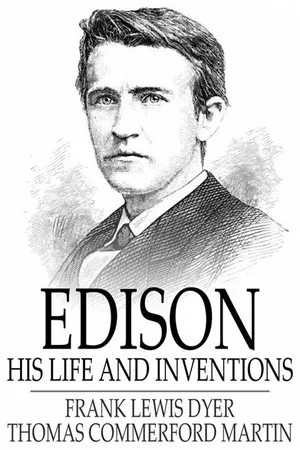
- 740 pages
- English
- ePUB (mobile friendly)
- Available on iOS & Android
eBook - ePub
Information
Publisher
The Floating PresseBook ISBN
9781775418450
Year
2010Chapter I - The Age of Electricity
*
THE year 1847 marked a period of great territorial acquisition by
the American people, with incalculable additions to their actual and
potential wealth. By the rational compromise with England in the dispute
over the Oregon region, President Polk had secured during 1846, for
undisturbed settlement, three hundred thousand square miles of forest,
fertile land, and fisheries, including the whole fair Columbia Valley.
Our active "policy of the Pacific" dated from that hour. With swift and
clinching succession came the melodramatic Mexican War, and February,
1848, saw another vast territory south of Oregon and west of the Rocky
Mountains added by treaty to the United States. Thus in about eighteen
months there had been pieced into the national domain for quick
development and exploitation a region as large as the entire Union
of Thirteen States at the close of the War of Independence. Moreover,
within its boundaries was embraced all the great American gold-field,
just on the eve of discovery, for Marshall had detected the shining
particles in the mill-race at the foot of the Sierra Nevada nine days
before Mexico signed away her rights in California and in all the vague,
remote hinterland facing Cathayward.
Equally momentous were the times in Europe, where the attempt to secure
opportunities of expansion as well as larger liberty for the individual
took quite different form. The old absolutist system of government was
fast breaking up, and ancient thrones were tottering. The red lava of
deep revolutionary fires oozed up through many glowing cracks in the
political crust, and all the social strata were shaken. That the wild
outbursts of insurrection midway in the fifth decade failed and died
away was not surprising, for the superincumbent deposits of tradition
and convention were thick. But the retrospect indicates that many
reforms and political changes were accomplished, although the process
involved the exile of not a few ardent spirits to America, to become
leading statesmen, inventors, journalists, and financiers. In 1847, too,
Russia began her tremendous march eastward into Central Asia, just
as France was solidifying her first gains on the littoral of northern
Africa. In England the fierce fervor of the Chartist movement, with its
violent rhetoric as to the rights of man, was sobering down and passing
pervasively into numerous practical schemes for social and political
amelioration, constituting in their entirety a most profound change
throughout every part of the national life.
Into such times Thomas Alva Edison was born, and his relations to
them and to the events of the past sixty years are the subject of
this narrative. Aside from the personal interest that attaches to the
picturesque career, so typically American, there is a broader aspect in
which the work of the "Franklin of the Nineteenth Century" touches
the welfare and progress of the race. It is difficult at any time to
determine the effect of any single invention, and the investigation
becomes more difficult where inventions of the first class have been
crowded upon each other in rapid and bewildering succession. But it will
be admitted that in Edison one deals with a central figure of the great
age that saw the invention and introduction in practical form of the
telegraph, the submarine cable, the telephone, the electric light, the
electric railway, the electric trolley-car, the storage battery, the
electric motor, the phonograph, the wireless telegraph; and that the
influence of these on the world's affairs has not been excelled at
any time by that of any other corresponding advances in the arts and
sciences. These pages deal with Edison's share in the great work of the
last half century in abridging distance, communicating intelligence,
lessening toil, improving illumination, recording forever the human
voice; and on behalf of inventive genius it may be urged that its
beneficent results and gifts to mankind compare with any to be credited
to statesman, warrior, or creative writer of the same period.
Viewed from the standpoint of inventive progress, the first half of
the nineteenth century had passed very profitably when Edison
appeared—every year marked by some notable achievement in the arts and
sciences, with promise of its early and abundant fruition in commerce
and industry. There had been exactly four decades of steam navigation
on American waters. Railways were growing at the rate of nearly
one thousand miles annually. Gas had become familiar as a means of
illumination in large cities. Looms and tools and printing-presses were
everywhere being liberated from the slow toil of man-power. The first
photographs had been taken. Chloroform, nitrous oxide gas, and ether
had been placed at the service of the physician in saving life, and
the revolver, guncotton, and nitroglycerine added to the agencies for
slaughter. New metals, chemicals, and elements had become available in
large numbers, gases had been liquefied and solidified, and the range
of useful heat and cold indefinitely extended. The safety-lamp had been
given to the miner, the caisson to the bridge-builder, the anti-friction
metal to the mechanic for bearings. It was already known how to
vulcanize rubber, and how to galvanize iron. The application of
machinery in the harvest-field had begun with the embryonic reaper,
while both the bicycle and the automobile were heralded in primitive
prototypes. The gigantic expansion of the iron and steel industry was
foreshadowed in the change from wood to coal in the smelting furnaces.
The sewing-machine had brought with it, like the friction match, one of
the most profound influences in modifying domestic life, and making it
different from that of all preceding time.
Even in 1847 few of these things had lost their novelty, most of them
were in the earlier stages of development. But it is when we turn to
electricity that the rich virgin condition of an illimitable new kingdom
of discovery is seen. Perhaps the word "utilization" or "application" is
better than discovery, for then, as now, an endless wealth of phenomena
noted by experimenters from Gilbert to Franklin and Faraday awaited the
invention that could alone render them useful to mankind. The eighteenth
century, keenly curious and ceaselessly active in this fascinating field
of investigation, had not, after all, left much of a legacy in either
principles or appliances. The lodestone and the compass; the frictional
machine; the Leyden jar; the nature of conductors and insulators;
the identity of electricity and the thunder-storm flash; the use of
lightning-rods; the physiological effects of an electrical shock—these
constituted the bulk of the bequest to which philosophers were the only
heirs. Pregnant with possibilities were many of the observations that
had been recorded. But these few appliances made up the meagre kit
of tools with which the nineteenth century entered upon its task of
acquiring the arts and conveniences now such an intimate part of "human
nature's daily food" that the average American to-day pays more for his
electrical service than he does for bread.
With the first year of the new century came Volta's invention of the
chemical battery as a means of producing electricity. A well-known
Italian picture represents Volta exhibiting his apparatus before the
young conqueror Napoleon, then ravishing from the Peninsula its treasure
of ancient art and founding an ephemeral empire. At such a moment this
gift of despoiled Italy to the world was a noble revenge, setting in
motion incalculable beneficent forces and agencies. For the first
time man had command of a steady supply of electricity without toil or
effort. The useful results obtainable previously from the current of a
frictional machine were not much greater than those to be derived from
the flight of a rocket. While the frictional appliance is still
employed in medicine, it ranks with the flint axe and the tinder-box
in industrial obsolescence. No art or trade could be founded on it; no
diminution of daily work or increase of daily comfort could be secured
with it. But the little battery with its metal plates in a weak
solution proved a perennial reservoir of electrical energy, safe and
controllable, from which supplies could be drawn at will. That which was
wild had become domesticated; regular crops took the place of haphazard
gleanings from brake or prairie; the possibility of electrical
starvation was forever left behind.
Immediately new processes of inestimable value revealed themselves; new
methods were suggested. Almost all the electrical arts now employed
made their beginnings in the next twenty-five years, and while the more
extensive of them depend to-day on the dynamo for electrical energy,
some of the most important still remain in loyal allegiance to the older
source. The battery itself soon underwent modifications, and new types
were evolved—the storage, the double-fluid, and the dry. Various
analogies next pointed to the use of heat, and the thermoelectric cell
emerged, embodying the application of flame to the junction of two
different metals. Davy, of the safety-lamp, threw a volume of current
across the gap between two sticks of charcoal, and the voltaic arc,
forerunner of electric lighting, shed its bright beams upon a dazzled
world. The decomposition of water by electrolytic action was recognized
and made the basis of communicating at a distance even before the days
of the electromagnet. The ties that bind electricity and magnetism in
twinship of relation and interaction were detected, and Faraday's work
in induction gave the world at once the dynamo and the motor. "Hitch
your wagon to a star," said Emerson. To all the coal-fields and all the
waterfalls Faraday had directly hitched the wheels of industry. Not
only was it now possible to convert mechanical energy into electricity
cheaply and in illimitable quantities, but electricity at once showed
its ubiquitous availability as a motive power. Boats were propelled by
it, cars were hauled, and even papers printed. Electroplating became
an art, and telegraphy sprang into active being on both sides of the
Atlantic.
At the time Edison was born, in 1847, telegraphy, upon which he was to
leave so indelible an imprint, had barely struggled into acceptance by
the public. In England, Wheatstone and Cooke had introduced a ponderous
magnetic needle telegraph. In America, in 1840, Morse had taken out his
first patent on an electromagnetic telegraph, the principle of which
is dominating in the art to this day. Four years later the memorable
message "What hath God wrought!" was sent by young Miss Ellsworth over
his circuits, and incredulous Washington was advised by wire of the
action of the Democratic Convention in Baltimore in nominating Polk.
By 1847 circuits had been strung between Washington and New York, under
private enterprise, the Government having declined to buy the Morse
system for $100,000. Everything was crude and primitive. The poles were
two hundred feet apart and could barely hold up a wash-line. The slim,
bare, copper wire snapped on the least provocation, and the circuit
was "down" for thirty-six days in the first six months. The little
glass-knob insulators made seductive targets for ignorant sportsmen.
Attempts to insulate the line wire were limited to coating it with
tar or smearing it with wax for the benefit of all the bees in the
neighborhood. The farthest western reach of the telegraph lines in
1847 was Pittsburg, with three-ply iron wire mounted on square glass
insulators with a little wooden pentroof for protection. In that office,
where Andrew Carnegie was a messenger boy, the magnets in use to receive
the signals sent with the aid of powerful nitric-acid batteries weighed
as much as seventy-five pounds apiece. But the business was fortunately
small at the outset, until the new device, patronized chiefly by
lottery-men, had proved its utility. Then came the great outburst of
activity. Within a score of years telegraph wires covered the whole
occupied country with a network, and the first great electrical industry
was a pronounced success, yielding to its pioneers the first great
harvest of electrical fortunes. It had been a sharp struggle for bare
existence, during which such a man as the founder of Cornell University
had been glad to get breakfast in New York with a quarter-dollar picked
up on Broadway.
Chapter II - Edison's Pedigree
*
THOMAS ALVA EDISON was born at Milan Ohio, February 11, 1847. The State that rivals Virginia as a "Mother of Presidents" has evidently other titles to distinction of the same nature. For picturesque detail it would not be easy to find any story excelling that of the Edison family before it reached the Western Reserve. The story epitomizes American idealism, restlessness, freedom of individual opinion, and ready adjustment to the surrounding conditions of pioneer life. The ancestral Edisons who came over from Holland, as nearly as can be determined, in 1730, were descendants of extensive millers on the Zuyder Zee, and took up patents of land along the Passaic River, New Jersey, close to the home that Mr. Edison established in the Orange Mountains a hundred and sixty years later. They landed at Elizabethport, New Jersey, and first settled near Caldwell in that State, where some graves of the family may still be found. President Cleveland was born in that quiet hamlet. It is a curious fact that in the Edison family the pronunciation of the name has always been with the long "e" sound, as it would naturally be in the Dutch language. The family prospered and must have enjoyed public confidence, for we find the name of Thomas Edison, as a bank official on Manhattan Island, signed to Continental currency in 1778. According to the family records this Edison, great-grandfather of Thomas Alva, reached the extreme old age of 104 years. But all was not well, and, as has happened so often before, the politics of father and son were violently different. The Loyalist movement that took to Nova Scotia so many Americans after the War of Independence carried with it John, the son of this stalwart Continental. Thus it came about that Samuel Edison, son of John, was born at Digby, Nova Scotia, in 1804. Seven years later John Edison who, as a Loyalist or United Empire emigrant, had become entitled under the laws of Canada to a grant of six hundred acres of land, moved westward to take possession of this property. He made his way through the State of New York in wagons drawn by oxen to the remote and primitive township of Bayfield, in Upper Canada, on Lake Huron. Although the journey occurred in balmy June, it was necessarily attended with difficulty and privation; but the new home was situated in good farming country, and once again this interesting nomadic family settled down.
John Edison moved from Bayfield to Vienna, Ontario, on the northern bank of Lake Erie. Mr. Edison supplies an interesting reminiscence of the old man and his environment in those early Canadian days. "When I was five years old I was taken by my father and mother on a visit to Vienna. We were driven by carriage from Milan, Ohio, to a railroad, then to a port on Lake Erie, thence by a canal-boat in a tow of several to Port Burwell, in Canada, across the lake, and from there we drove to Vienna, a short distance away. I remember my grandfather perfectly as he appeared, at 102 years of age, when he died. In the middle of the day he sat under a large tree in front of the house facing a well-travelled road. His head was covered completely with a large quantity of very white hair, and he chewed tobacco incessantly, nodding to friends as they passed by. He used a very large cane, and walked from the chair to the house, resenting any assistance. I viewed him from a distance, and could never get very close to him. I remember some large pipes, and especially a molasses jug, a trunk, and several other things that came from Holland."
John Edison was long-lived, like his father, and reached the ripe old age of 102, leaving his son Samuel charged with the care of the family destinies, but with no great burden of wealth. Little is known of the early manhood of this father of T. A. Edison until we find him keeping a hotel at Vienna, marrying a school-teacher there (Miss Nancy Elliott, in 1828), and taking a lively share in the troublous politics of the time. He was six feet in height, of great bodily vigor, and of such personal dominance of character that he became a captain of the insurgent forces rallying under the banners of Papineau and Mackenzie. The opening years of Queen Victoria's reign witnessed a belated effort in Canada to emphasize the principle that there should not be taxation without representation; and this descendant of those who had left the United States from disapproval of such a doctrine, flung himself headlong into its support.
It has been said of Earl Durham, who pacified Canada at this time and established the present system of government, that he made a country and marred a career. But the immediate measures of repression enforced before a liberal policy was adopted were sharp and severe, and Samuel Edison also found his own career marred on Canadian soil as one result of the Durham administration. Exile to Bermuda with other insurgents was not so attractive as the perils of a flight to the United States. A very hurried departure was effected in secret from the scene of trouble, and there are romantic traditions of his thrilling journey of one hundred and eighty-two miles toward safety, made almost entirely without food or sleep, through a wild country infested with Indians of unfriendly disposition. Thus was the Edison family repatriated by a picturesque political episode, and the great inventor given a birthplace on American soil, just as was Benjamin Franklin when his father came from England to Boston. Samuel Edison left behind him, however, in Canada, several brothers, all of whom lived to the age of ninety or more, and from whom there are descendants in the region.
After some desultory wanderings for a year or two along the shores of Lake Erie, among the prosperous towns then springing up, the family, with its Canadian home forfeited, and in quest of another resting-place, came to Milan, Ohio, in 1842. That pretty little village offered at the moment many attractions as a possible Chicago. The railroad system of Ohio was still in the future, but the Western Reserve had already become a vast wheat-field, and huge quantities of grain from the central and northern counties sought shipment to Eastern ports. The Huron River, emptying into Lake Erie, was navigable within a few miles of the village, and provided an admirable outlet. Large granaries were established, and proved so successful that local capital was tempted into the project of making a tow-path canal from Lockwood Landing all the way to Milan itself. The quaint old Moravian mission and quondam Indian settlement of one hundred inhabitants found itself of a sudden one of the great grain ports of the world, and bidding fair to rival Russian Odessa. A number of grain warehouses, or primitive elevators, were built along the bank of the canal, and the produce of the region poured in immediately, arriving in wagons drawn by four or six horses with loads of a hundred bushels. No fewer than six hundred wagons came clattering in, and as many as twenty sail vessels were loaded with thirty-five thousand bushels of grain, during a single day. The canal was capable of being navigated by craft of from two hundred to two hundred and fifty tons burden, and the demand for such vessels soon led to the development of a brisk ship-building industry, for which the abundant forests of the region supplied the necessary lumber. An evidence of the activity in this direction is furnished by the fact that six revenue cutters were launched at this port in these brisk days of its prime.
Samuel Edison, versatile, buoyant of temper, and ever optimistic, would thus appear to have pitched his tent with shrewd judgment. There was plenty of occupation ready to his hand, and more than one enterprise received his attention; but he devoted his energies chiefly to the making of shingles, for which there was a large demand locally and along the lake. Canadian lumber was used principally in this industry. The wood was imported in "bolts" or pieces three feet long. A bolt made two shingles; it was sawn asunder by hand, then split and shaved. None but first-class timber was used, and such shingles outlasted far those made by machinery with their cross-grain cut. A house in Milan, on which some of those shingles were put in 1844, was still in excellent condition forty-two years later. Samuel Edison did well at this occupation, and employed several men, but there were other outlets from time to time for his business activity and speculative disposition.
Edison's mother was an attractive and highly educated woman, whose influence upon his disposition and intellect has been profound and lasting. She was born in Chenango County, New York, in 1810, and was the daughter of the Rev. John Elliott, a Baptist minister and descendant of an old Revolutionary soldier, Capt. Ebenezer Elliott, of Scotch descent. The old captain was a fine and picturesque type. He fought all through the long War of Independence—seven years—and then appears to have settled down at Stonington, Connecticut. There, at any rate, he found his wife, "grandmother Elliott," who was Mercy Peckham, daughter of a Scotch Quaker. Then came the residence in New York State, with final removal to Vienna, for the old soldier, while drawing his pension at Buffalo, lived in the little Canadian town, and there died, over 100 years old. The family was evidently one of considerable culture and deep religious feeling, for two of Mrs. Edison's uncles and two brothers were also in the same Baptist ministry. As a young woman she became a teacher in the public high school at Vienna, and thus met her husband, who was residing there. The family never consisted of more than three children, two boys and a girl. A trace of the Canadian environment is seen in the fact that Edison's elder brother was named William Pitt, after the great English statesman. Both his brother and the sister exhibited considerable ability. William Pitt Edison as a youth was so clever with his pencil that it was proposed to send him to Paris as an art student. In later life he was manager of the local street railway lines at Port Huron, Michigan, in which he was heavily interested. He also owned a good farm near that town, and during the ill-health at the close of his life, when compelled to spend much of the time indoors, he devoted himself almost entirely to sketching. It has been noted by intimate observers of Thomas A. Edison that in discussing any project or new idea his first impulse is to take up any piece of paper available and make drawings of it. ...
Table of contents
- EDISON
- Contents
- Introduction
- Chapter I - The Age of Electricity
- Chapter II - Edison's Pedigree
- Chapter III - Boyhood at Port Huron, Michigan
- Chapter IV - The Young Telegraph Operator
- Chapter V - Arduous Years in the Central West
- Chapter VI - Work and Invention in Boston
- Chapter VII - The Stock Ticker
- Chapter VIII - Automatic, Duplex, and Quadruplex Telegraphy
- Chapter IX - The Telephone, Motograph, and Microphone
- Chapter X - The Phonograph
- Chapter XI - The Invention of the Incandescent Lamp
- Chapter XII - Memories of Menlo Park
- Chapter XIII - A World-Hunt for Filament Material
- Chapter XIV - Inventing a Complete System of Lighting
- Chapter XV - Introduction of the Edison Electric Light
- Chapter XVI - The First Edison Central Station
- Chapter XVII - Other Early Stations—The Meter
- Chapter XVIII - The Electric Railway
- Chapter XIX - Magnetic Ore Milling Work
- Chapter XX - Edison Portland Cement
- Chapter XXI - Motion Pictures
- Chapter XXII - The Development of the Edison Storage Battery
- Chapter XXIII - Miscellaneous Inventions
- Chapter XXIV - Edison's Method in Inventing
- Chapter XXV - The Laboratory at Orange and the Staff
- Chapter XXVI - Edison in Commerce and Manufacture
- Chapter XXVII - The Value of Edison's Inventions to the World
- Chapter XXVIII - The Black Flag
- Chapter XXIX - The Social Side of Edison
- Appendix
- List of United States Patents
- Endnotes
Trusted by 375,005 students
Access to over 1.5 million titles for a fair monthly price.
Study more efficiently using our study tools.