Find academic sophistication, pastoral sensitivity, and accessibility in the award-winning BECNT series
Noted New Testament scholar Frank Thielman offers pastors, students, and teachers a substantive yet accessible commentary on Ephesians in this addition to the award-winning BECNT series.
Thielman leads readers through all aspects of the book of Ephesians--sociological, historical, and theological--to help them better understand its meaning and relevance.
As with all BECNT volumes, this informative, balanced commentary features:
● Detailed interaction with the Greek text
● Extensive research
● Chapter-by-chapter exegesis
● A blend of scholarly depth and readability
● An acclaimed, user-friendly design
The BECNT series aims for academic sophistication with pastoral sensitivity and accessibility, making it a useful tool for pastors, church leaders, students, and teachers.
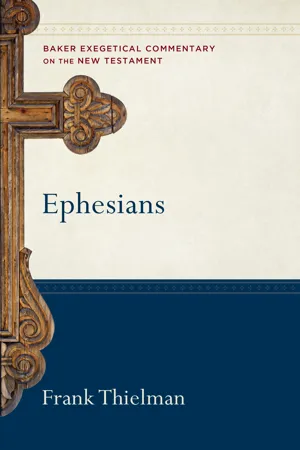
eBook - ePub
Ephesians (Baker Exegetical Commentary on the New Testament)
- 544 pages
- English
- ePUB (mobile friendly)
- Available on iOS & Android
eBook - ePub
Ephesians (Baker Exegetical Commentary on the New Testament)
About this book
Information
Subtopic
Commentaire biblique
II. Blessing God Who Has Blessed His People in Christ (1:3–14)
III. Thanksgiving for Conversion and Intercession for Understanding (1:15–23)
IV. From Children of Wrath to New Creation (2:1–10)
I. Prescript and Greeting (1:1–2)
The basic framework for the opening of Ephesians follows the conventions of Hebrew, Aramaic, and Greek letters for centuries both before and after Paul’s time. Greek letters typically began with a prescript that stated the name of the sender and then the name of the recipient, often with some descriptive term added to it (“my brother,” “my sister,” “my son,” “my daughter,” “my father,” “my lord,” “esteemed,” “beloved,” or the like; Exler 1923: 23–60). After this came a word or phrase of greeting similar to the oral salutations that people gave to one another when they met in person: “Rejoice!” or “Good health!” (Lieu 1985: 163–65). Hebrew and Aramaic letters, particularly those from the first and early second century, often followed a similar pattern, with the name of the sender followed by the name of the recipient and then the common oral salutation, now changed to “Peace” (Fitzmyer 1979: 189–93; Pardee 1992: 283–84; Dion 1992: 289). In both Greek and Semitic letters, this greeting was sometimes elaborated in various ways (“Many greetings,” “Good health always,” “Peace be multiplied to you”).
At least according to the second-century literary critic Lucian, Greek philosophers sometimes changed the standard epistolary greeting to make some point consistent with their philosophical convictions. Plato replaced “Rejoice!” with “Do well!” Pythagoras and Epicurus selected “Good health!” from among the conventional options because it fit nicely with their understanding of life (Lucian, Laps. 4–6).
No known modification of the customary framework from antiquity, however, matches the creativity of Paul’s changes to it. In Ephesians, as in most of his letters, he qualifies both prescript and greeting in elaborate ways to alert his readers to the theological significance of the letter. He writes as an envoy of Christ Jesus, appointed to this office by a deliberate act of God, and he writes to God’s people in Ephesus, who believe the gospel and are in Christ. His greeting becomes not a wish for good cheer or health but a prayer similar to that of the OT priests for the grace and peace of God to rest on his readers. Paul makes clear in the greeting, however, something that he will describe more fully in the letter: that the experience of God’s grace and peace in the present, climactic period of salvation history comes to God’s people through the Lord Jesus Christ.
Exegesis and Exposition
1Paul, an apostle of Christ Jesus by the will of God, to the saints who are ⌜in Ephesus⌝ and believers, in Christ Jesus. 2Grace to you and peace from God our Father and the Lord Jesus Christ.
[1:1] The letter begins by identifying its sender as Paul and then describing him as “an apostle of Christ Jesus through the will of God” (Παῦλος ἀπόστολος Χριστοῦ Ἰησοῦ διὰ θελήματος θεοῦ, Paulos apostolos Christou Iēsou dia thelēmatos theou). The significance we give to this identification and description will vary with the approach we take to the letter’s authorship, but it is reasonable to consider Ephesians a genuine Pauline letter, written in a later period than most of the undisputed letters and emphasizing different themes in a changed setting (see the commentary introduction).
Here Paul identifies himself as an apostle through the will of God for reasons similar to those that led him to use this same designation, or something like it, in five other letters. In Gal. 1:1; 1 Cor. 1:1; and 2 Cor. 1:1 the reason for these emphases is not far to seek: in each instance he addressed churches where people had raised questions about his apostleship (cf. Best 1997a: 32). In Rom. 1:1 and Col. 1:1 nothing clearly indicates that Paul’s apostleship was an issue, but Paul was addressing churches that he did not found and many people whom he did not know personally. He may have wanted to begin these letters, then, with a statement of the apostolic basis for the pastoral authority that he was about to exercise over his readers.
In the same way, Ephesians went to people largely unknown to Paul. He had heard only a general description of most of them (1:15; 4:21), and he could assume only that their knowledge of him was accurate (3:2). The self-description “apostle” immediately communicated why he thought he had the authority to address them in a pastoral letter.
For Paul, apostles were envoys—people whom someone or some group had sent on a specific mission. Paul could use the term of delegates that churches appointed for a special task, such as taking a gift to Paul (Phil. 2:25) or bringing monetary contributions to the needy in Jerusalem (2 Cor. 8:23). Paul could also use it in a semitechnical sense to mean someone whom God had set apart to preach the gospel (Rom. 1:1; Gal. 1:1, 15–16). In Ephesians, Paul couples apostles with prophets, and always in that order (2:20; 3:5; 4:11; cf. 1 Cor. 12:28–29; Did. 11.3). He places them at the foundation of the church (2:20) and at the head of the list of gifted people whom Christ has given to the church for its edification (4:11). For Paul, apostles played an important, authoritative role in shaping the church’s growth into what God intended the church to become (2:21; 4:13).
God had set Paul apart as a particular type of apostle. He was called to preach the gospel to non-Jewish peoples (Rom. 1:5; 11:13; Gal. 1:1, 15–16). This kind of apostleship often meant traveling with the gospel to distant places (Rom. 1:5–6, 13–14; 1 Cor. 4:9, 11; 9:5; 1 Thess. 2:1–2, 7) and frequently entailed the kind of suffering that Paul was experiencing as he wrote Ephesians (1 Cor. 4:8–15; 1 Thess. 2:1–2, 7, 9; cf. Eph. 3:1, 13; 4:1; 6:20). It also sometimes meant using letters to exercise oversight of Gentile believers whom he did not personally know (Rom. 1:5–6; 11:13; 15:15).
When Paul described himself as an apostle at the beginning of Ephesians, he probably intended to identify himself to his readers as one of the foundational guides of the church’s growth to maturity, with particular responsibility for the Gentiles in Ephesus (cf. 3:1–4, 8).
Paul identifies the recipients of his letter with the phrase τοῖς ἁγίοις τοῖς οὖσιν ἐν Ἐφέσῳ καὶ πιστοῖς ἐν Χριστῷ Ἰησοῦ (tois hagiois tois ousin en Ephesō kai pistois en Christō Iēsou, to the saints who are in Ephesus and believers, in Christ Jesus). For reasons explained in the introduction to the commentary, it seems best to keep ἐν Ἐφέσῳ in the text despite its absence from the three earliest manuscripts of Ephesians and from what Basil the Great in the mid-fourth century called “the old copies” known to him. Paul wrote Ephesians about seven years after his lengthy stay in the city, and this was ample time for dramatic changes to take place among the Christian groups that flourished there. Although he was writing to a city where he had spent between two and three years, the letter has a somewhat distant tone because Paul could no longer assume that Christians he had once known in the city still lived there or were still identified with the movement, nor could he assume that all who read this letter would have a clear understanding of the important role he had played in the establishment of the church in their city (1:15; 3:2; 4:21).[1]
Does Paul address this diverse body of readers as two different groups, “the saints who are in Ephesus” and “the believers who are in Christ Jesus”? Two considerations have sometimes led interpreters to this conclusion. First, for Paul to call his readers both “saints” and “believers” seems redundant—if they are “saints,” surely they are also “believers.” Second, Paul’s repetition of the article τοῖς in front of οὖσιν ἐν Ἐφέσῳ (ousin en Ephesō, who are in Ephesus) but not in front of πιστοῖς ἐν Χριστῷ Ἰησοῦ (pistois en Christō Iēsou, believers in Christ Jesus) might be understood to bind οὖσιν ἐν Ἐφέσῳ closely to ἁγίοις (hagiois, saints), which also has the article. This would leave πιστοῖς ἐν Χριστῷ Ἰησοῦ to refer to a separate group. On this understanding of the Greek, Paul addresses his letter “to the saints, that is, the ones in Ephesus, and to believers who are in Christ Jesus.”
This division of the readers into two groups, however, is without precedent in Paul’s other letters, and it is difficult to see what the difference between the two groups could be. Some interpreters have suggested that Paul (or the author) wrote to Jewish Christians, whom he called “saints” (cf. 2:19; Rom. 15:25–26, 31), and Gentile Christians, whom he called “faithful” or “believers” (e.g., Kümmel 1975: 355). If this is correct, at the beginning of the letter he introduces the theme of the relationship between Gentile Christianity and ancient Israel that he will later develop at length (2:11–22). Elsewhere in the letter, however, Paul regularly calls all his readers “saints” (1:15, 18; 3:8, 18; 4:12; 5:3; 6:18), so this solution is not likely to be correct.
What, then, of the grammatical problem? Paul probably intended the first τοῖς to go both with ἁγίοις and with πιστοῖς ἐν Χριστῷ Ἰησοῦ (Alford 1857: 66; Wallace 1996: 282; Hoehner 2002: 142). This is unusual, but native speakers of ancient Greek, such as Chrysostom (Hom. Eph., hom. 1; NPNF 13:51), Theodoret (R. Hill 2001: 2.33), and Theophylact (PG 124:1033) took the construction to mean that Paul was calling his readers in Ephesus both “saints” and “faithful” (or “believers”) and seemed to see nothing unnatural in it. The grammatical difficulties, then, are not insuperable, and this makes it likely that Paul addresses his readers as a single group of Christians in Ephesus who are both ἅγιοι and πιστοί.
What does he mean by these terms? The term ἅγιοι (hagioi, saints) takes its meaning from the OT, which speaks of God choosing his people from among all peoples of the earth to be “a royal priesthood and a holy [ἅγιον] nation” (Exod. 19:5–6 LXX). Because of this status, Israel should “be holy” (ἅγιοι) as God is “holy” (ἅγιος; Lev. 11:44–45; 19:2; 20:7). Israel’s holy status, given to it by God, should be lived out in holy conduct: those whom God has separated as his special people should live in a way that is separate from the surrounding environment. In Ephesians, Paul’s use of ἅγιος and related words follows the same pattern. Christ has made believers holy (ἁγιάζω, hagiazō) through the cleansing bath of the gospel (5:26), and so they have this status as a gift from God. Yet they must live in a way that is consistent with this status—they should be “holy [ἁγίους] and blameless before him in love” (1:4), and their conduct should be what is “proper for holy people [ἁγίοις]” (5:3).
The adjective πιστοί (pistoi) probably does not mean “faithful ones” in the sense of “loyal” or “trustworthy” people (e.g., Origen [Heine 2002: 81]; Lightfoot 1895: 310; Barth 1974: 67–69), although that is the most common meaning of the adjective (MM 515; BDAG 820–21). Since he will soon describe his readers as those who “have believed” (πιστεύσαντες, pisteusantes) the gospel (1:13), it is more likely that he addresses them here as “believers” in the sense that they have trusted the gospel message when they heard it (BDAG 821; Lincoln 1990: 6; O’Brien 1999: 87; Hoehner 2002: 142).
They are, moreover, both saints and believers ἐν Χριστῷ Ἰησοῦ. This does not mean that they are saints who trust Christ, although that is implied, but that they are saints and believers who are “in Christ.” As the people in Ephesus whom God has set apart as his own, and who believe the gospel, they live within the sphere of existence that Christ defines.
[1:2] Paul greets his readers in exactly the same way he greets his audience in seven of his other canonical letters (Rom. 1:7b; 1 Cor. 1:3; 2 Cor. 1:2; Gal. 1:3; Phil. 1:2; 2 Thess. 1:2; Philem. 3). This greeting has linguistic similarities to the standard salutations of Greek, Hebrew, and Aramaic letters of Paul’s time, but it is also innovative and distinctive. Letters in all three languages derived their greetings from the verbal salutation that people gave to one another in social settings, χαίρειν (charein, rejoice!) in Greek and שְׁלָם/שָׁלוֹם (šālôm/šĕlām, peace!) in Hebrew/Aramaic.[2] Native Hebrew and Aramaic speakers observed the Greek norms when writing in Greek, saluting their readers not with something like εἰρήνη ὑμῖν πληθυνθείη (eirēnē hymin plēthyntheiē, may peace be increased for you) but simply with χαίρειν (cf. Lieu 1985: 166–67).[3]
Paul’s greeting seems to have its origins in a combination of both the Greek and Semiti...
Table of contents
- Cover
- Series Page
- Title Page
- Copyright Page
- Dedication
- Contents
- Series Preface
- Author’s Preface
- Abbreviations
- Transliteration
- Map
- Introduction to Ephesians
- I. Prescript and Greeting (1:1-2)
- II. Blessing God Who Has Blessed His People in Christ (1:3–14)
- III. Thanksgiving for Conversion and Intercession for Understanding (1:15–23)
- IV. From Children of Wrath to New Creation (2:1–10)
- V. From Existence without God to Membership in the People of God (2:11–22)
- VI. Paul’s Divinely Given Task and His Suffering for the Gentiles (3:1–13)
- VII. Paul Prays for His Readers’ Inner Strength and Praises the God Who Can Give It (3:14–21)
- VIII. The Growth of the Church toward Unity and Maturity (4:1–16)
- IX. A Reminder of How to Live as New Human Beings (4:17–5:2)
- X. Avoiding and Transforming the Deeds of Darkness (5:3–14)
- XI. Wise Conduct within the Household (5:15–6:9)
- XII. Standing against the Strategies of the Devil (6:10–20)
- XIII. A Concluding Commendation and a Final Prayer-Wish (6:21–24)
- Works Cited
- Index of Subjects
- Index of Authors
- Index of Greek Words
- Index of Scripture and Other Ancient Writings
- Notes
- Back Cover
Trusted by 375,005 students
Access to over 1.5 million titles for a fair monthly price.
Study more efficiently using our study tools.
Frequently asked questions
Yes, you can cancel anytime from the Subscription tab in your account settings on the Perlego website. Your subscription will stay active until the end of your current billing period. Learn how to cancel your subscription
No, books cannot be downloaded as external files, such as PDFs, for use outside of Perlego. However, you can download books within the Perlego app for offline reading on mobile or tablet. Learn how to download books offline
Perlego offers two plans: Essential and Complete
- Essential is ideal for learners and professionals who enjoy exploring a wide range of subjects. Access the Essential Library with 800,000+ trusted titles and best-sellers across business, personal growth, and the humanities. Includes unlimited reading time and Standard Read Aloud voice.
- Complete: Perfect for advanced learners and researchers needing full, unrestricted access. Unlock 1.5M+ books across hundreds of subjects, including academic and specialized titles. The Complete Plan also includes advanced features like Premium Read Aloud and Research Assistant.
We are an online textbook subscription service, where you can get access to an entire online library for less than the price of a single book per month. With over 1.5 million books across 990+ topics, we’ve got you covered! Learn about our mission
Look out for the read-aloud symbol on your next book to see if you can listen to it. The read-aloud tool reads text aloud for you, highlighting the text as it is being read. You can pause it, speed it up and slow it down. Learn more about Read Aloud
Yes! You can use the Perlego app on both iOS and Android devices to read anytime, anywhere — even offline. Perfect for commutes or when you’re on the go.
Please note we cannot support devices running on iOS 13 and Android 7 or earlier. Learn more about using the app
Please note we cannot support devices running on iOS 13 and Android 7 or earlier. Learn more about using the app
Yes, you can access Ephesians (Baker Exegetical Commentary on the New Testament) by Frank Thielman, Yarbrough, Robert W., Stein, Robert, Robert W. Yarbrough,Robert Stein in PDF and/or ePUB format, as well as other popular books in Théologie et religion & Commentaire biblique. We have over 1.5 million books available in our catalogue for you to explore.