A Distinguished Theologian on the Doctrine of the Holy Spirit
Distinguished theologian Matthew Levering offers a historical examination of the doctrine of the Holy Spirit, defending an Augustinian model against various contemporary theological views. A companion piece to Levering's Engaging the Doctrine of Revelation, this work critically engages contemporary and classical doctrines of the Holy Spirit in dialogue with Orthodox and Reformed interlocutors. Levering makes a strong dogmatic case for conceiving of the Holy Spirit as love between Father and Son, given to the people of God as a gift.
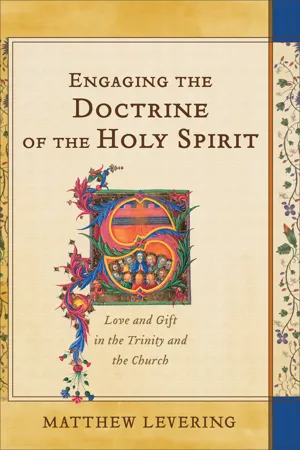
eBook - ePub
Engaging the Doctrine of the Holy Spirit
Love and Gift in the Trinity and the Church
- 448 pages
- English
- ePUB (mobile friendly)
- Available on iOS & Android
eBook - ePub
Engaging the Doctrine of the Holy Spirit
Love and Gift in the Trinity and the Church
About this book
Information
Topic
Theology & ReligionSubtopic
Christian Theology1
The Holy Spirit as Love and Gift
Hans Urs von Balthasar’s essay “The Holy Spirit as Love,” written two decades prior to his full-fledged exposition of the Holy Spirit in the final volume of his Theo-Logic, begins with a challenge to Latin theology of the Spirit. Balthasar remarks, “Since Augustine, speculation about the Trinity of God has so accustomed us to see the Second Divine person, whom John called the Logos, in the same perspective as ‘truth’ and ‘knowledge,’ while seeing the Third person in the same perspective as ‘will’ and ‘love,’ that we are astonished and confused when we are asked what is the basis for these statements in Sacred Scripture.”1 Pressing the issue, Balthasar asks whether the name “Love” should in fact be properly associated with the Holy Spirit. He finds numerous passages that describe the Father’s love for the Son, for the world, and for Jesus’s followers. In the Gospel of John, for example, either John the Baptist or the evangelist states that “the Father loves the Son, and has given all things into his hand” (John 3:35).2 The evangelist John famously proclaims that “God so loved the world that he gave his only Son, that whoever believes in him should not perish but have eternal life” (John 3:16). In 1 John 4:8 we read that “God is love,” and Balthasar takes this to refer to God the Father. Balthasar shows that the Son too is associated with love in the Gospel of John, for instance in John 11:5; 13:1; 14:31.
In the Johannine literature, moreover, the Holy Spirit is rather overwhelmingly associated with truth. In three places—John 14:17; 15:26; 16:13—Jesus names the Spirit “the Spirit of truth” and 1 John 5:7 states that “the Spirit is the truth.” The Spirit’s task in the Gospel of John, as Balthasar says, is “to ‘teach’ and to ‘recall’ (14:26), ‘to lead into all the truth’ (16:13), to ‘proclaim’ (16:13, 14), ‘to give testimony’ (15:26).”3 All of these are tasks associated with the intellect, just as the Son, as “Word/Logos,” is associated with the intellect by the Gospel of John.
The Gospel of John also describes the Spirit as a lawyer or (in Balthasar’s words) an “‘advocate’ in a trial who works for the clients who are referred to him (John 14:26; 15:26; 16:7) and attacks the opposite party by ‘convincing’ it ‘that there exists a sin, a righteousness and a judgment’ (16:8).”4 Surely a lawyer is not to be described as personal “Love”; it would rather seem that the lawyer’s work strictly involves the intellect’s tools. The major Pauline text that is often cited in support of the Spirit’s proper name of “Love” (comparable to the Son’s proper name of “Word”) is Romans 5:5: “God’s love has been poured into our hearts through the Holy Spirit who has been given to us.” But Balthasar shows that in fact in Paul’s letters “the overwhelming majority of texts link to the Pneuma the concept of power (dynamis), of a possession and ability given by God (charisma) and not infrequently of the knowledge of God’s salvific thoughts (1 Cor. 2:10–15).”5 It hardly seems that the Holy Spirit should be connected to “Love” any more than should the Father and Son, and indeed one might conclude that the Holy Spirit may be less connected to “Love” than are the Father and Son.
Although Balthasar goes on to creatively defend the connection of the Holy Spirit with love—in a fashion that raises its own difficulties—his central contribution for my purposes here consists in identifying the problem.6 Was Augustine, in his De Trinitate, correct in claiming that the Holy Spirit should be properly named “Love” and “Gift”? This question, which is fundamental for my theology of the Holy Spirit, requires for its answer a careful investigation of the biblical paths by which Augustine arrives at the names “Love” and “Gift.”7 Like Luigi Gioia, I consider that Augustine’s biblical exegesis plays the decisive role in his naming of the Holy Spirit, even if it is not enough to say, with Gioia, that Augustine’s naming of the Holy Spirit is “rigorously regulated by Scripture and the dynamic of salvation.”8 At issue is what it means for naming of the Holy Spirit to be “rigorously regulated by Scripture,” especially since some of Augustine’s exegetical moves would not be accepted by contemporary exegetes.9
Augustine’s arguments are most persuasive if one accepts, as I think we should, his assumptions about what Scripture is and does—above all his view that the Triune God wills to teach us about himself through Scripture, so that we might come to know and love the living God. The faith-based expectation that God in Scripture is teaching us about his triunity leads Augustine to be alert for clues to the identity of the Holy Spirit, clues that Augustine employs to build his case that the Spirit is properly (i.e., distinctively among the three persons) named not only “Holy Spirit” but also “Love” and “Gift.”10 Let us now turn to Augustine’s exegetical arguments for his influential naming of the Spirit.11
Augustine on the Holy Spirit as “Love” and “Gift”
In book 15 of the De Trinitate Augustine develops his argument for the view that “the Spirit is distinctively called by the term charity” by first appealing to 1 John 4:7–8.12 This passage reads, “Beloved, let us love one another; for love is of God, and he who loves is born of God and knows God. He who does not love does not know God; for God is love.” In his commentary on this passage from 1 John, Rudolf Schnackenburg observes, “The author is concerned to differentiate between the Christians and the false prophets, in order to establish that the real Christian is one who loves.”13 Schnackenburg interprets the phrase “love is of God” (1 John 4:7) to mean that love is God’s nature: “God is love” (1 John 4:8).14
Augustine, by contrast, sees a meaning in 1 John 4:7–8 about God the Trinity. On the one hand, love is “of God” (ex deo); on the other hand, love “is” God. The same love that is “of God” is “God.” Putting the two verses together, then, Augustine arrives at the following insight: 1 John 4:7–8 teaches that “love” is not only “God,” but is “God of God.” This is crucial because, as Augustine points out, the condition of being “God of God” in fact pertains to two persons, the Son and the Holy Spirit, who are fully divine but not unoriginate.15 For Augustine, therefore, the question is whether 1 John 4:7–8 is referring to the Son or to the Spirit.
To answer this question, Augustine appeals to what follows in 1 John 4. In verses 9 and 10 John explains that God manifested his love by sending “his Son to be the expiation for our sins” (1 John 4:10). In verse 11 John adds that since God has shown his love for us by sending his Son, “we also ought to love one another.” Indeed, “if we love one another, God abides in us” (1 John 4:12). How is it that we can love in this way? The crucial answer comes in verse 13: “By this we know that we abide in him and he in us, because he has given us of his own Spirit.” We know that God abides in us when we love; and we love when God gives us his Spirit. Augustine concludes that the “God of God” about whom John speaks when he say “love is of God” (1 John 4:7) is none other than the Holy Spirit, and God “has given us” the Spirit (1 John 4:13). Augustine sums up: “He [the Holy Spirit] then is the gift of God who is love.”16 The two names “Love” and “Gift” imply each other.
In Augustine’s view, this conclusion that 1 John 4:7–13 is speaking about the Holy Spirit as “Love” receives further confirmation from 1 John 4:16: “God is love, and he who abides in love abides in God, and God abides in him.” Augustine points out that verse 13 assures us that we know that we abide in God because God gives us the Holy Spirit. Now, in verse 16, John tells us that when we abide in love, we abide in God. It follows that the Holy Spirit abiding in us, and “love” ...
Table of contents
- Cover
- Title Page
- Copyright Page
- Dedication
- Contents
- Acknowledgments
- Introduction
- 1. The Holy Spirit as Love and Gift
- 2. Naming the Holy Spirit: East and West
- 3. The Holy Spirit and the Filioque
- 4. The Holy Spirit and Jesus Christ
- 5. The Holy Spirit and the Church
- 6. The Holy Spirit and the Unity of the Church
- 7. The Holy Spirit and the Holiness of the Church
- Conclusion
- Bibliography
- Scripture Index
- Name Index
- Subject Index
- Back Cover
Trusted by 375,005 students
Access to over 1.5 million titles for a fair monthly price.
Study more efficiently using our study tools.
Frequently asked questions
Yes, you can cancel anytime from the Subscription tab in your account settings on the Perlego website. Your subscription will stay active until the end of your current billing period. Learn how to cancel your subscription
No, books cannot be downloaded as external files, such as PDFs, for use outside of Perlego. However, you can download books within the Perlego app for offline reading on mobile or tablet. Learn how to download books offline
Perlego offers two plans: Essential and Complete
- Essential is ideal for learners and professionals who enjoy exploring a wide range of subjects. Access the Essential Library with 800,000+ trusted titles and best-sellers across business, personal growth, and the humanities. Includes unlimited reading time and Standard Read Aloud voice.
- Complete: Perfect for advanced learners and researchers needing full, unrestricted access. Unlock 1.5M+ books across hundreds of subjects, including academic and specialized titles. The Complete Plan also includes advanced features like Premium Read Aloud and Research Assistant.
We are an online textbook subscription service, where you can get access to an entire online library for less than the price of a single book per month. With over 1.5 million books across 990+ topics, we’ve got you covered! Learn about our mission
Look out for the read-aloud symbol on your next book to see if you can listen to it. The read-aloud tool reads text aloud for you, highlighting the text as it is being read. You can pause it, speed it up and slow it down. Learn more about Read Aloud
Yes! You can use the Perlego app on both iOS and Android devices to read anytime, anywhere — even offline. Perfect for commutes or when you’re on the go.
Please note we cannot support devices running on iOS 13 and Android 7 or earlier. Learn more about using the app
Please note we cannot support devices running on iOS 13 and Android 7 or earlier. Learn more about using the app
Yes, you can access Engaging the Doctrine of the Holy Spirit by Matthew Levering in PDF and/or ePUB format, as well as other popular books in Theology & Religion & Christian Theology. We have over 1.5 million books available in our catalogue for you to explore.