What the Gospels Tell Us about Who Jesus Is
This clear, compact introduction surveys what the Gospels tell us about who Jesus is by exploring his teachings and actions in their contexts. Darrell Bock, a leading evangelical New Testament scholar who speaks and teaches around the world, and Benjamin Simpson treat the Gospels as reliable sources for a plausible portrait of Jesus. Condensing years of extensive study on the topic, this handy, readable textbook presents fresh ways to understand the Gospels, especially the Synoptics in comparison with John.
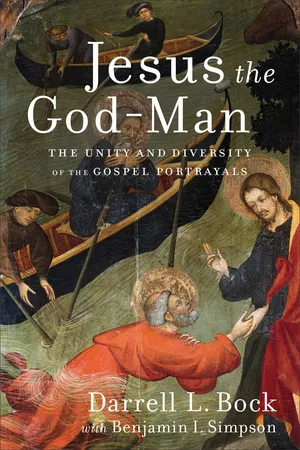
eBook - ePub
Jesus the God-Man
The Unity and Diversity of the Gospel Portrayals
- 208 pages
- English
- ePUB (mobile friendly)
- Available on iOS & Android
eBook - ePub
Jesus the God-Man
The Unity and Diversity of the Gospel Portrayals
About this book
Information
Topic
Theology & ReligionSubtopic
Biblical Studies1
Preparation: Birth, John the Baptist, and the Temptations
The Endorsed and Qualified Anointed One
For one must reckon a priori with the possibility—even with the probability—first, that in his teaching and life Jesus accomplished something new from which the first Christians had to proceed in their attempt to explain his person and work; second, that their experience of Christ exhibited special features not present in any obvious analogy to related religious forms. It is simply unscholarly prejudice methodically to exclude from the beginning this possibility—this probability.1
Jesus’s teaching was unique and made unique claims. But how in the world did the church reach this understanding? More important, how in the world did first-century Jewish disciples grasp it? In the face of a host of gods and idols in their world, what caused those who believed in one Creator God to affirm that Jesus’s relationship to God was neither polytheism nor a violation of the faith in the one God of the Shema? It is that journey portrayed in the Gospels that the theology of the Jesus of Scripture explores.
That transformation of thinking out of a Second Temple Jewish context is why understanding him and his portrait in the Gospels is so important. Jesus claims to give unique insight into God’s plan and to present the way to divine fellowship and blessing. Many of these claims are rooted in the Jewish foundations to which Jesus belonged. However, Jesus’s teaching on hope led to an appreciation that he was speaking about more than a plan for Israel. The nation’s calling always had been to serve as a means of blessing for the world. Jesus’s starting point involved a call to Israel to prepare for the promised completion of what God had started with them. However, that plan, at least as far back as Isa. 40–66, not to mention all the way back to Gen. 12:3, had foreseen the inclusion of the Gentile nations within God’s blessing. Jesus’s teaching ultimately aims at this comprehensive goal of blessing extended to all the righteous by faith from every nation. God’s promise, given long ago, had affirmed that blessing would come for the righteous in the whole world. We turn our attention to the major strands of Jesus’s teachings and actions because through their interplay we see what his ministry was all about.2 So we start with Jesus’s birth, John the Baptist, and the temptations.
Incarnation: Jesus the Sent Son/Messiah
This initial chapter focuses on the frame around which Jesus’s ministry appears. The incarnation emerges as part of a reflective introduction about Jesus the Word incarnate (John 1:1–18) or as part of the emphasis in the presentation of Jesus’s infancy in two of the Synoptics (Matt. 1–2; Luke 1–2). John plays all of his cards from the start, from the very first verse: “In the beginning was the Word, and the Word was with God, and the Word was God.” Jesus is affirmed as the Creator (John 1:1–3), a role for God. John tells the story of Jesus very much from heaven down.
The Synoptics take a different route. Mark simply starts with the ministry of John the Baptist and Jesus’s acceptance of baptism from him. This frames Jesus’s work in the eschatological hope and call to repent that John preached. It means that Jesus affirmed and endorsed John’s call to Israel to turn back to God and prepare for God’s coming deliverance. In both Matthew and Luke, the emphasis is on how Jesus’s birth fulfilled divine promises.
In Matthew, the emphasis is on themes tied to messianic promise or the patterns of Israel’s history, including themes about conflict and rejection. As a narrator Matthew points out how Jesus fulfills promises about where the Messiah would be born (Mic. 5:2), how Jesus replicates the calling of Israel as Son (Hosea 11:1), how he mirrors the suffering of the nation (Jer. 31:15), and how “God with us” would be born of a virgin (Isa. 7:14). In Matthew’s introduction, the portrait of “God with us” is the dominating note that implies the presence of the divine in Jesus. Jesus is clearly sent as part of a divine program already suggested in Scripture. The virgin birth points to the start of a unique journey for, with, and through Jesus. Yet this is still from the earth up, as those around Jesus’s birth are seen as coming to grips with what all of this means.
Luke’s infancy account goes in a similar direction but with less explicitness. A virgin birth is described, but Isaiah is not noted. The Scripture is present, but not in narrative notes of citation. Rather, hymns of scripturally rooted praise frame the birth as the arrival of hope. In Matthew, Jesus’s birth comes with suffering and rejection from the start, with the slaying of the infants in Bethlehem as Rachel weeps for her children. The notes in Matthew show the conflict from the start. In contrast, Jesus’s arrival in Luke is one of continuous joy, with the only hint of trouble coming near the end of the infancy sequence in Simeon’s word to Mary and in Jesus’s independent act when he stays behind in Jerusalem and declares that he must be about his Father’s work (Luke 2:49 NKJV).
In Luke, a series of three hymns presents the core theology. Mary is thankful that she can experience the grace of God as a humble woman of the nation and anticipates a just reversal, where the arrogant are brought down and the humble are exalted (Luke 1:46–55, the Magnificat). Zechariah praises God for raising up a Davidic Horn to rescue God’s people: Messiah is pictured as the rising sun of the morning, bringing dawn to darkness (Luke 1:68–79, the Benedictus). Simeon can return to God through death in peace because he has seen God’s salvation, with Messiah again seen as a light, a revelation to Gentiles, and a glory for Israel (Luke 2:29–32, Nunc Dimittus). So the note of explicit incarnation is less obvious in Luke. Rather, what dominates is the realization of God’s program and the hope it generates. The themes of joy and celebration arise in light of the fulfillment of divine promise. The hymns that reveal the theology of hope invoke the Abrahamic and Davidic covenants (Luke 1:31–35, 68–69) and point to Jesus as son of David, seated on the throne that God promised to David’s house. Here “son” takes on an ambiguity early in the account, for the king could be seen as a son (2 Sam. 7:8–18).
The Synoptics take the rest of the narrative to describe the kind of person Jesus is and to give the significance of his coming. Sometimes by looking back, aware of how the story ends, we miss how the story emerged in its unfolding and the struggle that faced those who followed him. We have a hard time understanding their struggle to appreciate what they were seeing at the time. Hindsight is twenty-twenty. So we can miss how the account builds up gradually to display who Jesus is for the evangelists. Knowing the end of the mystery, we forget the drama that takes us up many steps, one step at a time, to its disclosure. The birth of Jesus frames his ministry as one sent from God, the bearer of a special message as a result of a special birth. Just how special all of this was and what it all meant requires the rest of the story. The risk is that in arriving at the finish line of an exalted confession, we forget how we arrive there and how others got there as well. Luke’s infancy account ends with Jesus presenting his sense of vocation to his parents. He must be about the work of his Father. That brings us to the preparatory work of John the Baptist.
Jesus’s Submitting to John’s Baptism and the Divine Voice
Jesus’s choice to share in John’s baptism means that he was identifying with John’s call to the nation of Israel to repent and prepare for the coming of God’s kingdom. The point is important because some argue that Jesus taught wisdom and ethics and avoided talk about judgment or things that reflected Jewish apocalyptic hope, expecting a divine vindication for the righteous. John clearly fits in this latter category of teaching, so Jesus’s submitting to baptism by John indicates an acceptance of that message. Thus it is a flawed reading of Jesus to force a choice between a Jesus who called for ethical or moral integrity before God and one who preached about the coming judgment and vindication of God. As we shall see, Jesus taught and reflected on both ideas.
John’s ministry is corroborated by Josephus (Ant. 18.5.2 §§116–19),3 who points out that many Jews saw the defeat of Herod’s army by the Nabatean ruler Aretas IV as divine punishment for Herod’s slaying of John. Josephus reports that John urged people to receive baptism as well as to cultivate virtue and practice piety and justice. Josephus portrays this baptism as an act of purification. Virtue, piety, and justice are concepts that Josephus’s Roman audience could grasp. Herod slew John the Baptist because he feared John’s persuasive power with the people.
The eschatological elements of John’s ministry, drawing from Isa. 40:3, also have parallels in Judaism. The Qumran community appealed to this text for their separatism and desire to await the approach of God’s redemption (1QS 8.14; 9.19–20). The Qumranians applied this text to justify withdrawing from corrupt society and religious practices in order to study the law in holy preparation for God’s coming.
All the Gospels connect John to this Isa. 40 tradition when introducing his ministry.4 John’s baptism makes a call for righteousness similar to the Qumranians’ call but without the focus on law or withdrawal; rather, his baptism represents an identification with the nation’s and the individual’s need to prepare for God’s powerful coming. By submitting to baptism, one shared in the washing that the nation needed as preparation for God’s coming. However, it was not the rite of washing that was key for John but the response of the heart ready for God to come. In fact, given Luke 3:10–14, the stress of John’s call is that such a recognition of repentance will mean that the person prepared for God’s coming will treat others with more compassion and integrity. There is an important dimension to John and Jesus’s teaching that says turning toward God in repentance will impact how one also treats others. This is why, when Jesus is asked about the greatest commandment, he links love for God with love for one’s neighbor. The two go together. How we love and worship God is seen by how we walk and love others.
As all the Synoptics make clear, there is a call to bear fruit worthy of repentance: this is a part of the call to be prepared and baptized. It represents the removal of obstacles that stand in the way of God’s coming (cf. Isa. 57:14). Thus, there is a community dimension to the eschatological washing. When Jesus participates in John’s baptism, he is identifying with and endorsing the message of the prophet, especially in its national dimension as a community statement of Israel’s need for God and his coming.5
Associated with the baptism is the voice from heaven. This event appears to have been a primarily private interaction between Jesus and God, given Mark’s description. However, John the Baptist apparently also had access to it as a witness for Jesus, as John’s Gospel affirms (John 1:29–34). The other Gospels appear to highlight the event’s significance. It was at this event that God marked out his beloved Son as his unique agent.
Key to the event is not only the testimony of the heavenly voice but also the anointing by the Spirit. The voice marks out Jesus both as royal, given the allusion to Ps. 2:7, and as a servant figure, as the use of Isa. 42:1 shows. This affirmation lays the foundational groundwork for identifying Jesus’s roles. The experience of the voice and God’s provision of the Spirit served as a confirmation of his call. The anointing by the Spirit confirms the call by supplying the agent of enablement, who marks out Jesus as “anointed” (the Messiah-Christ) and also affirms his prophetic connection to the will of God.6
So we see God identifying Jesus as Son-Servant. Psalm 2 is a regal messianic psalm. Sonship and kingship come together, laying groundwork for what Jesus will say about the kingdom of God. What kind of son exactly is Jesus in relationship to the kingdom? What kind of servant is he exactly in relationship to the promise? The servant image looks to a figure who ultimately is not only God’s messenger of deliverance but also one who will not be completely understood in that role, as Isa. 49:1–6 and 52:13–53:12 indicate. Most Jews had not anticipated the surprising juxtaposition of king and servant that will reveal the unusual features of Jesus’s ministry. The unfolding of this combination is another part of the earth-up portrait the rest of the narratives will unfold.
With this directing call behind him, Jesus now is free to move out in ministry. He picks up the message where John the Baptist left off. God’s rule is approaching in the one whom God has marked to take up the call. First, however, there is an important test of his readiness.
Jesus’s Temptation: Introduction of the Battle Lines and the Son’s Qualifications
All the Synoptics recount Jesus’s temptations as the last event before Jesus moves into ministry. With Jesus’s initial encounter involving a challenge by malevolent forces, the nature of a more cosmic battle for what Jesus’s coming represents becomes a key part of the opening frame of Jesus’s ministry. The battle is not with flesh and blood but with spiritual forces that seek to challenge the way and program of God.
Mark tells the account in summary form, simply stating that Jesus was tempted, was with the beasts, and had angels minister to him. Mark immediately follows the account with Jesus’s proclamation that the time is fulfilled, the kingdom is approaching, and so one must repent and believe in the gospel. What is significant about Mark’s version is that Jesus emerged unbowed from the test. Unlike...
Table of contents
- Cover
- Title Page
- Copyright Page
- Dedication
- Contents
- Preface
- Abbreviations
- Introduction
- 1. Preparation: Birth, John the Baptist, and the Temptations
- 2. Jesus’s Central Message: The Kingdom of God
- 3. The Nature of the Kingdom: Presence, Realm, Ethics, Messiah, and the Father
- 4. Jesus’s Titles: Who Is Jesus?
- 5. Jesus’s Teaching and Actions: Showing Who He Is
- 6. Jesus’s Community of the New Era: The Calling of Those Who Respond
- 7. The Vindication to Come: Warning to Israel, Gentile Inclusion, and the Son of Man’s Return to Judge
- 8. Jesus’s Final Week: A Dispute over Authority
- Conclusion
- Author Index
- Scripture Index
- Subject Index
- Back Cover
Trusted by 375,005 students
Access to over 1.5 million titles for a fair monthly price.
Study more efficiently using our study tools.
Frequently asked questions
Yes, you can cancel anytime from the Subscription tab in your account settings on the Perlego website. Your subscription will stay active until the end of your current billing period. Learn how to cancel your subscription
No, books cannot be downloaded as external files, such as PDFs, for use outside of Perlego. However, you can download books within the Perlego app for offline reading on mobile or tablet. Learn how to download books offline
Perlego offers two plans: Essential and Complete
- Essential is ideal for learners and professionals who enjoy exploring a wide range of subjects. Access the Essential Library with 800,000+ trusted titles and best-sellers across business, personal growth, and the humanities. Includes unlimited reading time and Standard Read Aloud voice.
- Complete: Perfect for advanced learners and researchers needing full, unrestricted access. Unlock 1.5M+ books across hundreds of subjects, including academic and specialized titles. The Complete Plan also includes advanced features like Premium Read Aloud and Research Assistant.
We are an online textbook subscription service, where you can get access to an entire online library for less than the price of a single book per month. With over 1.5 million books across 990+ topics, we’ve got you covered! Learn about our mission
Look out for the read-aloud symbol on your next book to see if you can listen to it. The read-aloud tool reads text aloud for you, highlighting the text as it is being read. You can pause it, speed it up and slow it down. Learn more about Read Aloud
Yes! You can use the Perlego app on both iOS and Android devices to read anytime, anywhere — even offline. Perfect for commutes or when you’re on the go.
Please note we cannot support devices running on iOS 13 and Android 7 or earlier. Learn more about using the app
Please note we cannot support devices running on iOS 13 and Android 7 or earlier. Learn more about using the app
Yes, you can access Jesus the God-Man by Darrell L. Bock,Benjamin I. Simpson in PDF and/or ePUB format, as well as other popular books in Theology & Religion & Biblical Studies. We have over 1.5 million books available in our catalogue for you to explore.