A World-Class Scholar on Luther's Use of Scripture
The Reformation revolutionized church life through its new appreciation for God's presence working through the Bible. Coinciding with the five hundredth anniversary of the beginning of the Reformation, this volume explains how Luther's approach to the Bible drew his colleagues and contemporary followers into a Scripture-centered practice of theology and pastoral leadership. World-class scholar Robert Kolb examines the entire school of interpretation launched by Luther, showing how Luther's students continued the study and spread of God's Word in subsequent generations. Filled with fresh insights and cutting-edge research, this major statement provides historical grounding for contemporary debates about the Bible.
eBook - ePub
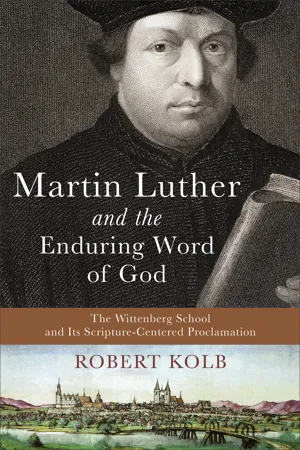
Martin Luther and the Enduring Word of God
The Wittenberg School and Its Scripture-Centered Proclamation
- 528 pages
- English
- ePUB (mobile friendly)
- Available on iOS & Android
eBook - ePub
Martin Luther and the Enduring Word of God
The Wittenberg School and Its Scripture-Centered Proclamation
About this book
Information
Topic
Theology & ReligionSubtopic
Christian Denominations1
The Bible in the World of Luther’s Childhood and Youth
Traces of the Bible, its narrative, and its view of human life filled the world of Martin Luther’s younger years. “The Bible was the most studied book of the Middle Ages,” comments Beryl Smalley at the beginning of her pioneering study of the use of Holy Scripture in medieval Europe. “Bible study represented the highest branch of learning.”1 The frequently encountered image of the medieval world as a world without Holy Scripture is quite false.
The Bible in German Society at the End of the Fifteenth Century
However, despite this focus on Scripture at the university and in the monastery, its presence within the context of daily life in the villages and towns, where most of the population lived, blended into a larger religious landscape. Scripture never appeared alone. It was heard alongside, and often mixed together with, the sacred stories of the saints, conveyed in several oral and written forms, especially the Legenda aurea of Jacob of Voragine, who edited earlier stories (in the manner of the Brothers Grimm) in the thirteenth century.2 These stories largely reflected a worldview in which human performance of certain rituals or good deeds mingled with a sense of divine power that sometimes embraced the magical to prescribe or explain how the good might be attained and evil avoided or overcome. Thus the structures within which the biblical stories were absorbed often reflected another way of perceiving reality than did the words of the Hebrew prophets and the New Testament evangelists and apostles. This framework into which the biblical narrative fell, in young Martin’s worldview, stood quite in contrast to the framework that Luther later found in Scripture. His parents’ world lacked an understanding of God as the God of conversation and community, engaged personally with his people, and an understanding of the human creature centered on trust in God’s goodness and mercy, as well as on love and service to other human beings, all of which shaped Luther’s mature worldview.
Physically, the Bible was not present in the world of most medieval Europeans. No book was. Most households in the Germany of Luther’s ancestors had no need of a bookshelf. Literacy was rising slowly in Germany around 1500, but the ability to read and write remained characteristic of only a very few into Luther’s own time. The cost of books the size of a Bible, or even a New Testament, exceeded the disposable income of most. By the late fifteenth century, however, some German merchants and artisans had acquired basic skills in Latin and accumulated sufficient money to purchase a Latin Bible—and as they began to appear, German translations—for household use.3 From 1350 onward, German translations had been available although not widely distributed.4 To the greatest extent, however, access to books in general and specifically to Scripture remained the province of those in holy orders. Into the late Middle Ages, for the common people Scripture remained but one of many tools for cultivating piety, albeit in clerically governed settings and circumstances.5
The first printed Bible in any European vernacular language appeared in 1465 or 1466, in German.6 Church leaders did believe that the people of God should not try to delve into the biblical text itself. Most famous, but not by any means unique, is the edict of Archbishop Berthold of Mainz, issued March 22, 1485, and reissued January 4, 1486, that forbade translations of the Bible, as well as other books, from Greek or Latin. He imposed penalties of excommunication and fines on those who published such translations without official approval. In addition, Berthold established a commission consisting of four masters, representing each of the four faculties of his university in Erfurt, to govern translating these texts.7 Popular Strassburg preacher Johannes Geiler von Kaisersberg (1445–1510) explained the necessity of the trained clergy’s interpreting Scripture to the common people: “It is dangerous to place the knife in the children’s hands to cut bread for themselves; they could cut themselves. So the Holy Scripture, which contains God’s bread, must be read and explained by those who have knowledge and experience.” Only they can deal with the inevitable difficulties that some texts present. The words themselves could easily be spoiled as the nourishment of faith.8 Widespread illiteracy rendered an actual prohibition of reading Scripture unnecessary; yet with the advent of cheaper books and advancing literacy in the early sixteenth century, such reading became a problem for ecclesiastical officials.
Although church officials were cautious and hesitant about reading Scripture in one’s own language, they wanted Christians to know what it contained. In the monastery, passages from Scripture filled the day, framed by seven hours of prayer. Significant percentages of the population lived the monastic way of life or at least a lay imitation of it. Some laypeople also could absorb some Scripture passages from the liturgy, although in Latin.9 By 1500 a majority of parish priests still ministered without benefit of formal theological training. Some were illiterate and learned by rote the basics of liturgical practice in order to conduct the Mass and administer the other sacraments. Most with some rudimentary education had neither tools nor training to enable them to construct sermons. However, by Luther’s time preaching was touching the lives of more people than a century earlier as towns commissioned special preachers and as mendicant brothers conducted preaching services in villages. Some peasants and townspeople ventured occasionally into a local monastery to hear sermons even though preaching normally took place in Latin there. Literate local priests could obtain postils, books of sermons on the appointed lessons, to aid them or provide them a text to read aloud to the congregation.10 Hughes Oliphant Old reports the variety of forms and styles in medieval preaching, the difficulty that preachers had in interpreting texts, the anchoring of preaching in the liturgical calendar, and its rhetorical style, using outlines filled with examples.11 Stephen Webb argues that medieval sermons made deep impressions on “impressionable” hearers “because their experiences were more concrete and tangible.” He also concedes that “the sound that most impressed the medieval mind was the bell, not the sermons,”12 perhaps because of the lack of a unitary framework that allowed application of the individual sermonic narratives to life as a whole. Luther complained that “having lost the Bible, they had nothing else to preach” than the lives of the saints,13 and these stories “were not written in accordance with the standard set by Scripture.”14 Thus biblically based sermons did not play as important a role in religious consciousness or practice as the sacraments and, above all, the Mass, which remained the central focal point of piety and penance. Sermons simply aided preparation for reception of the grace bestowed in the sacraments.15
A number of other media also inculcated elements of the biblical message and narrative into the minds of the populace. The ubiquitous altars, the main altar and side altars or chapel altars for saying masses for the dead, presented unique visual images in the medieval village. Thus they made a great impact on the people’s thinking. There too depictions of the saints reminded people of their particular powers to grant relief and assistance alongside the images of biblical narratives. In the second half of the fifteenth century a cheaper alternative to works set in movable type, the so-called block books, presented pictures of the heroes of the faith along with some text, both from Scripture and from the stories of the saints. The “Bibles of the Poor” and works such as the Speculum humanae salvationis (The Mirror of Salvation) and Concordantia caritatis (Harmony of Love), as well as depictions of King David’s life, the allegory of the Song of Solomon, or the Apocalypse—these reached a more limited audience. All these vehicles cultivated some sense of the story of salvation, the models for Christian behavior, and the terrors to be expected at the end of the world.16
Basic biblical knowledge was transmitted, as it had been for centuries, in a core curriculum that consisted of the Apostles’ Creed, the Lord’s Prayer, the Ten Commandments and/or lists of virtues and vices, and the Ave Maria. The ancient church had designed this program of instruction, dubbing it with the Latin term “catechism” (from Greek katēch...
Table of contents
- Cover
- Title Page
- Copyright Page
- Contents
- Abbreviations
- Introduction
- 1. The Bible in the World of Luther’s Childhood and Youth
- 2. In the Beginning God Said
- 3. Nowhere More Present Than in Scripture
- 4. Rightly Dividing the Word of Truth
- 5. Search the Scriptures
- 6. Faith Comes by Hearing
- 7. Teaching All Nations
- 8. Instruction in Sound Teaching
- 9. Searching the Scriptures the Wittenberg Way
- 10. Biographical Interlude
- 11. Formulas for Speaking Circumspectly and Avoiding Offense
- 12. Rightly Dividing the Word of Truth
- 13. In Season, Out of Season
- 14. With a Firm Grasp of the Word
- The Enduring Word of God
- Bibliography
- Subject Index
- Scripture Index
- Author Index
- Back Cover
Trusted by 375,005 students
Access to over 1.5 million titles for a fair monthly price.
Study more efficiently using our study tools.
Frequently asked questions
Yes, you can cancel anytime from the Subscription tab in your account settings on the Perlego website. Your subscription will stay active until the end of your current billing period. Learn how to cancel your subscription
No, books cannot be downloaded as external files, such as PDFs, for use outside of Perlego. However, you can download books within the Perlego app for offline reading on mobile or tablet. Learn how to download books offline
Perlego offers two plans: Essential and Complete
- Essential is ideal for learners and professionals who enjoy exploring a wide range of subjects. Access the Essential Library with 800,000+ trusted titles and best-sellers across business, personal growth, and the humanities. Includes unlimited reading time and Standard Read Aloud voice.
- Complete: Perfect for advanced learners and researchers needing full, unrestricted access. Unlock 1.5M+ books across hundreds of subjects, including academic and specialized titles. The Complete Plan also includes advanced features like Premium Read Aloud and Research Assistant.
We are an online textbook subscription service, where you can get access to an entire online library for less than the price of a single book per month. With over 1.5 million books across 990+ topics, we’ve got you covered! Learn about our mission
Look out for the read-aloud symbol on your next book to see if you can listen to it. The read-aloud tool reads text aloud for you, highlighting the text as it is being read. You can pause it, speed it up and slow it down. Learn more about Read Aloud
Yes! You can use the Perlego app on both iOS and Android devices to read anytime, anywhere — even offline. Perfect for commutes or when you’re on the go.
Please note we cannot support devices running on iOS 13 and Android 7 or earlier. Learn more about using the app
Please note we cannot support devices running on iOS 13 and Android 7 or earlier. Learn more about using the app
Yes, you can access Martin Luther and the Enduring Word of God by Robert Kolb in PDF and/or ePUB format, as well as other popular books in Theology & Religion & Christian Denominations. We have over 1.5 million books available in our catalogue for you to explore.