Bestselling Authors Tackle Difficult Issues for Believers and Doubters
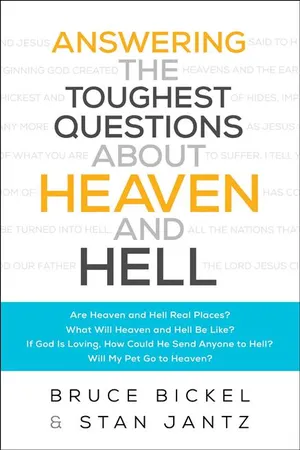
When it comes to the big questions about heaven and hell--Are these real places? Will God really send people to hell? What will we actually do in heaven?--Bruce Bickel and Stan Jantz don't pretend to have all the answers. But they do know how to wrestle with uncertainty and doubt. They welcome questions, and in these pages they ask some of the most important ones you have about heaven and hell. With candor, insight, and a disarming touch of humor, they provide some answers to these critical questions, yet they leave enough space--and grace--for you to keep wrestling, asking, and seeking Truth.
There is no shame in asking--after all, even some of the greatest men and women in the Bible had doubts. Don't let your questions go unanswered. What you find might just change your life.
- 176 pages
- English
- ePUB (mobile friendly)
- Available on iOS & Android
eBook - ePub
Answering the Toughest Questions About Heaven and Hell
About this book
Information
Topic
Theology & ReligionSubtopic
Christian Theology1
Is There an Afterlife?
Introduction
Robert was dying of cancer. His granddaughter, Erin, hoped and prayed that he would turn to God for the first time, put his life in Jesus’ hands, and be ready for eternal life. She longed to know she would see her grandfather again someday.
Erin recently began a relationship with God through Jesus, and she grew more and more curious about life after death. Her grandfather was never so interested in God or the afterlife. As an atheist, he believed there was no God and that life—the moments packed between our first and last breath—is all there is. For Robert, life was restricted to the immediate, the here and now, the physical and material. When death comes, the movie is finished, the credits role, and then all fades to black. Nothing awaits us. There is no sequel. And the rest of the world goes on.
When Robert died, Erin’s cousin (who is agnostic about God) tried to comfort her. She said, “Erin, Grandpa Robert lived well, and we can be thankful that now there is nothing for him. No more pain, no more anything. He would be glad we have our memories to look back on.” Erin agreed that living a good life was very important, but her cousin’s words were far from comforting. Erin could not help but believe there was more to life than this.
As she grieved her beloved grandfather’s death, she wrestled with what might or might not lie ahead. Is there life after this one? Is this life—this physical world and our experiences in it—all there is? Or are her newfound belief and her gut-level intuition correct in concluding there is plenty more life to be had after this one?

When it comes to Erin’s question, “Is there life after this?” Christianity answers a resounding yes! In fact, the promise of life after death is one of Christianity’s key doctrines. For better or worse, one way Christians have tried to begin conversations with others about faith in Jesus is by asking a basic (though somewhat jarring) question: “If you died today, do you know where you would go?” We’ve always wanted someone to pose that question to one of us so we could coolly reply, “To the morgue.”
But we digress.
Have you ever been asked that question? Have you ever been given the life-after-death pop quiz by an eager evangelist at the beach, in a church service, or on an airplane (one of the least appropriate and most anxiety-producing places to bring up death, by the way)? The underlying assumption in the zealous inquirer’s question about your postdeath destination is that there is in fact a postdeath destination. Be it heaven or hell, Christians claim everybody’s headed somewhere. The promise of heaven is, in part, what intrigues Erin about Christianity, and it gives her hope as she mourns for her grandfather and wrestles with the sorrow, pain, and uncertainty of life.
But are belief-colored glasses the only way to see a postdeath future? Or are there other road signs that point in the same mysterious direction? Later we’ll take a close look at what Christianity teaches, but first, let’s see who else is talking about life after death. As it turns out, Christians are not alone on this one.
The 99 Percent
Have you ever boldly expressed an opinion only to find you’re the only one who holds it? It happens to us more than you know! This, believe it or not, is the experience of those who say there is no life after death. Though Erin’s grandfather and cousin are two key players in this chapter’s opening story, they are part of a small minority of people in world history who don’t believe in a postdeath reality. Today the trend continues. Though there are pockets of disbelief around the world, the large majority of people believe in life after death. It’s important to note that this fact neither solves the afterlife enigma nor dismisses it. It’s simply a fact, one that is helpful to know as we explore honestly whether or not there is life after this one. What follows is a breakdown that reveals the ubiquity of the belief in life, of one kind or another, after death.
In the Old, Old Days
Belief in the afterlife was as prevalent centuries ago as it is today. In Alan Segal’s comprehensive history of the afterlife in Western religion, he notes: “Notions of afterlife are universal in human experience; indeed, they are older than human life, if Neanderthal grave sites are taken as evidence.”1 For millions of years tombs have been built to house dead bodies and various accoutrements (jewelry, tools, everyday utensils, food, decorations, and weapons) believed necessary for navigating the afterlife. The earliest tombs were in the deceased’s homes, and they evolved into the remarkable pyramids of ancient Egypt. The question for those cultures—going as far back as the Stone Age—was not if there was an afterlife, but rather how to equip and prepare a person for it.2 Anthropologists can’t say for sure if humanity’s oldest ancestors were religious, but the nature of their burial sites leaves little doubt that they believed their dead relatives were not finished living.
What Do the World’s Major Religions Say?
The same is true for those in the world who are religious: Life after death is a slam dunk. Since their beginning, the great world religions—Christianity, Islam, Judaism, Hinduism, Buddhism, and all their variations—have expressed belief in one of two basic distinctions of the afterlife. Western religion teaches resurrection of the body, while Eastern religion believes souls are reunited with a transcendent ultimate reality. Our intention is not to describe the myriad intricacies found in this planet’s religions, but here’s a snapshot of what the major ones believe about the hereafter:
Buddhism
Buddhists affirm two options: transmigration (reincarnation) or nirvana. With transmigration, one’s spirit (or soul) inhabits another physical body; life after death is really life after life. But the true goal is nirvana. Nirvana is the extinction of desire, through which the spirit of the self is united with the highest state of consciousness. Afterlife then, whether it is rebirth into another living creature or reaching the ultimate, unified consciousness of Buddha, is important in Buddhism.
Hinduism
The afterlife in Hinduism is also rooted in reincarnation. A person’s self, or spiritual essence, is believed to be divine and is on a cyclical journey of birth and rebirth. The goal in each life is to attain moska, or total liberation from the life and death cycle. Similar to Buddhism, moska is nirvana, or ultimate union with Brahman, the divine. The Bhagavad Gita, India’s enduring religious work, says this about the self: “Never the spirit was born; the spirit shall cease to be never; never was a time it was not. . . . Birthless and deathless and changeless remaineth the spirit forever.”3 In other words, a person’s spirit is eternal, never born and never to die, making afterlife an assumed belief in Hinduism.
Judaism
In general, Judaism is less preoccupied with the afterlife than the other Abrahamic, monotheistic religions (Christianity and Islam). “Nevertheless, there can be no question that classic Judaism had a strong expectation—disorganized, but strong just the same—that certain events will await us all after we die.”4 In the Jewish Torah (first five books of the Old Testament), a good person’s death resulted in a reunion with Jewish ancestors like Abraham, Isaac, and Jacob (Genesis 25:8, 17; 49:33; Deuteronomy 32:50). Later in Jewish history, according to the Old Testament book of Daniel, the afterlife bears a resemblance to those of other primary Western religions. Though it’s less clearly articulated or emphasized, Judaism also believes life does not end with death.
Islam
Belief in the afterlife is paramount in Islam. Muslims believe there are two destinations for the human soul, and eventually the resurrected human body. According to Islam, the day of judgment is when the earth will be destroyed and everyone will be raised from the dead to be judged by Allah according to their deeds. Once judged, deceased souls will be reunited with their restored bodies to spend eternity in paradise (heaven) or hell. Until the resurrection of the dead, souls are at rest, receiving a foretaste of their eternal destination.
Belief in the afterlife, though it takes different forms, courses through the world’s major belief systems. If you performed a one-question “man on the street” interview in Dubai, Shanghai, Tel Aviv, Bangalore, Tehran, or Dallas, much more often than not the response to “Do you believe there is life after death?” would be yes. Given the vast array of cultures, religions, and values represented in each of these far-flung cities, the uniform acknowledgment of an unprovable afterlife is fascinating.
What Does Science Say?
In our book Answering the Toughest Questions About God and the Bible, one question we wrestled with was “Why doesn’t God make himself more obvious?” Great question, right? While writing that chapter, we met Jacob, a church visitor who struggled with faith. He said, “I’ve prayed many times for God—if he’s out there—to prove it to me.”
Jacob’s request for God to provide rock-solid proof of his existence reveals the heart of our cultural expectation of God (and everything else, for that matter). In our age of science we rely, more than ever, on measurable, repeatable, physical attributes to “prove” what is real. Miracles are becoming the stuff of legend. If it’s real, we want to be able to see, touch, taste, hear, and smell it, or at least confirm it through scientific measurement (because nobody has seen or smelled a quark!).
This desire is not new. Thomas, one of Jesus’ first devoted followers, wanted the same thing we want: physical proof. When the other disciples claimed Jesus had risen from the dead, he said, “I won’t believe it unless I see the nail wounds in his hands, put my fingers in to them, and place my hand into the wound in his side” (John 20:25 NLT).
Since Thomas made that statement two thousand years ago, we’ve developed tools that are much more powerful than human sight and touch, but our instinctual craving is still like his. When truth claims are made, we say, “Prove it.” The same goes for the afterlife.
Humanity has only just begun to lean on science as the one-stop shop for truth (much to the dismay of the faithful who believe there is truth that science cannot measure or prove), but the question is still worth asking. Can science teach us anything about the possibility of the afterlife? And if so, what? Let’s jump into a couple of scientific disciplines and see if, and how, they might point toward life after death.
Biology and the afterlife
Every kid has an aha moment. It may come in a conversation with a parent, in a first science class, or upon inspecting fresh roadkill. It’s the moment one realizes there is stuff on the inside of us that makes the outside work: hearts in our chests, muscles in our legs, and brains in our heads. But as school-age kids learn more about the facts of physical bodies in biology class, they are also uncovering feelings and thoughts that are far more difficult to assess. How does a junior high girl measure jealousy? How does a boy prove his desire to fit in? How does either measure their developing identi...
Table of contents
- Cover
- Title Page
- Copyright Page
- Contents
- Acknowledgments
- Introduction
- 1. Is There an Afterlife?
- 2. What Happens When You Die?
- 3. Are Heaven and Hell for Real?
- 4. Can I Believe What the Bible Says About the End of the World?
- 5. Do All Roads Lead to Heaven?
- 6. If God Is Loving, How Could He Send Anyone to Hell?
- 7. Is Hell a Divine Torture Chamber?
- 8. How Do You Get into Heaven?
- 9. What Will Heaven Be Like?
- 10. How Can I Be Sure About Heaven?
- Appendix 1: Will There Be Animals in Heaven?
- Appendix 2: Can My Loved Ones in Heaven See Me?
- Appendix 3: Will There Be Rewards in Heaven?
- Appendix 4: Are Near-Death Experiences for Real?
- Notes
- About the Authors
- Back Ad
- Back Cover
Trusted by 375,005 students
Access to over 1.5 million titles for a fair monthly price.
Study more efficiently using our study tools.
Frequently asked questions
Yes, you can cancel anytime from the Subscription tab in your account settings on the Perlego website. Your subscription will stay active until the end of your current billing period. Learn how to cancel your subscription
No, books cannot be downloaded as external files, such as PDFs, for use outside of Perlego. However, you can download books within the Perlego app for offline reading on mobile or tablet. Learn how to download books offline
Perlego offers two plans: Essential and Complete
- Essential is ideal for learners and professionals who enjoy exploring a wide range of subjects. Access the Essential Library with 800,000+ trusted titles and best-sellers across business, personal growth, and the humanities. Includes unlimited reading time and Standard Read Aloud voice.
- Complete: Perfect for advanced learners and researchers needing full, unrestricted access. Unlock 1.5M+ books across hundreds of subjects, including academic and specialized titles. The Complete Plan also includes advanced features like Premium Read Aloud and Research Assistant.
We are an online textbook subscription service, where you can get access to an entire online library for less than the price of a single book per month. With over 1.5 million books across 990+ topics, we’ve got you covered! Learn about our mission
Look out for the read-aloud symbol on your next book to see if you can listen to it. The read-aloud tool reads text aloud for you, highlighting the text as it is being read. You can pause it, speed it up and slow it down. Learn more about Read Aloud
Yes! You can use the Perlego app on both iOS and Android devices to read anytime, anywhere — even offline. Perfect for commutes or when you’re on the go.
Please note we cannot support devices running on iOS 13 and Android 7 or earlier. Learn more about using the app
Please note we cannot support devices running on iOS 13 and Android 7 or earlier. Learn more about using the app
Yes, you can access Answering the Toughest Questions About Heaven and Hell by Bruce Bickel,Stan Jantz in PDF and/or ePUB format, as well as other popular books in Theology & Religion & Christian Theology. We have over 1.5 million books available in our catalogue for you to explore.