The Life, Legacy, and Lessons of a Civil Rights Giant
"Justice is something every generation has to strive for."
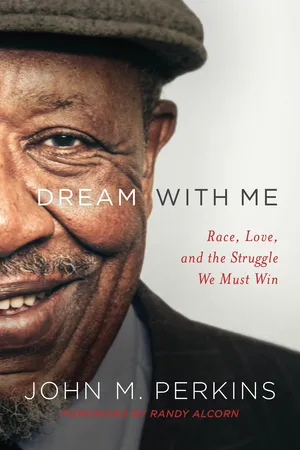
A trailblazer in the civil rights movement, John M. Perkins led voter registration efforts in 1964, worked for school desegregation in 1967, and was jailed and tortured in 1970. He is no less zealous today as he sees a new generation of freedom fighters battling the same issues and the same systems he has spent his life working to correct.
Through his raw, personal stories spanning from the civil rights era to today, Perkins shows us that, though the fight is not over, there are many reasons to hope and to carry on the good work he and his contemporaries began more than a generation ago. He calls us to work for justice by living out God's redemptive love in all of our relationships.
"It all comes down to love," he says. "Love will always be our final fight."
- 224 pages
- English
- ePUB (mobile friendly)
- Available on iOS & Android
eBook - ePub
About this book
Information
Topic
Theology & ReligionSubtopic
Social Science Biographies1
Side by Side (but Not Together)
Desegregation was one of the big goals of the civil rights movement. “Separate but equal” in the South became “separate and unequal.” The disparities were in things as small as water fountains and as vitally important as education and health care.
In fact, when we black patients were sick, we had trouble getting to see a doctor. We had to be to the doctor’s office by 8:00 a.m., because if we weren’t, other black patients would get there first, and we might not get to see the doctor that day. If a doctor did see us, it would always be in the afternoon after the white patients had left. People would sit all day at the doctor’s office and still not see the doctor that day. Our time meant nothing to them.
In the case of an accident, or if the doctor had to rush to the hospital, none of us black patients got treated. We had to return the next day and start over again. Appointments didn’t exist for blacks.
My son Phillip had polio as a child, and we learned that we could get some of his medication through the March of Dimes. They told us they had a representative in every county and sent us to a health clinic in downtown Mendenhall, Mississippi.
We had to go in through a back door and wait for hours in a separate waiting room to get my little boy’s medicine. I didn’t think about it too much. That’s the way things were, and the important thing was to take care of Phillip.
In the years since then, I often have thought about those walls that kept black people and white people apart, even in places where we had so much in common. And yet we were treated as if we were two different species.

In 1973, Voice of Calvary Ministries, the ministry Vera Mae and I started after we moved back to Mississippi in 1960, opened a health clinic in the black section of Mendenhall. We had an X-ray machine and all new equipment. We were thrilled about our clinic, but we had barely gotten it open before a terrible flood caused thousands of dollars of damage to our equipment and the facility. We needed to find a location on higher ground.
The white doctor who had run the clinic up by the courthouse had died, and according to his wishes, his widow was to sell the building only to someone who would use it as a medical clinic. The property was located uptown, in the white section of town, and no property had ever been sold to a black person there before. The widow sold us the building because we convinced her we were committed to using it to provide health care for the community.
I’ll never forget the day we took possession of that building. We paid her $75,000 cash, and she deeded the clinic over to Voice of Calvary.
As soon as we had the keys, a bunch of us went inside. The first thing I noticed was the wall that divided blacks and whites. Many times I had stared at the wall from the black side. For the first time, we were able to look at both sides of the wall, and it confirmed what we had already assumed: the white side had nice, beautiful paneling; the black side was bare and worn.
The stark contrast was symbolic of how everything we blacks had was inferior.
I picked up a sledgehammer and started slamming it against the wall with all my might. We tore down that dividing wall in less than thirty minutes. It felt good! It also reminded me of something the apostle Paul wrote in Ephesians 2:14–16: Christ has made peace between Jews and gentiles, and He has united us by breaking down the wall of hatred that separated us.
It was an emotional experience, and I didn’t care that we had ruined nice paneling that, under other circumstances, we would have reused. From that time on, we determined there would be only one waiting room—open to blacks and whites.
At our new clinic, all patients came in through the same door and sat in the same waiting room until a doctor was ready to see them. From the beginning, even some poor whites used our clinic.
The first physician to work at the clinic was Dr. Kevin Lake. For a while volunteer doctors came to help out for a few months or a year or two. Dr. Gene McCarty was the clinic’s first full-time doctor. He stayed for two years and helped expand the clinic’s capacity as a medical facility. Dr. Dennis Adams, a young black man from New York, joined the clinic staff because he felt God was calling him to serve with us in Mississippi. He’s been at the clinic for more than forty years. He and his wife raised their kids in Mendenhall. People love him. He has black and white patients.
When I visit Mendenhall, I love to watch people going into that integrated clinic. I smile because it’s in the shadow of the courthouse.
Tearing down the wall in that health center was for me what refusing to give up her seat on that bus must have been for Rosa Parks. That is something I look back on and think, Because of what we did, things are different. Life is better now.
To this day, every time I see the building, it brings me great joy to know that the wall that once separated the races came tumbling down.
Discrimination was prominent in restaurants, hotels, and bus depots. Black citizens weren’t allowed to participate in the society they had spent centuries helping build.
Segregation was wrong, so we fought it with all we had.
In 1968, civil rights hero Andrew Young, who stood on the balcony with Martin Luther King Jr. when he was killed, spoke at Jackson State University, a historically black university. The organizers printed 3,000 posters promoting the event. The auditorium where Mr. Young spoke could seat about 1,500 people.
Fewer than 400 attended. About 250 came from the community, leaving about 150 students from a campus of 3,700 undergraduate and graduate students. I don’t blame the students for not coming. I blame the professors for not making the event a priority.
Two days before Christmas in 1969, I was jailed for protesting the beating of a black boy who supposedly telephoned a white girl to ask her for a date. Vera Mae helped organize a shopping boycott of white-owned stores in Mendenhall to protest. In February of the following year, I went to the Rankin County Jail in Brandon to visit nineteen Tougaloo college students who had been arrested after a protest march. I was subsequently arrested and tortured by white police officers. We as a society have failed the students of today if they don’t understand and respect the leaders and martyrs who worked tirelessly for the cause of equality.
Courageous men, women, and children who were willing to give their lives for the cause of equality led the civil rights movement. Young people were often the hands and feet behind the vision of the adult leaders. They made sacrifices and provided energy for the movement.
I’ll never forget one Sunday in 1964 when a bunch of kids met up together and decided they were going to integrate the movie theater in Mendenhall. This was fairly early on in the integration efforts, but they had a pretty good idea that integrating meant going to jail and getting beaten up.
The kids tried to keep it a secret because they knew their parents wouldn’t want them involved. But word got out, sending numerous parents into a fearful panic. They feared not only for their children’s safety but also for their own livelihoods. People whose kids went to jail for trying to integrate a whites-only facility risked losing their jobs, their insurance, and their homes.
I attended the meeting, not to try to talk them out of anything, but to listen. My eldest children—Spencer, Joanie, Phillip, and Derek—were there. Vera Mae and I wanted the kids to go even though, like the other parents, we were concerned for their safety. We didn’t have to worry about the other threats because we didn’t work for white folks, the bank didn’t have a lien on our house, and our insurance agent was a fairly decent white man.
At the meeting, I listened to the organizer talk to the kids. He told them the truth—they might go to jail, get beaten, or, worst of all, killed.
Finally, he said, “It’s time to go.” The way he said those words was as powerful as if he were saying, “Even if no one comes with me, I’m going.”
As I recall, Spencer, who wasn’t more than eleven at the time, was the first to stand and go with him. (Although it may have been Joanie—she was always a rebel.) Derek also was a rebel, and Phillip would do anything Spencer did. All four of my children, along with fourteen others, tried to integrate the theater.
That event was a pivotal moment in my life. I had to make a choice, and that choice revealed a lot about who I am. If my kids are ready to give their lives for the cause, I’m willing to let them do it. Some parents might not have agreed with that decision, but my children understood that some ideals are important enough to risk their lives for.
I was proud of them for that stance.
The theater owners must have also recognized the determination of these young protesters. When they heard the kids were coming, they closed the theater.
Permanently.
Not long ago, I went back to Mendenhall and crossed paths with Bettye Norwood, who had been part of our ministry. After being employed with World Vision in California for twenty years, she came back home and worked in the Simpson County district attorney’s office.
When she was growing up, it was unheard of for a black woman to have such a position. “I never thought that I would be in this courthouse working with a top official,” she said.
As we talked, we reminisced about the time a group of us integrated a local truck stop.
I was terrified, but I was the leader, so I tried not to let it show.
The employees at the truck stop finally decided to serve us, and we sat while they put the plates and forks in front of us. I tried to pick up my fork, but I was shaking so badly, I couldn’t do it.
Afterward, people asked me, “What did you do?”
“We integrated. That’s what we went there to do.”
Fear or no fear, we had made up our minds that we were going to keep pressing on until we were allowed to sit at tables just like the white people.
If you want to see how much Mississippi has changed in the last fifty years, look at the restaurants. Pictures of the group that integrated the Woolworth’s lunch counter in downtown Jackson back in 1963 remain etched in my mind.
“A huge mob gathered, with open police support while the three of us sat there for three hours,” a member of that group, former Tougaloo College sociology professor John Salter, said. “I was attacked with fists, brass knuckles and the broken portions of glass sugar containers, and was burned with cigarettes.”1
A few blocks from the location of that Woolworth’s is Hal and Mal’s. The place features live music and is regularly filled with both black and white customers. A few blocks in the other direction is the King Edward Hotel, which reminds me how far we’ve come.
According to the Jackson Free Press,
Built in 1922, the current iteration of the hotel was a favorite watering hole for white state legislators and other dealmakers during the days of Prohibition and after. The hotel fell on hard times midway through the 1950s, and the King Edward remained segregated after other downtown hotels integrated. When it finally began admitting black guests, the hotel’s remaining white patrons jumped ship, and in 1967, the King Edward closed its doors.2
In 2009, the hotel reopened after the building was renovated by a group of investors, including a white attorney, a black professional athlete, and a black rap artist. In the remodeled building, anyone can rent apartments, stay in hotel rooms, and eat at the restaurant, bar, and coffee shop. This truly is a testament to progress and transformation.
I like to talk about the positive changes of integration. However, it’s harder to talk about the costs and unintended effects. Take, for example, the schools.
Six of my children—Spencer, Joanie, Phillip, Derek, Deborah, and Wayne—were among the first black children to attend the all-white school in Mendenhall. But while they were there, their white teachers did not treat them the same way they treated the white children.
Phillip’s teacher wouldn’t allow him to answer questions in class. For two years Spencer went to the school and no one talked to him. The seat next to him was always left empty, and as far as people at school were concerned, both his first and last name were a racial slur.
Whenever one of my kids did make a white friend, it wasn’t long before that friend would come to school and say, “My parents said I can’t play with you anymore.”
Phillip was probably hurt the most by his school experience. Because he was sickly, I had always given him a lot of love. He grew to expect that other people would love him too. When he went to the white school and the people treated him with hatred, the rejection almost destroyed him.
I didn’t even know several of the stories until many years later because our children had tried to keep some of the hatred and rejection they had experienced from hurting me and Vera Mae too. Deborah remembers some of this well and says,
My first day in class with all white students, I walked in and was assigned my seat. Of course, everyone was staring. Even the teacher seemed to be a little shaken presenting her lesson plan. Confidence was rarely a problem for me as a kid, with three athletic older brothers, but this day I was all alone. Not one student said a word to me, nor did I see a smile. It see...
Table of contents
- Cover
- Title Page
- Copyright Page
- Endorsements
- Dedication
- Contents
- Appreciation
- Foreword
- Acknowledgments
- Introduction
- Prologue
- 1. Side by Side (but Not Together)
- 2. That We Might Be One
- 3. Poor Whites
- 4. Fighting without Fists
- 5. The Three Rs
- 6. Incarnation (Being Jesus in the Flesh)
- 7. Real Justice
- 8. Spencer
- 9. Affirming Human Dignity
- 10. The Final Fight
- 11. The Power of Forgiveness
- 12. Above the Noise
- 13. The Church of the Future
- 14. Dream with Me
- Gratitude
- Recommended Reading
- Notes
- About the Author
- Back Ads
- Back Cover
Trusted by 375,005 students
Access to over 1.5 million titles for a fair monthly price.
Study more efficiently using our study tools.
Frequently asked questions
Yes, you can cancel anytime from the Subscription tab in your account settings on the Perlego website. Your subscription will stay active until the end of your current billing period. Learn how to cancel your subscription
No, books cannot be downloaded as external files, such as PDFs, for use outside of Perlego. However, you can download books within the Perlego app for offline reading on mobile or tablet. Learn how to download books offline
Perlego offers two plans: Essential and Complete
- Essential is ideal for learners and professionals who enjoy exploring a wide range of subjects. Access the Essential Library with 800,000+ trusted titles and best-sellers across business, personal growth, and the humanities. Includes unlimited reading time and Standard Read Aloud voice.
- Complete: Perfect for advanced learners and researchers needing full, unrestricted access. Unlock 1.5M+ books across hundreds of subjects, including academic and specialized titles. The Complete Plan also includes advanced features like Premium Read Aloud and Research Assistant.
We are an online textbook subscription service, where you can get access to an entire online library for less than the price of a single book per month. With over 1.5 million books across 990+ topics, we’ve got you covered! Learn about our mission
Look out for the read-aloud symbol on your next book to see if you can listen to it. The read-aloud tool reads text aloud for you, highlighting the text as it is being read. You can pause it, speed it up and slow it down. Learn more about Read Aloud
Yes! You can use the Perlego app on both iOS and Android devices to read anytime, anywhere — even offline. Perfect for commutes or when you’re on the go.
Please note we cannot support devices running on iOS 13 and Android 7 or earlier. Learn more about using the app
Please note we cannot support devices running on iOS 13 and Android 7 or earlier. Learn more about using the app
Yes, you can access Dream with Me by John M. Perkins in PDF and/or ePUB format, as well as other popular books in Theology & Religion & Social Science Biographies. We have over 1.5 million books available in our catalogue for you to explore.