eBook - ePub
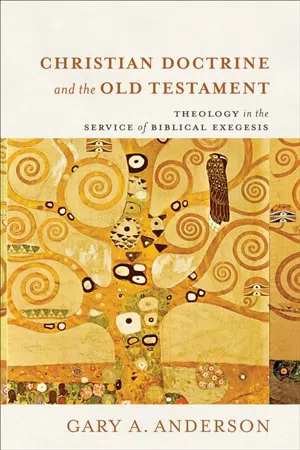
Christian Doctrine and the Old Testament
Theology in the Service of Biblical Exegesis
- 240 pages
- English
- ePUB (mobile friendly)
- Available on iOS & Android
eBook - ePub
Christian Doctrine and the Old Testament
Theology in the Service of Biblical Exegesis
About this book
The Old Testament offers a rich palette of ideas, images, and narratives that help us unpack some of the more compact and opaque theological ideas of the New Testament. In conversation with both Christian and Jewish interpreters, prominent scholar Gary Anderson explores the exegetical background of key Christian doctrines. Through a deeper reading of our two-Testament Bible, he illustrates that Christian doctrines have an organic connection to biblical texts and that doctrine can clarify meanings in the text that are foreign to modern, Western readers. Anderson traces the development of doctrine through the history of interpretation, discussing controversial topics such as the fall of man, creation out of nothing, the treasury of merit, and the veneration of Mary along the way. He demonstrates that church doctrines are more clearly grounded in Scripture than modern biblical scholarship has often supposed and that the Bible can define and elaborate the content of these doctrines.
Information
Part 1
“Who Is a God Like You?”
1
Apophatic Theology
The Transcendence of God and the Story of Nadab and Abihu
The story of the tragic deaths of Nadab and Abihu has bothered readers for centuries. As Edward Greenstein observes, the tale is a “model of undecidability. . . . It looks to most readers like a punishment in search of a crime.”1 In this chapter I suggest that this manner of formulating the problem points toward its solution. When read through an apophatic lens, the narrative shows us what we can and cannot know about God’s presence in the liturgical life of ancient Israel. Apophatic theology does not simply solve a textual puzzle; rather, it allows the reader to plumb the depths of biblical religion.
One of the strangest stories in the Bible is that of Nadab and Abihu in Lev. 10. Immediately after the consecration of the priesthood (Lev. 8) and the miraculous consumption of the sacrifices on the eighth day (Lev. 9:24), these two priests offer ʾēš zārâ (“strange fire”) and are incinerated on the spot (Lev. 10:1–2). In the Jewish postbiblical liturgical reading cycle of the synagogue, this tale is paired with the death of Uzzah when he tries to steady the ark in 2 Sam. 6,2 but Greenstein has argued that there are innerbiblical grounds for this association: “Uzzah was the son of Abinadab, and this name has been constructed from Abi[hu] and Nadab.”3 Though my emphasis will be on Nadab and Abihu, I wish to claim that both stories explore the theme of divine holiness within the framework of God’s choice to dwell among the Israelites.
The Danger of the Ark in Israel’s History
The first thing the reader must bear in mind is the Bible’s assumption that God has really taken up residence in the tabernacle. Michael Wyschogrod, in an essay on the notion of incarnation in the Jewish tradition, has argued: “God has undertaken to enter the world and to dwell in a place.”4 But this deeply “incarnational” character of the tabernacle carries a particular danger along with it: individuals will be tempted to co-opt either the building itself (cf. Jer. 7) or its most important artifact—the ark—to their own political and/or religious advantage and so compromise the freedom of God. We can see this danger enacted in the so-called ark narrative in the books of Samuel.5 This narrative opens with Israel suffering a terrible defeat at the hands of the Philistines. The troops subsequently return to camp and the elders pose the obvious question: “Why has the LORD put us to rout today before the Philistines?” (1 Sam. 4:3a). The reader knows the answer: the sins of Hophni and Phineas, the sons of Eli. But the elders do not share this knowledge. Though they ask the right question, they do not wait for an answer. Their inquiry turns out to be less a lament over Israel’s sin than a (subtle) challenge that God take immediate action: “Let us bring the ark of the covenant of the LORD here from Shiloh, so that he may come among us and save us from the power of our enemies” (4:3b). As André Caquot and Philippe de Robert conclude: “All this seems to suggest a certain arrogance in the attitude of the elders of Israel.”6
This stratagem appears promising at first. For when the Philistines learn of the arrival of the ark, they quake in fear: “Woe to us! Who can deliver us from the power of these mighty gods? These are the gods who struck the Egyptians with every sort of plague in the wilderness” (4:8). But calmer heads prevail and they venture forth to battle. The results for the Israelites, however, are devastating: “So the Philistines fought; Israel was defeated, and they fled, everyone to his home. There was a very great slaughter, for there fell of Israel thirty thousand foot soldiers. The ark of God was captured; and the two sons of Eli, Hophni and Phinehas, died” (4:10–11).
The precise character and gravity of Israel’s sin becomes clearer when we compare the Israelite reaction to their initial defeat with what happens to the Israelite armies at Ai (Josh. 7).7 Just as in 1 Sam. 4, the Israelites suffer a terrible defeat due to an unknown sin: Achan (7:2–5), the narrator informs us, has taken booty for himself in violation of Mosaic law (7:1). After the return of the defeated soldiers, Joshua and the tribal elders tear their clothes, put ashes on their heads, and fall on their faces before the ark, imploring God to explain the reason for the defeat.
Then Joshua tore his clothes, and fell to the ground on his face before the ark of the LORD until the evening, he and the elders of Israel; and they put dust on their heads. Joshua said, “Ah, Lord GOD! Why have you brought this people across the Jordan at all, to hand us over to the Amorites so as to destroy us? Would that we had been content to settle beyond the Jordan! O LORD, what can I say, now that Israel has turned their backs to their enemies! The Canaanites and all the inhabitants of the land will hear of it, and surround us, and cut off our name from the earth. Then what will you do for your great name?” (Josh. 7:6–9)
God is quick to answer: Achan’s sin has led to Israel’s defeat. They must attend to this misdeed before any other military action can be attempted (7:12–26).
It is striking how differently the Israelites behave in 1 Sam. 4. Instead of taking the opportunity to appeal to God in the deliberate and solemn fashion that we find in Joshua (tearing of clothes, placing ashes on their heads, and falling on their faces before the ark), they simply pose what appears to be a perfunctory question: “Why has the LORD put us to rout?” Eschewing a posture of penance and allowing God no time to respond, the elders concoct their own solution: they race to the shrine and remove the ark of the covenant, believing that its sacramental agency can assure them a victory. By failing to address the sin that occasioned the terrible defeat, the elders have unwittingly turned the ark into something of a lucky charm.
We can contrast this aberrant understanding of the power of the ark with David’s understanding in 2 Sam. 15:25. Here is a man who possesses a divine promise regarding the eternal character of his kingdom (2 Sam. 7), but even with this promissory note in hand, when he is driven from the city of Jerusalem by his upstart son, Absalom, he refuses to use the ark as a guarantee of safe return.
Abiathar came up, and Zadok also, with all the Levites, carrying the ark of the covenant of God. They set down the ark of God, until the people had all passed out of the city. Then the king said to Zadok, “Carry the ark of God back into the city. If I find favor in the eyes of the LORD, he will bring me back and let me see both it and the place where it stays. But if he says, ‘I take no pleasure in you,’ here I am, let him do to me what seems good to him.” . . . So Zadok and Abiathar carried the ark of God back to Jerusalem, and they remained there. (2 Sam. 15:24–26, 29, emphasis added)
David realizes that everything that is taking place is the result of his dalliance with Bathsheba, just as the prophet Nathan predicted. Though David has no doubts about the power of the ark, he is spiritually mature enough to realize that it will provide no advantage in his penitential state.8 The freedom of God is honored precisely in respect to the object to which God has tied his presence.
For this reason the ark narrative comes to a preliminary conclusion in 1 Sam. 6 with the story of the ark’s return to Israel and the slaying of those in Beth-Shemesh who greeted its arrival improperly.9 In response to their grave misdeed, the people cry out: “Who is able to stand before the LORD, this holy God?” (1 Sam. 6:20). The implied answer is obvious: no mortal should presume to be safe when standing before the God of Israel.10 This is the lesson to be learned from the improper treatment of the ark back at the beginning of the ark narrative. God’s presence in the ark is not to be taken lightly. The ark is no lucky charm. The men of Beth-Shemesh do the rational thing: they forward this dangerous cargo to the inhabitants of Kiriath-jearim.
What Did Nadab and Abihu Do Wrong?
This brings me to the subject of this chapter, the incense offering of Nadab and Abihu. The story follows upon the theophany that was the climax of the ceremony of consecration on the eighth day: “Fire came out from the LORD and consumed the burnt offering and the fat on the altar; and when all the people saw it, they shouted and fell on their faces” (Lev. 9:24). Immediately thereafter we read:
Now Aaron’s sons, Nadab and Abihu, each took his censer, put fire in it, and laid incense on it; and they offered strange fire [ʾēš zārâ] before the LORD, such as he had not commanded them. And fire came out from the presence of the LORD and consumed them, and they died before the LORD. Then Moses said to Aaron, “This is what the LORD meant when he said,
‘Through those who are near me
I will show myself holy,
and before all the people
I will be glorified.’”
And Aaron was silent. (Lev. 10:1–3 NRSV alt.)
The story about Nadab and Abihu’s cultic error has puzzled interpreters for centuries—going all the way back to Philo of Alexandria.11 Christian Frevel sums things up well: “The short episode raises more questions than it answers.”12 Before entertaining some of the proposed solutions to the challenges this text poses, let us look at the story within its present canonical environment.
A few basic structural factors must be borne in mind before we can ask what Nadab and Abihu have done wrong. First of all, it is important to note that chaps. 8–10 open with a reference to the “taking” of various materials that are necessary for the ritual:13
The LORD spoke to Moses saying: “Take Aaron and his sons with him, the vestments, the anointing oil, the bull of sin offering.” (Lev. 8:1–2)
On ...
Table of contents
- Cover
- Title Page
- Copyright Page
- Contents
- Acknowledgments
- Abbreviations
- Introduction
- Part 1: “Who Is a God Like You?”
- Part 2: “In the Beginning”
- Part 3: “The Word Became Flesh”
- Part 4: “Conformed to the Image of His Son”
- Epilogue
- Scripture and Other Ancient Writings Index
- Author Index
- Subject Index
- Back Cover
Trusted by 375,005 students
Access to over 1.5 million titles for a fair monthly price.
Study more efficiently using our study tools.
Frequently asked questions
Yes, you can cancel anytime from the Subscription tab in your account settings on the Perlego website. Your subscription will stay active until the end of your current billing period. Learn how to cancel your subscription
No, books cannot be downloaded as external files, such as PDFs, for use outside of Perlego. However, you can download books within the Perlego app for offline reading on mobile or tablet. Learn how to download books offline
Perlego offers two plans: Essential and Complete
- Essential is ideal for learners and professionals who enjoy exploring a wide range of subjects. Access the Essential Library with 800,000+ trusted titles and best-sellers across business, personal growth, and the humanities. Includes unlimited reading time and Standard Read Aloud voice.
- Complete: Perfect for advanced learners and researchers needing full, unrestricted access. Unlock 1.5M+ books across hundreds of subjects, including academic and specialized titles. The Complete Plan also includes advanced features like Premium Read Aloud and Research Assistant.
We are an online textbook subscription service, where you can get access to an entire online library for less than the price of a single book per month. With over 1.5 million books across 990+ topics, we’ve got you covered! Learn about our mission
Look out for the read-aloud symbol on your next book to see if you can listen to it. The read-aloud tool reads text aloud for you, highlighting the text as it is being read. You can pause it, speed it up and slow it down. Learn more about Read Aloud
Yes! You can use the Perlego app on both iOS and Android devices to read anytime, anywhere — even offline. Perfect for commutes or when you’re on the go.
Please note we cannot support devices running on iOS 13 and Android 7 or earlier. Learn more about using the app
Please note we cannot support devices running on iOS 13 and Android 7 or earlier. Learn more about using the app
Yes, you can access Christian Doctrine and the Old Testament by Gary A. Anderson in PDF and/or ePUB format, as well as other popular books in Theology & Religion & Biblical Criticism & Interpretation. We have over 1.5 million books available in our catalogue for you to explore.