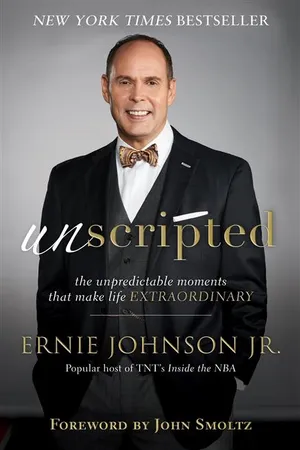
Ernie Johnson Jr. has been in the game a long time. With one of the most recognized voices in sports broadcasting, he is a tireless perfectionist when it comes to preparing and delivering his commentary. Yet he knows that some of sports' greatest triumphs--and life's greatest rewards--come from those unscripted moments you never anticipated.
In this heartfelt, gripping autobiography, the three-time Sports Emmy Award-winner and popular host of TNT's Inside the NBA provides a remarkably candid look at his life both on and off the screen. From his relationship with his sportscaster father to his own rise to the top of sports broadcasting, from battling cancer to raising six children with his wife, Cheryl, including a special needs child adopted from Romania, Ernie has taken the important lessons he learned from his father and passed them on to his own children. This is the untold story, the one Ernie has lived after the lights are turned off and the cameras stop rolling. Sports fans, cancer survivors, fathers and sons, adoptive parents, those whose lives have been touched by a person with special needs, anyone who loves stories about handling life's surprises with grace--Unscripted is for all of these.
- 224 pages
- English
- ePUB (mobile friendly)
- Available on iOS & Android
eBook - ePub
About this book
Information
Print ISBN
9780801074103
Subtopic
Réussite personnelle1
Blackberries
IT WAS A FASTBALL, about belt high. I say “fast” meaning it was a straight pitch, not a curveball or a slider. Dads whose sons were in a league of eight- and soon-to-be nine-year-olds in the mid-1960s didn’t let their sons throw breaking stuff.
Anyway, I had a good look at this belt-high fastball from my position at shortstop in a game that we, the Vees (don’t ask, I don’t know), were leading by a couple runs. That lead was in jeopardy because this belt-high fastball, which I had such a good look at, was lined over my head before I had a chance to take my glove off my knee. It bounced once in left center field and cleared the chain-link fence, which no player in our league had ever cleared on a hop, much less on the fly, so this ground-rule double was pretty impressive in my book.
The hit scored the runners from second and third and tied the game. This necessitated a meeting on the mound so our coach could tell us, the infielders, what we should do if the next ball was hit to us now that the go-ahead runner stood at second, still grinning about his display of eight-year-old power. The coach had his say. We nodded as if we understood the defensive strategy he had outlined, though I’m pretty sure our first baseman was thinking more about how good a snow cone would taste when this game was over. So was I. It may have been an early Saturday morning, but it was Georgia, and it was hot. It was “try not to think about snow cones in the middle of the game” hot. And so we, the Vees (look, maybe the league was just using the alphabet to name teams; I don’t know, so stop asking), trotted back to our positions, and that’s when this story, for me, became worth telling.
You see, before another pitch could be thrown, we had to find two of our outfielders. When that belt-high fastball had been sent screaming, or at least speaking in more than an indoor voice, over my head and into the gap, our left fielder and center fielder had converged and had had the best seats in the house to watch the ball hit the grass and disappear into the trees and bushes and underbrush that adorned this part of the ballpark where no ball had ever gone before. And during our meeting of the minds on the mound, they apparently had taken it upon themselves to climb the chain-link fence and retrieve the “Official League” baseball. This was not necessary because, while the league may have been strapped when it came to naming its teams, I am certain the umpiring crew was equipped with more than one baseball for a game of this magnitude. Perhaps they had wanted to find that ball and award it to the peewee power hitter, who was now flexing his biceps at second base while waiting for play to resume. Whatever their motives, the search was under way, and the rest of us Vees (don’t even . . . ) sprinted toward the fence to provide encouragement, or point to where we thought the ball had gone, or simply ask, “Why are you on that side of the fence?”
As it turns out, this was not a search that would require a compass or bloodhounds or even twenty-twenty eyesight. The ball had come to rest in plain sight about ten feet past the fence. Our two missing outfielders had seen it. But they had also discovered a blackberry bramble, and it was filled with a mother lode of ripe and apparently delicious blackberries. While the infielders were getting chapter and verse from the coach on what to do if the ball was hit in our direction, our left fielder and center fielder were stretching their skinny arms through the bramble, deftly avoiding the menacing thorns, rejoicing in their discovery, and testifying to another reason this game is indeed our national pastime.
I’ll be the first to admit this may not be a thigh-slapping, gut-busting story. It is unlikely anyone who hears it will immediately jump on their Twitter account and give it an LOL. It probably falls more into the “Oh, isn’t that amusing?” category. But a game that features a blackberry delay struck a chord with my dad. And oh, by the way, I have no memory of how the rest of that game turned out. From that point on, it simply became “the blackberry moment.”
It would be years before that story became, for me, more than the tale of a Little League game delayed. We would tell and retell that story in our family and laugh each time as if we’d just gotten back from the ballpark. My father was a major league pitcher in the 1950s, most notably as a reliever for those great Milwaukee Braves teams, and he delighted in the innocence of that story. As he transitioned from the playing field to the broadcast booth, as the Braves moved from Milwaukee to Atlanta, he was a regular on the banquet and luncheon circuits. If you were a member of the Kiwanis Club, the Optimist Club, the Jaycees, the Rotary Club, or the Salvation Army, you heard Ernie Johnson Sr. deliver a speech.
I loved to tag along. I loved to hear again what the members of those clubs were hearing for the first time. What it was like to play alongside the likes of Hank Aaron and Eddie Mathews and Warren Spahn and Lou Burdette. What it was like to pitch to Stan Musial and Ted Williams and Jackie Robinson. And what was even better than hearing my dad tell those stories was hearing and seeing the reaction. Belly laughs . . . palms hitting tables, making silverware clink against plates and drinking glasses . . . middle-aged men trying to catch their breath before the old right-hander uncorked another gem from the memory bank.
Every once in a while he’d throw this one in: “And then there was that morning when little Ernie, and he’s seated right down here in front, was playing a peewee game over at Murphey Candler Park. . . .” And the story of the blackberry moment would be told by the greatest storyteller I ever knew.
In many ways that story has become central to my perspective on you name it: work, relaxation—shoot, life. It’s a kind of parable about not being afraid to step away from the game (translated the job, the meeting, the conference call, the list of emails, the seemingly pressing matter at hand) to appreciate the unexpected, unscripted moments. When I stop to think about it, it’s always the blackberry moments that stand out when I think about the wide variety of sports I’ve had the chance to be a part of in the winding course of my career.
In 1998, I was doing track and field play-by-play at the World Cup finals in Johannesburg, South Africa. Know what I remember most about that trip? Not the 100- and 200-meter golds won by Marion Jones, remarkable as they were. No, it was a visit to Soweto a day or two before the runners ran, the pole-vaulters vaulted, the high jumpers jumped, and the steeplechasers did whatever steeplechasers do. I’d heard about Soweto. It was a focal point in the fight against apartheid. It was there in June of 1976 that thousands of high school students staged a protest march—the Soweto Uprising—that turned deadly as South African authorities opened fire.
Now, twenty-two years later, I was riding in a van with a producer and a video crew following a busload of US athletes to the township where a new sports center for kids had been built. I looked out the window of the van at the rows upon rows of what were basically tiny huts with tin roofs, thinking at times it appeared a neighborhood had been built on a landfill. And I saw this brand-new facility and this sea of kids and parents waiting outside for this busload of athletes to arrive. And I remember the smiles. I still have photos of that day on the shelves of my home office, and every time I look at those snapshots I see something new and the feeling of that day returns and I feel lucky. USA Track and Field gave us T-shirts to give out to the kids, and I have pictures of tiny kids wearing extra-large T-shirts that nearly touched the ground. There’s a picture of me reaching to shake hands with a group of kids, and they’re laughing, and so are the moms and a grandmother. There are looks on faces that say, “Who’s this guy with the receding hairline and the plastic credential hanging around his neck?” or “What’s with this hand extended . . . Do you want me to slap it or shake it?” Oh, that day was marvelous. And I remember, as we drove back to our Johannesburg hotel that evening, we saw the sun setting in our rearview mirror so brilliantly that we had to pull over so we could take pictures. The Creator had his paintbrush out again, and it was a spectacular finish to an unforgettable day.
I’ll tell you the truth. I had to look up on the internet the highlights of that 1998 track meet, but I will never forget those Soweto images or that sunset. That’s what unscripted blackberry moments do. I think God has placed blackberry brambles along the paths we walk every day. We just need the eyes to see them, the ears to hear them, and the hearts to detect them. All that stands in the way is the busyness of life. We’re all so focused on sticking to the script from one day to the next, one meeting to the next, one sales call to the next, that we blow right by the unscripted moments that can profoundly impact not just our lives but also the lives of those with whom we share the planet, the workplace, or a home. If there’s one thing life has taught me, it’s not to fear the unscripted but to embrace it.
On August 16, 2011, the story of the blackberry moment at that Little League park and all it has meant occupied my every thought. Soon it would come spilling from my own lips as I delivered my father’s eulogy.
2
Dad
MY FATHER HAD HAIRY EARS. Check that. He had really, really hairy ears. He had “Hey, what are you doin’ wearin’ earmuffs in the middle of summer?” hairy ears. When I would see an infomercial on late-night TV extolling the virtues of a state-of-the-art trimmer that could remove unsightly nose and ear hairs, I would dismiss its claims outright because the manufacturers had obviously never tried that thing out on Ernest Thorwald Johnson Sr. I would go so far as to say that the folks who make Weed Eaters would have been at least a bit intimidated by the sight. I wondered sometimes when he asked me to repeat something I’d said to him if my words hadn’t gotten tangled up in that underbrush and never reached his eardrums. So where’s this going? you ask. I’m getting there.
In the last month or so of my father’s days, before congestive heart failure brought the curtain down on what was a George Bailey–style wonderful life, he lived for a short time in an Atlanta rehabilitation center. Ernie Senior, or Big Guy, as we called him around the house, or Poppy, as the grandchildren called him, or the right-hander, as I called him when we worked Atlanta Braves telecasts in the mid-1990s, was six foot four, a great athlete whose talents had taken him to the major leagues as a pitcher for the Milwaukee Braves and the Baltimore Orioles in the 1950s. Now at the age of eighty-seven, he was struggling. Strength, energy, balance—they were all leaving him. And so was his memory. His mind was playing tricks on him. The early stages of Alzheimer’s had become more and more evident. I think that was the most difficult part of his illness for our family to witness. My dad’s loss of access to the vault of memories he’d accumulated was heartbreaking.
One afternoon in the rehab center’s living room/sunroom/visiting area for families, I finally did something with my dad I had never done before. I trimmed those hairy ears. The trimmer, with a fresh, right-outta-the-package battery, hummed as I turned it on. With the trimmer inches from my dad’s left ear, I began to wonder if there was any fine print in the instruction manual detailing what to do if the device became jammed or entangled in hair too dense for this model to handle. But I forged ahead, and with great success, I might add. In fact, the left ear was going so well that I thought I’d have to ask the janitorial staff if they had a broom and a dustpan I could borrow. Dad and I laughed about what had to be an interesting if not comedic scene for others in the room, and as I moved to the other side, I couldn’t help but wonder what was going on between my dad’s ears. What if he had lost the ability to remember things the rest of us thought we’d never forget?
Did he remember growing up in Vermont? That’s where he was born to Swedish parents, Thorwald and Ingeborg. That’s where he spent time ski jumping and ice-skating and becoming a star baseball, basketball, and football player at Brattleboro High School. Did he remember the first time he laid eyes on that cheerleader, Lois Denhard, who would become his wife of sixty-three years? How about his World War II tour of duty with the United States Marine Corps in the Pacific? The unbreakable bonds he forged with his brothers in arms there, with whom he would remain in contact for years to come until slowly their numbers dwindled?
How well did he remember, I wondered, that glorious 1957 World Series in which he was a relief pitcher for the Milwaukee Braves, playing alongside legends such as Hank Aaron, Eddie Mathews, Warren Spahn, and Lou Burdette? Did he remember being my seventh-grade basketball coach at St. Jude’s outside Atlanta—benching me for not playing tough enough in one game and later celebrating with me when my two free throws in the closing seconds gave us the championship? (In all honesty, the other team, Westminster, had fouled me intentionally, knowing there was no way the scrawny kid would hit two pressure free throws. Had I been coaching Westminster I would have done the same thing.)
Did he recall how my two older sisters, Dawn and Chris, and I would sneak up behind him while he sat in his easy chair in the den and play with his hair? He had a special way of spreading it around so that his head was pretty much covered. It wasn’t a comb-over as much as it was a “swirl” on top of his head, so if you caught him unaware, you could actually scoop up his hair and extend it straight up a good seven or eight inches. It was a wondrous sight. He would feign annoyance—“C’mon, you guys”—but it was always said with a laugh, so we never stopped doing it.
Did he remember all the piano recitals Dawn and Chris had participated in and those early morning or late afternoon horseback rides with Chris? How about those Christmas Day games of H-O-R-S-E on the driveway basketball “court” when we spent as much time retrieving the ball from the woods as we did shooting it? Everybody in the family played, which led to some marathon games, but there were so many laughs that nobody cared. How about that one round of golf we played at Augusta National? If you’re not into golf, Augusta National is the site of the Masters Tournament every year and is basically the Sistine Chapel of the sport. Did he remember how lucky we were to be playing golf on December 10, 1998, on a seventy-degree day, putting on the same greens that the greats of the game had putted on and walking the same fairways? (Okay, for those of you who are wondering, he beat me by a couple strokes, and we both broke a hundred.) So many blackberry moments in a life that spanned nearly ninety years.
As I finished with his right ear and the trimmer’s smooth hum was replaced by a labored groan, I stepped back not only to admire my handiwork but also to gaze at the man I had always wanted to be.
Back in the day (that’s athletespeak for “a long time ago”), it wasn’t always enough for a Major League Baseball player just to be a Major League Baseball player. Salaries weren’t that great “back in the day,” so Dad had a job during the off-season selling insurance for Northwestern Mutual. I had always wanted to be a baseball player like him, but in the winter, I had wanted to wear a long-sleeved white business shirt just like he would wear to work. My exact wish, my mom says, went like this: “I want to wear a white shirt where the sleeves go down like an insurance man.” When his playing days were through, Dad did not make a career of the insurance business. Baseball was in Big Guy’s blood. The Milwaukee Braves made him their public relations director and later a member of the broadcast team after the franchise moved to Atlanta in the mid-1960s. And that is when my education truly began. It was then my father became the greatest influence in my life.
Growing up as the son of a broadcaster certainly had its perks, no doubt about it. Not many kids can tag along with their dad to the ballpark, hang out around the batting cage, and listen to Hank Aaron ask you how your Little League team is doing. I also got the chance simply to watch Dad work. I don’t think he realized it at the time, but he was teaching me without ever actually trying. I watched his meticulous game preparation. He was always among the first to arrive at the park and never rushed through the pregame work that needed to be done. I listened to him interview players and managers and then sat in the radio booth during the game, watching and listening as he called the game. To this day, baseball fans who used to listen to him tell me, “I got to talk to your dad once, and he sounded just the same in person as he did on the radio.” No surprise there. Dad’s mantra was “Be yourself.” He never put on airs, never tried to create some persona. He was simply “good old Ernie” to viewers and listeners.
But his greatest teaching didn’t come on the field or in the booth. It came on the walk from the field to the press box. Fans who came early to watch batting practice would without fail beckon to my dad from fifty yards away. “Hey, Ernie!” would come the call from an unknown voice. After my father turned and made his way through the blue wooden seats of Atlanta–Fulton County Stadium to come face-to-face with the owner of that unfamiliar voice, he would hear a familiar tale. “Man, we listen to you all the time. We came up here from Macon and just wanted to say hi.” And my dad would spend time with these strangers as if they were lifelong friends.
I have volumes of mental notes from meetings like that. My dad wasn’t lecturing me about respect; he was demonstrating it. He wasn’t preaching to me about humility; he was modeling it. During one particular broadcast, shortly after Skip Caray and Pete Van Wieren were hired to be Dad’s partners, Skip came out of a commercial break and said, “We head to the top of the fourth, and to call it for you, here again is the voice of the Braves, Ernie Johnson.” Dad did the play-by-play for that half inning and then during the next set of commercials turned to Skip and said, “Hey, if it’s all right with you, Skip, you don’t need to introduce me that way. You and me and Pete—we’re all the voice of the Braves.” That’s just the way he was. Just being himself—Big Guy.
Those lessons learned at the ballpark during my teenage years would be a guiding light as my professional career began. The baseball player thing never quite panned out for me. I walked on as a freshman at the University of Georgia and was told to walk off as a sophomore. There aren’t many roster spots available for guys who are good with the glove but can’t hit their weight. That was me. So having spent so much time watching my dad work in broadcasting, I decided to try it too. From a radio station in Athens, Georgia, to TV jobs in Macon and Spartanburg, South Carolina, and Atlanta, and then eventually to Turner Broadcasting, I have heard my father’s voice.
• “Be yourself.”
• “Don’t think you’re special because of the job you have.”
• “Never think you’re bigger than the game.”
• “Treat everyone with respect.”
• “Be loyal.”
• “Once you’ve done your best, to heck with it.”
• “Take the high road.”
I need to spend a moment or two on that last one because to this day it remains very much a guidepost, especially in my professional career. No matter what line of work you’re in, there will be times when you’re criticized or when you feel a co-worker has done you wrong—maybe done something behind your back to elevate his or her value and at the same time diminish yours. Back in the 1970s, long before anybody thought of Twitter and its ability to deliver up-to-the-second opinions on everything from breaking news to celebrity gossip, there was fan mail. Grasp the concept. Actually write a letter, put it in an envelope, put a stamp on it, and then wonder if the intended recipient in fact received it and would have the inclination to respond. My dad got a ton of fan mail as an Atlanta Braves announcer and did his best to respond to all of it.
Sometimes I would sit in his office at the stadium hours before a game and read those letters from fans praising the quality of the Braves’ broadcasts, telling my dad how much they enjoyed listening to him. His fan mail was ...
Table of contents
- Cover
- Title Page
- Copyright Page
- Endorsements
- Dedication
- Contents
- Foreword by John Smoltz
- Introduction
- 1. Blackberries
- 2. Dad
- 3. The Girl at the Bank
- 4. We Have Company
- 5. Love You Too
- 6. Inside the NBA
- 7. Unforgettable Moments
- 8. Bump
- 9. Tough Conversations
- 10. Trust God . . . Period
- 11. You May Have Cancer, but It Doesn’t Have You
- 12. I’m Good with That
- 13. Father of the Bride . . . and the Groom
- 14. You Know ’Em When You See ’Em
- Acknowledgments
- Photo Insert
- Notes
- About the Author
- Back Ads
- Back Cover
Trusted by 375,005 students
Access to over 1.5 million titles for a fair monthly price.
Study more efficiently using our study tools.
Frequently asked questions
Yes, you can cancel anytime from the Subscription tab in your account settings on the Perlego website. Your subscription will stay active until the end of your current billing period. Learn how to cancel your subscription
No, books cannot be downloaded as external files, such as PDFs, for use outside of Perlego. However, you can download books within the Perlego app for offline reading on mobile or tablet. Learn how to download books offline
Perlego offers two plans: Essential and Complete
- Essential is ideal for learners and professionals who enjoy exploring a wide range of subjects. Access the Essential Library with 800,000+ trusted titles and best-sellers across business, personal growth, and the humanities. Includes unlimited reading time and Standard Read Aloud voice.
- Complete: Perfect for advanced learners and researchers needing full, unrestricted access. Unlock 1.5M+ books across hundreds of subjects, including academic and specialized titles. The Complete Plan also includes advanced features like Premium Read Aloud and Research Assistant.
We are an online textbook subscription service, where you can get access to an entire online library for less than the price of a single book per month. With over 1.5 million books across 990+ topics, we’ve got you covered! Learn about our mission
Look out for the read-aloud symbol on your next book to see if you can listen to it. The read-aloud tool reads text aloud for you, highlighting the text as it is being read. You can pause it, speed it up and slow it down. Learn more about Read Aloud
Yes! You can use the Perlego app on both iOS and Android devices to read anytime, anywhere — even offline. Perfect for commutes or when you’re on the go.
Please note we cannot support devices running on iOS 13 and Android 7 or earlier. Learn more about using the app
Please note we cannot support devices running on iOS 13 and Android 7 or earlier. Learn more about using the app
Yes, you can access Unscripted by Ernie Johnson in PDF and/or ePUB format. We have over 1.5 million books available in our catalogue for you to explore.