A Jesus Creed 2017 Old Testament Book of the Year
Wisdom plays an important role in the Old Testament, particularly in Proverbs, Job, and Ecclesiastes. Now in paperback, this major work from renowned scholar Tremper Longman III examines wisdom in the Old Testament and explores its theological influence on the intertestamental books, the Dead Sea Scrolls, and especially the New Testament.
Longman notes that wisdom is a practical category (the skill of living), an ethical category (a wise person is a virtuous person), and most foundationally a theological category (the fear of the Lord is the beginning of wisdom). The author discusses Israelite wisdom in the context of the broader ancient Near East, examines the connection between wisdom in the New Testament and in the Old Testament, and deals with a number of contested issues, such as the relationship of wisdom to prophecy, history, and law.
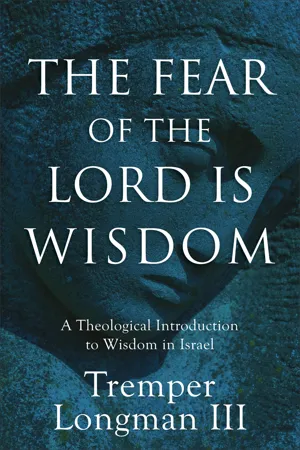
eBook - ePub
The Fear of the Lord Is Wisdom
A Theological Introduction to Wisdom in Israel
- 336 pages
- English
- ePUB (mobile friendly)
- Available on iOS & Android
eBook - ePub
About this book
Information
Part 1
The Heart of Wisdom
PROVERBS, ECCLESIASTES, AND JOB
The title of this book, The Fear of the Lord Is Wisdom: A Theological Introduction to Wisdom in Israel, announces that it is a study of wisdom. But what exactly is wisdom in the OT? Since at least the mid-nineteenth century and the work of Johann Bruch, scholars have spoken of “wisdom literature”; wisdom as a genre of literature distinct from, say, the Historical Books and the Prophets and Law.1 Granted, the health of wisdom as a genre has waxed and waned from its nineteenth-century origins until the present moment, but even today most scholars would affirm that Proverbs, Job, and Ecclesiastes form the core of wisdom literature. Some scholars of the genre would add other texts, including a number of wisdom psalms and the Song of Songs. Others would go further and place the Joseph narrative, Esther, Daniel, and certain other historical narratives and even prophets in this literary category.
In recent days, however, the idea of a wisdom genre has come under serious question. Will Kynes presents the most persuasive case that wisdom should not be considered a genre. He rightly indicates that there is no evidence that the so-called wisdom books were considered a genre in antiquity or even really until the mid-nineteenth century and Bruch’s work. That said, he also recognizes that this is not a sufficient argument against the idea of a genre of wisdom literature, since as a single argument it commits the so-called genetic fallacy, which argues that “an idea’s origin can either confirm or contradict is truth.”2 In other words, emic (native) categories are not the only valid ones. Etic (outsider) categories, those formulated by modern scholars, have their utility, as in the use of modern grammatical categories in the description and teaching of ancient languages.3
Kynes furthers his argument by pointing out that even the core books (Proverbs, Job, Ecclesiastes) are not easily distinguished generically from the other books of the OT. For instance, he questions the very existence of ideas commonly associated with wisdom as modern constructs imposed on the literature, or at least their distinctive use within a supposed wisdom literature (he names, for instance, creation theology, universalism, empiricism, retribution, and secularism).
He has also noticed that there has been a gradual but persistent expansion of wisdom literature in scholarship. As noted in the second paragraph of this section above, some scholars would include broad swaths of the OT under the rubric wisdom. He sees here an analogy to how scholarship saw the influence of Deuteronomic theology where Samuel–Kings, if not Joshua through Kings, Jeremiah, and other prophets were labeled Deuteronomistic. He then asserts, in the case of wisdom, that if everything is wisdom (a bit of an overstatement), then nothing is wisdom.
Kynes and others thus present questions that a book like mine purporting to describe wisdom cannot ignore. Is wisdom really dead? Is there no wisdom literature? Is there no distinctive wisdom movement? Are there no wisdom teachers or sages to be distinguished from priests or prophets or kings? These are questions we will take up in the following chapters.
But where to begin? Though wisdom as a distinct literary category, movement, or professional status can be challenged, perhaps successfully (as we will see), there is no denying that the concept of wisdom makes its presence known in the OT. Wisdom is the English translation of ḥokmâ, and a person who is characterized by wisdom is called a ḥākām.4
Accordingly, perhaps it is best to understand this book not primarily as a description of a literary genre but rather as an exploration of the concept of wisdom. Kynes himself will agree with us on this level since he states that his approach “would treat wisdom (now with a lower case w) as a concept similar to holiness or righteousness instead of a genre.”5
So we will leave open the question of whether wisdom is a genre and embark on a study of the concept of wisdom (for more on wisdom as a genre, see appendix 2). But how should we organize our exploration? Where do we start and how do we progress?
One approach could be diachronic, starting with the earliest texts that speak of ḥokmâ and moving on from there until the latest texts. That would be a legitimate, but also a highly speculative, approach, speculative because the dating of texts is both highly complex and extremely controversial.
I have thus decided to approach the question synchronically. This does not mean that I will avoid all questions of when texts were likely or probably composed, but my description of wisdom will not depend on their dating, at least in major points.
I will start then with those texts that speak of ḥokmâ most pervasively. While this does not presume that they compose a genre, this does lead us to start with the three books that are, as we have noted above, considered the core of a supposed wisdom genre.
The first question we are going to ask is, what is the nature of wisdom? We start with Proverbs, which announces in its preamble (1:1–7) that it intends to make its readers wise.
1. Bruch, Weisheits-Lehre der Hebräer.
2. Kynes, Obituary.
3. A point I made as early as 1987 (Longman, Literary Approaches) in a book that was reprinted in 1996 with other books from the series in a combined volume titled Foundations of Contemporary Interpretation (see esp. 127–28).
4. The question of whether ḥākām is used as a professional category will be addressed in chap. 12.
5. Kynes, Obituary.
1
Proverbs
The Fear of the Lord Is the Beginning of Wisdom
The book of Proverbs is a book of instruction and, like its ancient Egyptian counterparts (see chap. 9 below), begins with a preface, which states the purpose of the following chapters in terms of their intended effect upon readers:
The proverbs of Solomon, the son of David, king of Israel—
to know wisdom and discipline;
to understand insightful sayings;
to receive the teaching of insight,
righteousness, justice, and virtue;
to give to the simple prudence,
to the young knowledge and discretion.
Let the wise hear and increase teaching;
let those with understanding acquire guidance,
so they may understand a proverb and a difficult saying,
the words of the wise and their enigmas.
The fear of Yahweh is the beginning of knowledge,
but fools despise wisdom and discipline. (1:1–7)1
The lengthy purpose statement of the preface begins “to know wisdom.” The Hebrew word commonly translated “wisdom” is ḥokmâ. Ḥokmâ is the word used most frequently in Proverbs to denote the hoped-for consequence of reading the book of Proverbs, though there are many other closely related words found in the preface as well as throughout the book, words like “discipline” (mûsār), “understanding” (bînâ), “insight” (haśkēl), “prudence” (ʿormâ), “discretion” (məzimmâ), and others. Truth be told, we struggle to find the exact nuance of these words (thus the variation among translations),2 but they all seem to be aspects of the broader concept of wisdom, and thus our focus will be an overarching understanding of wisdom in the book of Proverbs.
What Is Wisdom according to the Book of Proverbs?
We have to look not only at the preface but also the contents of the teaching of Proverbs in order to discover the meaning of wisdom. As we do so, we will see that wisdom is not a simple concept. Our description of wisdom in Proverbs will unfold on three levels: practical, ethical, and theological. While we will present wisdom separately as practical, then ethical, and finally theological, we should state right at the beginning that in Proverbs the three are deeply intertwined. No one can be truly wise unless one is wise practically, ethically, and theologically.
The Skill of Living: The Practical Level
When people think of the book of Proverbs today, they often think of it as a repository of advice about how to navigate life. Proverbs is a book that gives nitty-gritty instructions about how to avoid pitfalls and maximize success understood as having and maintaining robust relationships with others, maintaining personal health, and working in a way that will ensure a life-sustaining income (if not riches).
While we will see that certain excessive expectations of wisdom along these lines are wrong-minded (see chap. 11), it would be an error to deny that the teaching of Proverbs intends to impart advice that indeed has such purposes. Consider the following examples:
A slack palm makes poverty;
a determined hand makes rich. (10:4)
Here the wisdom instructor commends industriousness as the route to material success, while warning against laziness, which will lead to disaster.
A winking eye brings troub...
Table of contents
- Cover
- Title Page
- Copyright Page
- Dedication
- Contents
- Acknowledgments
- Abbreviations
- Prologue
- Part 1: The Heart of Wisdom
- Part 2: Wisdom Elsewhere in the Old Testament
- Part 3: Israel’s Wisdom
- Part 4: Further Refining Our Understanding of Wisdom
- Part 5: The Afterlife of Israel’s Wisdom
- Appendix 1: Wisdom in the Twenty-First Century
- Appendix 2: Is Wisdom Literature a Genre?
- Bibliography
- Index of Modern Authors
- Index of Scripture and Other Ancient Writings
- Index of Subjects
- Back Cover
Trusted by 375,005 students
Access to over 1.5 million titles for a fair monthly price.
Study more efficiently using our study tools.
Frequently asked questions
Yes, you can cancel anytime from the Subscription tab in your account settings on the Perlego website. Your subscription will stay active until the end of your current billing period. Learn how to cancel your subscription
No, books cannot be downloaded as external files, such as PDFs, for use outside of Perlego. However, you can download books within the Perlego app for offline reading on mobile or tablet. Learn how to download books offline
Perlego offers two plans: Essential and Complete
- Essential is ideal for learners and professionals who enjoy exploring a wide range of subjects. Access the Essential Library with 800,000+ trusted titles and best-sellers across business, personal growth, and the humanities. Includes unlimited reading time and Standard Read Aloud voice.
- Complete: Perfect for advanced learners and researchers needing full, unrestricted access. Unlock 1.5M+ books across hundreds of subjects, including academic and specialized titles. The Complete Plan also includes advanced features like Premium Read Aloud and Research Assistant.
We are an online textbook subscription service, where you can get access to an entire online library for less than the price of a single book per month. With over 1.5 million books across 990+ topics, we’ve got you covered! Learn about our mission
Look out for the read-aloud symbol on your next book to see if you can listen to it. The read-aloud tool reads text aloud for you, highlighting the text as it is being read. You can pause it, speed it up and slow it down. Learn more about Read Aloud
Yes! You can use the Perlego app on both iOS and Android devices to read anytime, anywhere — even offline. Perfect for commutes or when you’re on the go.
Please note we cannot support devices running on iOS 13 and Android 7 or earlier. Learn more about using the app
Please note we cannot support devices running on iOS 13 and Android 7 or earlier. Learn more about using the app
Yes, you can access The Fear of the Lord Is Wisdom by Tremper Longman in PDF and/or ePUB format, as well as other popular books in Theology & Religion & Biblical Criticism & Interpretation. We have over 1.5 million books available in our catalogue for you to explore.