eBook - ePub
Information
Print ISBN
9780762787869
1
Any journey that takes us away from our familiar world, with its easy supplies of water, food, warm clothing and sources of heat, to some extent places us in the survival category.
Preparation and Equipment
People travelling by car in a country as populated as the United States have been cut off in blizzards and caught in snow drifts for hours before rescue services could reach them, and no doubt found themselves wishing they had brought more warm drinks, warm clothing, food and water.
Those who set out on long expeditions to remote mountains, deserts or across oceans will be fully aware that they are embarking on a journey of survival and will have made the necessary preparations. Even they, however, may be overconfident of their fitness and the quality of their pack, and may find themselves overstretched or caught out by the variable forces of nature.
However well equipped you may be, it is always best to be aware that chance and accident can place you in a dangerous predicament. The more aware you are of the potential hazards the better prepared you are likely to be to cope with them.
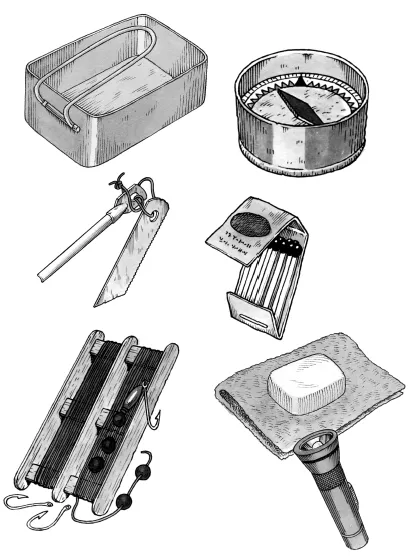
A compass, matches, torch and fishing kit are several of the many items a person should have with them in a survival situation.
One of the first rules of survival is not to take for granted the methods of transport or organisations you may be relying on. Learn to prepare and equip yourself so that you are one step ahead of the worst eventuality.
PLANNING
The adage that time spent in planning is never wasted applies as much to survival as it does to office work. Simply thinking through a journey in advance, and considering some of the options if things do not work out as scheduled, will be time well spent. You will find that if things do go wrong you will be prepared. You may be able to prevent a good deal of inconvenience, or even save the precious moments that could mean the difference between life and death for yourself and others.
If you are setting out on an expedition that will involve any measure of endurance and exposure to the elements, detailed planning will obviously be necessary. This should be geared to the particular requirements of the environment you will be in. Equipping a vehicle with the right tools, a medical pack and spare food and water is a significant step in the right direction.
EQUIPMENT
Owing to the current vogue for outdoor equipment, the greatest danger is not so much not knowing what to wear or carry but being bewildered by choice and ending up with the wrong equipment. The best approach is to ask trained staff in a specialist shop, many of whom will be outdoor enthusiasts themselves. They will help you to cut through the jungle of rival products and give you straightforward advice on what you require for your particular circumstances. For example, there is an endless range of excellent boots for sale which may leave your mind buzzing, but if you are intending to go mountain climbing the selection can be quickly narrowed down by an expert, saving you time and energy.
Real deal
One note of caution is that since the fashion industry has adopted the ‘outdoor look’, you will need to make sure that the clothing and footwear you buy is the real McCoy and not a fashionable imitation.
With regard to clothing in general, the layering system transfers sweat away from the body towards the outside. If you choose your clothing carefully, the material will not absorb the sweat and become wet, cold and uncomfortable.
TIP:
SURVIVAL GEAR
SURVIVAL GEAR
Headwear
• Hat –woolly/thermal/ waterproof/sun
• Headcover Balaclava
• Shemagh/keffiyeh/ Arab headdress
• Helmet (for climbing)
• Scarf/neck-cloth (to soak up sweat and control temperature)
Clothing
• Jacket/fleece
• Trousers/over-trousers
• Wool sweater
• Shirts
• Thermal underwear
• Gloves and/or mittens
• Socks
Footwear
• Boots – winter/hillwalking
• Sandals
• Gaiters
• Spare laces
• Spare insoles
• Crampons
• Skis
Load-carrying equipment
• Rucksack
• Daysack
• Bergen
Miscellaneous equipment
• Survival pack
• Medical pack
• Mess pack and knife/fork/spoon
• Water bottle and mug
• Survival knife (length approx. 114ins/30cm; blade approx. 7ins/18cm)
• Lockable/ retractable knife
• Tent
• Camp bed
• Sleeping bag
• Bivi bag
• Sleeping mat
• Hammock
• Mosquito net
• Parachute
• Ropes/cord
• Karabiner
• Ice axe
• Telescopic walking/snow stick
• Bungees
• Shovel/spade (foldable)
• Compass
• GPS
• Watch
• Chronograph
• Heart-rate monitor
• Torch
• Dark glasses /shades (especially for polar and desert regions)
• Monocular Binoculars
• Telescope
• Map case
• Stove
• Wash pack
Headwear
Up to 50 per cent of body heat can be lost through the head, so headwear is an important aspect of your equipment. Make sure you are equipped with at least one sturdy hat. If you are going into a cold environment you will want something along the lines of a balaclava or a hat that can be pulled down to cover the ears and neck. If it is going to be wet you will want something waterproof to supplement the hood of your jacket. In the desert it will be a good idea to follow the example of the Arabs and carry a keffiyeh, or Arab headdress, also known as a shemagh. If you cannot obtain the real thing, carry a piece of light cloth about 3ft 3ins (100cm) square that can be folded to cover the head, neck and shoulders, and wrapped round the face when necessary. These cloths can be obtained from survival shops.
Jackets
A good-quality, breathable jacket is a worthwhile investment. It will help to keep you dry and warm, not only by protecting you from rain but, if it is a breathable material such as Gore-Tex, by reducing the amount of body sweat. That will also help to reduce your water consumption, which is a priority in any climate. The jacket should have a deep hood with a wired peak, storm flaps and large adjustable pockets, to keep your hands warm.
Pullovers
A warm, dry pullover and/or fleece should be available to wear, for example, when you have stopped walking, and should be kept easily accessible in your backpack. Do not wear too much clothing when you are ex...
Table of contents
- Survival Techniques
- Table of Contents
- Introduction
- 1. Preparation and Equipment
- 2. Survival in the Desert
- 3. Survival at Sea
- 4. Survival in the Tropics
- 5. Survival in Polar Regions
- 6. Survival in Mountains
- 7. Surviving Natural Disasters
- 8. First Aid
- 9. Firemaking, Tools and Weapons
- 10. Trapping, Fishing and Plant Food
- 11. Navigating and Signalling
- 12. Rafts and River Crossings
- 13. Ropes and Knots
- 14. Urban Survival
- Index
Trusted by 375,005 students
Access to over 1.5 million titles for a fair monthly price.
Study more efficiently using our study tools.