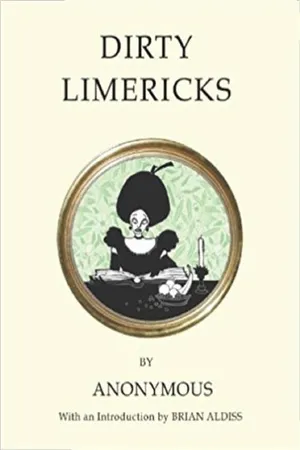
eBook - ePub
Information
Print ISBN
9781847497093
Introduction
British ballads have come and more or less gone. The mark of these common songs and rhymes is that they address someone:
You married men whom Fate has assigned
To marry with them that are too much kind.
Or they may quote a higher authority:
Says my uncle, I pray you discover
What hath been the cause of your woes.
Or they may speak out for a group:
Six jolly wee miners, an’ miner lads are we.
Mostly these humble poems express dissatisfaction with one aspect or another of life. All rather similar to the blues which superseded them. In general, they are local complaints.
The limerick, that wily serpent, is written by a different kind of person. This person has no time for jolly wee miners and country lasses, unless they can be made to form the subject of a striking moral deficiency. The limerick writer is more sophisticated, and appears to be well travelled; he knows what is painted on a shutter in Calcutta, or what punishment the Bishop of Birmingham meted out, or the complications in the life of a prostitute in Rangoon, or the uses for clay in Bombay, and so on. He is a worldly person, generally a man, whose geographical knowledge extends throughout the British Empire. Indeed, the heyday of the limerick was very likely the heyday of the Empire, only a generation or two ago.
We imagine a sturdy District Commissioner, sitting on his veranda, chota peg by his side, summing up the misfortunes of a young girl from Madras in five succinct lines. No fool he. Immorality and perversions fail to shock him. Indeed, the more surreal they are, the better. They may take place in underground aviaries, in a rather dusty cave outside Belgrave, by a punt-fraught river near Buckingham, or in a crowd at Stroud.
Our connoisseur of the curious has to master an intricate rhyme scheme: AABBA. It is not a format for weaklings.
The first limerick I was told when a juvenile may have been composed by another juvenile. I quote it merely for antiquarian purposes:
There was a young lady from Riga
Who had an affair with a tiger.
The result of the fuck
Was a paralysed duck,
Two goats and a circumcised spider.
At the age of five, when I had been so recently the product of a gynaecological event myself, this even more unlikely outcome may have seemed amusing. But the folly of the putative bard went even deeper: the rhyme scheme does not work. “Spider” does not rhyme with either “tiger” or “Riga”. The menagerie as described is impossible. Better perhaps to concentrate on the parturition which followed the affair:
Poor girl! Her long labour
Was described by a neighbour
Like Frankenstein climbing the Eiger.
While this is not particularly good, rhyme receives better consideration. The amateur rhymester did not foresee, before setting out, that the only word to rhyme with “tiger”, apart from “E...
Table of contents
- Introduction
- Editor’s Note
- Dirty Limericks
- Geographical
- I
- II
- III
- IV
- V
- VI
- VII
- VIII
- IX
- X
- XI
- XII
- XIII
- XIV
- XV
- XVI
- XVII
- XVIII
- XIX
- XX
- XXI
- XXII
- XXIII
- XXIV
- XXV
- XXVI
- XXVII
- XXVIII
- XXIX
- XXX
- XXXI
- XXXII
- XXXIII
- XXXIV
- Sexual
- I
- II
- III
- IV
- V
- VI
- VII
- VIII
- IX
- X
- XI
- XII
- XIII
- XIV
- XV
- XVI
- XVII
- XVIII
- XIX
- XX
- XXI
- XXII
- XXIII
- XXIV
- XXV
- XXVI
- XXVII
- XXVIII
- XXIX
- XXX
- XXXI
- XXXIII
- XXXIV
- XXXV
- XXXVI
- XXXVII
- XXXVIII
- Bestial
- I
- II
- III
- IV
- V
- VI
- VII
- VIII
- IX
- X
- XI
- XII
- XIII
- XIV
- XV
- XVI
- XVII
- XVIII
- XIX
- XX
- Lavatorial
- I
- II
- III
- IV
- V
- VI
- VII
- VIII
- IX
- X
- XI
- XII
- XIII
- XIV
- XV
- XVI
- XVII
- XVIII
- XIX
- XX
- Clerical and Institutional
- I
- II
- III
- IV
- V
- VI
- VII
- VIII
- IX
- X
- XI
- XII
- XIII
- XIV
- XV
- XVI
- XVII
- XVIII
- XIX
- XX
- Original
- I
- II
- III
- IV
- V
- VI
- VII
- VIII
- IX
Trusted by 375,005 students
Access to over 1.5 million titles for a fair monthly price.
Study more efficiently using our study tools.