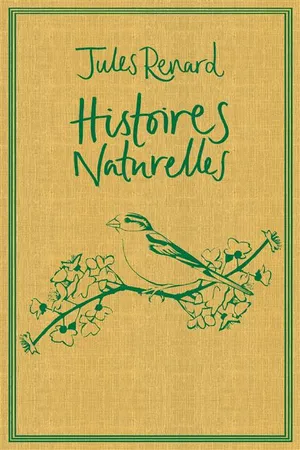
eBook - ePub
Information
Introduction
Students of French know Poil de Carotte, Renard’s autobiographical tales about the sufferings of a sensitive child who is bullied by his mother and neglected by his father; musicians and singers are familiar with five of his poems from Histoires naturelles, set to music of genius by Maurice Ravel in 1906; admirers of Julian Barnes’s recent memoir, Nothing to Be Frightened of, will be aware of Renard’s wonderfully epigrammatic Journal; and lovers of art may have encountered Histoires naturelles through the illustrations of Toulouse-Lautrec and Pierre Bonnard. For the rest, this great writer (Albert Thibaudet called Renard ‘un des plus grands écrivains de son temps’) is largely unknown in English-speaking countries.
He was born on 22nd February 1864 in Châlons-du-Maine. His father, who worked on the construction of the local railway, moved to Chitry-les-Mines in 1866, where he later became mayor. From 1875–81, Jules and his older brother attended a boarding school in Nevers. Despite failing the first part of his baccalauréat, Renard was finally accepted at the École Normale Supérieure in Paris, which he left before completing his studies.
Aged twenty-four, he begins to eke out a living as a writer; he frequents the literary cafés, writes poetry that an actress friend, Danièle Davyle, recites in the salons. A year’s military service follows in Bourges. 1886 sees the publication of a volume of poems, Les Roses, which is reviewed by Camille Delaville in La Revue verte. He starts working as a journalist for several newspapers. ‘Tout vaut mieux que de retourner à Chitry,’ he writes to his father.
He stays in Paris and supplements his meagre allowance by tutoring three children and working as a secretary for their father. In 1888 he marries the seventeen-year-old Marie Morneau. The substantial dowry enables him to publish a volume of short stories, Crime de village, dedicated to his father. His first child is born in February 1889. At the end of the year he founds, with other young writers, the Mercure de France, a paper for which he writes regular articles over the next few years. In 1890 Lemerre publishes Sourires pincés, a volume containing nine of the tales that will eventually appear in Poil de Carotte. He immerses himself in Paris, frequents the theatre, pays regular visits to Alphonse Daudet and establishes contact with writers such as Marcel Schwob and André Gide, who later declares that he reads Renard ‘comme un classique’. His first major prose work, L’Écornifleur, appears in 1892 to critical acclaim. Coquecigrues and La Lanterne sourde are published in 1893, Le Vigneron dans sa vigne and Poil de Carotte in 1894. He makes the acquaintance of several artists, including Steinlen, Vallotton and Toulouse-Lautrec, all of whom will illustrate his work. His fame gradually spreads.
‘Le Chasseur d’images’, the first piece of the Histoires naturelles, is published in 1895 in La Nouvelle Revue. Renard widens his circle of friends and meets Edmond Rostand, who introduces him to Sarah Bernhardt. He attends the funeral of Paul Verlaine in 1896, a year which sees the first edition of Histoires naturelles, which contains forty-five texts. He rents an old vicarage at Chaumot, near Chitry, and calls it ‘La Gloriette’, which is also his pet name for Marie, and from now on spends his holidays there – the surrounding countryside will inspire many of the pages of the Histoires naturelles. He hires two servants to look after his property in the country: Simon Chalumeau (Philippe from ‘La Mort de Brunette’ and ‘Le lièvre’ in Histoires naturelles, the factotum who features in much of Renard’s work, correspondence and the Journal); and his wife – the ‘Ragotte’ in his stories, to whom he devotes an entire chapter (‘Ragotte’) in Nos Frères farouches (1909). His one-act comedy, Le Plaisir de rompre, is premiered in March 1897 and dedicated to Edmond Rostand, whose own Cyrano will enjoy a box-office success later in the year. Renard’s elation is tempered by the suicide of his father who, suffering from a serious disease, shoots himself in the heart. Another one-act play, Le Pain de ménage, is given its first performance in 1898.
Despite his increasing fame in Paris, Renard spends more and more time in the country with his family at ‘La Gloriette’, where he finishes ...
Table of contents
- Introduction
Trusted by 375,005 students
Access to over 1.5 million titles for a fair monthly price.
Study more efficiently using our study tools.
Frequently asked questions
Yes, you can cancel anytime from the Subscription tab in your account settings on the Perlego website. Your subscription will stay active until the end of your current billing period. Learn how to cancel your subscription
No, books cannot be downloaded as external files, such as PDFs, for use outside of Perlego. However, you can download books within the Perlego app for offline reading on mobile or tablet. Learn how to download books offline
Perlego offers two plans: Essential and Complete
- Essential is ideal for learners and professionals who enjoy exploring a wide range of subjects. Access the Essential Library with 800,000+ trusted titles and best-sellers across business, personal growth, and the humanities. Includes unlimited reading time and Standard Read Aloud voice.
- Complete: Perfect for advanced learners and researchers needing full, unrestricted access. Unlock 1.5M+ books across hundreds of subjects, including academic and specialized titles. The Complete Plan also includes advanced features like Premium Read Aloud and Research Assistant.
We are an online textbook subscription service, where you can get access to an entire online library for less than the price of a single book per month. With over 1.5 million books across 990+ topics, we’ve got you covered! Learn about our mission
Look out for the read-aloud symbol on your next book to see if you can listen to it. The read-aloud tool reads text aloud for you, highlighting the text as it is being read. You can pause it, speed it up and slow it down. Learn more about Read Aloud
Yes! You can use the Perlego app on both iOS and Android devices to read anytime, anywhere — even offline. Perfect for commutes or when you’re on the go.
Please note we cannot support devices running on iOS 13 and Android 7 or earlier. Learn more about using the app
Please note we cannot support devices running on iOS 13 and Android 7 or earlier. Learn more about using the app
Yes, you can access Histoires Naturelles by in PDF and/or ePUB format, as well as other popular books in Literature & Classics. We have over 1.5 million books available in our catalogue for you to explore.