
eBook - ePub
Information
Jealousy
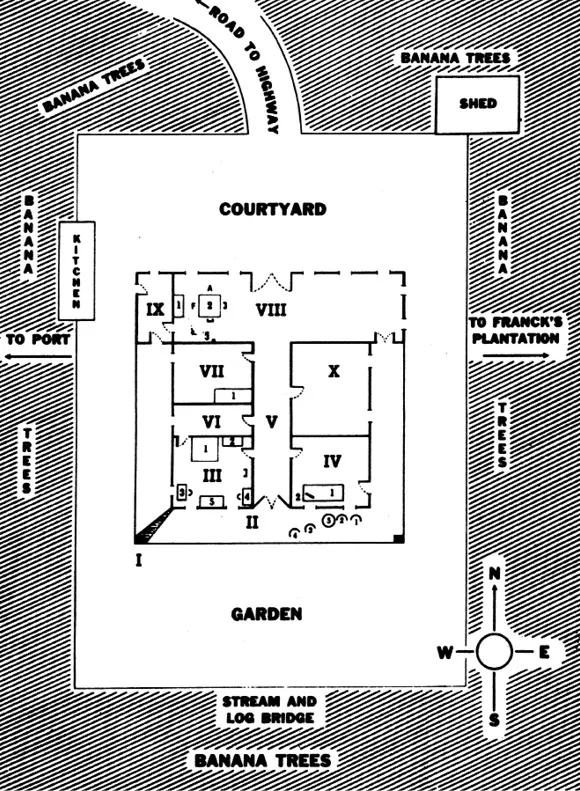
I. South-west pillar and its shadow at the beginning of the novel
II. Veranda: 1) Franck’s chair; 2) A…’s chair; 3) Empty chair; 4) Husband’s chair; 5) Coffee table
III. A…’s room: 1) Bed; 2) Chest; 3) Dressing table; 4) Writing table;
5) Wardrobe
IV. Office: 1) Desk; 2) Photo of A…
V. Hallway
VI. Bathroom
VII. Small bedroom: 1) Bed
VIII. Living room /dining room:
1) Buffet; 2) Table; 3) Centipede mark on wall
IX. Pantry
X. Storage room or other (not described)
Now the shadow of the column – the column which supports the south-west corner of the roof – divides the corresponding corner of the veranda into two equal parts. This veranda is a wide, covered gallery surrounding the house on three sides. Since its width is the same for the central portion as for the sides, the line of shadow cast by the column extends precisely to the corner of the house – but it stops there, for only the veranda flagstones are reached by the sun, which is still too high in the sky. The wooden walls of the house – that is, its front and west gable end – are still protected from the sun by the roof (common to the house proper and the terrace). So at this moment the shadow of the outer edge of the roof coincides exactly with the right angle formed by the terrace and the two vertical surfaces of the corner of the house.
Now A… has come into the bedroom by the inside door opening onto the central hallway. She does not look at the wide-open window through which – from the door – she would see this corner of the terrace. Now she has turned back towards the door to close it behind her. She still has on the light-coloured, close-fitting dress with the high collar that she was wearing at lunch when Christiane reminded her again that loose-fitting clothes make the heat easier to bear. But A… merely smiled: she never suffered from the heat, she had known much worse climates than this – in Africa, for instance – and had always felt fine there. Besides, she doesn’t feel the cold either. Wherever she is, she keeps quite comfortable. The black curls of her hair shift with a supple movement and brush her shoulders as she turns her head.
The heavy handrail of the balustrade has almost no paint left on top. The grey of the wood shows through, streaked with longitudinal cracks. On the other side of this rail, a good six feet below the level of the veranda, the garden begins.
But from the far side of the bedroom the eye carries over the balustrade and only touches ground much farther away, on the opposite slope of the little valley, among the banana trees of the plantation. The sun cannot be seen between their thick clusters of wide green leaves. However, since this sector has been under cultivation only recently, the regular criss-crossing of the rows of trees can still be clearly followed. The same is true of almost all the property visible from here, for the older sectors – where confusion has gained the ascendancy – are located higher up on this side of the valley – that is, on the other side of the house.
It is on the other side, too, that the highway passes, just below the edge of the plateau. This highway, the only road that gives access to the property, marks its northern border. A dirt road leads from the highway to the sheds and, lower still, to the house, in front of which a large cleared area with a very slight slope permits cars to be turned around.
The house is built on a level with this courtyard, from which it is separated by no veranda or gallery. On the three other sides, however, it is enclosed by the veranda.
The slope of the terrain, more pronounced from the start of the courtyard, causes the central portion of the veranda (which runs along the front of the house on the south) to stand at least six feet above the garden.
On all sides of the garden, as far as the borders of the plantation, stretches the green mass of the banana trees.
On the right and the left, their proximity is too great, combined with the veranda’s relative lack of elevation, to permit an observer stationed there to distinguish the arrangement of the trees – while farther down the valley, a quincunx shape be made out at first glance. In certain very recently replanted sectors – those where the reddish earth is just beginning to yield supremacy to foliage – it is easy enough to follow the regular perspective of the four intersecting lanes along which the young trunks are aligned.
This exercise is not much more difficult, despite their more advanced growth, for those sectors of the plantations on the opposite hillside: this, in fact, is the place which offers itself most readily to inspection, the place over which surveillance can be maintained with the least difficulty (although the path to reach it is a long one), the place which the eye falls on quite naturally of its own accord when looking out of one or the other of the two open windows of the bedroom.
Her back to the hall door she has just closed, A… absently stares at the paint-flaked wood of the balustrade and, nearer her, the paint-flaked window frame, then, nearer still, the scrubbed wood of the door.
She takes a few steps into the room, goes over to the heavy chest and opens its top drawer. She shifts the papers in the right-hand side of the drawer, leans over and, in order to see the rear of the drawer better, pulls it a little farther out of the chest. After looking a little longer, she straightens up and remains motionless, elbows close to her body, forearms bent and hidden by the upper part of her body – probably holding a sheet of paper between her hands.
She turns towards the light now in order to continue reading without straining her eyes. Her inclined profile does not move any more. The paper is pale-blue, the size of ordinary letter paper, and shows the creases where it had been folded into quarters.
Then, holding the letter in one hand, A… closes the drawer, moves towards the little work table (near the second window, against the partition separating the bedroom from the hallway) and sits down in front of the writing case, from which she removes a sheet of pale-blue paper – similar to the first, but blank. She unscrews the cap of her pen, then, after a glance to the right (which does not include even the middle of the window frame behind her), bends her head towards the writing case in order to begin writing.
The lustrous black hair falls in motionless curls along the line of her back, which the narrow metal fastening of her dress indicates a little lower down.
Now the shadow of the column – the column which supports the south-west corner of the roof – lengthens across the flagstones of the central part of the veranda, in front of the house where the chairs have been set out for the evening. Already the tip of the line of shadow almost touches the doorway that marks the centre of the façade. Against the west gable end of the house, the sun falls on the wood about a yard and a half above the flagstone. Through the third window, which looks out on this side, it would reach far into the bedroom if the blinds had not been lowered.
The pantry is at the other end of this west wing of the veranda. Through its half-op...
Table of contents
- Jealousy
- Introduction
- Jealousy
- calder publications
Trusted by 375,005 students
Access to over 1.5 million titles for a fair monthly price.
Study more efficiently using our study tools.
Frequently asked questions
Yes, you can cancel anytime from the Subscription tab in your account settings on the Perlego website. Your subscription will stay active until the end of your current billing period. Learn how to cancel your subscription
No, books cannot be downloaded as external files, such as PDFs, for use outside of Perlego. However, you can download books within the Perlego app for offline reading on mobile or tablet. Learn how to download books offline
Perlego offers two plans: Essential and Complete
- Essential is ideal for learners and professionals who enjoy exploring a wide range of subjects. Access the Essential Library with 800,000+ trusted titles and best-sellers across business, personal growth, and the humanities. Includes unlimited reading time and Standard Read Aloud voice.
- Complete: Perfect for advanced learners and researchers needing full, unrestricted access. Unlock 1.5M+ books across hundreds of subjects, including academic and specialized titles. The Complete Plan also includes advanced features like Premium Read Aloud and Research Assistant.
We are an online textbook subscription service, where you can get access to an entire online library for less than the price of a single book per month. With over 1.5 million books across 990+ topics, we’ve got you covered! Learn about our mission
Look out for the read-aloud symbol on your next book to see if you can listen to it. The read-aloud tool reads text aloud for you, highlighting the text as it is being read. You can pause it, speed it up and slow it down. Learn more about Read Aloud
Yes! You can use the Perlego app on both iOS and Android devices to read anytime, anywhere — even offline. Perfect for commutes or when you’re on the go.
Please note we cannot support devices running on iOS 13 and Android 7 or earlier. Learn more about using the app
Please note we cannot support devices running on iOS 13 and Android 7 or earlier. Learn more about using the app
Yes, you can access Jealousy by in PDF and/or ePUB format, as well as other popular books in Literature & Classics. We have over 1.5 million books available in our catalogue for you to explore.