eBook - ePub
Information
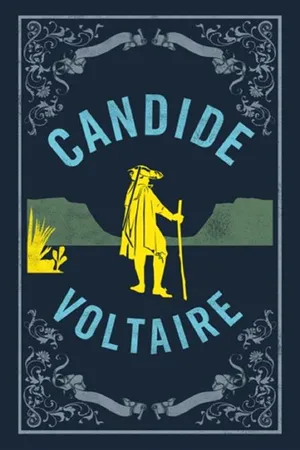
Candide
or Optimism
or Optimism
Translated from the German by Dr Ralph, with additional notes found in the Doctor’s pocket when he died in Minden in the Year of Our Lord 1759.
Chapter 1
How Candide was raised in a beautiful castle,
and how he was thrown out of there.
In Westphalia, in the castle of Baron Thunder-ten-Tronkh, there lived a young man to whom Nature had given the sweetest of dispositions. His face was an open book. He was relatively sound of mind but very simple of spirit. That is, I think, the reason why he was called Candide. The older servants of the house suspected that he was the son of the Baron’s sister and a good and honest local gentleman, whom the young lady in question had never wanted to marry, because he could only prove to have seventy-one noble forebears, the rest of his genealogical tree having been destroyed by the ravages of time.
The Baron was one of the most powerful lords in Westphalia, for his castle had a door and windows. He even had a tapestry decorating his main hall. The dogs in his yard could, in case of need, double up as a pack of hounds. His stable boys were his huntsmen, the local vicar his court chaplain. They all called him milord and laughed at his jokes.
Madame the Baroness weighed about twenty-five stone and was for that reason much esteemed. And the dignity with which she did the honours gained her even more respect. Her seventeen-year-old daughter Cunégonde was a healthy-looking, plump and attractive little thing with rosy cheeks. The Baron’s son took after his father in all respects. The tutor Pangloss* was the house oracle, and the young Candide listened to his lessons with all the earnestness of his tender years and character.
Pangloss taught metaphysico-theologo-cosmolonigology. He proved admirably that there was no effect without a cause and that in the best of all possible worlds the castle of the Baron was the most beautiful of all castles, and the Baroness the best of all possible baronesses.
“It has been proved,” he said, “that things could not be otherwise. Given that all things have been made to a certain end, they have necessarily been made to the best end. Just look: noses are made to wear spectacles, and so we wear spectacles. Our feet are clearly shaped to wear shoes, and so we wear shoes. Rocks are formed so they can be cut to build castles, which is why the Baron has a beautiful castle – the greatest baron of the province must needs have the best home. And since pigs are made to be eaten, we eat pork throughout the year. As a result, those who have suggested that everything is good are talking nonsense. One should say instead that everything is the best it could be.”
Candide listened attentively and believed innocently, for he thought Miss Cunégonde was extremely beautiful, even if he never plucked up the courage to tell her. He concluded that, after the good fortune of being born the Baron of Thunder-ten-Tronck, the next level of bliss was to be Miss Cunégonde, the third to see her every day and the fourth to listen to Master Pangloss, the greatest philosopher of the province and hence of the earth.
One day Cunégonde went for a walk near the castle in a little wood they called “park”. In the bushes she saw Doctor Pangloss giving a lesson in experimental physics to one of her mother’s chambermaids, a very pretty and eager little brunette. Since Miss Cunégonde had a great gift for sciences, she observed with bated breath the repeated experimentation she witnessed. She clearly saw the Doctor’s sufficient reason,* and the effects and causes. She left in a state of excitement, deep in thought and filled with a burning desire to become a scientist too, thinking she might be young Candide’s sufficient reason and he hers.
She bumped into Candide on her way back to the castle. She blushed; Candide blushed too. She greeted him with a choked voice, and Candide spoke to her without knowing what he said. The next day after dinner, as everyone was leaving the table, Cunégonde and Candide found themselves behind a screen. Cunégonde dropped her handkerchief; Candide picked it up. She innocently took his hand. The young man innocently kissed the young lady’s hand with an ardour, sensitivity and grace that were something else. Their lips met; their eyes caught fire; their knees trembled; their hands wandered. Baron Thunder-ten-Tronck happened to walk past the screen, and when he saw that cause and that effect, he threw Candide out of his castle with firm kicks up his behind. Cunégonde fainted. No sooner had she come to than the Baroness slapped her. And there was much commotion in the most beautiful and the most pleasant of all possible castles.
Chapter 2
What became of Candide among the Bulgars.*
Expelled from his earthly paradise, Candide walked for a long time without knowing where he was going. He wept, turning his eyes heavenwards, and often looked back at the most beautiful of all castles where the most beautiful of all young baronesses lived. He fell asleep in between two furrows in the middle of a field without having eaten. It began to snow heavily. The next day, rigid with cold, Candide dragged himself to the nearest village, which was called Valdberghoff-trarbk-dikdorff. He was penniless, starving and exhausted. In this sad state, he halted at the door of an inn. Two men dressed in blue spotted him: “Look, comrade,” said one of them, “now there’s a sturdy young man, and of the right height too.” They walked over to Candide and very politely invited him to have dinner with them.
“I feel honoured, gentlemen,” replied Candide with charming modesty, “but I cannot afford to pay my share.”
“Never mind that,” said one of the men in blue. “People of your stature and merit don’t have to pay a thing. You are five foot five, aren’t you?”
“Yes, sir, that’s my height,” he responded with a bow.
“Sir, please, join us at our table. Not only will we pay for your meal, but we’ll make sure that a man like you will never lack money. We men ought to look after each other.”
“You’re right,” said Candide. “That’s what Master Pangloss always used to say. I can see that it’s all turning out for the best.”
The men insisted on giving him a few crowns. He accepted and wanted to write out an IOU. The men refused and they sat down at their table: “Don’t you feel a deep love for—”
“Oh, yes!” he replied. “I feel a very deep love for Cunégonde.”
“That’s not what I meant,” said one of the men. “We want to know if you feel a deep love for the King of the Bulgars.”
“Not in the least,” he responded, “since I’ve never laid eyes on him.”
“What? He’s the most charming king you’ll ever meet, and we must drink to his health.”
“With pleasure, gentlemen,” he said and took a sip.
“Enough of that,” the men told him. “We hereby declare you the stalwart protector, defender and hero of the Bulgars. Your fortune is made and your glory assured.”
There and then they put chains on his feet and took him to their regiment. They made him turn right and left, lift the ramrod, put it back, take aim, shoot and march at the double. And they gave him thirty strokes of the cane. The next day, he did slightly less badly at the drills, and he only received twenty. The day after that, he only got ten, and his comrades considered him a genius.
Candide was baffled and did not quite understand how all this made him a hero. One fine spring morning, he decided to go for a walk. In the belief that it was the prerogative of the human species, as well as of animals, to use their legs as they see fit, he walked straight ahead. He had not covered five miles before four other heroes, six feet tall, caught up with him, clapped him in irons and threw him in a dungeon. They asked him the judicial question of whether he preferred to receive thirty-six strokes of the cane from the entire regiment or have his head filled with twelve lead bullets all at once. In vain he protested that man has free will and that he wanted neither one nor the other: he had to make a choice. He chose to exercise God’s gift known as “freedom” and opted to run the gauntlet thirty-six times. He got no further than two. The regiment consisted of two thousand men. That added up to four thousand ...
Table of contents
- Candide or Optimism
Trusted by 375,005 students
Access to over 1.5 million titles for a fair monthly price.
Study more efficiently using our study tools.
Frequently asked questions
Yes, you can cancel anytime from the Subscription tab in your account settings on the Perlego website. Your subscription will stay active until the end of your current billing period. Learn how to cancel your subscription
No, books cannot be downloaded as external files, such as PDFs, for use outside of Perlego. However, you can download books within the Perlego app for offline reading on mobile or tablet. Learn how to download books offline
Perlego offers two plans: Essential and Complete
- Essential is ideal for learners and professionals who enjoy exploring a wide range of subjects. Access the Essential Library with 800,000+ trusted titles and best-sellers across business, personal growth, and the humanities. Includes unlimited reading time and Standard Read Aloud voice.
- Complete: Perfect for advanced learners and researchers needing full, unrestricted access. Unlock 1.5M+ books across hundreds of subjects, including academic and specialized titles. The Complete Plan also includes advanced features like Premium Read Aloud and Research Assistant.
We are an online textbook subscription service, where you can get access to an entire online library for less than the price of a single book per month. With over 1.5 million books across 990+ topics, we’ve got you covered! Learn about our mission
Look out for the read-aloud symbol on your next book to see if you can listen to it. The read-aloud tool reads text aloud for you, highlighting the text as it is being read. You can pause it, speed it up and slow it down. Learn more about Read Aloud
Yes! You can use the Perlego app on both iOS and Android devices to read anytime, anywhere — even offline. Perfect for commutes or when you’re on the go.
Please note we cannot support devices running on iOS 13 and Android 7 or earlier. Learn more about using the app
Please note we cannot support devices running on iOS 13 and Android 7 or earlier. Learn more about using the app
Yes, you can access Candide by in PDF and/or ePUB format, as well as other popular books in Literature & Classics. We have over 1.5 million books available in our catalogue for you to explore.