eBook - ePub
Information
Topic
LiteraturSubtopic
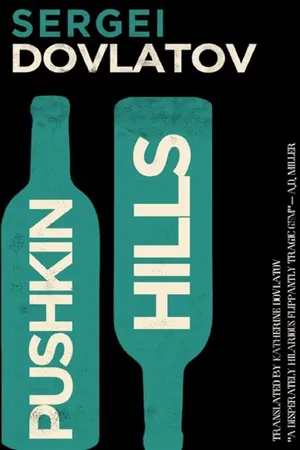
Literatur AllgemeinPushkin Hills
Notes
p. 7, Gordin, Shchegolev, Tsyavlovskaya… Kern’s memoirs: Arkady Gordin (1913–97) was a Pushkin expert who wrote a number of books on Pushkin in Mikhailovskoye, where the Pushkin Preserve is now located. Pavel Shchegolev (1877–1931) and Tatyana Tsyavlovskaya (1897–1978) were also noted Pushkin specialists. Anna Kern (1800–79) was briefly Pushkin’s lover. The two met in nearby Trigorskoye in 1825.
p. 8, Alexei Vulf’s Diaries: Alexei Nikolayevich Vulf (1805–81) was a bon vivant and close friend of Pushkin.
p. 8, Ryleyev’s mother: Kondraty Ryleyev (1795–1826) was a leader in the Decembrist Revolt of 1825, which sought to overthrow the Tsar, and a publisher of Pushkin’s work.
p. 12, Hannibal… Zakomelsky: Ibrahim Hannibal (1696–1781) was Pushkin’s great-grandfather, an African (probably from modern-day Eritrea) who was kidnapped as a child and given as a gift to the Russian tsar, later becoming a high-ranking favourite of Peter the Great. Pushkin wrote an unfinished novel, The Negro of Peter the Great, on the subject of Hannibal. There is a famous painting that was traditionally thought to depict Hannibal, though some scholars have argued that the medal depicted in the painting was an order not created until after Hannibal’s death. Baron Ivan Mellor–Zakomelsky (1725–90), the putative subject of the painting, was a high-ranking general who served in the Second Russo-Turkish War.
p. 13, The Bronze Horseman: Pushkin’s 1833 narrative poem which takes its title from a statue of Peter the Great in St Petersburg.
p. 15, Likhonosov: Viktor Likhonosov (1936–) was closely associated with the “Village Prose” literary movement of the Sixties that focused on rural life in the Soviet Union and often presented a nostalgic or idealized view of Russia.
p. 16, Mandelstam: Osip Mandelstam (1891–1938), Russian poet and essayist.
p. 17, the writer Volin’s work: Probably Vladimir Volin (1924–98), writer and journalist who worked for a variety of Soviet magazines and journals.
p. 18, Gleb Romanov… in Bucharest: Gleb Romanov (1920–67) was a popular actor and performer. Ruzhena Sikora (1918–2006) was a well-known Soviet singer of Czech origin. “This song for two soldi” is a line from the song ‘Una canzone da due soldi’ by the Italian singer Achille Togliani (1924–95). ‘I Daydreamt of You in Bucharest’ was a Russian song from the Fifties performed by Sidi Tal (1912–83), a Jewish singer popular in the Soviet Union.
p. 20, The sacred path will not be overgrown: A deliberate distortion of Pushkin’s famous poem ‘Exegi monumentum’: “the people’s path will not be overgrown”. Dovlatov famously attempted never to have two words in one sentence begin with the same letter – Pushkin’s text “ne zarastyot narodnaya tropa” has two Ns.
p. 23, Agdam: An Azeri fortified white wine.
p. 26, the Order of the Red Star: A decoration given for exceptional military bravery, or for long service in the armed forces.
p. 27, Gagarin: Yuri Gagarin (1934–68), Soviet cosmonaut and the first human to travel into outer space.
p. 29, The Decembrist uprising: The failed attempt to overthrow the Tsar in 1825, directly supported by many of Pushkin’s close friends.
p. 29, Benois: Alexandre Benois (1870–1960) was a Russian artist who worked extensively with the Ballets Russes and Sergei Diaghilev.
p. 31, Yesenin… Pasternak: Sergei Yesenin (1895–1925), a Russian lyrical poet who committed suicide at the age of thirty. His works were widely celebrated, but many were banned by the authorities. The poet and novelist Boris Pasternak (1890–1960) suffered enormously at the hands of the authorities, especially after being awarded the Nobel Prize for Literature in 1958 for the novel Doctor Zhivago, which was banned in the Soviet Union.
p. 31, Solzhenitsyn’s: Alexander Solzhenitsyn (1914–2008), dissident writer and activist.
p. 32, the famous drawing by Bruni: In 1837, Fyodor Bruni (1799–1875) sketched Pushkin on his deathbed.
p. 32, the secret removal and funeral… Alexander Turgenev: Alexander Turgenev (1784–1846), a close friend of Pushkin’s, transported the poet’s body to the family vault in Svyatogorsky Monastery, near Mikhailovskoye.
p. 33, Kramskoy’s Portrait of a Woman on the wall: Ivan Kramskoy (1837–87), Russian ...
Table of contents
- Pushkin Hills
Trusted by 375,005 students
Access to over 1.5 million titles for a fair monthly price.
Study more efficiently using our study tools.
Frequently asked questions
Yes, you can cancel anytime from the Subscription tab in your account settings on the Perlego website. Your subscription will stay active until the end of your current billing period. Learn how to cancel your subscription
No, books cannot be downloaded as external files, such as PDFs, for use outside of Perlego. However, you can download books within the Perlego app for offline reading on mobile or tablet. Learn how to download books offline
Perlego offers two plans: Essential and Complete
- Essential is ideal for learners and professionals who enjoy exploring a wide range of subjects. Access the Essential Library with 800,000+ trusted titles and best-sellers across business, personal growth, and the humanities. Includes unlimited reading time and Standard Read Aloud voice.
- Complete: Perfect for advanced learners and researchers needing full, unrestricted access. Unlock 1.5M+ books across hundreds of subjects, including academic and specialized titles. The Complete Plan also includes advanced features like Premium Read Aloud and Research Assistant.
We are an online textbook subscription service, where you can get access to an entire online library for less than the price of a single book per month. With over 1.5 million books across 990+ topics, we’ve got you covered! Learn about our mission
Look out for the read-aloud symbol on your next book to see if you can listen to it. The read-aloud tool reads text aloud for you, highlighting the text as it is being read. You can pause it, speed it up and slow it down. Learn more about Read Aloud
Yes! You can use the Perlego app on both iOS and Android devices to read anytime, anywhere — even offline. Perfect for commutes or when you’re on the go.
Please note we cannot support devices running on iOS 13 and Android 7 or earlier. Learn more about using the app
Please note we cannot support devices running on iOS 13 and Android 7 or earlier. Learn more about using the app
Yes, you can access Pushkin Hills by in PDF and/or ePUB format, as well as other popular books in Literatur & Literatur Allgemein. We have over 1.5 million books available in our catalogue for you to explore.