- 300 pages
- English
- ePUB (mobile friendly)
- Available on iOS & Android
eBook - ePub
Information
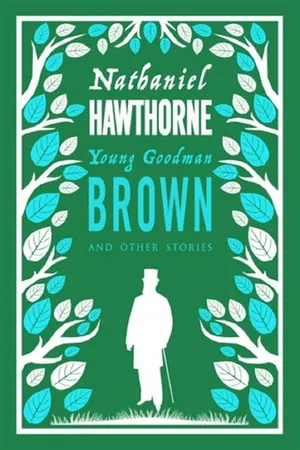
Young Goodman Brown
and Other Stories
and Other Stories
The Gentle Boy
In the course of the year 1656, several of the people called Quakers, led, as they professed, by the inward movement of the spirit, made their appearance in New England. Their reputation, as holders of mystic and pernicious principles, having spread before them, the Puritans early endeavoured to banish, and to prevent the further intrusion of the rising sect. But the measures by which it was intended to purge the land of heresy, though more than sufficiently vigorous, were entirely unsuccessful. The Quakers, esteeming persecution as a divine call to the post of danger, laid claim to a holy courage, unknown to the Puritans themselves, who had shunned the cross, by providing for the peaceable exercise of their religion in a distant wilderness. Though it was the singular fact that every nation of the earth rejected the wandering enthusiasts who practised peace towards all men, the place of greatest uneasiness and peril, and therefore in their eyes the most eligible, was the province of Massachusetts Bay. The fines, imprisonments and stripes, liberally distributed by our pious forefathers, the popular antipathy, so strong that it endured nearly a hundred years after actual persecution had ceased, were attractions as powerful for the Quakers, as peace, honour and reward would have been for the worldly-minded. Every European vessel brought new cargoes of the sect, eager to testify against the oppression which they hoped to share; and, when shipmasters were restrained by heavy fines from affording them passage, they made long and circuitous journeys through the Indian country and appeared in the province as if conveyed by a supernatural power. Their enthusiasm, heightened almost to madness by the treatment which they received, produced actions contrary to the rules of decency, as well as of rational religion, and presented a singular contrast to the calm and staid deportment of their sectual successors of the present day. The command of the spirit, inaudible except to the soul, and not to be controverted on grounds of human wisdom, was made a plea for most indecorous exhibitions, which, abstractly considered, well deserved the moderate chastisement of the rod. These extravagances, and the persecution which was at once their cause and consequence, continued to increase, till, in the year 1659, the government of Massachusetts Bay indulged two members of the Quaker sect with the crown of martyrdom.*
That those who were active in or consenting to this measure made themselves responsible for innocent blood is not to be denied: yet the extenuating circumstances of their conduct are more numerous than can generally be pleaded by persecutors. The inhabitants of New England were a people whose original bond of union was their peculiar religious principles. For the peaceful exercise of their own mode of worship, an object, the very reverse of universal liberty of conscience, they had hewn themselves a home in the wilderness; they had made vast sacrifices of whatever is dear to man; they had exposed themselves to the peril of death, and to a life which rendered the accomplishment of that peril almost a blessing. They had found no city of refuge prepared for them, but, with Heaven’s assistance, they had created one; and it would be hard to say whether justice did not authorize their determination to guard its gate against all who were destitute of the prescribed title to admittance. The principle of their foundation was such, that to destroy the unity of religion might have been to subvert the government and break up the colony, especially at a period when the state of affairs in England had stopped the tide of emigration and drawn back many of the pilgrims to their native homes. The magistrates of Massachusetts Bay were, moreover, most imperfectly informed respecting the real tenets and character of the Quaker sect. They had heard of them, from various parts of the earth, as opposers of every known opinion, and enemies of all established governments; they had beheld extravagances which seemed to justify these accusations; and the idea suggested by their own wisdom may be gathered from the fact that the persons of many individuals were searched, in the expectation of discovering witch marks. But after all allowances, it is to be feared that the death of the Quakers was principally owing to the polemic fierceness, that distinct passion of human nature, which has so often produced frightful guilt in the most sincere and zealous advocates of virtue and religion. An indelible stain of blood is upon the hands of all who consented to this act, but a large share of the awful responsibility must rest upon the person then at the head of the government.* He was a man of narrow mind and imperfect education, and his uncompromising bigotry was made hot and mischievous by violent and hasty passions; he exerted his influence indecorously and unjustifiably to compass the death of the enthusiasts; and his whole conduct, in respect to them, was marked by brutal cruelty. The Quakers, whose revengeful feelings were not less deep because they were inactive, remembered this man and his associates, in aftertimes. The historian of the sect* affirms that, by the wrath of Heaven, a blight fell upon the land in the vicinity of the “bloody town” of Boston, so that no wheat would grow there, and he takes his stand, as it were, among the graves of the ancient persecutors, and triumphantly recounts the judgements that overtook them, in old age or at the parting hour. He tells us that they died suddenly, and violently, and in madness; but nothing can exceed the bitter mockery with which he records the loathsome disease, and “death by rottenness”, of the fierce and cruel governor.
* * *
On the evening of the autumn day that had witnessed the martyrdom of two men of the Quaker persuasion, a Puritan settler was returning from the metropolis to the neighbouring country town in which he resided. The air was cool, the sky clear and the lingering twilight was made brighter by the rays of a young moon, which had now nearly reached the verge of the horizon. The traveller, a man of middle age, wrapped in a grey frieze cloak, quickened his pace when he had reached the outskirts of the town, for a gloomy extent of nearly four miles lay between him and his house. The low, straw-thatched houses were scattered at considerable intervals along the road and, the country having been settled but about thirty years, the tracts of original forest still bore no small proportion to the cultivated ground. The autumn wind wandered among the branches, whirling away the leaves from all except the pine trees, and moaning as if it lamented the desolation of which it was the instrument. The road had penetrated the mass of woods that lay nearest to the town, and was just emerging into an open space, when the traveller’s ears were saluted by a sound more mournful than even that of the wind. It was like the wailing of someone in distress, and it seemed to proceed from beneath a tall and lonely fir tree, in the centre of a cleared but unenclosed and uncultivated field. The Puritan could not but remember that this was the very spot which had been made accursed a few hours before by the execution of the Quakers, whose bodies had been thrown together into one hasty grave, beneath the tree on which they suffered. He struggled, however, against the superstitious fears which belonged to the age, and compelled himself to pause and listen.
“The voice is most likely mortal, nor have I cause to tremble if it be otherwise,” thought he, straining his eyes through the dim moonlight. “Methinks it is like the wailing of a child; some infant, it may be, which has strayed from its mother and chanced upon this place of death. For the ease of mine own conscience, I must search this matter out.”
He therefore left the path, and continued somewhat fearfully across the field. Though now so desolate, its soil was pressed down and trampled by the thousand footsteps of those who had witnessed the spectacle of that day, all of whom had now retired, leaving the dead to their loneliness. The traveller at length reached the fir tree, which from the middle upward was covered with living branches, although a scaffold had been erected beneath, and other preparations made for the work of death. Under this unhappy tree, which in aftertimes was believed to drop poison with its dew, sat the one solitary mourner for innocent blood. It was a slender and light-clad little boy, who leant his face upon a hillock of fresh-turned and half-frozen earth, and wailed bitterly, yet in a suppressed tone, as if his grief might receive the punishment of crime. The Puritan, whose approach had been unperceived, laid his hand upon the child’s shoulder and addressed him compassionately.
“You have chosen a dreary lodging, my poor boy, and no wonder that you weep,” said he. “But dry your eyes, and tell me where your mother dwells. I promise you, if the journey be not too far, I will leave you in her arms tonight.”
The boy had hushed his wailing at once, and turned his face upward to the stranger. It was a pale, bright-eyed countenance, certainly not more than six years old, but sorrow, fear and want had destroyed much of its infantile expression. The Puritan, seeing the boy’s frightened gaze, and feeling that he trembled under his hand, endeavoured to reassure him.
“Nay, if I intended to do you harm, little lad, the readiest way were to leave you here. What! You do not fear to sit beneath the gallows on a new-made grave, and yet you tremble at a friend’s touch. Take heart, child, and tell me what is your name, and where is your home?”
“Friend,” replied the little boy, in a sweet, though faltering voice, “they call me Ilbrahim, and my home is here.”
The pale, spirited face, the eyes that seemed to mingle with the moonlight, the sweet, airy voice and the outlandish name almost made the Puritan believe that the boy was in truth a being which had sprung up out of the grave on which he sat. But perceiving that the apparition stood the test of a short mental prayer, and remembering that the arm which he had touched was lifelike, he adopted a more rational supposition.
“The poor child is stricken in his intellect,” thought he, “but verily his words are fearful, in a place like this.” He then spoke soothingly, intending to humour the boy’s fantasy.
“Your home will scarce be comfortable, Ilbrahim, this cold autumn night, and I fear you are ill provided with food. I am hastening to a warm supper and bed, and if you will go with me, you shall share them!”
“I thank thee, friend, but though I be hungry and shivering with cold, thou wilt not give me food nor lodging,” replied the boy, in the quiet tone which despair had taught him, even so young. “My father was of the people whom all men hate. They have laid him under this heap of earth, and here is my home.”
The Puritan, who had laid hold of little Ilbrahim’s hand, relinquished it as if he were touching a loathsome reptile. But he possessed a compassionate heart, which not even religious prejudice could harden into stone.
“God forbid that I should leave this child to perish, though he comes of the accursed sect,” said he to himself. “Do we not all spring from an evil root? Are we not all in darkness till the light doth shine upon us? He shall not perish, neither in body nor, if prayer and instruction may avail for him, in soul.” He then spoke aloud and kindly to Ilbrahim, who had again hid his face in the cold earth of the grave. “Was every door in the land shut against you, my child, that you have wandered to this unhallowed spot?”
“They drove me forth from the prison when they took my father thence,” said the boy, “and I stood afar off, watching the crowd of people, and when they were gone, I came hither, and found only this grave. I knew that my father was sleeping here, and I said, ‘This shall be my home.’”
“No, child, no – not while I have a roof over my head, or a morsel to share with you!” exclaimed the Puritan, whose sympathies were now fully excited. “Rise up and come with me, and fear not any harm.”
The b...
Table of contents
- Young Goodman Brown and Other Stories
Trusted by 375,005 students
Access to over 1.5 million titles for a fair monthly price.
Study more efficiently using our study tools.
Frequently asked questions
Yes, you can cancel anytime from the Subscription tab in your account settings on the Perlego website. Your subscription will stay active until the end of your current billing period. Learn how to cancel your subscription
No, books cannot be downloaded as external files, such as PDFs, for use outside of Perlego. However, you can download books within the Perlego app for offline reading on mobile or tablet. Learn how to download books offline
Perlego offers two plans: Essential and Complete
- Essential is ideal for learners and professionals who enjoy exploring a wide range of subjects. Access the Essential Library with 800,000+ trusted titles and best-sellers across business, personal growth, and the humanities. Includes unlimited reading time and Standard Read Aloud voice.
- Complete: Perfect for advanced learners and researchers needing full, unrestricted access. Unlock 1.5M+ books across hundreds of subjects, including academic and specialized titles. The Complete Plan also includes advanced features like Premium Read Aloud and Research Assistant.
We are an online textbook subscription service, where you can get access to an entire online library for less than the price of a single book per month. With over 1.5 million books across 990+ topics, we’ve got you covered! Learn about our mission
Look out for the read-aloud symbol on your next book to see if you can listen to it. The read-aloud tool reads text aloud for you, highlighting the text as it is being read. You can pause it, speed it up and slow it down. Learn more about Read Aloud
Yes! You can use the Perlego app on both iOS and Android devices to read anytime, anywhere — even offline. Perfect for commutes or when you’re on the go.
Please note we cannot support devices running on iOS 13 and Android 7 or earlier. Learn more about using the app
Please note we cannot support devices running on iOS 13 and Android 7 or earlier. Learn more about using the app
Yes, you can access Young Goodman Brown and Other Stories by in PDF and/or ePUB format, as well as other popular books in Literature & Classics. We have over 1.5 million books available in our catalogue for you to explore.