Paul's relationship to Christianity-as a Pharisaic Jew whose moment of revelation on the road to Damascus has made him the most famous early Christian-is still a topic of great interest to scholars of early Christianity and Judaism. This collection of essays from world-renowned scholars examines how Christians of the first two centuries perceived Paul's Jewishness, and how they seized upon Paul's views on Judaism in order to advance their own claims about Christianity.
The contributors offer a comprehensive examination of various early Christian views on Paul, in texts contained both in and outside of the New Testament, demonstrating how the reception of Paul's thought affected the formation of Judaism and Christianity into separate entities. Divided into five sections, the arguments focus upon Paul's reception in Ephesians, the other Deutero-Pauline Epistles, the Acts of the Apostles, Marcion of Synope and the reaction of Paul's opponents. Featuring essays from scholars including Judith Lieu, James H. Charlesworth and Harry O. Meier, this volume forms a perfect resource for scholars to reassess Paul's Jewishness and relationship with Judaism.
eBook - ePub
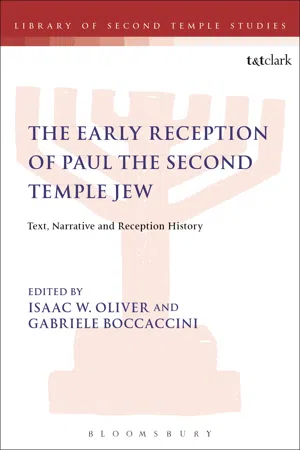
The Early Reception of Paul the Second Temple Jew
Text, Narrative and Reception History
- 344 pages
- English
- ePUB (mobile friendly)
- Available on iOS & Android
eBook - ePub
The Early Reception of Paul the Second Temple Jew
Text, Narrative and Reception History
About this book
Information
Chapter 1
Introduction
Isaac W. Oliver and Gabriele Boccaccini
In recent years, a growing number of studies have appeared which focus on the Jewishness of Paul. The very same set of questions which were once addressed to Jesus (for instance, whether he was “Christian” or “Jewish”) are now asked about Paul. No longer seen as the first “Christian” systematic theologian, if not the creator of Christianity, Paul also is reintroduced to his Jewish context and understood within the diverse world of Second Temple Judaism.1
In June 2014, the Third Nangeroni Meeting of the Enoch Seminar, titled “Re-Reading Paul as a Second Temple Jewish Author,” was held at the Waldensian Faculty of Theology in Rome. Scholars of Second Temple Judaism and Pauline studies gathered together to discuss Paul afresh as a Jewish thinker. A select number of the proceedings from that meeting were subsequently edited by Gabriele Boccaccini and Carlos A. Segovia and published in Paul the Jew: Rereading the Apostle as a Figure of Second Temple Judaism (Fortress 2016). During the final session of the Third Nangeroni Meeting, participants discussed how the topic of Paul might be pursued in future venues sponsored by the Enoch Seminar. A number of participants voiced support for Isaac W. Oliver’s proposal of a conference that would center on the reception of Paul. More specifically, the conference would focus on the receptions of Paul during the first two centuries that related to Paul’s Jewishness as well as his views on Judaism with the hope that such an examination might enrich our understanding of the complex, diverse nature of early Christian-Jewish relations. The plan materialized two years later, when the Seventh Nangeroni Meeting, “The Early Reception of Paul the Second Temple Jew,” transpired from June 26, 2016, to June 30, 2016, in the same welcoming halls of the Waldensian School of Theology in Rome.2
The Seventh Nangeroni Meeting, therefore, grew out of a previous scholarly encounter that wished to understand Paul as part and parcel of Second Temple Judaism. In this regard, the Seventh Nangeroni Meeting continued the pursuit of the Enoch Seminar to investigate what is called “early Christianity” within its Jewish contours. The conference, however, moved beyond the study of Paul proper (e.g., the so-called undisputed letters) as it sought to appreciate the reception of Paul in its own right and thus gaze at the Jewish matrix of early Christianity through the prism of reception history. As noted above, the conference focused, furthermore, on the reception of Paul the Jew. Studies on the reception of Paul abound but often without sufficient appreciation of the Jewish sources and issues that are critical for understanding the formation of early Christianity. Perhaps this is partly due to long-held assumptions about early Christian-Jewish relations. It is often assumed that the Jesus movement, for the most part, had moved on and beyond certain questions in the generations immediately following the time of Paul. Matters once deemed critical for Jewish-Christian relations, including the role and place of the Torah among followers of Jesus, were of marginal importance or simply irrelevant by the end of the first century. The relationship of the Jesus movement to its Jewish heritage and the Jewish people was no longer a burning question, as “the partings of the ways” became a fait accompli, once the pillars of the first generation of Jewish followers of Jesus, Shimon Kepha (Simon Peter), Yaakov (James) the brother of Jesus, and Yohanan (John) had passed away.3
By now, these points have been sufficiently problematized, and the time seems ripe to approach anew the reception of Paul with a clearer understanding of the Jewish framework that continued to shape the Jesus movement well after 70 CE. Indeed, the study of the reception of Paul’s legacy on early Christian-Jewish relations comes at a time when interest in reception history in general is very much in vogue. Once viewed as a secondary method of inquiry when compared to the more traditional approaches used in historical criticism (e.g., textual, source, form, and redaction criticism), reception history now boasts a vast array of publications. There are now journals, book series, an encyclopedia, and even a handbook devoted to the reception of biblical and extra-biblical literature.4 Numerous books continue to appear, including recent contributions on the reception of Paul by some of the participants of the Seventh Nangeroni Meeting.5
In the fall of 2015, a session at the Annual Meeting of the Society of Biblical Literature in Atlanta reviewed the book edited by Mark Nanos and Magnus Zetterholm, Paul within Judaism: Restoring the First-century Context to the Apostle (2015).6 The volume essentially promotes what has been dubbed, “the Radical Perspective on Paul,” or as some of its adherents prefer, “Paul within Judaism,” a perspective positing that Paul remained a Torah-observant Jew throughout his life. Some of its advocates even maintain that Paul’s gospel in some ways only directly concerned Gentiles. Once the floor was open for discussion, the question about Paul’s reception in documents such as Ephesians and the Acts of the Apostles was brought to the attention of the participants. At a session meant to deal exclusively with the Jewishness of the “historical Paul,” it was felt that such a “radical” argumentation on behalf of Paul’s Jewishness could not ignore some of the first receptions of Paul that may have perceived him otherwise. Perhaps, a study of these first receptions of Paul might provide some kind of measuring stick for assessing or at least comparing our own constructions of Paul—however objective we may imagine them to be.
It is hoped, t herefore, that the chapters appearing in this volume, which present the fruits of the scholarly collaboration of the Seventh Nangeroni Meeting, will enrich our discussions on such timely matters that are relevant for the study of early Judaism and Christianity in its various subfields. This volume covers a broad spectrum of ancient texts and authors: Ephesians, Colossians, 1 Timothy, the Gospel of Matthew, the Pseudo-Clementines, the Revelation of John, the Acts of the Apostles, Marcion, the pseudo-correspondence between Paul and Seneca, the Letter of James, Justin Martyr, the Letter to the Hebrews, 2 Peter, and 1 Clement. The conference had to limit itself in some way. Therefore, only texts dating from the first two centuries of the Common Era were considered.
Part I opens with an investigation on the reception of Paul the Second Temple Jew in the Letter to the Ephesians. If one consensus emerged from the session devoted to this letter it was that the author of Ephesians most assuredly operates within a framework of Jewish assumptions. In his chapter, “The Construction of Gentiles in the Letter to the Ephesians,” Matthew Thiessen shows how the author of Ephesians, like many Jews of the time, divided the world into two camps: Jews and Gentiles. The writer of the letter further depicts the Gentiles in a stereotypical fashion—an ethnic form of discoursing that is also attested in Paul’s own letters. Indeed, the affinity between Ephesians’s and Paul’s epistles leads Thiessen to question whether it is not time to revisit the possibility that Paul wrote more than the seven undisputed letters. The assumption that only seven letters of Paul are genuine, as Thiessen notes pointing to Benjamin White’s recent work on the reception of Paul, relies heavily on the claims made long ago by F. C. Baur. The German intellectual certainly did not carry out his historical-critical inquiry in a manner detached from any theological bias. Indeed, discussions during the conference often revolved on the legacy of Baur and how it has colored our understanding of Paul and the reception of his writings. In any case, Thiessen concludes that if Paul did not write Ephesians, then at least its author found Paul’s ethnic reasoning helpful to speak of the benefits made available through Christ to Gentiles qua Gentiles.
In his chapter, “‘You Who Once Were Far Off Have Been Brought Near’: The Ethne-in-Christ According to Ephesians,” William S. Campbell contends that Ephesians was consciously written in the Pauline tradition, and considers Ephesus as a viable original destination of the letter, given its peculiar vocabulary, which makes sense in connection with Ephesus and its popular cult of Artemis. In Ephesians the Gentiles are described as having been brought near but not into Israel. In other words, they become joint-heirs with the Jews, but the ekklesia is not conceived as an alternative to or as replacing Israel. The author of Ephesians is mainly concerned in showing how Gentile followers of Jesus share in the inheritance of Israel in a way that strengthens their identity and not feel deprived of previous cultural attachments such as the cult of Artemis.
Eric Noffke in “Ephesians in the Jewish Political Debate of the First Century: Rethinking Paul’s Approach in Facing New Challenges” situates Ephesians historically within the new circumstances that developed during the Flavian era in order to comprehend the discourse of Ephesians on interethnic unity. Ephesians had to solve problems in a new religious and political situation imposed upon Judaism as well as Jesus’s followers, not least because of the destruction of the temple.
Part II explores two other Deutero-Pauline Epistles, Colossians and 1 Timothy. In “Colossians’s Grounding Traditionalization of Paul,” Anders Klostergaard Petersen deems Colossians to be an entirely Jewish text in the sense that it conceives its Christ-religion as genuine Judaism and views all other forms as false instantiations. Petersen looks at Colossians through a Weberian lens and detects a social process of traditionalization that departs from the charismatic type of authority attested in the authentic letters of Paul. Nevertheless, Colossians uses Paul as a source of authority with a concern for cultural preservation and social maintenance. “The Shadow and the Substance: Early Reception of Paul the Jew in the Letter to the Colossians” by James Waddell considers Colossians within the philosophical context of Middle Platonism. Waddell opines that the author of Colossians responded to local Jews advocating a Judaizing Platonist philosophy peculiar to the Lycus River Valley or a Platonizing Judaism observed in the synagogues of Colossae. The letter, accordingly, employs the language of a Middle Platonist form of Pythagoreanism that in the end isolated the Colossians community from Jewish observances by discounting them as mere shadows. In a certain way, Paul himself had already laid the foundation for this kind of distancing, Waddell argues, for even if Paul did not begrudge his fellows Jews for remaining Torah observant, he reoriented the church’s identity, since he did not expect Gentiles to maintain Jewish practices such as circumcision, kashrut, or the Sabbath.
Kathy Ehrensperger’s “Διδάσκαλος ἐθνῶν—Pauline Trajectories According to 1 Timothy” is devoted exclusively to the study of one of the Pastoral Epistles, 1 Timothy. Ehrensperger examines the depiction of Paul in 1 Timothy as the διδάσκαλος ἐθνῶν, which, she contends, stands in clear succession of Paul’s self-presentation in the undisputed letters as the ἀπόστολος ἔθνων. By remembering Paul as the διδάσκαλος ἐθνῶν, 1 Timothy can develop a number of issues that Paul addressed to the ἔθνη in Christ. Similarly to the undisputed Pauline letters, the guidance provided in 1 Timothy is clearly envisaged as rooted in Jewish traditions in as much as these are applied to ἔθνη. The advice provided, in other words, is specific rather than universally addressed to all who are in Christ. With this framework in mind, Ehrensperger discusses those passages in 1 Timothy that deal with widows. She argues that the concern for widows in 1 Timothy is seen as part of the obligation to “remember the poor” in analogy to contemporary Jewish practice based on traditional notions of social justice (צדקה), which are applied to the ἐκκλησίαι ἐθνῶν.
Reception, as we noted, may also include rejection. Part III, “The Rejection of Paul? Searching for Paul’s Opponents,” accordingly, is devoted to the investigation of those who were possibly critical of the teachings of Paul or his followers on Judaism. For some two decades now, David Sim has mounted a coherent argument that the Gospel of Matthew should be read as an anti-Pauline text. In this latest piece, “Jew against Jew: The Reception of Paul in Matthew’s Christian-Jewish Community,” Sim not only surmises and updates his previous findings on the topic but also responds to some of the arguments raised b y his critics. With respect to the reception of Paul the Jew, Sim observes that it matters little whether Paul remained a Torah-observant Jew, as the Radical ...
Table of contents
- Cover
- Half-Title
- Title
- Contents
- Notes on Contributors
- Chapter 1 INTRODUCTION Isaac W. Oliver and Gabriele Boccaccini
- Part I THE RECEPTION OF PAUL THE SECOND TEMPLE JEW IN EPHESIANS
- Part II THE RECEPTION OF PAUL THE SECOND TEMPLE JEW: THE OTHER DEUTERO-PAULINE EPISTLES
- Part III THE REJECTION OF RECEPTION OF PAUL? SEARCHING FOR PAUL’S OPPONENTS
- Part IV The Reception of Paul the Second Temple Jew in the Acts of the Apostles
- Part V MARCION AND THE RECEPTION OF PAUL THE SECOND TEMPLE JEW
- Part VI SEARCHING FOR OTHER RECEPTIONS OF PAUL THE SECOND TEMPLE JEW
- Index of Authors
- Index of Texts
- Copyright
Trusted by 375,005 students
Access to over 1.5 million titles for a fair monthly price.
Study more efficiently using our study tools.
Frequently asked questions
Yes, you can cancel anytime from the Subscription tab in your account settings on the Perlego website. Your subscription will stay active until the end of your current billing period. Learn how to cancel your subscription
No, books cannot be downloaded as external files, such as PDFs, for use outside of Perlego. However, you can download books within the Perlego app for offline reading on mobile or tablet. Learn how to download books offline
Perlego offers two plans: Essential and Complete
- Essential is ideal for learners and professionals who enjoy exploring a wide range of subjects. Access the Essential Library with 800,000+ trusted titles and best-sellers across business, personal growth, and the humanities. Includes unlimited reading time and Standard Read Aloud voice.
- Complete: Perfect for advanced learners and researchers needing full, unrestricted access. Unlock 1.5M+ books across hundreds of subjects, including academic and specialized titles. The Complete Plan also includes advanced features like Premium Read Aloud and Research Assistant.
We are an online textbook subscription service, where you can get access to an entire online library for less than the price of a single book per month. With over 1.5 million books across 990+ topics, we’ve got you covered! Learn about our mission
Look out for the read-aloud symbol on your next book to see if you can listen to it. The read-aloud tool reads text aloud for you, highlighting the text as it is being read. You can pause it, speed it up and slow it down. Learn more about Read Aloud
Yes! You can use the Perlego app on both iOS and Android devices to read anytime, anywhere — even offline. Perfect for commutes or when you’re on the go.
Please note we cannot support devices running on iOS 13 and Android 7 or earlier. Learn more about using the app
Please note we cannot support devices running on iOS 13 and Android 7 or earlier. Learn more about using the app
Yes, you can access The Early Reception of Paul the Second Temple Jew by Isaac W. Oliver, Gabriele Boccaccini, Isaac W. Oliver,Gabriele Boccaccini in PDF and/or ePUB format, as well as other popular books in Theology & Religion & Biblical Criticism & Interpretation. We have over 1.5 million books available in our catalogue for you to explore.