Justin Stratis explores the meaning of the biblical phrase 'God is love' through an examination of two quintessentially modern Protestant theologians: Friedrich Schleiermacher and Karl Barth. This book contains both a detailed engagement with Schleiermacher's untranslated lectures on Dialektik and their relation to his more well-known work, as well as a new assessment of Barth's doctrine of God which both respects his radical innovations and yet places him within the stream of traditional, catholic trinitarianism.
After considering the complexities of theological predication, and comparing several classical and contemporary approaches to the implication of 'love', Stratis presents and ultimately commends the distinct approaches of Schleiermacher and Barth for their tendency to treat divine love as a 'conclusion' to the doctrine of God, rather than as a conceptual starting point. In contrast to many contemporary approaches, Stratis concludes with the suggestion that God's love is best conceived as his being toward fellowship, rather than as the eminent instance of loving fellowship understood according to human experiences of love.
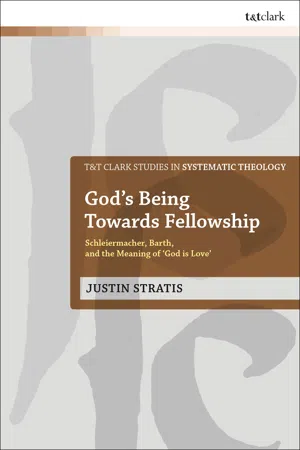
eBook - ePub
God's Being Towards Fellowship
Schleiermacher, Barth, and the Meaning of ‘God is Love’
- 208 pages
- English
- ePUB (mobile friendly)
- Available on iOS & Android
eBook - ePub
God's Being Towards Fellowship
Schleiermacher, Barth, and the Meaning of ‘God is Love’
About this book
Information
Part I
FRIEDRICH SCHLEIERMACHER AND THE ACTIVE GOD OF LOVE
1
INTRODUCTION TO PART I
In Part I, we aim to explore Friedrich Schleiermacher’s understanding of God in order to observe how this influences his conception of divine love. One of the reasons why Schleiermacher is such an interesting theologian is that, for him, there are literally no doctrines which can be taken for granted; every doctrine must justify itself on the grounds of what he identifies as the ‘essence’ of the Christian religion, namely, the experience of being redeemed by Jesus Christ through the church. Accordingly, because Schleiermacher takes such a critical stance to the history of dogma, it becomes all the more important to understand exactly how his theological intuitions are formed. Hence, we are necessarily drawn to the core matter directing Schleiermacher’s account of the divine attributes, and that is the very meaning of the term ‘God’.
In order to accomplish our task, we will look primarily at three of Schleiermacher’s most important texts: his massively influential On Religion: Speeches to its Cultured Despisers (1799), his less known lectures on Dialektik (delivered at several points during his academic career), and his magnum opus, The Christian Faith (in particular, the second edition, published successively in two volumes in 1830 and 1831, alternatively referred to as the Glaubenslehre). There is, we suggest, a good deal of continuity between these three works. What makes them different, however, are the roles that ‘God’ plays in each respectively: in the Speeches, the undercurrent of all life, in the Dialektik, the transcendental ground of knowledge, and in The Christian Faith, the ultimate cause of Christian consciousness. By addressing Schleiermacher’s understanding of God from several angles, our hope is that by the time we arrive at his treatment of ‘God is love’ in the final paragraphs of the Glaubenslehre, it should be generally self-evident what he will be obligated to say on the topic. Consequently, we will have before us a rather explicit example of what it means to treat ‘God is love’ as a conclusion, rather than the presupposition of the doctrine of God.
The first three chapters of this part concern what we are calling Schleiermacher’s ‘concept’ of God – that is, it addresses that which Schleiermacher thinks the word ‘God’ designates in particular contexts. Here, we will examine the first two speeches from On Religion, the transcendental part of the 1814/15 cycle of the Dialektik lectures, and the ethical propositions from the Einleitung to the Glaubenslehre. Our conclusion will be that, for Schleiermacher, God stands in a necessary relationship with the world, yet must also be strictly distinct from it in a number of important ways.
Chapter 4 will concern Schleiermacher’s doctrine of God proper, as reflected in his treatment of the divine attributes in the Glaubenslehre. Here, we will be able to observe how Schleiermacher’s ‘religious’ understanding of God is utterly congruent with his ‘concept’ of God, even as it emerges from the soil of a particular religious community, the Christian Church. Further, we will encounter Schleiermacher’s interpretation of ‘God is love’ as the utterly active self-communication of the divine life in the redemption of the world.
1
GOD AS THE UNIVERSE IN ON RELIGION
Schleiermacher’s first major publication, On Religion: Speeches to Its Cultured Despisers (1799), was written as a response to the scepticism of his Romantic colleagues towards all things religious.1 As Jack Forstman observes, Schleiermacher was regarded as something of an enigma by the Berlin Romantics.2 In particular, they were curious as to why someone who shared with them such negative sentiments about traditional Christianity would persist in an ecclesial career. On Religion offers an intriguing apologia: what the cultured critics had despised was not actually religion at all. Indeed, were they to perceive the true essence of religion, they would find themselves not driven away but towards religion’s self-evident persuasiveness.
Clearly, the five speeches comprising On Religion are substantial enough to warrant comprehensive study.3 Nevertheless, for the purposes of this chapter – to penetrate the meaning of Schleiermacher’s identification of love with the divine essence – we bring to this text a rather limited question: what is the meaning and role of ‘God’ in Schleiermacher’s early account of religion? Admittedly, the most careful response would require attention to the subsequent revisions of the text, published in 1806, 1821, and 1831.4 Such a technical treatment, however, would exceed the modesty of our query. For this reason, and because we are especially interested in Schleiermacher’s early understanding of God, we will interact exclusively with the first edition, published in 1799, particularly the second speech, ‘On the Essence of Religion’.5
Religion as the intuition of the universe
We begin our investigation with a brief glance at the first speech, the so-named Apology. Here, Schleiermacher introduces an important theme which persists throughout his career, namely, that of the ‘two primal forces of nature’ which organize and animate all finite reality: ‘appropriation/attraction’ (Abneignen/Anziehen) and ‘repulsion/expansion’ (Abstoßen/Verbreiten).6 The human soul, as a constituent of finite reality, is recognized as an instantiation of this general polarity and thus serves as an entry point into Schleiermacher’s main argument.7 Every soul, he explains, possesses, on the one hand, a drive to appropriate that which is external, that is, to ‘draw into itself everything that surrounds it’ with the goal of ‘wholly absorbing it into its innermost being’.8 This drive, he says, tends towards enjoyment and is thus satisfied in possessing by way of reception that which presents itself to it. It is the posture of the soul which attends to the particulars of life; hence, it necessarily limits its vision to ‘whatever is at hand’.9 The second drive is marked by a different tendency, one which seeks to ‘extend its own inner self even further, thereby permeating and imparting to everything from within, while never being exhausted itself’.10 Unlike the former, this latter drive inclines the soul to ‘overlook individual things’ as it seeks actively ‘to penetrate and to fill everything with reason and freedom’.11 This impulse, in contrast to its counterpart, prefers to see the world in its totality, regarding particulars only as possible receptors for the unifying principle that is the soul’s own self-assertion. Hence, whereas the first drive represents a passive impulse, the second is one of activity; whereas the former receives the world, the latter makes it. These twin forces – of which the human soul is but one instantiation – form the warp and woof of reality according to Schleiermacher.
Understanding this dipolar construal of reality helps to illuminate with greater depth the reasons why Schleiermacher so strongly rejects the conception of religion as either ‘metaphysics’ or ‘morals’ in the second speech, ‘On the Essence of Religion’. Simply put, for Schleiermacher, metaphysics and morals (i.e., ethics) are disciplines which, respectively, attend to the forces of receptivity (Abneignen/Anziehen) and activity (Abstoßen/Verbreiten) laid out in the first speech. Metaphysics, in seeking to ‘determine and explain the universe according to its nature’,12 aims ultimately to reflect the world in the form of knowledge.13 As such, it is concerned with rightly receiving that which is external and hence corresponds to the power of attraction or receptivity. Morals, on the other hand, seek ‘to continue the universe’s development and perfect it by the power of freedom’.14 As such, it struggles to direct properly the force of activity and expansion as it expresses itself in the human soul. Note that, for Schleiermacher, this distinction is strict: to confuse metaphysics with morals or vice versa is tantamount to circumventing the basic polarity of all finite reality. Further, to the extent that religion is called upon to facilitate such an ill-fated relation, it too propagates a fundamental error: the very confusion which Schleiermacher’s search for religion’s ‘essence’ is meant to correct.15
So because metaphysics and morals by nature attend only partially to reality, neither discipline can be regarded as a truly comprehensive science. Nevertheless, a comprehensive principle is, in Schleiermacher’s mind, absolutely necessary in order to explain how the two opposing forces co-inhere in that which confronts us as one basic reality. ‘Where, then, is the unity of this whole?’ he asks. ‘Where does the unifying principle lie for this dissimilar material?’16 The answer, surprisingly (at least for the original readers), lies in religion, for only in religion, Schleiermacher argues, is there any warrant for considering reality to be both ‘real’ and accessible. This is why Schleiermacher presents his revisioning of religion as the basis for what he terms ‘a higher realism’.17 But what is this principle of unity, and how is it that ‘religion’ gives us access to such a thing?
To answer this question, we turn to a well-known and programmatic passage from the second speech. Therein, Schleiermacher states:
Religion’s essence is neither thinking nor acting, but intuition and feeling [Anschauung und Gefühl]. It wishes to intuit the universe, wishes devoutly to overhear the universe’s own manifestations and actions, longs to be grasped and filled by the universe’s immediate influences in childlike passivity.18
In this well-known declaration, what Schleiermacher considers to be the ground for speaking of reality as a basic unity becomes evident. It is, unambiguously, the universe (das Universum).19 In essence, the universe, for Schleiermacher, is simply that which exerts itself upon the whole of reality, thereby comprehending both the force of expansion and the force of attraction. It should be emphasized, therefore, that the universe is not simply another term for ‘the world’, understood as in, for example, ‘the whole of finite reality’, as the term might imply in our contemporary context. To the contrary, the universe is the very thing which makes the world a world by establishing the ultimate relatedness of all finite particulars. In other words, the world stands as one only insofar as all things are commonly subordinated to the force of the universe. As Redeker explains, ‘The universe is for [Schleiermacher] unity and wholeness in contrast to the multiplicity of natural and human events…. This wholeness and unity is not empirically perceived, nor is it the causal structure of nature in space and time; it is the ultimate, which acts upon men and things.’20
Our means of access to the universe, Schleiermacher explains, is not knowledge or action but rather intuition (Anschauung).21 For Schleiermacher, the faculty of intuition is conceived in much the same way as it is in Kant’s first Critique: to ‘intuit’ means essentially to perceive oneself to be the recipient of an action.22 As Schleiermacher explains, ‘All intuition proceeds from an influence of the intuited on th...
Table of contents
- Cover
- Halftitle Page
- Title Page
- Dedication Page
- Contents
- Abbreviations
- Introduction
- Part I: Friedrich Schleiermacher and the Active God of Love
- Part II: Karl Barth and the Personal God of Love
- Conclusion: God’s being towards fellowship
- Bibliography
- Index
- Imprint
Trusted by 375,005 students
Access to over 1.5 million titles for a fair monthly price.
Study more efficiently using our study tools.
Frequently asked questions
Yes, you can cancel anytime from the Subscription tab in your account settings on the Perlego website. Your subscription will stay active until the end of your current billing period. Learn how to cancel your subscription
No, books cannot be downloaded as external files, such as PDFs, for use outside of Perlego. However, you can download books within the Perlego app for offline reading on mobile or tablet. Learn how to download books offline
Perlego offers two plans: Essential and Complete
- Essential is ideal for learners and professionals who enjoy exploring a wide range of subjects. Access the Essential Library with 800,000+ trusted titles and best-sellers across business, personal growth, and the humanities. Includes unlimited reading time and Standard Read Aloud voice.
- Complete: Perfect for advanced learners and researchers needing full, unrestricted access. Unlock 1.5M+ books across hundreds of subjects, including academic and specialized titles. The Complete Plan also includes advanced features like Premium Read Aloud and Research Assistant.
We are an online textbook subscription service, where you can get access to an entire online library for less than the price of a single book per month. With over 1.5 million books across 990+ topics, we’ve got you covered! Learn about our mission
Look out for the read-aloud symbol on your next book to see if you can listen to it. The read-aloud tool reads text aloud for you, highlighting the text as it is being read. You can pause it, speed it up and slow it down. Learn more about Read Aloud
Yes! You can use the Perlego app on both iOS and Android devices to read anytime, anywhere — even offline. Perfect for commutes or when you’re on the go.
Please note we cannot support devices running on iOS 13 and Android 7 or earlier. Learn more about using the app
Please note we cannot support devices running on iOS 13 and Android 7 or earlier. Learn more about using the app
Yes, you can access God's Being Towards Fellowship by Justin Stratis in PDF and/or ePUB format, as well as other popular books in Theology & Religion & Christian Theology. We have over 1.5 million books available in our catalogue for you to explore.