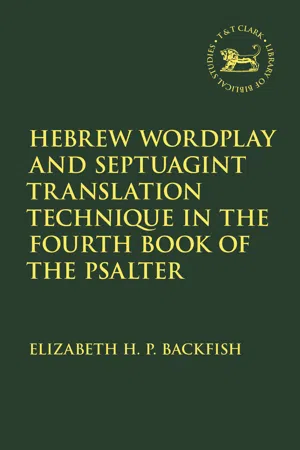
This volume examines numerous Hebrew wordplays not identified and discussed in previous research, and the technique of the Septuagint translators, by offering another criterion of evaluation – essentially, their concern about the style of translating Hebrew into Greek. Elizabeth Backfish's study analyzes seventy-four wordplays employed by the Hebrew poets of Psalms 90-106, and how the Septuagint renders Hebrew wordplay in Greek.
Backfish estimates that the Septuagint translators were able to render 31% of the Hebrew semantic and phonetic wordplays (twenty-four total), most of which required some sort of transformation, or change, to the text in order to function in Greek. After providing a thorough summary of research methods on wordplay, definitions and research methodology, Backfish summarizes all examples of wordplay within the Fourth Psalter, and concludes with examples of the wordplay's replication, similar rendition or textual variation in the Septuagint. Emphasising the creativity and ingenuity of the Septuagint translators' work in passages that commentators often too quickly identify as the results of scribal error or a variant Vorlage from the Masoretic text, Backfish shows how the aptitude and flexibility displayed in the translation technique also contributes to conversations in modern translation studies.
eBook - ePub
Hebrew Wordplay and Septuagint Translation Technique in the Fourth Book of the Psalter
- 200 pages
- English
- ePUB (mobile friendly)
- Available on iOS & Android
eBook - ePub
Hebrew Wordplay and Septuagint Translation Technique in the Fourth Book of the Psalter
About this book
Information
Chapter 1
INTRODUCTION
Just as each musical instrument holds a unique place and purpose within the orchestral consort, so also wordplay serves the poet as a unique literary tool for creatively and effectively communicating a message. It is, therefore, not surprising that the psalmists used this trope to entertain, challenge, and inspire their readers. The Greek translators of the Hebrew psalms had a formidable responsibility to render Hebrew wordplay to the best of their ability. However, even the most able translators would have struggled to render poetry into a receptor language, much less a component of poetry that is so dependent on the relationship between the sound and meaning of the original. This book seeks to understand better the Septuagint (LXX) translators’ approach to Hebrew wordplay by exploring the linguistic nature of wordplay, identifying its presence in Book IV of the Hebrew Psalter, and analyzing the LXX’s rendering of these occurrences.
The use of wordplay in biblical poetry and prose has long been recognized by biblical scholars, and yet a full-scale study of wordplay in the Psalter awaits exploration. Likewise, the translation techniques employed to convey various poetic devices in the LXX have shed light on the translators’ understanding of Hebrew poetry, as well as their role as translators, and yet a study of the rendering of wordplay in the LXX also awaits further research. Since the renewed focus on modern linguistics and literary theory in the field of biblical studies, the opportunity to analyze wordplay in Book IV of the Hebrew Psalter and to explore that multifaceted poetic device in Greek translation is particularly ripe for an extended study.
The following introduction will review the history of research on wordplay within biblical scholarship and LXX studies. A separate discussion on word-play within literary theory, including its history, linguistic nature, typology, and function, will follow, offering a more nuanced and emic understanding of the trope. Several important methodological guideposts will then conclude this chapter.
Research on Wordplay within the Hebrew Bible
Wordplay is prevalent in all known languages worldwide, so it is not surprising that every book of the Old Testament contains this trope.1 Readers of the Old Testament have long recognized and appreciated this literary phenomenon. The manifold interpretations to which wordplay lends itself were happily exploited within rabbinic Judaism.2 According to Roberta Frank, medieval Europe generally believed that “the world of the divine was imagined to require a separate, more sacred language than that used by men,” so biblical wordplay was expected.3 According to Chaucer, “goddes speken in amphibologies” (“God spoke in ambiguities”), and Old English scriptural verse tried to replicate wordplays, exegete them, and even create additional wordplays.4 Biblical scholarship, however, sustained a relative lack of interest in wordplay until the late nineteenth century, when the first monographlength work on the subject was written by Immanuel Moses Casanowicz. His 1892 dissertation entitled Paronomasia in the Old Testament was later published in 1894.
Casanowicz’s methodology reflected that of his era and served as a model for later studies on biblical wordplay. In Paronomasia in the Old Testament, he describes the nature and use of paronomasia in classical, modern, and Semitic languages. He then discusses various types of paronomasia in the Old Testament, offering examples. The entire last half (over 40 pages) of the study is an appended, nearexhaustive list of wordplays in the Old Testament, arranged alphabetically, with neither explanation nor conclusions. Casanowicz’s work advanced the study of biblical wordplay by offering definitions and classifications of different types of wordplay, as well as collating these wordplays in an easily accessible format. Casanowicz was undeniably a pioneer in the study of wordplay, but pioneers forge the way for others to follow and build. Three aspects of Casanowicz’s ground-breaking work yield room for advance: (1) Casanowicz defines wordplay as a subcategory of paronomasia, which is comprised of sound-paronomasia and sense-paronomasia. Because he considers sense-paronomasia to be “an artificial offspring” of sound-paronomasia,5 he focuses almost exclusively on the latter, thereby passing over many semantic wordplays. (2) Casanowicz simply lists the biblical paronomasia he has found. There is no development or analysis of different types of paronomasia and their patterns, or the identification of tendencies within certain corpora. (3) Casanowicz’s study predates the many advances in literary scholarship on poetic rhetoric.6
Until the 1970s, biblical scholars followed Casanowicz’s lead in method and perspective, largely in isolation from literary scholarship.7 Anthony J. Petrotta insightfully summarizes this divide between biblical and literary scholars:
In contradistinction to biblical studies, the characteristics of literary-critical studies of wordplay are not sound but meaning, not listing examples but discourse about the passage or line where the wordplay occurs, and not “embellishment” but various functions from structuring to pathos.8
Clearly, biblical scholarship needed to join hands with literary scholarship, not least of all in the study of wordplay.
The past four decades have seen nothing short of a literary revolution in biblical studies. By applying the tools of modern linguistics and literary theory to Hebrew poetry, scholars such as Terence Collins, Stephen Geller, Adele Berlin and Robert Alter have advanced our understanding of biblical poetry and given us a richer and more accurate understanding of poetic devices and rhetorical functions.9
Although not yet fully utilizing these modern literary insights, J. J. Glück offered in 1970 one of the first substantial works on biblical wordplay since Casanowicz. In his “Paronomasia in Biblical Literature,” Glück uses paronomasia, wordplay, and pun interchangeably, but he classifies wordplay into six linguistic categories: equivocal (double entendre), metaphonic, parosonantic, farraginous (similar to onomatopoeia), associative (using syntax), and assonantic.10 He does not offer much by way of summary analysis, but he concludes with a positive note echoed throughout his article, namely that wordplay is no crass pun, but “an inseparable part of the word-magic, the subtle eloquence of the Bible.”11 Thus, Glück offers helpful classification (if not definitions) based on a solid relationship between literary and biblical studies, as well as a shift in perspective concerning the positive and rhetoricallyrich nature of wordplay.
Another important work from 1970 is William Holladay’s “Form and Word-Play in David’s Lament over Saul and Jonathan.”12 Written just two years after James Muilenburg’s influential Presidential address to the Society of Biblical Literature, “Form Criticism and Beyond,” Holladay attempts to exercise rhetorical criticism on 2 Sam 1:18-27 by showing how an intricate system of interlocking wordplays affects the structure of the pericope.13 The following two decades saw other important works on wordplay, each offering new insights into the phenomenon of Hebrew word-play.14
Although the study of biblical wordplay had come a long way since Casanowicz, it was not until 1991 that another monographlength study appeared. In his revised dissertation, Lexis Ludens: Wordplay and the Book of Micah, Anthony Petrotta spends nearly half of his study contextualizing, defining, classifying, and explaining the function and significance of wordplay. Although at times overly harsh about older studies on wordplay,15 his study is monumental in his application of linguistics, his understanding of the relationship between wordplay and ambiguity, and the centrality of humor in the trope. The second half of Petrotta’s work applies this nuanced understanding of wordplay to the book of Micah. In the 25 years since Petrotta’s publication, no other monograph on biblical wordplay in a single corpus has been published.
Several other important studies since Petrotta have contributed to our understanding of wordplay. The 1990s saw E. L. Greenstein’s dictionary article in Anchor Bible Dictionary, which carefully classified the various types and functions of wordplays,16 and Isaac Kalimi’s article, “Paronomasia in the Book of Chronicles,” which identifies wordplays within Chronicles not mentioned in Casanowicz’s work.17 The beginning of the millennium then saw the landmark collection of essays edited by Scott Noegel in Puns and Pundits: Word Play in the Hebrew Bible and Ancient Near Eastern Literature, which incorporates not only recent insights from modern literary theory, but also those from ancient Near East research.18 Finally, Knut Heim has written the most recent dictionary article for Dictionary of the Old Testament: Wisdom, Poetry and Writings, “Wordplay,” which shows an insightful understanding of semantics, as well as a helpful classification.19
There are currently no studies devoted exclusively to wordplay within the Psalms. Several articles highlight a single wordplay.20 Other contributions discuss wordplay in a given psalm.21 Some commentaries and works on translation include examples from the Psalter,22 but no single work offers both a detailed methodology and exhaustive analysis of the book of Psalms or of any of its five books.
Research on the Septuagint, Translation Technique, and Its Use of Wordplay
Contexts of LXX Psalms
There exists no consensus regarding the origin and nature of the LXX translation. Scholars disagree, for example, on whether the extant translations should be treated as reflections of the original translation or as recensions and revisions of an older, lost translation. Jannes Smith offers the most convincing arguments for treating the LXX as a reflection of the original translation: (1) the translators at times used various Greek words for the same Hebrew words; (2) at other times they used the same Greek word for various Hebrew words; and (3) they seemed to struggle occasionally with the meaning of the Hebrew original.23
Most scholars agree that the LXX Psalter was translated as early as the second century BCE,24 or as late as the first century CE.25 Sometime during the second century BCE is the current preference among scholars;26 however, as Jennifer Dines explains, “Nearly all these attempts at dating are very tentative and there is seldom a consensus.”27 Because koine Greek remained fairly stable during this window of time, and because there is little external evidence, it is impossible at this time to pinpoint the date of composition further than that.28
As for location, scholars still disagree whether LXX Psalms was translated in Egypt or Palestine; however, the affinity of the LXX translation technique with Egyptian translation practice and the disassociation of the LXX with the kaige tradition, make an Egyptian provenance much more likely.29 Textual evidence from Egyptian petition documents and religious texts (hymns to Isis and Osiris, for example) may also favor an Egyptian provenance, as it is likely that the LXX translator borrowed certain lexemes in the semantic field of salvation, praise, and mercy.30
As for the question of whether the translation of LXX Psalms was made by one translator (or unified group of translators) or by many distinct translators, most scholars affirm the unity of their translation, that the book was either translated by a single individual or a group working closely together.31
The translator’s cultural context might have influenced his or her translation of wordplay in particular. The translator was torn between two cultures and two languages, and between the need to...
Table of contents
- Cover
- Title Page
- Copyright
- Dedication
- Contents
- List of Tables
- List of Symbols
- Acknowledgments
- Chapter 1 Introduction
- Chapter 2 Writing the Right Words: Wordplay Within Book IV of the Hebrew Psalter
- Chapter 3 LXX Translation of Wordplay in Book IV of the Psalms: Writing the Right Words from Left to Right
- Chapter 4 Conclusion
- Bibliography
- Index of References
- Index of Authors
Trusted by 375,005 students
Access to over 1.5 million titles for a fair monthly price.
Study more efficiently using our study tools.
Frequently asked questions
Yes, you can cancel anytime from the Subscription tab in your account settings on the Perlego website. Your subscription will stay active until the end of your current billing period. Learn how to cancel your subscription
No, books cannot be downloaded as external files, such as PDFs, for use outside of Perlego. However, you can download books within the Perlego app for offline reading on mobile or tablet. Learn how to download books offline
Perlego offers two plans: Essential and Complete
- Essential is ideal for learners and professionals who enjoy exploring a wide range of subjects. Access the Essential Library with 800,000+ trusted titles and best-sellers across business, personal growth, and the humanities. Includes unlimited reading time and Standard Read Aloud voice.
- Complete: Perfect for advanced learners and researchers needing full, unrestricted access. Unlock 1.5M+ books across hundreds of subjects, including academic and specialized titles. The Complete Plan also includes advanced features like Premium Read Aloud and Research Assistant.
We are an online textbook subscription service, where you can get access to an entire online library for less than the price of a single book per month. With over 1.5 million books across 990+ topics, we’ve got you covered! Learn about our mission
Look out for the read-aloud symbol on your next book to see if you can listen to it. The read-aloud tool reads text aloud for you, highlighting the text as it is being read. You can pause it, speed it up and slow it down. Learn more about Read Aloud
Yes! You can use the Perlego app on both iOS and Android devices to read anytime, anywhere — even offline. Perfect for commutes or when you’re on the go.
Please note we cannot support devices running on iOS 13 and Android 7 or earlier. Learn more about using the app
Please note we cannot support devices running on iOS 13 and Android 7 or earlier. Learn more about using the app
Yes, you can access Hebrew Wordplay and Septuagint Translation Technique in the Fourth Book of the Psalter by Elizabeth H. P. Backfish in PDF and/or ePUB format, as well as other popular books in Theology & Religion & Biblical Studies. We have over 1.5 million books available in our catalogue for you to explore.