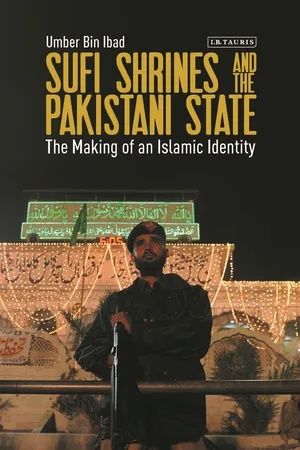
After the creation of Pakistan in 1947, Sufi shrines became highly contested. Considered deviant and `un-Islamic', they soon fell under government control as part of a state-led strategy to create an `official', more unified, Islamic identity. This book, the first to address the political history of Sufi shrines in Pakistan, explores the various ways in which the postcolonial state went about controlling their activities. Of key significance, Umber Bin Ibad shows, was the `West Pakistan Waqf Properties Ordinance', a governmental decree issued in 1959. Formed when General Ayub Khan assumed the role of Chief Martial Law Administrator, this allowed the state to take over shrines as `waqf property'. According to Islamic law, a waqf, or charitable endowment, had to be used for charitable or religious purposes and the state created a separate Auqaf department to control the finances and activities of all the shrines which were now under a state sponsored waqf system.
Focusing on the Punjab - famous for its large number of shrines - the book is based on extensive primary research including newspapers, archival sources, interviews, court records and the official reports of the Auqaf department. At a time when Sufi shrines are being increasingly targeted by Islamist extremists, who view Sufism as heretical, this book sheds light on the shrines' contentious historical relationship with the state. An original contribution to South Asian Studies, the book will also be relevant to scholars of Colonial and Post-Colonial History and Sufism Studies.
- 224 pages
- English
- ePUB (mobile friendly)
- Available on iOS & Android
eBook - ePub
About this book
Information
Table of contents
- Cover
- Editorial
- Title Page
- Copyright
- Dedication
- Contents
- List of Tables
- Acknowledgements
- Introduction
- 1. The Colonial State and Shrines
- 2. Double-Reterritorialisation: Drifting Towards the Nationalisation of Shrines
- 3. Legality, Judicial Processes and Waqf: A Transition from Moral to Total Control of Shrines
- 4. The Post-Colonial State, Shrines and the Auqaf Department
- 5. Developing and Redefining Shrines in the Post-Zia Period
- Conclusion
- Appendix
- Notes
- Bibliography
Trusted by 375,005 students
Access to over 1.5 million titles for a fair monthly price.
Study more efficiently using our study tools.
Frequently asked questions
Yes, you can cancel anytime from the Subscription tab in your account settings on the Perlego website. Your subscription will stay active until the end of your current billing period. Learn how to cancel your subscription
No, books cannot be downloaded as external files, such as PDFs, for use outside of Perlego. However, you can download books within the Perlego app for offline reading on mobile or tablet. Learn how to download books offline
Perlego offers two plans: Essential and Complete
- Essential is ideal for learners and professionals who enjoy exploring a wide range of subjects. Access the Essential Library with 800,000+ trusted titles and best-sellers across business, personal growth, and the humanities. Includes unlimited reading time and Standard Read Aloud voice.
- Complete: Perfect for advanced learners and researchers needing full, unrestricted access. Unlock 1.5M+ books across hundreds of subjects, including academic and specialized titles. The Complete Plan also includes advanced features like Premium Read Aloud and Research Assistant.
We are an online textbook subscription service, where you can get access to an entire online library for less than the price of a single book per month. With over 1.5 million books across 990+ topics, we’ve got you covered! Learn about our mission
Look out for the read-aloud symbol on your next book to see if you can listen to it. The read-aloud tool reads text aloud for you, highlighting the text as it is being read. You can pause it, speed it up and slow it down. Learn more about Read Aloud
Yes! You can use the Perlego app on both iOS and Android devices to read anytime, anywhere — even offline. Perfect for commutes or when you’re on the go.
Please note we cannot support devices running on iOS 13 and Android 7 or earlier. Learn more about using the app
Please note we cannot support devices running on iOS 13 and Android 7 or earlier. Learn more about using the app
Yes, you can access Sufi Shrines and the Pakistani State by Umber Bin Ibad in PDF and/or ePUB format, as well as other popular books in Theology & Religion & Middle Eastern History. We have over 1.5 million books available in our catalogue for you to explore.