- 328 pages
- English
- ePUB (mobile friendly)
- Available on iOS & Android
eBook - ePub
About this book
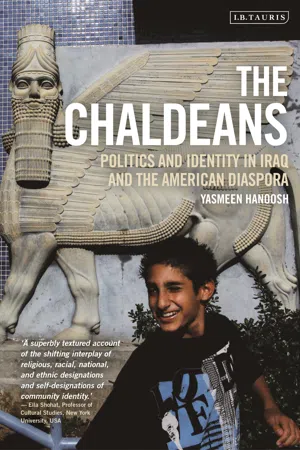
Modern Chaldeans are an Aramaic speaking Catholic Syriac community from northern Iraq, not to be confused with the ancient Mesopotamian civilization of the same name. First identified as 'Chaldean' by the Catholic Church in the sixteenth century, this misnomer persisted, developing into a distinctive and unique identity. In modern times, the demands of assimilation in the US, together with increased hostility and sectarian violence in Iraq, gave rise to a complex and transnational identity. Faced with Islamophobia in the US, Chaldeans were at pains to emphasize a Christian identity, and appropriated the ancient, pre-Islamic history of their namesake as a means of distinction between them and other immigrants from Arab lands. In this, the first ethnographic history of the modern Chaldeans, Yasmeen Hanoosh explores these ancient-modern inflections in contemporary Chaldean identity discourses, the use of history as a collective commodity for developing and sustaining a positive community image in the present, and the use of language revival and monumental symbolism to reclaim association with Christian and pre-Christian traditions.
Information
1
ON THE POLITICS OF APPELLATION: THE MAKING OF THE MODERN CHALDEANS
I am an Assyrian today, tomorrow, forever, and I am proud of it.
Raphael Bidawid, Chaldean Patriarch of Babylonia, 19741
Any Chaldean who calls himself Assyrian is a traitor, and any Assyrian who calls himself Chaldean is a traitor.
Emmanuel Dally, Chaldean Patriarch of Babylonia, 20062
Disputes, negotiations and resolutions regarding the representatively ‘accurate’ appellations for the modern Chaldeans and Assyrians are not confined to the statements of the two recent patriarchs. They dot the diasporic history of the Eastern Christian communities throughout the twentieth century and extend well into the present. What accounts for this contentious history?
In the diasporas of Europe and the United States, where most of the communities are now settled, Syriac studies and Assyriology developed as the two authoritative scholarly traditions of writing about Eastern Christianity. The appellation debate has also found its way into various contemporary religious and political discourses at home. Additionally, a discursive transnational social field of native scholarship on Chaldean and Assyrian history and nomenclature has emerged in the diasporic locales, creating distinct narratives of identity that link the ancient past to the current present in specific ahistorical ways.
This chapter offers a rereading of these narratives to locate the links, or missing links, between the ancient and modern Assyrians and Chaldeans and to retrace the occurrences of the appellations ‘Chaldean’, ‘Assyrian’ and ‘Nestorian’ to particular events and periods. The controversies over collective identities to be disentangled here are central to understanding what shapes the particularity of the contemporary Chaldean collective. Historically, the circulation of the three labels was crucial to the survival and reshaping of the group. Moreover, the denominational affiliation of the followers of the Church of the East played a crucial role in determining the kind of foreign protection they received from the sixteenth century onwards. The genealogy of these interconnected and overlapping identities directly links to the Churches that make up the historic Iraqi Christian presence. This genealogy provides insights into the formative imperialist relations responsible for West–East dichotomies and the intermediary position these native Christian institutions and communities served within those divides. This marginalized history critically locates some of the earliest – although by no means only – hegemonic dynamics that led to constructing the identitarian crisis in the post-Ottoman ‘Middle East’ and ‘Arab world’. By turning to the intervention of institutional powers such as the Roman Catholic Church and other organized Western Christian missions to the Middle East, this discussion marks some of the earliest sectarian politics that augmented the tensions between ethno-religious majorities and minorities in the modern Middle East.
Three questions direct the enquiry into the appellation dispute: first, how did the term ‘Assyrian’ become attached to a Church that materialized in 431 CE, when the last – needless to say non-Christian – Assyrian Kingdom began to dissolve in 612 BCE? That is, who are the modern Assyrians, who today affiliate with the ‘Assyrian Church of the East’, the ‘Assyrian Ancient Church of the East’, the ‘Assyrian Evangelical Church’, the ‘Assyrian Pentecostal Church’ and other ‘Assyrian’ Churches, in relation to the ancient Assyrians from whom they claim descent? Second, what is the relationship between the ancient Chaldeans of southern Mesopotamia and the modern Catholic Chaldeans of the Nineveh Plains, northeast of Mosul (and Detroit suburbs), followers of the ‘Patriarch of Babylon of the Chaldeans’? Third, how are the ancient and modern Chaldeans and Assyrians related or unrelated to each other? That is, how did the ‘Nestorian’ appellation that used to apply to both groups fall out of use and how did its holders become the ancient-turned-modern Chaldeans and Assyrians?
From approximately the third to the fifteenth centuries, both Chaldeans and Assyrians belonged to the Church of the East, or the ‘Nestorian Church’, without denominational distinctions and were generally known as Syriacs (Suraye). Later on, as the missionary activity of the Church of the East intensified in East Asia and as Western missionary posts became more prominent in and around Mesopotamia, Syriac communities splintered to form several distinct collectives that conceptually converge or diverge in selective political and cultural contexts.
While several historical studies have documented the denominational conversions within the Church of the East,3 most community historiographies of these communities bypass this ecclesial history and turn instead to pre-Christian history as the primary originator of modern Assyrian and Chaldean identities. Understanding how members of these communities reconstruct and appropriate pre-Christian history and the strategic utility they designate for its use in the present is key to understanding the contentious modern history of these communities. The importance of the complicit, European- and American-enabled history of modern Chaldean and Assyrian identities is twofold. Significantly, we may be on the verge of witnessing the erasure of Christianity in Iraq. Moreover, this history shaped a distinction between Assyrianness as an ethnic and national identity and Chaldeanness as a religious identity for quite some time, in ways that have created a different appeal for the primordialist argument at different times and places between home and diaspora. This complex history calls for telling the distinct story of identity-making as performed by or on the modern Chaldean and Assyrians since their earliest contact with the Christian West. Current narratives of identity underscore three components: one, a claim to the Aramaic language; two, a distinct Christian liturgy that links back to the liturgy of the Church of the East; and three, a place of origin in contiguous or overlapping regions of historical Mesopotamia.
Chaldeans and Assyrians: The Pre-Christian Context
Scholars generally prefer to use the term ‘Assyrian’ to refer to a language rather than an ethnicity. On the other hand, popular encyclopaedic sources such as Wikipedia, Encyclopedia Britannica and Encarta – and less straightforwardly the Old Testament4 – concur that the term ‘Assyrian’ refers to the various ethnic groups that occupied the region on the Upper Tigris River or Assyria or Ashur, until the fall of Nineveh in 612 BCE. Popular sources also refer to the ancient Chaldeans as semi-nomadic tribes who settled in southern Mesopotamia in the early part of the first millennium BCE.
The Chaldean dynasty, the last of the Babylonian dynasties, assumed power after the fall of the Assyrian Kingdom in 612 BCE, and until the Persian invasion of 539 BCE. The town of Ur Kasdim (traditionally rendered in English as ‘Ur of the Chaldees’) is presented in the Hebrew Bible, Old Testament and other related literature as the birthplace of Abraham.5 Other traditional sources such as Josephus and Maimonides locate Ur Kasdim in northern Mesopotamia. Early twentieth-century archaeology identified the place with the Sumerian city of Ur in southern Mesopotamia, which was under the rule of the Chaldeans. ‘Chaldea proper’ initially referred to the vast plain in the south but eventually came to represent all of Mesopotamia.6
The early Assyrians spoke what came to be known as Akkadian or Old Assyrian, while the contemporaneous Chaldean tribes likely spoke a dialectal subset of the same language. Their dialect came to be known as ‘Babylonian’ in reference to the Babylonian region these Chaldean tribes populated.7 Around 2000 BCE, the Akkadian or Old Assyrian that early Assyrians spoke along with its ‘Babylonian’ subsets that the Chaldean tribes spoke constituted the lingua franca of Mesopotamia. One millennium later, Aramaic began competing with Akkadian so that by the mid-eighth century BCE both Chaldeans and Assyrians were speaking Aramaic. The Arameans, a semi-nomadic and pastoral people who originated and populated Upper Mesopotamia after 1100 BCE, introduced Aramaic’s relatively advanced Phoenician-based writing system. Not before long, it became the second official language of the Assyrian Empire in 752 BCE. Aramaic eventually supplanted the Akkadian that the Chaldeans and Assyrians had spoken earlier. It thereby gained the status of a lingua franca among the various ethnic groups living in the Assyrian Empire, as well as in most of the Near East and Egypt.8
From a lingua franca, Aramaic mushroomed into an array of dialects, some mutually intelligible and some not. They were roughly classified into Western and Eastern dialects, according to their geographical location in relation to the Euphrates River. Of these dialects one gained a particularly prestigious status later. It came to be known as ‘Biblical Aramaic’ in relation to the sections of the biblical books of Daniel and Ezra – along with the Talmud – that were written in this dialect. Another variety of Aramaic was believed to be the mother tongue of Jesus as well as the language of the New Testament. As the East Syriac communities, mainly with the help of Catholic and Protestant missionaries, began to introduce the Syriac alphabets as a writing system for Aramaic, the Aramaic variety they spoke eventually came to be known as ‘Neo-Syriac’.9 A number of Aramaic – or Syriac – dialects died out, while a few transformed and survived. Later on, predominantly in the nineteenth century, British and American Christian missions played a seminal role in reviving Biblical Aramaic and consolidating the living Aramaic dialects through providing a writing system, a printing press and new font types.
The relevance of this ethno-linguistic history lies in the evocative power of the nomenclature in use today. The dialects that contemporary Assyrians and Chaldeans speak are known interchangeably as ‘Neo-Aramaic’ and ‘Neo-Syriac’ – or Sureth in the native tongue. They harken back to eras that predate the social formations of the current ethno-linguistic groups that identify with the original users of these languages.
Chaldean, Assyrian and Nestorian: The Early Christian Context
Historian John Joseph was one of the first to significantly note that the enlisting of Christianity as a decisive component of the group’s communal identity—along with its immense confessional convolutions—gave rise to the identity disputes among modern Chaldeans and Assyrians.10 When Christian missionaries and pioneer excavators arrived in Mesopotamia from the United States and Britain in the early nineteenth century, they encountered three representatives of the Church of the East: Jacobites, Nestorians and Chaldeans. In particular contexts these three groups referenced themselves with the title ‘Syrian Christians’ all the while applying the other titles in formal contexts to differentiate their religious filiations. This was during a time when the title ‘Assyrian’ as a referent to a living group of Mesopotamian Christians had not been fully revived yet. It came to widely replace the term ‘Nestorian’ much later. Nonetheless, long before this revival the appellation disputes were set in motion due to the interchangeable use of other titles.
Germane to this context is the title ‘Uniate’, which refers to the six Eastern Churches which were excommunicated or deemed heretical by Papal Rome, but who at some point abjured the schismatic doctrines and accepted Papal supremacy in Christological matters. These are the Catholic branches of the Maronite, Armenian, Melkite, Chaldean, Syrian and Coptic Churches. The notion of ‘rite’ developed around these Uniate groups. While they looked to the mother Church in Rome they were allowed patriarchic and liturgical autonomy at home. Thus, the Nestorians (later known as Assyrians) were not Uniates because they did not join the Church of Rome, whereas the Chaldeans came to be Uniates by virtue of converting from Nestorianism to Roman Catholicism.11 Simultaneously, this transformed them from ‘Eastern Christians’ or the pejorative ‘Nestorians’ to the prestigious, legacy-laden ‘Chaldeans’.
Today, the only Uniate rite with a noticeable presence in Iraq (though alarmingly dwindling since the 1990s) is the Chaldean Rite. According to contemporary nationalist and religious Chaldean publicity, Chaldeans have constituted the largest group of Iraqi Christians since the East Syrian schism with Rome in 431 CE. The two other recognizable churches that make up the historic Iraqi Christian presence are the Jacobite and Assyrian Churches. The former is also known as ‘Syrian’ and ‘West Syrian Orthodox’. In Arabic the followers are known as ‘Ya‘aqiba’ or ‘Siryan Orthodox’ to differentiate them from ‘Siryan Catholic’. The Jacobites are one of three Monophysite groups that formulated a doctrinal reaction against Nestorianism and continued to uphold their orthodoxy. The following sections detail the formation of the two other churches, the Chaldean and Assyrian, in the wake of the Nestorian schism.
An Origin Story: The Nestorians
‘Nestorius’, the patriarch of Constantinople, wrote Aubrey Russell Vine of the Anglican Church in 1937, ‘has provided a name for a heresy which he did not originate, possibly did not even hold, and for a Church which he did not found.’12 Yet his name and the Christological heresy became firmly co-associated, turning the Nestorian appellation into a stigmatic title for the Church of the East and its followers. The ‘Nestorian schism’ originated in the wake of the condemnation of Nestorius at the 431 CE Council of Ephesus. It caused the enduring separation between the long-anathematized Nestorian Church of the East and the Byzantine Church. Nestorius’s anathematized followers began to be referenced as Nestorians by their adversaries. By 1332 CE, as we know from an Arabic manuscript by Slewa ibn Yohannan of Mosul, the Nestorian appellation had become a stigmatic title for the Church of the East. The trend persisted well into the nineteenth century until, thanks to the support of the Anglican Church, the clergy appropriated the title ‘Assyrian’.
To offer a partial justification for his Anglican Church which had relatively recently conjured up the ‘Assyrian’ appellation when he was writing his book in 1937, Vine pointed out that the early Eastern Churches who espoused the new Christological doctrine ‘never officially used the title Nestorian to describe themselves, though they have not usually objected to it; their own designation is “Church of the East”’. But through the term ‘Nestorian’, emphasis had shifted from the geographical to the theological designation of these Churches, which became unified and independent from the Roman Empire in Persia only in the early sixth century.13
Pronounced a flagrant heretic, Nestorius was banished to Arabia in 435. Little is known about his life in exile, yet his legend contributes an anecdote of practical utility to the pool of contemporary narratives of appellations. Among modern Chaldeans, this anecdote associates the non-Catholic Assyrians with a heresy greater than their non-Catholicism. It presumes Nestorius’s doctrinal affinity with Islam while tacitly justifying the Catholic Chaldeans’ otherwise censured departure from the Nestorian Church and their acceptance of the lucrative offers of the Roman Catholic Church.
The year 489 marked the end of Nestorianism in the Roman Empire, when Emperor Zeno gave orders to close and destroy the Nestorian school of theology, compelling the followers of this doctrine to seek refuge in Persia. The Persian government was initially opposed to Christianity, the religion of its national rival. Yet when the Nestorians sought refuge in Persia, the authorities found it politically viable to espouse and even encourage this schismatic doctrine among the Christian subjects of the empire. Thus, ...
Table of contents
- Cover
- Halftitle Page
- Title Page
- Dedication Page
- Contents
- List of Figures
- List of Plates
- Acknowledgements
- Abbreviations
- Introduction
- Chapter 1. On the Politics of Appellation: The Making of the Modern Chaldeans
- Chapter 2. Archaeology, Philology and Mission: The Modern History of Ancient Chaldean History
- Chapter 3. Arab/Chaldean/Assyrian Distinctions: Political Survival in the New Nation State of Iraq
- Chapter 4. From Religious to Ethnic Minority: Between Iraq and America in the Twentieth Century
- Chapter 5. Family, Marriage and Ethnic Economy: A Transnational Social Field Perspective
- Chapter 6. The Modern Chaldean Church: Global Circuits of Ecclesial Power
- Chapter 7. A Safe Haven Dream: Home Between Detroit and the Nineveh Plains
- Chapter 8. Chaldeanness: The Official Narrative and Its Changing Displays
- Epilogue: Centre and Peripheries of Chaldeanness in the Twilight of the Nation State
- Appendix: Appellations and Languages
- Notes
- Works Cited
- Index
- Imprint
Trusted by 375,005 students
Access to over 1.5 million titles for a fair monthly price.
Study more efficiently using our study tools.
Frequently asked questions
Yes, you can cancel anytime from the Subscription tab in your account settings on the Perlego website. Your subscription will stay active until the end of your current billing period. Learn how to cancel your subscription
No, books cannot be downloaded as external files, such as PDFs, for use outside of Perlego. However, you can download books within the Perlego app for offline reading on mobile or tablet. Learn how to download books offline
Perlego offers two plans: Essential and Complete
- Essential is ideal for learners and professionals who enjoy exploring a wide range of subjects. Access the Essential Library with 800,000+ trusted titles and best-sellers across business, personal growth, and the humanities. Includes unlimited reading time and Standard Read Aloud voice.
- Complete: Perfect for advanced learners and researchers needing full, unrestricted access. Unlock 1.5M+ books across hundreds of subjects, including academic and specialized titles. The Complete Plan also includes advanced features like Premium Read Aloud and Research Assistant.
We are an online textbook subscription service, where you can get access to an entire online library for less than the price of a single book per month. With over 1.5 million books across 990+ topics, we’ve got you covered! Learn about our mission
Look out for the read-aloud symbol on your next book to see if you can listen to it. The read-aloud tool reads text aloud for you, highlighting the text as it is being read. You can pause it, speed it up and slow it down. Learn more about Read Aloud
Yes! You can use the Perlego app on both iOS and Android devices to read anytime, anywhere — even offline. Perfect for commutes or when you’re on the go.
Please note we cannot support devices running on iOS 13 and Android 7 or earlier. Learn more about using the app
Please note we cannot support devices running on iOS 13 and Android 7 or earlier. Learn more about using the app
Yes, you can access The Chaldeans by Yasmeen Hanoosh in PDF and/or ePUB format, as well as other popular books in History & Middle Eastern History. We have over 1.5 million books available in our catalogue for you to explore.