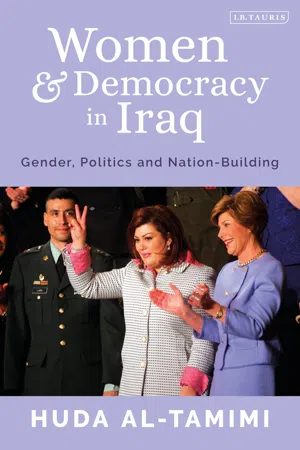
As the post-invasion reconstruction of Iraq has unfolded, the potential for Iraqi women to participate actively and visibly in the country's political structure has been one of its most notable results. The 2005 Constitution required that no less than 25% of seats in the Iraqi Parliament be filled by women. Yet despite subsequent parliamentary statistics suggesting great strides for female political participation, there has been a resounding silence on the wider implications of this quota for women in Iraqi political life.
This book is the first full-length study of women's political representation in Iraq. Based on interviews with politicians and substantial media analysis, Huda Al-Tamimi outlines the political, sectarian and cultural constraints facing female Members of Parliament, and the ways in which individual women and women's organizations are actively challenging barriers to their political influence. The book is a vital contribution to discussions concerning the success and limitations of gender quotas in the Middle East. It also offers new and critical perspectives on the evolution of Iraqi politics, a subject that remains of high priority for a region and international community interested in the nation's reconstruction.
- 328 pages
- English
- ePUB (mobile friendly)
- Available on iOS & Android
eBook - ePub
About this book
Information
1
Introduction: Impetus behind the Parliamentary Gender Quota in Iraq
Ever since the region that is now modern Iraq first came under Ottoman rule in the sixteenth century, the fortunes of Iraqi women have waxed and waned in step with fluctuations in the country’s political climate. Throughout contemporary history, Iraqi women have struggled simply to gain and hold basic rights. Amid shifts in the political landscape that have included monarchies, dictatorships, armed conflict, international sanctions and civil unrest, women’s ability to have a measurable impact on Iraq’s public policy has remained minimal across time. It may be argued that the opportunity for women to exert a viable influence on the country’s future through formal election to, and participation in, public office has only very recently become possible. This situation was brought about largely by the political and institutional reconstruction following the United States’ invasion of Iraq in 2003. The expressed primary aim of the invasion was to locate and destroy weapons of mass destruction (WMD). As these claims were repudiated,1 the rationale turned to the need to depose the Iraqi president Saddam, whose Ba’athist regime was accused of state-sponsored violence and political persecution of the Iraqi people for more than two and a half decades.
While the regime change sparked by US-allied forces in Iraq was met with outrage among certain segments of the Iraqi and international communities,2 it gave many Iraqi people hope for the possibility of moving to a democratic government. The invasion and the nation-state’s subsequent moves toward democratization have led to mixed results for Iraqi women in politics as well as across the domestic, religious, legal and employment sectors. Reforms to the judicial, legislative and executive governing powers under the political transition post-2003 aimed to establish more liberal discourses in Iraq, particularly relating to Iraqi women’s role in government. Although the hopes of instituting more gender-egalitarian trends have been dampened by factors including lack of security and ongoing contentions between political parties and religious factions, Iraq’s transition to democracy has indeed shaped new processes by which women may potentially mobilize, become active and seek political influence.3
As the post-invasion reconstruction of Iraq has unfolded, the potential for Iraqi women to participate actively and visibly in the country’s political structure has been one of its most notable results. Increased opportunities for women to engage in public policy-making can be attributed to the redrafting of the Iraqi Constitution in 2005.4 Specifically, a quota for female Members of Parliament (MPs) became embedded within the Elections Law, legislating that women should achieve “not less than one-quarter of the Council of Representatives members” (Article 47, Section 4).5
The 2005 Constitution granted women at least nominal equality with men, retaining an article that has been in place since the Ba’athist Provisional Constitution was adopted in 1970: “Iraqis are equal before the law without discrimination based on gender, race, ethnicity, origin, color, religion, creed, belief or opinion, or economic and social status” (Article 14). The 2005 Constitution extended this formalized statement of gender equality into the political sphere: “The citizens, men and women, have the right to participate in public affairs and to enjoy political rights including the right to vote, to elect and to nominate” (Article 20). Although the transition to democracy has been characterized by sectarian conflict and increased violence toward women, the new constitution also has offered the promise of an unprecedented formal political role for women in the Iraqi Parliament.
After the new constitution was ratified, parliamentary elections in 2005, 2010 and 2014 resulted in 31.5 percent, 26.1 percent and 25.3 percent of parliamentary seats being awarded to women, respectively.6
While those statistics suggest great strides for women’s political participation, the current literature is largely silent about the extent to which Iraqi female politicians have been empowered by greater representation. The study of gender quotas stipulates that the inclusion of women in governing institutions is critical, as gaining parliamentary seats is not an end in itself, but rather a means for participating in authoritative decision-making that determines how a society functions. The achievement of gender impartiality in post-conflict countries and insuring democracy in the long term depend on many elements comprising the progress of a democratic political culture, the level of mobilization of women in civil society, and the clearness and reliability of democratic establishments.7
In this sense, quota scholars Ballington and Dahlerup differentiate between the descriptive and substantive representation of women in politics: from simple increases in numbers of female representatives in the elected body to evaluations of those women’s efficacy and achievements as political agents.8 Childs and Krook extend this distinction by urging researchers to consider “how the substantive representation of women occurs” and discerning “what specific actors do,” in recognition of the diversity of women’s voices.9 In this way “substantive representation” can be understood not simply as those who “initiate policy proposals,” but also those who “embolden others to take steps to promote policies for women, regardless of the number of female representatives.”10
A further distinction may be drawn in the form of symbolic representation, a term that refers to the legitimacy of political institutions and their representatives as perceived by the constituencies being represented.11 The extent to which women gain symbolic capital and ability to influence public policy determines in part the degree to which democratic processes develop and function adequately. For this reason, it is recommended to explore public opinion, including media discourses, surrounding the implementation of gender quotas to understand quota effects comprehensively.12
Given that multiple schools of thought align gender justice with democracy, it is important to delineate the difference between Western democracy and the notions of reformers in the Arab world. This distinction must by definition take into account the influences of Islam, as religion has been highly politicized and deeply ingrained into Iraqi social and cultural frameworks. Any articulation of Islamic democracy must be premised on the acceptance of tawhid; that is the conviction and witness that “there is no God but God” and at “the core of the Islamic religious experience … stands God Who is unique and Whose will is the imperative and guide for all.”13 Within this framework lie the Islamic notions of consultation, consensus and ijtihad.14 Contributing to the debate about Islam and democracy, Fatema Mernissi acknowledges the importance of institutions and concepts of Western representative democracy such as “constitution,” “parliament” and “universal suffrage”;15 however, she asserts that for Arab women, democracy is a mark of modernity that presents “an unhoped-for opportunity to construct an alternative to the tradition that weighs so heavily … [to find] new worlds where freedom is possible.”16 Although in the Iraqi context greater opportunity now exists for women to influence public policy via the political process, the formal gender equality of political engagement remains elusive. That aside, Iraqi women have a long tradition of political activism and participation in their country’s affairs, even though their mobilization in formal political roles has languished throughout history.
This book aims to explicate the avenues by which Iraqi women gain and hold parliamentary positions under the electoral gender quota, the extent to which they do influence policy change and their personal experiences while serving as public agents. By illuminating the processes by which Iraqi women are mobilized in Parliament and the subsequent outcomes for women, this research responds to the challenge promulgated by Childs and Krook. The book evaluates Iraq’s progress toward eroding gender-based discrimination and considers its potential to identify future opportunities for women to engage effectively in the political and social advancement of their gender.
The role of women in politics is important to consider when characterizing a country’s developmental and gender-egalitarian status because social change comes about in large part through political action.17 How women become motivated and recognized as political actors can be understood only in the context of their particular cultures and histories, and analyzing this context may reveal both possibilities for and limitations on women’s public influence in a given state.18 At the same time, social forms such as gender status and political representation cannot be entirely isolated from regional and global influences.19 Women across the Middle East share patterns of political participation, with shifts in their public roles mirroring larger political changes that have occurred across the region.20 Throughout history, the role of Middle Eastern women in politics has tended to be inconsistent, informal and organized in support of men with whom they have socially accepted connections. The avenue through which women’s political activism becomes legitimized (i.e., the state, religious authorities or primordial political units such as tribes or clans) affects both the potential for women to become active political agents and the forms their political influence takes.21
Both men and women in the Middle East have become increasingly politicized since the beginning of the twentieth century.22 Factors such as population growth, urbanization, economic development and globalization, education and labor force expansion have contributed to these increases in political activism among people across all social classes.23 Some of the twenty-first-century discourse on globalization and democracy has posited that global influence on developing countries has a gender dimension, as noted by leading feminist scholars such as Valentine Moghadam, Sylvia Walby and Laurel Weldon who argue that democracy cannot be achieved unless women become full participants in the political process—whether through formally elected public office or through social movements.24 Democratization has been problematical across the Middle East due to the region’s engagement in generations-long cultural conflicts between traditionalists and modernists, fundamentalists and liberalists, proponents of equality of citizenship and those who support the politics of national identity and so-called authenticity.25 These ideological clashes bear heavily on gender relations as traditionally patriarchal societal systems are challenged by increasingly vigorous women’s movements advocating for democratization as well as demanding the full participation of women in the political, economic, labor and conflict resolution systems.26 This process has been addressed in several bodies of literature and has formed the theme of a number of international conferences. For example, in 1995, the Fourth World Conference on Women in Beijing acknowledged the underrepresentation of women at most governmental levels, the central role of gender in the development of nations and the need to empower women as decision-makers to achieve transparent and accountable government.27
Deniz Kandiyoti postulates that, despite the widely differing trajectories of evolution of their states and societies, all Middle Eastern countries have struggled with similar challenges in establishing modern nation-states and developing new notions of sovereignty and citizenship.28 She further argues that an adequate analysis of women’s status in predominantly Muslim societies must be “grounded in a detailed examination of the political projects of contemporary states and of their historical transformations.”29 The representation of women in political discourses, levels of formal emancipation they have reached and forms of economic and political participation they have achieved are inextricably linked to state-building processes. The question of Middle Eastern women’s experience has emerged as a hotly debated issue where the treatment of women comes either to symbolize ideologies formed to legitimize new forms of state power or to support the cultural authenticity of conservative Islam. The nature of a country’s formative experiences, then, must be analyzed to clarify the roles of its women in sociopolitical processes. The degree to which women are integrated into civic and political life has come to serve as one barometer for the nation-state’s level of modernization.30
Specific to the Iraqi situation, several variables and combinations thereof have contributed to fluctuations in women’s rights, position and political participation across history. These contributing factors have included tribal segmentation and traditions, patriarchal structures, religiosity, wars, political agendas and party ideologies, the socioeconomic climate, globalization and international pressures. Overwhelmingly across history, Iraqi society was patriarchal with male authority permeating every institution from the family to the echelons of government, and women were conditioned from birth for obedience. Early measures to encourage the emancipation of Iraqi women were taken during a repressive authoritarian regime, rather than as part of a gradual evolution toward democratization and the autonomous representation of gender interests.31 The tyrannical nature of the state that emerged in the 1970s and the international sanctions imposed in the 1990s disintegrated Iraqi society and traumatized its citizens. Factors that should have been assets to women, such as increased education, employment, suffrage and multiculturalism, had the potential to become liabilities as the state manipulated the notion of Iraqi iden...
Table of contents
- Cover
- Halftitle Page
- Dedication Page
- Title Page
- Contents
- Acknowledgments
- 1 Introduction: Impetus behind the Parliamentary Gender Quota in Iraq
- 2 Historical Context for Iraqi Women’s Political Participation
- 3 Gender Quotas and Women’s Political Mobilization in Iraq and the Middle East
- 4 Descriptive Representation: Quota Effects on Numbers of Women in Office
- 5 Case Studies: Twelve Iraqi Female Members of Parliament since 2005
- 6 Substantive Representation: How Have Women Affected Public Policy?
- 7 Symbolic Representation: Legitimacy and Media Treatment of Women as Political Agents
- 8 The Iraqi Political Situation and Women’s Representation Post-2014: An Update on Case Study MP Activities since 2014
- 9 Conclusion
- Notes
- Bibliography
- Index
- Copyright Page
Trusted by 375,005 students
Access to over 1.5 million titles for a fair monthly price.
Study more efficiently using our study tools.
Frequently asked questions
Yes, you can cancel anytime from the Subscription tab in your account settings on the Perlego website. Your subscription will stay active until the end of your current billing period. Learn how to cancel your subscription
No, books cannot be downloaded as external files, such as PDFs, for use outside of Perlego. However, you can download books within the Perlego app for offline reading on mobile or tablet. Learn how to download books offline
Perlego offers two plans: Essential and Complete
- Essential is ideal for learners and professionals who enjoy exploring a wide range of subjects. Access the Essential Library with 800,000+ trusted titles and best-sellers across business, personal growth, and the humanities. Includes unlimited reading time and Standard Read Aloud voice.
- Complete: Perfect for advanced learners and researchers needing full, unrestricted access. Unlock 1.5M+ books across hundreds of subjects, including academic and specialized titles. The Complete Plan also includes advanced features like Premium Read Aloud and Research Assistant.
We are an online textbook subscription service, where you can get access to an entire online library for less than the price of a single book per month. With over 1.5 million books across 990+ topics, we’ve got you covered! Learn about our mission
Look out for the read-aloud symbol on your next book to see if you can listen to it. The read-aloud tool reads text aloud for you, highlighting the text as it is being read. You can pause it, speed it up and slow it down. Learn more about Read Aloud
Yes! You can use the Perlego app on both iOS and Android devices to read anytime, anywhere — even offline. Perfect for commutes or when you’re on the go.
Please note we cannot support devices running on iOS 13 and Android 7 or earlier. Learn more about using the app
Please note we cannot support devices running on iOS 13 and Android 7 or earlier. Learn more about using the app
Yes, you can access Women and Democracy in Iraq by Huda Al-Tamimi in PDF and/or ePUB format, as well as other popular books in Politics & International Relations & Middle Eastern History. We have over 1.5 million books available in our catalogue for you to explore.