Tchavdar S. Hadjiev introduces students to the books of Joel, Obadiah, Habakkuk, and Zephaniah (the Minor Prophets) in their original historical contexts and to the issues surrounding their composition and interpretation.
Hadjiev pays particular attention to important topics such as eschatology, prophecy and cult, intertextuality, theodicy and the genre of the prophetic book. Readers will come to grips with the key themes of judgment, repentance, and salvation in relation to their historical and canonical contexts. Finally, Hadjiev provides a theological evaluation of the prophetic attitude to foreigners and the vision of their final destruction, which is pervasive in Joel, Obadiah, Habakkuk and Zephaniah, and helps readers to grapple with this theme in a modern context.
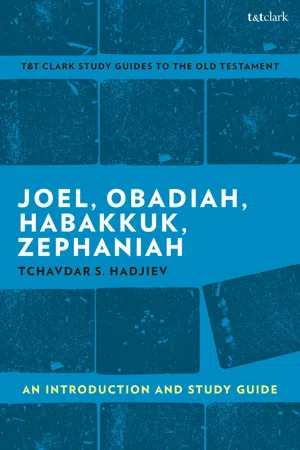
- 160 pages
- English
- ePUB (mobile friendly)
- Available on iOS & Android
eBook - ePub
About this book
Information
1
Joel, Obadiah, Habakkuk, Zephaniah and the book of the Twelve
Chapter Outline
The book of the Twelve hypothesis
Evaluating the hypothesis
Conclusion
Further study
The book of the Twelve hypothesis
During most of the twentieth century scholars aimed to read the books of the Minor Prophets primarily against the background of their presumed original historical context. Zephaniah and Habakkuk were usually interpreted against the background of Judah in the late monarchic period (seventh century BCE), during the reigns of Josiah and Jehoiakim. Obadiah was usually placed in the exilic period (sixth century BCE) and Joel in post-exilic times (fifth or fourth century BCE). A good example of this approach can be found in the classic History of Prophecy in Israel by Blenkinsopp (1996).
Over the last three decades a major shift has occurred in this respect. The idea of the ‘book of the Twelve’ arrived in full force on the academic scene. According to this hypothesis the scrolls of the Minor Prophets right from the start were incorporated into a single literary work and were read and redacted with the other prophetic texts in mind. This way of understanding the compositional history of the Twelve has implications for the way in which the individual ‘books’ are to be read. Instead of the putative historical contexts of the prophets’ proclamation, or of the first writing and subsequent redaction of their oracles, scholars now tend to look primarily to the literary context of the Twelve as providing us with the appropriate reference point for understanding the prophetic word.
The particulars of this compositional history are reconstructed in different ways. Nogalski (1993a,b) suggests that there were some ‘literary precursors’ to the book of the Twelve: a book of the Four prophets (Hosea, Amos, Micah and Zephaniah) and a Haggai-Zechariah corpus. The decisive step in the formation of the Twelve was a ‘Joel-related layer’ in which a redactor incorporated these precursors with Joel, Obadiah, Nahum, Habakkuk and Malachi and heavily edited the newly created work to form a single composition. In German scholarship this process is seen as a much more complicated affair. Both Schart (1998) and Wöhrle (2006, 2008a) accept the existence of a book of the Four, but postulate a number of editions between it and the final form of the Twelve. In Schart’s opinion first Nahum and Habakkuk were added, then Haggai and Zechariah, then Joel and Obadiah, each of those resulting in redactional insertions in the already existing corpus. Wöhrle argues that at an early stage Hosea was removed from the beginning of the book of the Four and was replaced by Joel. This reshaped book of the Four was joined to Haggai-Zechariah (and Nahum) and the newly created composition underwent several redactions before Hosea was reintroduced as the opening section of the book of the Twelve. Bosshard-Nepustil (1997) proposes an entirely different model. During the exilic period early versions of Joel, Habakkuk and Zephaniah were added to Hosea, Amos, Micah and Nahum and subsequently edited to parallel the redactional developments of the book of Isaiah.
Whatever the precise details of the reconstructed compositional history, the adoption of such an approach impacts the way these prophetic books are interpreted. For example, Nogalski (2000) terms Joel the ‘literary anchor’ of the Twelve and argues that it is meant to be read not independently but with the rest of the Minor Prophets in mind. It introduces key motifs like fertility, Judah and Jerusalem and the Day of the Lord that resurface later and unify the collection. The book offers a ‘historical paradigm’ centred around the themes of disaster, repentance, restoration and judgement of enemy nations that is meant to serve as an interpretative prism through which the rest of the Minor Prophets are to be read. This paradigm provides an explanation for the shape of the history that is to unfold in the Twelve and a hope for its final outcome.
According to Everson (2003) the book of the Twelve in its totality presents the reader with a ‘theology of history’ which understands the Assyrian, Babylonian and Persian periods as a series of ‘days of Yahweh’: historical crises in which Yahweh’s kingship and presence were manifested in particular ways. Within that scheme Habakkuk is a reflection on the tragic death of Josiah in 609 BCE coming straight after the ‘day of Yahweh’ manifested in the demise of Assyria, depicted in Nahum. Habakkuk contributes to the Twelve’s theology of history by focusing on a period of disillusionment when, in contrast to the ‘days of Yahweh’, God’s intervention and blessing were not immediately apparent. Its contribution consists of the call to remain faithful through the difficult times of uncertainty and suffering.
Evaluating the hypothesis
Two types of evidence, external and internal, support the existence of a ‘book of the Twelve’, according to the proponents of this theory: First, manuscript evidence and references in ancient sources suggest that the first recipients of the books of the Minor Prophets regarded them as integral parts of a single whole (Nogalski 1993a: 2–3; Jones 1995: 8; Fuller 1996; Schart 1998: 4). Second, careful analysis of the text demonstrates that the Twelve exhibit a number of literary interconnections. Exploration of these connections forms an important part of the work of Nogalski, Schart, Bosshard-Nepustil and Wöhrle, reviewed above. The existence of such links, in their view, suggests a deliberate effort to bind the prophetic scripts together. The careful reader will pick up the numerous allusions and interpret the various parts of the collection in light of each other.
Not everyone, however, has been convinced by this approach (Ben Zvi 1996c, 2009b; Beck 2005; Hadjiev 2009: 7–40; Renz 2018). The fact that towards the end of the first millennium BCE the Twelve were copied onto a single scroll and sometimes referred to as a single entity does not tell us very much. It shows that eventually the twelve independent scripts of the Minor Prophets were brought together in an anthology type collection (Beck 2006), but does not necessarily throw any light on
the process of their composition or the intentions of the editors responsible for the final form of their books (Hadjiev 2020). The alleged interconnections between the books of the Minor Prophets are an even less secure basis on which to build such a theory. Sometimes the appearance of shared vocabulary is simply a coincidence. On other occasions there are unmistakable literary allusions, but their role is not to suggest to the reader that the different books of the Minor Prophets form a single composition (Ben Zvi 1996c: 135–42; Hadjiev 2010, 2020; Renz 2018).
Moreover, some textual features point in the exact opposite direction, that the Minor Prophets are to be read separately, not together. Unlike the books of Isaiah, Jeremiah and Ezekiel, the putative ‘book of the Twelve’ is not unified by means of a single prophetic figure, or a common title. If anything, by attributing the prophetic material to different individuals from different historical periods, the superscriptions of the various Minor Prophets create the impression that these are independent works (Ben Zvi 1996c: 137). The Minor Prophets possess their own unique style, theology and structure that sets them apart from one another. The ‘book of the Twelve’, on the other hand, has none of those features. Apart from a broad chronological development it has no discernible structure. In fact, in the different textual traditions the order of some of the books varies. The Twelve also possess no common theme (Renz 2018; Hadjiev 2020). Even the ‘Day of the Lord’ motif, which occurs more frequently in the Minor Prophets than anywhere else in the Hebrew Bible, is not pervasive and uniform enough to qualify as an unifying theme for the Twelve (Beck 2005). It features prominently in some scrolls (Joel, Obadiah, Zephaniah) but plays only a marginal, or non-existent, role in others (Hosea, Nahum, Habakkuk, Jonah).
Conclusion
The old position, that the Minor Prophets were originally independent writings and are, at least in the first instance, to be approached as such, has still a lot to commend it. This is not to say that the ‘Twelve’ cannot, or should not, be read as a collection. However, it has to be clear that such readings are based on the decision of the reader to place the prophetic scrolls in a larger literary, or canonical, context, not the intention of the editors who produced the ‘Twelve’. Within such contexts the prophetic books may acquire new meanings, but that still does not negate the necessity of looking at them first and foremost as independent works.
Further study
On the book of the Twelve hypothesis see Nogalski, 1993a,b; Dicou 1994; Jones 1995; Bosshard-Nepustil 1997; Schart 1998; Wöhrle 2006, 2008a. On Joel and the Twelve see Nogalski 2000; Sweeney 2003b; Wöhrle 2010; Jeremias 2012; Troxel 2015b. On Habakkuk and the Twelve see Everson 2003 and Renz 2018. On the Day of the Lord see Beck 2005. More general criticisms of the hypothesis are offered by Ben Zvi 1996c, 2009b; Hadjiev 2009, 2010, 2020. On the Twelve as an anthology see Beck 2006. For a helpful survey of recent scholarship on the Twelve see Jones 2016.
Part One
Joel
2 Reading Joel as a composite literary work: The structure and unity of the book
3 The contexts of Joel: Historical, literary and canonical
4 The setting and genre of Joel
5 ...
Table of contents
- Cover
- Half-Title
- Series
- Title
- Contents
- Series preface
- Abbreviations
- Introduction
- 1 Joel, Obadiah, Habakkuk, Zephaniah and the book of the Twelve
- Part One Joel
- Part Two Obadiah
- Part Three Habakkuk
- Part Four Zephaniah
- Bibliography
- General subject index
- Index of scripture references
- Copyright
Trusted by 375,005 students
Access to over 1.5 million titles for a fair monthly price.
Study more efficiently using our study tools.
Frequently asked questions
Yes, you can cancel anytime from the Subscription tab in your account settings on the Perlego website. Your subscription will stay active until the end of your current billing period. Learn how to cancel your subscription
No, books cannot be downloaded as external files, such as PDFs, for use outside of Perlego. However, you can download books within the Perlego app for offline reading on mobile or tablet. Learn how to download books offline
Perlego offers two plans: Essential and Complete
- Essential is ideal for learners and professionals who enjoy exploring a wide range of subjects. Access the Essential Library with 800,000+ trusted titles and best-sellers across business, personal growth, and the humanities. Includes unlimited reading time and Standard Read Aloud voice.
- Complete: Perfect for advanced learners and researchers needing full, unrestricted access. Unlock 1.5M+ books across hundreds of subjects, including academic and specialized titles. The Complete Plan also includes advanced features like Premium Read Aloud and Research Assistant.
We are an online textbook subscription service, where you can get access to an entire online library for less than the price of a single book per month. With over 1.5 million books across 990+ topics, we’ve got you covered! Learn about our mission
Look out for the read-aloud symbol on your next book to see if you can listen to it. The read-aloud tool reads text aloud for you, highlighting the text as it is being read. You can pause it, speed it up and slow it down. Learn more about Read Aloud
Yes! You can use the Perlego app on both iOS and Android devices to read anytime, anywhere — even offline. Perfect for commutes or when you’re on the go.
Please note we cannot support devices running on iOS 13 and Android 7 or earlier. Learn more about using the app
Please note we cannot support devices running on iOS 13 and Android 7 or earlier. Learn more about using the app
Yes, you can access Joel, Obadiah, Habakkuk, Zephaniah by Tchavdar S. Hadjiev in PDF and/or ePUB format, as well as other popular books in Theology & Religion & Biblical Studies. We have over 1.5 million books available in our catalogue for you to explore.