This interdisciplinary volume of text and art offers new insights into various unsolved mysteries associated with Mary Magdalene, Mary of Bethany, Mary the Mother of Jesus, and Miriam the sister of Moses. Mariamic traditions are often interconnected, as seen in the portrayal of these women as community leaders, prophets, apostles and priests. These traditions also are often inter-religious, echoing themes back to Miriam in the Hebrew Bible as well as forward to Maryam in the Qur'an. The chapters explore questions such as: which biblical Mary did the author of the Gospel of Mary intend to portray-Magdalene, Mother, or neither? Why did some writers depict Mary of Nazareth as a priest? Were extracanonical scriptures featuring Mary more influential than the canonical gospels on the depiction of Maryam in the Qur'an?
Contributors dig deep into literature, iconography, and archaeology to offer cutting edge research under three overarching topics. The first section examines the question of "which Mary?" and illustrates how some ancient authors (and contemporary scholars) may have conflated the biblical Marys. The second section focuses on Mary of Nazareth, and includes research related to the portrayal of Mary the Mother of Jesus as a Eucharistic priest. The final section, "Recovering Receptions of Mary in Art, Archeology, and Literature," explores how artists and authors have engaged with one or more of the Marys, from the early Christian era through to medieval and modern times.
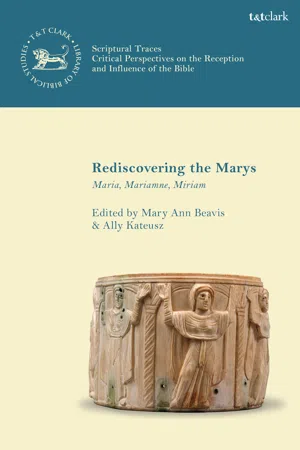
eBook - ePub
Rediscovering the Marys
Maria, Mariamne, Miriam
- 288 pages
- English
- ePUB (mobile friendly)
- Available on iOS & Android
eBook - ePub
Rediscovering the Marys
Maria, Mariamne, Miriam
About this book
Information
Section One
Revisiting Which Mary: Does Which Mary Matter?
1
The Magdalene Effect
Reading and Misreading the Composite Mary in Early Christian Works
Mark Goodacre
Introduction
It is rare for biblical scholars to make an impact on popular culture, but there is one area where they have achieved something remarkable. After centuries of confusion over the character and reputation of Mary Magdalene, scholars of early Christianity have achieved a coup. They have successfully persuaded novelists, documentary makers, and even film producers that Mary Magdalene was not a sex worker1 and, moreover, that she was one of the most important figures in the emerging Christian movement, the first witness of the resurrection, the apostle to the apostles. The success of the coup has a lot to do with popular culture’s love of revisionist history, alongside the gratifying anti-ecclesial sentiment that the church has done a key character a grave injustice.2 But the roots and energy for the coup are found in the pioneering work done over the last generation by scholars like Elaine Pagels, Elizabeth Schüssler Fiorenza, Karen King, Ann Graham Brock, Jane Schaberg, and Esther De Boer, all of whom have established beyond reasonable doubt that Mary Magdalene is a key character worthy of careful study not only in the synoptic gospels and John but also in other early Christian gospels.3
The primary stimulus for the rehabilitation and celebration of Mary has been the discovery of her own gospel, the Gospel of Mary, interest in which coincided with the development of feminist hermeneutics.4 Here was a gospel that bore the name of a woman, which had been lost for centuries and which may well have been suppressed by male authorities. In spite of its apparent popularity, attested in three separate witnesses, two from the third century,5 it is not even dignified with a mention by any patristic author.
If the publication and study of the Gospel of Mary has provided a major motivation for the reassessment of Mary’s reputation, interest in her character has been further stimulated by the exploration of other early Christian gospels in which she appears, not only those discovered at Nag Hammadi in 1945, the Gospel of Thomas, the Dialogue of the Saviour, and the Gospel of Philip,6 but also Pistis Sophia, first published in 1776 but only now beginning to get the attention it deserves.7 What has emerged in the scholarship on Mary in these works is a fascinating portrait of a leading woman in early Christianity, a spokesperson for the disciples, a visionary who is Jesus’ confidante, a leader who holds her own in debate and whom Jesus loves more than anyone else.
There is, however, an important question about this woman that is seldom asked. It is usually simply assumed that the woman in question is Mary Magdalene. The Gospel of Mary is often christened The Gospel of Mary Magdalene and scholars characterize the woman found in early Christian gospels as “the Magdalene.” But is this description accurate? Is it clear that the woman witnessed in these works is Mary Magdalene, or is she in fact a composite character who has traits drawn not only from Mary Magdalene but also from Mary of Bethany? I would like to argue that the Mary of early Christian gospels is not Mary Magdalene. Or, more precisely, the point is that she is not solely Mary Magdalene. As a literary character, she is drawn with elements that derive not only from Mary Magdalene but also from Luke’s and John’s portraits of Mary of Bethany—she has a sister called Martha, she prostrates herself at Jesus’ feet, she weeps, she listens, and she loves Jesus very much.8
The Gospel of Mary of Magdala?
Karen King’s important and influential book on The Gospel of Mary characterizes the work as The Gospel of Mary of Magdala. It is the new title of the work. The identity of its lead character is clear—this is Mary Magdalene.9 Jane Schaberg is so certain about the identity of Mary, both here and in other early Christian gospels, that she repeatedly simply calls her “the Magdalene.”10 Esther de Boer and Marvin Meyer, on their first mention of “the Gospel of Mary,” clarify immediately: “—that is, the Gospel of Mary Magdalene.”11 Likewise, Bruce Chilton explains, as he introduces the gospel, that “The Mary in the title refers to the Magdalene.”12 Others make the identification as a simple aside, as when Hal Taussig introduces her as “the figure of Mary (most likely Magdalene).”13 Indeed, the identification goes back to the first publication of the gospel by Carl Schmidt at the end of the nineteenth century.14
It is, in other words, a matter largely established in scholarship on early Christianity that the Gospel of Mary is rightly re-titled the Gospel of Mary of Magdala and that its heroine is Mary Magdalene. If there were any doubt about Mary’s identity in this work, it is thought to be further established by other early Christian gospels. The Gospel of Thomas, the Gospel of Philip, the Dialogue of the Saviour, and Pistis Sophia are all regarded as works that feature Mary Magdalene as a character.
In the light of this kind of certainty, a reminder about the title of the Gospel of Mary is in order. In the Codex Berolinensis Gnosticus (BG 8502), the work is called ⲡ[ⲉ]ⲩⲁⲅⲅⲉⲗⲓⲟⲛ ⲕⲁⲧⲁ ⲙⲁⲣⲓϩⲁⲙⲙ, “the gospel according to Mary.” The character is called ⲙⲁⲣⲓϩⲁⲙⲙ (“Mariham”) throughout. The gospel is not called “the Gospel of Mary Magdalene,” the character is never called “Mary Magdalene,” and the town “Magdala” is never mentioned.15 Similarly, in the two Greek fragments, P.Oxy 3525 and P.Ryl 463, she is called Μαριάμμη (“Mariammē”) and not Mary Magdalene. The same is true of the Gospel of Thomas, the Dialogue of the Saviour, and the Sophia of Jesus Christ.16 In each of these works, the character’s name is simply Mary.17
Mary of Bethany in Early Christian Gospels
Given the rarity of the epithet “Magdalene” in these works, it is worth asking whether the character should be read as Mary Magdalene. It is certainly the case that the character called Mary often has traits derived from the depiction of Mary Magdalene in the Synoptics and John.18 The post-resurrection dialogue format of the Gospel of Mary and the Dialogue of the Saviour provides a context that coheres with Mary Magdalene’s presence, given her prominence in the resurrection narratives in the Synoptics (Matt 28:1–10; Mark 16:1–8; Luke 24:1–11) and especially John (John 20:1–18). There is also a possible echo of John’s resurrection narrative in the Gospel of Mary:
| John 20:18 | Mary 7.1-2 (Greek) | Mary 7.1-2 (Coptic) |
| ἔρχεται Μαριὰμ ἡ Μαγδαληνὴ ἀγγέλλουσα τοῖς μαθηταῖς ὅτι ἑώρακα τὸν κύριον, καὶ ταῦτα εἶπεν αὐτῇ. | [καὶ ἦρχεν αὐτοῖς τού]των τῶν λόγ(ων), ἐμ[οῦ] ποτε ἐν ὁράματι ἰδ[ούσης τὸν κύριον εἶπον], κύριε σήμερον … | ⲁⲩⲱ ⲁⲥⲁⲣⲭⲉⲓ ⲛ̅ϫⲱ ⲛⲁⲩ ⲛ̅ⲛⲉϊϣⲁϫⲉ ϫⲉ ⲁ{ϊ}ⲛⲟⲕ ⲡⲉϫⲁⲥ ⲁⲓⲛⲁⲩ ⲉⲡϫ̅ⲥ̅ ϩⲛ ⲟⲩϩⲟⲣⲟⲙⲁ ⲁⲩⲱ ⲁⲉⲓϫⲟⲟⲥ ⲛⲁϥ ϫⲉ ⲡϫ̅ⲥ̅ ⲁϊⲛⲁⲩ ⲉⲣⲟⲕ ⲙ̅ⲡⲟⲟⲩ ϩⲛ ⲟⲩϩⲟⲣⲟⲙⲁ ⲁϥⲟⲩⲱϣⲃ ⲡⲉϫⲁϥ ⲛⲁϊ ϫⲉ … |
| John 20:18 | Mary 7:1-2 |
| Mary Magdalene went and announced to the disciples, “I have seen the Lord”; and she told them that he had said these things to her. | She said, “I saw the Lord in a vision and I said to him, ‘Lord, I saw you today in a vision.” |
Although the agreement is not close, the parallel is suggestive. In John’s gospel, Mary Magdalene announces to the disciples that she has seen the Lord while in the Gospel of Mary, Mary announces that she has seen the Lord “in a vision.” The Gospel of Mary may be evoking Mary Magdalene’s words from John’s gospel,19 but the parallel is not close enough for the reader to be sure.20
However, other motifs that might be linked to Mary Magdalene are at least equally characteristic of Mary of Bethany. Thus, Mary is often characterized by weeping (Gos. Mary 9.5; Dial. Sav. 126.13–14; Pistis Sophia 5.138), and this has an obvious parallel in John 20:11–18, when Mary Magdalene weeps at the tomb, but the motif of Mary’s weeping is something that is also found in relation to Mary of Bethany.21 Her weeping at Lazarus’s tomb in John 11:33 leads directly to one of the most famous and memorable moments of John’s gospel, when Jesus wept (John 11:35).22
Similarly, one of the most characteristic actions of Mary in Pistis Sophia, her prostration at Jesus’ feet, is not peculiar to Mary Magdalene in the Synoptics or John; it is characteristic of Mary of Bethany. In Pistis Sophia, the motif is repeated ove...
Table of contents
- Cover
- Series Page
- Title Page
- Contents
- Figures
- Abbreviations
- Introduction
- Section One Revisiting Which Mary: Does Which Mary Matter?
- Section Two Rediscovering the Marys in Mission and Leadership
- Section Three Recovering Receptions of the Marys in Literature, Art, and Archaeology
- References
- Contributors
- Index
- Index of Biblical References
- Copyright Page
Trusted by 375,005 students
Access to over 1.5 million titles for a fair monthly price.
Study more efficiently using our study tools.
Frequently asked questions
Yes, you can cancel anytime from the Subscription tab in your account settings on the Perlego website. Your subscription will stay active until the end of your current billing period. Learn how to cancel your subscription
No, books cannot be downloaded as external files, such as PDFs, for use outside of Perlego. However, you can download books within the Perlego app for offline reading on mobile or tablet. Learn how to download books offline
Perlego offers two plans: Essential and Complete
- Essential is ideal for learners and professionals who enjoy exploring a wide range of subjects. Access the Essential Library with 800,000+ trusted titles and best-sellers across business, personal growth, and the humanities. Includes unlimited reading time and Standard Read Aloud voice.
- Complete: Perfect for advanced learners and researchers needing full, unrestricted access. Unlock 1.5M+ books across hundreds of subjects, including academic and specialized titles. The Complete Plan also includes advanced features like Premium Read Aloud and Research Assistant.
We are an online textbook subscription service, where you can get access to an entire online library for less than the price of a single book per month. With over 1.5 million books across 990+ topics, we’ve got you covered! Learn about our mission
Look out for the read-aloud symbol on your next book to see if you can listen to it. The read-aloud tool reads text aloud for you, highlighting the text as it is being read. You can pause it, speed it up and slow it down. Learn more about Read Aloud
Yes! You can use the Perlego app on both iOS and Android devices to read anytime, anywhere — even offline. Perfect for commutes or when you’re on the go.
Please note we cannot support devices running on iOS 13 and Android 7 or earlier. Learn more about using the app
Please note we cannot support devices running on iOS 13 and Android 7 or earlier. Learn more about using the app
Yes, you can access Rediscovering the Marys by Mary Ann Beavis, Ally Kateusz, Mary Ann Beavis,Ally Kateusz in PDF and/or ePUB format, as well as other popular books in Theology & Religion & Biblical Studies. We have over 1.5 million books available in our catalogue for you to explore.