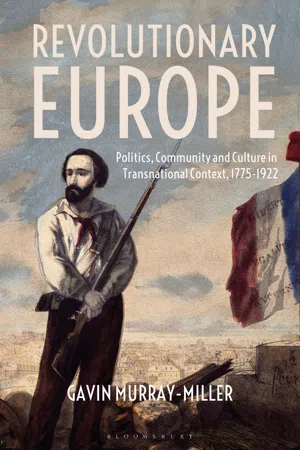
eBook - ePub
Revolutionary Europe
Politics, Community and Culture in Transnational Context, 1775-1922
- 368 pages
- English
- ePUB (mobile friendly)
- Available on iOS & Android
eBook - ePub
Revolutionary Europe
Politics, Community and Culture in Transnational Context, 1775-1922
About this book
CHOICE Outstanding Academic Title 2021
Revolutionary Europe is an original examination of radical political movements during Europe's long 19th century. It employs both national and transnational contexts, incorporating new debates in Atlantic history, empire studies and cultural history to give a comprehensive narrative of the period from 1775 to 1922.
Rather than assessing revolution as a purely theoretical, socially-driven force or a structural phenomenon, the book presents revolution as a process of community building and cultural identification born from instances of acute social and political crisis. Taking into account various moments of political upheaval during the 19th century, including the French, Russian and 1848 revolutions, it explores the ways in which political actors attempted to construct new definitions of sovereignty and social unity in a period characterized by vast social, economic and governmental change.
In a wide-ranging text that covers Britain and much of continental Europe in detail, as well as reaching out to the Americas and Atlantic and Mediterranean Worlds, Gavin Murray-Miller provides an authoritative transnational study of revolution in the 19th-century age of high nationalism.
Information
CHAPTER 1
PATRIOTS AND CITIZENS: AMERICA AND FRANCE (1763–1789)
“From what we now see, nothing of reform on the political world ought to be held improbable,” the radical Thomas Paine wrote in 1791. “It is an age of Revolutions, in which everything must be looked for.”1 Having witnessed political strife and conflict across two continents, Paine certainly knew of what he spoke. During the late eighteenth century, popular protests and political unrest were symptomatic of a transformation occurring throughout the Atlantic world that contemporaries did not hesitate to identify as a “revolution.” If the term possessed a certain novelty, it was by no means unfamiliar to European and colonial elites. Nearly three decades earlier, the Enlightenment philosopher Voltaire had remarked, “Everything I see is sowing the seeds of a revolution that is bound to occur. … Our young people are very fortunate, they will see great things.”2 As to whether the “revolution” imagined by Paine and Voltaire were one and the same is questionable. Yet it was undeniable that each in their one way saw themselves as living in a moment of profound change in which “everything must be looked for.”
Historians have been inclined to view the late eighteenth century as an “age of democratic revolution” that began in the British colonies before spreading through Europe and the Americas. At the heart of this revolutionary drama were pitched battles for freedom and the creation of new independent nations founded on the ruins of illiberal early modern empires.3 In more romantic variations of this narrative, the period saw “the people” or “the nation” awaken from their slumber to become the authors of their own destiny. To label the period an age of “democratic revolution” is, however, to focus on the outcomes rather than the causes. While ideas regarding rights and liberty had been circulating throughout eighteenth-century society for some time, the catalysts for the violent convulsions that took place had far more systemic and diverse origins. During the mid-eighteenth century, states confronted a series of new problems stemming from imperial rivalries and growing expenses associated with state building projects. These factors aggravated a common struggle between center and periphery that cut across early modern empires.4 At the same time, economic growth and a budding consumer culture were undermining traditional social hierarchies in favor of wealth and market-driven relationships.5 Taken together, historians have argued that these broad changes engendered social and political tensions that would encourage new models of sovereignty and political belonging underpinning modern conceptions of citizenship.
It is, however, important to note that these dynamics provided the backdrop against which revolutions unfolded. They establish a context for assessing radical change, but they do not sufficiently explain the process of revolution itself. Closer examination reveals that moments of crisis presented new opportunities for re-imagining sovereign and social bonds. As state structures and polities broke down, political actors were increasingly compelled to step in and fill the vacuum left by traditional authority. It was in this respect that concepts like “the people” and “the nation” acquired their saliency. The American and French revolutions were not so much “democratic” revolutions as they were “citizenship” revolutions that profoundly altered the relationship between state and individual.6 Ideas focused on civic participation and contractual government cut across the Atlantic world and played a key factor in shaping understandings of community that reconfigured existing models of sovereignty and political authority. As political elites came to speak in the name of “the people” against kings and royal governors, they were obliged to define this entity and, in the process, furnish the basis for a novel type of society anchored in notions of rights and popular sovereignty. The democratic limitations of these revolutions were clearly evident. Fears over disorder often encouraged elites to seek means of constraining political participation and advancing concepts of citizenship that were compatible with desires for social stability.
In a more direct way, the changing circumstances associated with the collapse of order were also significant in reshaping the very understanding of revolution itself. The concept of “revolution” had a long tradition among European thinkers. It typically connoted a period of civil disorder spurred by tyrannical and corrupting forces. The pamphleteer Marchamont Nedham writing during the English Civil War commended Cromwell’s protectorate as “a Revolution in Government” against the “inconveniences of Tyranny, Distractions [and] Misery” perpetrated by the Stuart monarchy.7 For Thomas Hobbes, revolution implied a conservative principle linked to the restoration of just authority following a cycle of political turmoil. In the restoration of the Stuart dynasty after years of civil war, Hobbes was inclined to see “in this revolution a circular motion of the sovereign power” and a return to legitimate authority.8 As such, revolution connoted a return to first principles and a means of correcting the anarchy and civil discord that tyranny invited.
This interpretation began to change after 1688 in response to the Glorious Revolution that unfolded in England. What one historian has deemed “the first modern revolution” in history saw England engulfed in a sustained period of popular and political violence as battles between monarchist and parliamentarian factions tore the county apart. The upheavals of 1688 radically transformed English society, securing religious tolerance, new political institutions guaranteed by a constitution and a modernizing economic policy that would enrich Great Britain over the coming century.9 Enlightenment thinkers like David Hume and Voltaire were correct to see the seminal events of 1688 as a transformative moment, but others persisted to use the more familiar tropes of restoration and return in comprehending the changes that had occurred. In expressing his admiration for the Glorious Revolution, the English political writer and bibliophile Thomas Hollis saw fit to describe himself as “a lover of liberty, his country and its excellent constitution so nobly restored at the happy Revolution.”10 For Hollis as for many others, revolution continued to be understood as an instrument of restoration, not insurgency or innovation.11
The crises of authority that broke out during the late eighteenth century effectively ingrained the modern meaning of revolution in European political discourse. Reacting against royal “tyranny,” North American colonists would initially call for a return to a society vested in traditional notions of British liberty. However, in the wake of the American war and the debates that grew up in the French Estates General during 1789, it was evident the meaning of revolution was in a state of transition. Rather than a return to the past, the idea of restoration gave way to a break with tradition. Both American and French political actors came to see themselves as creating new communities of citizens that favored “the people” over monarchy and royal absolutism. Such assertions became the central motif of a modern revolutionary tradition that would unequivocally associate revolutionary action with social, political and cultural modernization.
A British Imperial Community
“We are here at the end of the world,” wrote William Byrd I from his plantation on the James River in 1690.12 Two months travel by ship from the English metropole and inhabiting a Virginian wilderness populated with “wild Indians,” it was indeed easy to imagine that one was living at the ends of the earth, or at least what most educated people of the period might have considered the “civilized” world. Two generations later, however, these expressions of isolation and detachment would hardly have been shared among Britons. By the mid-eighteenth century, colonists no longer felt they were inhabiting a distant frontier. Colonial particularism was being eroded by adherence to common British values, collective trade policies and an Anglicized culture. Cities such as London and Manchester seemed less distant thanks in part to the wide availability of English goods and commodities that circulated through the Atlantic.13 Patriotism expressed in anthems and robust declarations testified to an emotional tie felt by individuals coming to see themselves as members of an intercontinental society known as the British Empire.14
Colonists took an interest in the ideas of early English nationalists whose veneration for Anglo-Saxon heritage and the traditions of English constitutionalism reinforced a cultural and historic connection with the metropole.15 Prominent English legal writers and political philosophers such as John Locke insisted upon the unique system of law and government that set England (and later Britain) apart from other societies. While European kingdoms on the continent succumbed to a despotic royal absolutism, Britain clung fast to its traditions of jurisprudence and parliamentarianism, a point settled during the Glorious Revolution of 1688. Common law affirmed the right of subjects to resist arbitrary authority and oppose legislation passed without consent. These were considered the “absolute rights of every Englishman” as the legal historian William Blackstone dubbed them, the “birthright and privilege” of Britons and the basis of its parliamentary government. British “privilege” did not mean “equality”—for deep social cleavages and hierarchies remained entrenched in British society, not least of all slavery. It signified rather what the statesman Edmund Burke would later describe as an “entailed inheritance.”16 This inheritance manifested itself in the laws and institutions that protected the liberties belonging to all subjects.17 It was, in short, what made Englishman “English” or Britons “British.”
In the minds of colonists, liberty was crucial to their understanding of English and British identity. “British Blood runs in our Veins, and the spirit of Englishmen in our Hearts,” as one Jamaican author proclaimed, and by this he meant the spirit of liberty common to all free-born subjects of the crown.18 Settlers inhabiting the distal Atlantic colonies insisted their allegiance to Britain and its empire rested upon loyalty to a common monarchy which was committed to upholding and protecting the rights of its subjects throughout the world. Rights, liberty and privilege: this was how those in the colonies interpreted empire. It constituted a single community united under a sovereign crown and associated through a set of commonly recognized rights. As the governor of Massachusetts, Thomas Pownall explained in 1752: “Tis through this system only that a people become [a] political body; tis the chain, the bonds of union by which very vague and independent particles cohere.”19
The New World provided fertile soil on which to put these ideas of liberty and freedom into practice. For most of the seventeenth and eighteenth centuries, mercantile firms and joint-stock companies participated in overseas expansion and founding settlements abroad. In this respect, colonization was viewed as a private business venture requiring minimal state oversight. The assemblies set up were, for the most part, autonomous, with settlers attending to local administration, trade and day-to-day affairs.20 These bodies provided an education in the practices of political autonomy and self-governance distinct from the abstract theories of liberty found in Enlightenment philosophy.21 For this reason, it was not uncommon that colonial assemblies served as forums of heated debate on the application of common law and the meaning of rights.22 Also for this reason, colonists tended to be among the most ardent defenders of their liberal inheritance. They were quick to remind authorities they could not be treated as one treated conquered people nor that their voluntary departure from home had in any way forfeited their natural liberties. “No Englishman in their Wits will ever Venture their Lives and Estates to Enlarge the Kings Dominion abroad, and Enrich the whole English Nation,” asserted the puritanical minister and Massachusetts official Increase Mathers, “if their Reward after all must be to be deprived of their English Liberties.”23 Colonists looked askance on anything that might be construed as a curtailment of their rights, perennially safeguarding the traditions of law and self-governance to which they believed themselves entitled.24
The freedoms that many colonists extolled were as practical as they were principled. London did not possess the resources or capabilities to administer its vast empire directly. In a very real sense, metropolitan rule depended upon the consent of the colonies, many separated from the mother country by an ocean. In essence, British power did not flow outward from London. Authority was distributed between center and periphery, producing an imperial polity characterized by indirect governance and largely self-governing bodies.25 The fragmentary nature of British authority did not, however, dampen the emotional attachment that many colonists felt toward their empire. Imperial patriotism, whether expressed through shared political ideals or colonial wars fought primarily against the French, reinforced a sense of collective mission and destiny. In 1763, when colonists and the British army succeeded in expelling France from North America, British flags hung in every major colonial city and statues of King George III were erected in town squares. Yet if a British Atlantic commonwealth did exist, the nature of its relationship was never clearly spelled out, and herein lay the problem.
Metropolitans too spoke of British liberty, but in a different context. For them, liberty meant the sovereign authority of Parliament. It was Parliament’s sovereign right to govern and legislate that underwrote Britain’s system of governance and guaranteed the rights and liberties of free-born Britons. As British subjects, colonists were expected to submit to the supreme authority of the kingdom. It was evident that metropolitans and colonists were speaking two different languages of liberty that possessed contrasting understandings of what it meant to be British, a point that became clearly evident in the 1760s as Britain began restructuring the empire.
By mid-century, London faced a ballooning public debt, higher state expenditure and a host of administrative problems associated with managing a vast, multiethnic empire. Catholic French Canadians needed to be assimilated and relations between white settlers and indigenous people effectively managed to avoid violence; trading vessels required naval protection while debt needed to be curbed.26 A more proficient and streamlined imperial structure was envisaged as a solution to these problems, promising what the political economist Malachy Postlethwayt referred to as a greater “union in government and constitution.” “If the English colonies in America were wisely consolidated into one body and happily united in one common interest,” he asked, “… would not such political concord and harmony establish invincible strength and power?”27 In short, a British system of colonial governance was beginning to emerge as officials and policy makers sought to maximize revenue. Rule from the center was becoming the new guiding philosophy, and colonists did not hesitate to label it monarchial “tyranny.”
In the coming years, a series of issues ranging from land policies in the West to new taxes placed on sugar, paper and most notoriously tea provided occasions for conflict. Merchants resorted to boycotts, bootlegging and noncompliance to circumvent the detested taxes. They even obstructed the collection of duties and applied social pressure on cohorts to resist. Tax collectors were particularly unwelcome, in some instances being lynched by mobs and run out of town. Rowdy groups of “patriots” like the Boston-based Sons of Liberty organized craftsmen and laborers and took to the streets. Rioting had a long tradition in English political culture. It was a popular means of expressing social grievances and injustice for those without a political voice, and the language and symbols used by colonists would have hardly been considered unique in the eighteenth century.28 Rioters burned effigies in the street, compared unpopular officials to the devil and made appeals to liberty in public declarations. In 1765, mobs replied to the detested Stamp Act by burning an effigy of Andrew Oliver, the Massachusetts stamp collector. The crowd then gathered outside Oliver’s home, decapitated the effigy to loud cries and proceeded to loot the house. The following week, it was Lieutenant-Governor Thomas Hutchinson’s turn when an angry mob stormed his palatial house and razed it to the ground. Threats of violence echoed throughout the other colonies, with tax collectors and public officials singled out for popular retribution. In these moments of disorder, mobs attained their own authority with some colonists exhibiting a brazen hostility to all forms of social status and authority in the defense of their “liberties.”
No less quarrelsome, colonial elites defended their autonomy in a torrent of pamphlets and petitions. Writers argued that the London parliament did not possess the autho...
Table of contents
- Cover
- Halftitle Page
- Title Page
- Dedication Page
- Contents
- List of Illustrations
- List of Maps
- Acknowledgments
- Introduction
- 1. Patriots and Citizens: America and France (1763–1789)
- 2. Liberty, Equality, Fraternity or Death: Radicalizing the French Revolution
- 3. Artisans, Citoyennes and Slaves: The Meaning of Equality in a Revolutionary World
- 4. Taming the Furies of Revolution: Order, Disorder and Empire (1794–1815)
- 5. Transnational Revolutionaries: Post-Napoleonic Europe and the Mediterranean (1815–1835)
- 6. Socialism and Social Protest: From Reform to Radicalism (1815–1848)
- 7. The Indian Summer of Romantic Revolution: 1848 and the Reassessment of European Radicalism
- 8. The Revolutionary Tradition at a Crossroads: The Anarchists (1865–1905)
- 9. The Revival and Failure of Revolutionary Constitutionalism: The Russian and Ottoman Empires (1905–1914)
- 10. Forging the New Regime: War and Revolution in the Russian Empire (1914–1922)
- Epilogue: Revolutionary Currents beyond Europe
- Notes
- Selected Bibliography
- Index
- Imprint
Trusted by 375,005 students
Access to over 1.5 million titles for a fair monthly price.
Study more efficiently using our study tools.
Frequently asked questions
Yes, you can cancel anytime from the Subscription tab in your account settings on the Perlego website. Your subscription will stay active until the end of your current billing period. Learn how to cancel your subscription
No, books cannot be downloaded as external files, such as PDFs, for use outside of Perlego. However, you can download books within the Perlego app for offline reading on mobile or tablet. Learn how to download books offline
Perlego offers two plans: Essential and Complete
- Essential is ideal for learners and professionals who enjoy exploring a wide range of subjects. Access the Essential Library with 800,000+ trusted titles and best-sellers across business, personal growth, and the humanities. Includes unlimited reading time and Standard Read Aloud voice.
- Complete: Perfect for advanced learners and researchers needing full, unrestricted access. Unlock 1.5M+ books across hundreds of subjects, including academic and specialized titles. The Complete Plan also includes advanced features like Premium Read Aloud and Research Assistant.
We are an online textbook subscription service, where you can get access to an entire online library for less than the price of a single book per month. With over 1.5 million books across 990+ topics, we’ve got you covered! Learn about our mission
Look out for the read-aloud symbol on your next book to see if you can listen to it. The read-aloud tool reads text aloud for you, highlighting the text as it is being read. You can pause it, speed it up and slow it down. Learn more about Read Aloud
Yes! You can use the Perlego app on both iOS and Android devices to read anytime, anywhere — even offline. Perfect for commutes or when you’re on the go.
Please note we cannot support devices running on iOS 13 and Android 7 or earlier. Learn more about using the app
Please note we cannot support devices running on iOS 13 and Android 7 or earlier. Learn more about using the app
Yes, you can access Revolutionary Europe by Gavin Murray-Miller in PDF and/or ePUB format, as well as other popular books in Historia & Historia europea. We have over 1.5 million books available in our catalogue for you to explore.