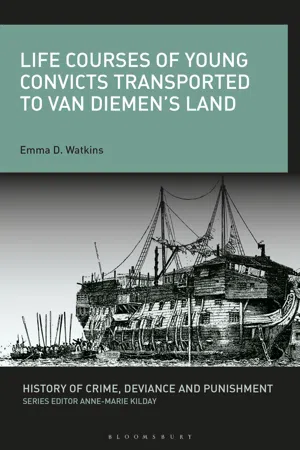
Drawing on digital criminal records, this book traces the life courses of young convicts who were sentenced at the Old Bailey and transported to Van Diemen's Land in the early 19th century. It explores the everyday lives of the convicts pre- and post-transportation, focusing on their crimes, punishments, education, employment and family life right up to their deaths.
Emma D. Watkins contextualizes these young convicts within the punishment system, economy and culture that they were thrust into by their forced movement to Australia. This allows an understanding of the factors which determined their chances of achieving a 'settled life' away from crime in the colony.
Packed with case studies offering vivid accounts of the offenders' lives, Life Courses of Young Convicts Transported to Van Diemen's Land makes an important contribution to the history of transportation, social history and Australian history.
- 208 pages
- English
- ePUB (mobile friendly)
- Available on iOS & Android
eBook - ePub
Life Courses of Young Convicts Transported to Van Diemen's Land
About this book
Information
1
Introduction
In the nineteenth century many convicted juveniles were handed down a sentence of transportation to Australia. This book will explore the crimes and punishments of some of these individuals, as well as their pre- and post-transportation lives, including family life, occupational standing and mortality. These juvenile convicts will then be contextualized within the punishment system, economy and culture that they were thrust into by their forced movement to Van Diemen’s Land (VDL) (now known as Tasmania). Were these juvenile convicts, who were convicted at the Old Bailey (the Central Criminal Court in London), able to form ‘settled’ colonial lives? This is not simple to determine. However, certain aspects surrounding the formation of relationships, employment and criminal desistance all point to a settled life. This may not mean climbing the social and economic spectrum of society, but rather the formation of a stable and normal working-class life free from crime. In essence, despite their early-life upheaval, were they able to form families and maintain employment? Or, were they plagued by unemployment, instability and criminal activity related to a lack of ties – be they social or economic? Marrying and having children, for example, did not necessarily result in a settled life but such factors supported one. Similarly, committing a crime in the colony after freedom does not conclude the life was unsettled. However, if a juvenile continued in crime up until his or her death, which resulted in repeated punishments and confinement thereby preventing any work and family life, this would be an unsettled life. As well as uncovering what a settled life was for these juveniles, the lasting impact of the experience of being transported to a penal colony during youth will be explored.
When convict transportation to Australia began in the late eighteenth century it was not a new concept. Not only had exile or banishment been a punishment for centuries, but also, by the seventeenth century, transportation was increasingly used for criminals. As early as 1607 criminals were transported to the Virginian plantations in Colonial America (Shaw 1966, 22–23). Britain was not alone or the first to use transportation; other European countries had already used criminals and vagrants to colonize imperial territories as has been demonstrated in Anderson’s (2016) work on the Carceral Archipelago. The history of transportation has been widely studied (Shaw 1966; Hughes 2003; Brooke & Brandon 2005), with a focus on different aspects of convict lives, for example: on skills and employment (Nicholas 1988; Oxley 1996); family-life (Maxwell-Stewart et al. 2015); health (Kippen & McCalman 2015); and reoffending (Frost & Maxwell-Stewart 2001). Yet, there has been a concentration on adult convicts, and juvenile lives are only lightly touched on. That is not to say juveniles have been ignored. There has been significant work on juvenile offending, as Godfrey et al. (2017) have pointed out, including: administrative histories of judicial and penal reform for children (Bailey 1987; Radzinowicz & Hood 1990); more social- and cultural-based studies on juvenile delinquency (Pinchbeck & Hewitt 1973; Pearson 1983; King 1998, 2006; Shore 1999a, 2011; Ellis 2014); studies of juvenile institutions (Stack 1992; Cale 1993; Cox 2003); studies of the policing of juveniles (Jackson & Bartie 2014); and studies of juvenile court records (Bradley 2007, 2009). However, the study of the whole lives of offenders convicted as juveniles has been scarce. Thanks to the works of Shore (1999a), Slee (2003), Jackman (2001, 2009) and Nunn (2015, 2017) there has been an increasing focus on male juvenile convicts – but this focus has been largely from an institutional perspective. This is similarly the case for juvenile females. Research on female offenders has expanded but, excepting the work of Cox (2003) which concentrates on training and reform in Britain, the concentration has been on adult female convicts (Beddoe 1979; Oxley 1996; Smith 2008b; Williams 2014; Kavanagh & Snowden 2015) with only a passing notice of juveniles. Given the few female juveniles transported, it is not surprising that they were overlooked but this research has now focused on their young lives. As Nunn pointed out, it is difficult to form an adequate picture of the male juvenile lives beyond the institution (2017, 171). This is largely because research into convicts ends with the Conduct Records but this research goes beyond these records by combining them with non-criminal records including newspapers, and birth, marriage and death records, much in the manner of Godfrey et al. (2017). This will allow an understanding of both their lives under sentence and their life-outcomes.
Convicts were transported from England to VDL from 1803 until 1853. Approximately 10,000–13,000 juveniles, under eighteen years of age, were among the 73,000 convicts transported (Brooke & Brandon 2005, 221; Humphrey 2008, 22). This subgroup is made up of juveniles and members of the underclass (Gatrell 1996, 448). Both characteristics made them of little importance, individually, to contemporary society. While middle-class children were idealized, contemporary descriptions of working-class juvenile offenders were immortalized as the Artful Dodger in Oliver Twist (Dickens 1838). Even before this, parliamentary committees, newspapers and penny dreadfuls all contributed to a stereotypical view of juvenile delinquents as a threat to society. Between 1800 and 1850, the English population doubled from 8.3 million to 16.8 million (Jefferies 2005, 3). By the 1830s half the population of England and Wales was aged below twenty, and nearly 40 per cent was aged fourteen and under (Kirby 2003, 26–27). As King (1998, 116) pointed out, the problematic relationship between youth and authority can be traced back to the sixteenth century, but the rapid population growth created significant new challenges for successive governments. ‘Central among them was how the state should deal with its predominantly young, predominantly poor citizens’ (Godfrey et al. 2017). This group may have been written about collectively, including the important historical works of Pearson (1983), and criminological works such as Pitts (2005), Hendrick (2006) and Goldson and Muncie (2006) which focused on the system as ‘“unjust” and that it perpetuated disadvantage’ (Godfrey et al. 2017). However, here the whole lives of these juveniles will be explored in order to place the human at the centre of the administrative record. As such, case studies are an important aspect of this research.
Case Study No.1 Mary Ann Oseman
Born in Camden to Mary Ann Oseman and Thomas Oseman, a bricklayer in the Parish of St Pancras, Mary was described simply as a ‘girl’ under ‘Trade’ in her transportation record – implying that she had no employment at the time of her conviction. However, Mary previously claimed in court that she was paid one penny every morning to light the fire of her prosecutor, which her prosecutor denied.
Despite being transported by fourteen years of age, Mary had at least one previous conviction. Her first appearance in the courts was in September 1831, when she was just nine years old. This case was acquitted; however, she was again brought before the court in April 1834 under another charge of larceny, and this time she was given a one-week prison sentence.
Through exploring Mary’s Description List, we find she was fourteen when transported. This matches her birth record which states she was born in late October 1822. Therefore, Mary was convicted aged twelve and reached VDL by age fourteen.
Mary was sentenced to seven years’ transportation for stealing a watch to the value of one pound from a widow named Ann Moore. In fact, Mary had broken into her prosecutor’s house while she was asleep, waking her up in the process. This gave rise to an alarm and the presence of police. According to John Fitzgerald, the police constable, Mary stated it was the first time she had ever stolen. Yet, she was indicted twice in the same session, which includes a guilty plea for stealing a shawl worth one pound from Elizabeth Naylor. It is very possible that it was because of these two successive prosecutions against Mary that she gained a place aboard a vessel bound for Australia. Especially coupled with the fact that she broke into a dwelling house at night. This was seen as a particularly serious crime because it was thought that the owners would be put in fear.
Just one of the 165 convicts transported on the New Grove in October 1834, Mary arrived at VDL in March 1835. The Conduct Record holds a wealth of information about offenders. While confirming Mary’s two Old Bailey convictions, the record also reveals further information about Mary’s contact with the criminal justice system. Namely, that she was in Newgate prison and that she also spent time in a refuge and/or at Mrs Fry’s school. Elizabeth Fry established The House of Discipline and School of Reform for Girls in 1825, which later became known as the School of Discipline and took in girls for reformation. Mary’s record states that she spent time in ‘Mrs Fry’s school’ but it also mentions that she spent time in a refuge. It is unclear whether the refuge being referred to was Mrs Fry’s school or another institution Mary spent time in. When the ship’s surgeon superintendent refers to her character, he stated she was ‘indifferent but young and thoughtless disposition’, but he also added that she was not ‘bad’. Indeed, Mary’s behaviour while under supervision in the colony reflects this. Mary committed a series of non-serious offences resulting in several visits to a female factory for hard labour. Most offences were absenteeism. It was also noted that ‘through extreme carelessness [Mary] let her master’s baby fall to the ground by which its leg was broken’. This comment implies that there was nothing malicious in the incident: it was an accident.
Eventually Mary received her Free Certificate in 1841, a timely seven years after her sentence expired. If a settled life can be measured by such outcomes as marriage or steady employment, Mary did settle. Approved for marriage in May 1839 (before freedom), she married a free man named George Clarke and they went on to have nine children. They migrated to Wallaroo, South Australia. George died in 1875 at Kadina, South Australia, but Mary lived for a further nineteen years. Mary remarried a Christopher Charlton who survived her (he died in 1903). Mary died at the old age of sixty-seven in January 1894 and was buried at the Wallaroo Cemetery in South Australia.
Mary is only one individual and we are not privy to – as with many studies of historical lives – her internal decision making. Yet, we can still assess collective life events and paths. It is not possible to ascertain if Mary was happy in marriage, but we do know she stayed with her husband until his death and formed a large family. Despite her arduous start to colonial life, Mary built a new life free from crime, but was Mary’s life typical of these juveniles? By placing juvenile convicts like Mary in their colonial context and comparing and contrasting their life events, it is possible to explore these juveniles lives collectively.
Case studies like Mary Ann Oseman’s were formed by nominally linking both criminal and non-criminal records.1 The juvenile offenders traced were initially sampled from the Old Bailey Proceedings (2018). Those convicted under fourteen, who were sentenced to transportation in the early-nineteenth century, were selected.2 Next, they were traced in the British Transportation Records to ascertain which juveniles undertook the journey.3 The approach described here is one which closely follows the method employed by Godfrey et al. (2007, 2010, 2017). For example, in Young Criminal Lives the long-term impact of youth justice interventions was considered by incorporating the use of biographical data into life-course analysis. In this way, the information of individuals was retrospectively, sequentially ordered by life events, enabling analysis and examination of trends. This life-course method has become increasingly popular with historians (Turner 2009; Williams 2014; Maxwell-Stewart and Kippen 2015). After linking the lives of individuals, typical and atypical biographies were examined to interrogate those trends and humanize offenders. Criminologists have long emphasized the link between criminal behaviour and individual background, and have increasingly applied a longitudinal life-course perspective in their analysis (Vikstrom 2011, 861–862). This is demonstrated in the work of Elder (1974) and Giele and Elder (1998). When conducting life-course research, the encoding of historical events and social interaction outside the person is the key (Giele & Elder 1998, 22). Life-course, defined in terms of trajectories from birth to death, allows the uncovering of a line of development that includes phases from childhood to adulthood – including getting a job, having children, being transported, marrying or migrating (Vikstrom 2011, 863). This book uses this approach to explore the lives of juvenile convicts. While their criminal activity is important in understanding their whole lives, their criminality or desistance is not necessarily the most important factor under deliberation. As well as changing criminal legislation and the importance of structural factors, it is important to explore offenders’ lives before, during and after any criminal activity (Sampson & Laub 2005; Vikstrom 2011, 862–863). Using a collective biographical approach, as described by Giele and Elder (1998, 19), it is possible to reveal the underlying features of these juveniles lives, which control mechanisms and structural changes fail to explain (Vikstrom 2011, 861–862). The wealth of records left behind in the form of criminal and social records allows this approach. And by historically contextualizing those individuals uncovered, including familial relationships and employment, as well as significant historical events, individual pathways can be understood.
The nature of historical evidence may not have changed, but our access to it and its presentation has (Cohen 2006, 391). The large-scale digitization of primary sources has allowed historians ‘new insights’ into working-class lives. Indeed, the ‘elaborate bureaucracy of surveillance’ established in VDL, which is now vastly digitized, is a prime example. These records contain numerous observations for the same individual allowing the piecing together of individual criminal lives and the carrying out of statistical analysis to varied research questions – at a scale unimaginable using non-digitized documentation (Shore & Johnston 2015, 3–4). Most criminal justice–generated documents have information not just on crime, but also on the criminal. When this is combined with detailed historical newspapers, thorough narratives can emerge (Godfrey 2014, 79). In research which depends largely upon documents generated by and for the state, every additional piece of information is welcome in confirming or altering interpretation (Frost 2011, 26). While significant interactions, events and decision-making will remain hidden in history, interpretation based on available evidence and knowledge of relevant social and economic histories will aid the construction of narratives. It was possible to uncover detailed information thanks to the rich sources used. From the criminal records created for surveillance to the newspapers created for public consumption, all provide different perspectives of the juveniles’ life. The life events and narratives of these juveniles can never be understood if they are not contextualized. In order to do this, primary sources, including the Official Statistical Returns of VDL and correspondence of those in authority are vital. This allows aspects such as the economy, colonial offending, education, health, mortality and the population to be understood. In this way, a baseline by which to measure the life-outcomes of the juveniles could be produced to explore what life-outcome a juvenile convict, who had been transported to VDL in the nineteenth century, could reasonably expect. Only then is it possible to approach the question of whether they were able to settle into their post-transportation lives and which factors affected life-outcomes such as gender or criminality.
The difficulty of concentrating on the whole life of these juvenile offenders is that their context changed over time. While this does not make it impossible to assess the ‘success’ of their lives, it does make it difficult to point to the contributing factors. It is not possible to produce a hierarchy of causation, since the working factors which led to the life-outcomes of the juvenile’s lives are the sum total of all the negative and positive conditions taken together. Meaning, no one main cause or turning point can be chosen. Yet, as Gorovitz (1965, 1969) pointed out, differentiated factors can still be chosen as the most important contributing factors. These are not arbitrary choices, but they are not objective choices either. While causation is ultimately objective, the working factors chosen here will be partial and pragmatic. However, they will be justified through a full outline of their context and explained in comparison with other competing contributing factors (Rigby 1995). Certainly the context of each individual changed over time, especially given that the period in question runs from 1816 to the turn of the century – when the last juvenile was known to have died. Consequently, factors acting on the lives of these juveniles will be difficult to uncover but this is where biographical narratives become important. It will only be possible to point to the major contributing factors with any certainty – through a thorough understanding of the whole lives of these juveniles combined with their acting background factors.
Book outline
By using the method outlined here, it is possible to uncover the lives of historical actors which have been overlooked. To explore these individual lives, the following themes were assessed, including: crime; punishment; education, training and occupation; family life; and death.
In order to address questions of recidivism and desistance, the crimes committed by these juvenile convicts will be explored in Chapter 3. The severity, number and timing of offences committed by these young offenders will be considered. Next, the punishments they endured will be investigated to further understand their experience under servitude in Chapter 4. From hard labour and flogging, to confinement in the cells and extended sentences – what did these juvenile convicts endure? And, did this effect their life-outcomes? One of the measures of their life-outcomes will be their employment, and important in assessing this will be not only their education and training, but also the changing economy. This will be explored in Chapter 5 by turning to the Official Statistical Returns – taking particular notice of the economy, the average wage rates and changing populations (referring to migration and transportation). Allowing the following questions to be approached: Were the juvenile convicts (dis)advantaged in the labour market? Were they able to gain employment, and what was that employment? To gain a rounded understanding of their whole lives it is important to assess if they married or formed relationships. From the behaviour of the juvenile convicts themselves to the decisions of the administrators and the conditions of the penal colony into which they were thrust, were these female and male juvenile convicts able to form ‘settled’ familial lives and which factors inhibited or facilitated this process? This will be explored in Chapter 6. The conclusion of juveniles’ lives is just as important as their experiences. Chapter 7 will explore whether their mortality was affected by being transported as convicts to VDL. This question will be addressed ...
Table of contents
- Cover
- Halftitle Page
- Title Page
- Contents
- List of tables
- List of case studies
- Acknowledgements and dedication
- 1 Introduction
- 2 Historiography
- 3 Crime
- 4 Punishment
- 5 Education, training and employment
- 6 Family life
- 7 Death
- 8 Conclusion
- Notes
- Bibliography
- Index
- Imprint
Trusted by 375,005 students
Access to over 1.5 million titles for a fair monthly price.
Study more efficiently using our study tools.
Frequently asked questions
Yes, you can cancel anytime from the Subscription tab in your account settings on the Perlego website. Your subscription will stay active until the end of your current billing period. Learn how to cancel your subscription
No, books cannot be downloaded as external files, such as PDFs, for use outside of Perlego. However, you can download books within the Perlego app for offline reading on mobile or tablet. Learn how to download books offline
Perlego offers two plans: Essential and Complete
- Essential is ideal for learners and professionals who enjoy exploring a wide range of subjects. Access the Essential Library with 800,000+ trusted titles and best-sellers across business, personal growth, and the humanities. Includes unlimited reading time and Standard Read Aloud voice.
- Complete: Perfect for advanced learners and researchers needing full, unrestricted access. Unlock 1.5M+ books across hundreds of subjects, including academic and specialized titles. The Complete Plan also includes advanced features like Premium Read Aloud and Research Assistant.
We are an online textbook subscription service, where you can get access to an entire online library for less than the price of a single book per month. With over 1.5 million books across 990+ topics, we’ve got you covered! Learn about our mission
Look out for the read-aloud symbol on your next book to see if you can listen to it. The read-aloud tool reads text aloud for you, highlighting the text as it is being read. You can pause it, speed it up and slow it down. Learn more about Read Aloud
Yes! You can use the Perlego app on both iOS and Android devices to read anytime, anywhere — even offline. Perfect for commutes or when you’re on the go.
Please note we cannot support devices running on iOS 13 and Android 7 or earlier. Learn more about using the app
Please note we cannot support devices running on iOS 13 and Android 7 or earlier. Learn more about using the app
Yes, you can access Life Courses of Young Convicts Transported to Van Diemen's Land by Emma D. Watkins in PDF and/or ePUB format, as well as other popular books in History & Australian & Oceanian History. We have over 1.5 million books available in our catalogue for you to explore.