eBook - ePub
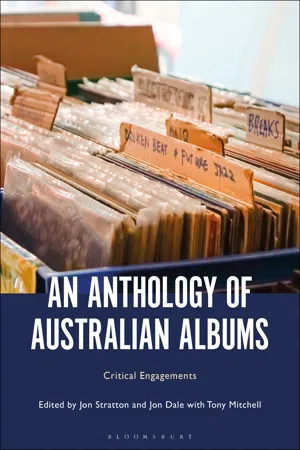
An Anthology of Australian Albums
Critical Engagements
- 240 pages
- English
- ePUB (mobile friendly)
- Available on iOS & Android
eBook - ePub
An Anthology of Australian Albums
Critical Engagements
About this book
An Anthology of Australian Albums offers an overview of Australian popular music through the lens of significant, yet sometimes overlooked, Australian albums. Chapters explore the unique qualities of each album within a broader history of Australian popular music. Artists covered range from the older and non-mainstream yet influential, such as the Missing Links, Wendy Saddington and the Coloured Balls, to those who have achieved very recent success (Courtney Barnett, Dami Im and Flume) and whose work contributes to international pop music (Sia), to the more exploratory or experimental (Curse ov Dialect and A.B. Original). Collectively the albums and artists covered contribute to a view of Australian popular music through the non-canonical, emphasizing albums by women, non-white artists and Indigenous artists, and expanding the focus to include genres outside of rock including hip hop, black metal and country.
Information
1
The Missing Links, The Missing Links (1965)
The Missing Links made only one album. Their eponymous record was released in December 1965. It was put together at a time when singles were still more highly regarded by record companies, and in common with, for example, the first Who album, My Generation, released in the UK two months earlier, The Missing Links was more a collection of diverse material than a coherent, organized and unified package. Things, though, had begun to change. George Martin, who produced the Beatles’ Rubber Soul between mid-October and mid-November 1965 said: ‘Up till then, we had been making albums rather like a collection of singles. Now we were beginning to think about albums as a bit of art on their own. And Rubber Soul was the first to emerge that way’ (Doggett and Humphries 2010).
The first Easybeats album, Easy, released in September 1965 was unified by all the songs being originals written by members of the group. The Missing Links contained six songs composed by members of the group and six covers. While the album’s organization might appear old-fashioned, the recordings on it were anything but suggesting, perhaps, a lack of understanding of the radical nature of the group by Philips, the record company. By the time of the release of The Missing Links this incarnation of the group had released three singles. All were included on the album with the exception of the B-side of the first single, ‘Something Else’, the group’s cover of Eddie Cochran’s 1957 single. It is not known how many copies of the album Philips had pressed but the general assumption is probably around 500, a similar number as had been pressed of the group’s previous singles. Clearly, Philips was not expecting the album to sell in large numbers.
The Missing Links were formed as a five-member group in early 1964. Peter Anson, the driving force, had grown up listening to his father’s jazz and blues albums. Danny Cox, the drummer, had been in the Zodiacs, an early r&b group which later morphed into the Showmen and supplied two members of the second version of the Missing Links. Dave Boyne, the lead guitarist, and Ronnie Peel, who played bass, had both been members of a surf group called the Mystics. Bill Brady completed the line-up as the singer. The Rolling Stones’ early releases provided an inspiration for the group. Anson was said to have the longest hair of any male in Sydney at that time and the others weren’t far behind. As the Milesago site writes: ‘Long hair was the unmistakable, unavoidable badge of difference and rebellion – and there was nothing tacit about it. Simply having long hair in those days exposed the Links to constant scorn, ridicule, abuse and, on many occasions, to physical violence, both threatened and actual.’ Indeed, it was their hair that helped give the group their name when a club owner where they were playing first saw them and thought they looked like a cross between humans and apes.
This version of the Missing Links recorded one single for Parlophone, the label with which Ted Albert, who also signed the Easybeats, had a relationship. The Missing Links were known as the wildest r&b group in Sydney. The first version of the group lasted until around July 1965. After Anson left to form the Syndicate, others started to leave. By mid-year the group may not have existed. Then a group which, it seems, was given permission to use the name, coalesced around guitarist John Jones and Andy James (born Anderson), drummer and subsequently vocalist, with lead guitarist Doug Ford, Ian Thomas on bass, and Chris Grey on keyboards. This version of the group released three singles and the self-titled album. If the first version of the Missing Links had a reputation as being almost out of control, the second version built on this and outdid the first group with the most extraordinary music, both live and recorded, heard in Australia up to that time.
David Nichols (2016: 59) remarks: ‘[The Missing Links] were not typical of their day, but they were exactly the kind of band that had to exist at a time when Australians were grappling with that question of what the strengths of Australian music could be,’ further noting insightfully about the change in personnel that ‘it was not so much a group in flux, more a name looking for some people to embody it’ (2016: 62). The significance of the Missing Links came from their existence at a time when Australia remained isolated and conservative but when change was just beginning to happen, when younger people especially were forming an increasing undercurrent wanting transformation with little idea of what would happen when morals and norms were freed up.
The Missing Links tested boundaries of acceptability in music as in everyday life. They presented a challenge to mainstream Australian values. This was even truer of the second version of the group than the first. To take one example, where the first version of the Missing Links wore suits on stage, like all Australian groups of the time, the second version ‘devised their own bizarre stage costumes made from dyed hessian sacks, and frequently appeared in fancy dress outfits, dressed as gorillas, pirates, gangsters or mummies’ (Milesago). Ian Marks reproduces a photograph of the group from a 1965 issue of the teen magazine Everybodys standing around, or sitting on, dustbins with each member wearing a different costume (Marks and McIntyre 2011: 87). The idea was to make it appear as if the group had got their clothing from the rubbish. The point is that suits made groups look respectable. The Beatles’ manager, Brian Epstein, had put that group into suits and even the Rolling Stones started out their career wearing suits. The miscellaneous outfits of the Missing Links were a visual demonstration of disrespectability. There is a story that the Missing Links Mark 1 had got the gig supporting the Rolling Stones on their first tour. However, the night before the first show, the promoter Harry M. Miller dropped by, took one look and refused to let them on stage. In one version of the story this was because the group were even more wild than the Rolling Stones. In another version it was because Miller thought the group too scruffy (see Milesago n/a; Nimervoll n/a). Either way, it would seem he thought the home-grown group more extreme than the English group which had provided much of their inspiration.
We can think of the Missing Links in terms of their position in the Australian cultural imaginary. Graham Dawson (1994: 48) explains the idea of cultural imaginaries, ‘designating by this term those vast networks of interlinking discursive themes, images, motifs and narrative forms that are publicly available within a culture at any one time, and articulate its psychic and social dimensions’. The Missing Links can be read as a manifestation of the inchoate wish for something different, founded in youthful freedom from overbearing authority, and most directly founded in parental power, beginning to transform Australian society.
In the early 1960s the baby-boomer generation were preparing to revolutionize conservative Australia. The Beatles toured in 1964. In his book about that tour Glenn A. Baker (1986: 7) writes: ‘No single instance of Beatlemania throughout the globe ever came close to the intensity and sheer magnitude of the social upheaval which accompanied the 1964 Australian Beatles tour.’ Baker notes that the crowds on the streets were larger than those in cities in the UK and America. In Adelaide, where there had been a large British emigration, it has been calculated that over half the population lined the streets from the airport or stood expectantly outside the Town Hall to where the group had been driven.
Baker (1986: 7) goes on to comment:
Australia reacted to the visit by the Beatles with such fervour because, young and old, it was crying out for a tangible manifestation of the new freedoms which were emerging in England and America, freedoms it didn’t quite understand. The Beatles were a sign from above, a skewer to lance the boil of stifling conservatism.
The Beatles provided an opportunity for young people, especially girls, to lose their inhibitions and behave outside of the limits imposed on their behaviour by respectable Australian society. At the same time, the Beatles seemed safe. As we have seen, they wore suits, they sang about love and their songs, at this time anyway, still worked within the accepted limits of popular music.
Albert’s family ran the most important music publishing company in Australia. Albert had been put in charge of their new A&R department formed with the purpose of signing promising Australian groups. Albert had signed the Missing Links before the Easybeats. Parlophone released the Missing Links’ single ‘We 2 Should Live’ in March 1965, the Easybeats single ‘For My Woman’ came out the same month. The anonymous author of the Missing Links page on Milesago (n/a) comments that
it’s known that George Young was a serious fan, catching the group anytime he could. Listening to tracks like ‘Untrue’ and ‘All I Want’, it’s hard to avoid the conclusion that The Easybeats owe the Links a considerable debt. I challenge anyone to compare the verses of ‘Untrue’ and the chorus of the Easy’s [sic] ‘I’ll Make You Happy’ and not hear a strong resemblance!
It is in the transposition that George Young’s genius for hearing what would be popular can be found. The melody that the Missing Links buried in the verses is moved to the chorus in ‘I’ll Make You Happy’ where it is expressed using the same lyrics in every chorus. ‘For My Woman’ reached number 33 in Sydney. The Missing Links’ ‘Untrue’ was the B-side of ‘We 2 Should Live.’ The single did not chart.
The Easybeats were five young immigrants desperate to be accepted and successful. In this first version of the Missing Links the members were all Australian born and confident enough to rebel against that society. The Easybeats, as their name suggests, materialized the acceptable form of threat, they sent a frisson up the spine but, in the end, nothing really changed. They offered songs about love and wedding rings – their single ‘Wedding Ring’ climbed to number 6 in Sydney in the second half of 1965 – which is why girls found them likeable and unthreatening, like the Beatles who, after all, only wanted to hold your hand (‘I Want to Hold Your Hand’ was number 1 in the UK and Australia at the end of 1963).
The songs of the Missing Links, especially the second version, are transgressive. For example, they reference madness – one of their most celebrated tracks is their own composition ‘(You’re) Drivin’ Me Insane’ and they covered Eddie Cochran’s ‘Nervous Breakdown’ and James Brown’s ‘I’ll Go Crazy.’ Cannibalism was suggested in another of their own compositions, the much respected ‘Wild about You,’ itself covered by the Saints on their 1977 album, (I’m) Stranded. All these tracks appear on the album. Central to the Missing Links’ oeuvre was the rejection of parental authority. On The Missing Links they covered Bob Dylan’s ‘On the Road Again,’ from his 1965 album, Bringing It All Back Home. This is a song about chaotic and irrational family life in which the singer is the only reasonable, sane person. In the first verse we are told: ‘Your mama, she’s a-hidin’/Inside the icebox/Your daddy walks in wearin’/A Napoleon Bonaparte mask.’ Clinton Heylin (2009: 230) describes the lyrics as an ‘account of a home life that reads like some long-lost episode of The Addams Family written by Luis Bunuel.’ Each verse ends with a version of ‘Then you ask why I don’t live here/Honey, do you have to ask?’ This is how many American, British and Australian teenagers in the 1960s felt about their parents’ safe, suburban lives, lives that on the surface seemed so ordinary and banal but which were structured and hemmed in by strict mores that from the outside, from the point of view of their children, appeared bizarre.
The cover which was most important to the group was of Bo Diddley’s ‘Mama, Keep Your Big Mouth Shut.’ The Missing Links’ version is taken from that on the Pretty Things self-titled first album released in March 1965. In the UK the Pretty Things were regarded as even more unsavoury than the Rolling Stones. On The Missing Links the track lasts for five minutes and forty-four seconds. The final three minutes is composed of feedback and distortion held together by a repeated bass guitar figure. The use of such non-musical elements was still very unusual at this time. It is said that Dave Longmore, an Englishman who had been a member of one of New Zealand’s wildest groups, the Bitter End, a group inspired by the Pretty Things, who was in the group for a while between the two settled line-ups, suggested the use of feedback (Milesago n/a). Longmore may have heard the Kinks using feedback and distortion. Certainly, feedback was being used by Australian surf groups like the Atlantics. However, for the Missing Links feedback and distortion were a way of expanding music and breaking it down. Andy Anderson has described a typical show by the second and more radical version of the group:
We packed out Susie Wong’s. We were a real joke to a lot of them, but the fans who did come down were die hard, real fired up. We’d play ‘Mama, Keep Your Big Mouth Shut’ for thirty minutes or for as long as the instruments would last. You’d have Doug Ford driving his guitar into the PA system and me with the mic in the PA system, underneath cymbals and bashing shit out of a conga drum, making ringing sounds, with John Jones feeding back for I don’t know how long. (Schmidt 2014)
This use of feedback and distortion was entirely new in popular music. John Lennon had persuaded the Beatles to include a feedback drone on ‘I Feel Fine’ after hearing Dave Davies, the Kinks’ lead guitarist, using it to cut through the noise of screaming girls at a show at which both groups played in Bournemouth (Clayson 2007). Not knowing where to put it, Martin had opted for the beginning of the track.1
Davies had also pioneered the use of distortion when he cut the speaker cone being used for his guitar and the resulting sound was used on the Kinks’ ‘You Really Got Me,’ released in 1964. The Missing Links’ use of feedback and distortion was much more excessive. Doug Pattie (2013: 66) has remarked: ‘Noise, in the sonic framework of a number of popular music genres, signals freedom, the breaking of restraint, and the manifestation of a profoundly rebellious spirit that animates the musicians.’ Paul Hegarty (2007: 59), in his discussion of noise, argues, ‘Electrification brings the guitar centre stage, changing group dynamics. … Rock’n’roll is the first musical form that consistently works with loudness; this was music to be played loud, and an assertion of youth identity.’ The Missing Links were notorious for their use of volume: ‘The Links Mk II continued the proud tradition of turning everything up full-bore – Baden Hutchins recalls a gig at The Bowl disco, where the intense feedback shattered a mirror ceiling, showering glass over the startled patrons!’ (Milesago n/a). With what freedom were the Missing Links concerned? In this instance, ‘Mama, Keep Your Big Mouth Shut,’ it would seem it was freedom from maternal authority – but this could also be a synecdoche for freedom from social restraints. We can now see a similarity of concern between the cover of ‘On the Road Again’ and ‘Mama, Keep Your Big Mouth Shut.’
At this point we can think about the Missing Links’ third and last single, which was also the final track on their album, ‘H’Tuom Tuhs.’ It was extraordinary that Philips allowed the group to release this track as a single and, inevitably, it sold very few copies and got no radio airplay. ‘H’Tuom Tuhs’ is the backwards tape of ‘Mama, Keep Your Big Mouth Shut.’ It was spread over both sides of the single. Again, it is remarkable that at this time an entire track should be made up of a single backwards tape. Another Beatles song, ‘Tomorrow Never Knows,’ which was released on Revolver in 1966, is usually given the credit for being the first to use avant-garde musique concrète techniques in popular music. These included tape loops and the modification of Lennon’s voice using a Leslie speaker cabinet, and also Paul McCartney’s guitar parts played backwards. The B-side of ‘Paperback Writer,’ ‘Rain,’ recorded after ‘Tomorrow Never Knows’ but released prior to Revolver, also includes backwards vocals towards the end. ‘H’Tuom Tuhs’ is both earlier and more excessive in that it is an entire track untreated other than being backwards.2
Where might the Missing Links have got the idea for this? Backwards, or reverse, tape had been used in musique concrète since avant-garde artists had gained access to tape recorders after the Second World War. One person who worked on the borders of musique concrète and popular music was Delia Derbyshire whose day job was in the BBC’s R...
Table of contents
- Cover
- Halftitle
- Title Page
- Contents
- Notes on Contributors
- Preamble
- Introduction Jon Stratton with Jon Dale
- 1 The Missing Links, The Missing Links (1965) Jon Stratton
- 2 Wendy Saddington and The Copperwine, Wendy Saddington and The Copperwine Live (1971) Julie Rickwood
- 3 Coloured Balls, Ball Power (1973) Paul ‘Nazz’ Oldham
- 4 The Scientists, Blood Red River (1983) Jon Stratton
- 5 The Plums, Gun (1994); Deadstar, Deadstar (1996); Milk (1996); Over the Radio (1999) Caroline Kennedy
- 6 Shakaya, Shakaya (2002) Panizza Allmark
- 7 Striborg, Spiritual Catharsis (2004) Catherine Hoad
- 8 Curse ov Dialect, Wooden Tongues (2006) Sarah Attfield
- 9 The Drones, I See Seaweed (2013) Adam Trainer
- 10 Roger Knox & The Pine Valley Cosmonauts, Stranger in My Land (2013); Roger Knox, Give It a Go (1983) Liz Dean with Roger Knox
- 11 Dami Im, Dami Im (2013) Sarah Keith
- 12 Courtney Barnett, Sometimes I Sit and Think, and Sometimes I Just Sit (2014) John Encarnacao
- 13 Sia, This Is Acting (2016) Laura Glitsos
- 14 Flume, Skin (2016) Ed Montano and Gene Shill
- 15 A.B.Original, Reclaim Australia (2016) Suzi Hutchings and Dianne Rodger
- Imprint
Trusted by 375,005 students
Access to over 1.5 million titles for a fair monthly price.
Study more efficiently using our study tools.
Frequently asked questions
Yes, you can cancel anytime from the Subscription tab in your account settings on the Perlego website. Your subscription will stay active until the end of your current billing period. Learn how to cancel your subscription
No, books cannot be downloaded as external files, such as PDFs, for use outside of Perlego. However, you can download books within the Perlego app for offline reading on mobile or tablet. Learn how to download books offline
Perlego offers two plans: Essential and Complete
- Essential is ideal for learners and professionals who enjoy exploring a wide range of subjects. Access the Essential Library with 800,000+ trusted titles and best-sellers across business, personal growth, and the humanities. Includes unlimited reading time and Standard Read Aloud voice.
- Complete: Perfect for advanced learners and researchers needing full, unrestricted access. Unlock 1.5M+ books across hundreds of subjects, including academic and specialized titles. The Complete Plan also includes advanced features like Premium Read Aloud and Research Assistant.
We are an online textbook subscription service, where you can get access to an entire online library for less than the price of a single book per month. With over 1.5 million books across 990+ topics, we’ve got you covered! Learn about our mission
Look out for the read-aloud symbol on your next book to see if you can listen to it. The read-aloud tool reads text aloud for you, highlighting the text as it is being read. You can pause it, speed it up and slow it down. Learn more about Read Aloud
Yes! You can use the Perlego app on both iOS and Android devices to read anytime, anywhere — even offline. Perfect for commutes or when you’re on the go.
Please note we cannot support devices running on iOS 13 and Android 7 or earlier. Learn more about using the app
Please note we cannot support devices running on iOS 13 and Android 7 or earlier. Learn more about using the app
Yes, you can access An Anthology of Australian Albums by Jon Stratton, Jon Dale, Tony Mitchell, Jon Stratton,Jon Dale,Tony Mitchell in PDF and/or ePUB format, as well as other popular books in Mezzi di comunicazione e arti performative & Storia dell'Australia e dell'Oceania. We have over 1.5 million books available in our catalogue for you to explore.