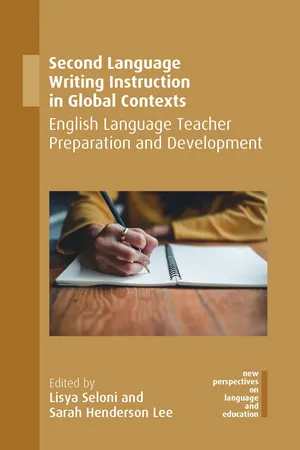
This book revisits second language (L2) writing teacher education by exploring the complex layers of L2 writing instruction in non-English dominant contexts (i.e. English as a foreign language contexts). It pushes the boundaries of teacher education by specifically examining the development of teacher literacy in writing in under-represented L2 writing contexts, and re-envisions L2 writing teacher education that is contextually and culturally situated, moving away from the uncritical embracement of Western-based writing pedagogies. It explores and expands on writing teacher education – how language teachers come to understand their own writing practices and instruction, and what their related experiences are in non-English dominant contexts across the globe.
Chapter 4 is free to download as an open access publication under a CC BY NC ND licence. You can access it here: https://zenodo.org/record/7096127#.YymCsHbMLcs
eBook - ePub
Second Language Writing Instruction in Global Contexts
English Language Teacher Preparation and Development
- English
- ePUB (mobile friendly)
- Available on iOS & Android
eBook - ePub
Second Language Writing Instruction in Global Contexts
English Language Teacher Preparation and Development
About this book
Information
Topic
Personal DevelopmentSubtopic
Professional Development1Exploring Second Language Writing Teacher Education: The Role of Adaptive Expertise
Alan Hirvela
Introduction
In writing research, we are understandably drawn to the writing itself and those who produce it, i.e. students. Not surprisingly, then, in both native language (L1) and second/foreign language (L2) writing scholarship, we see a dominant focus on students. But what about those who teach the students? In the approximately four decades since L2 writing scholarship began to emerge as a domain in its own right (as opposed to a subset within L1 scholarship), a relatively small body of research has focused on teachers of writing. Hence, we have no meaningful knowledge base regarding the epistemologies that guide teachers’ instructional practices, or the practices themselves. In the understandable zeal to decode students’ experiences with writing, we have tended to keep teachers on the sidelines, despite the crucial roles they play in students’ acquisition of L2 writing skills. It was the recognition of this imbalance that motivated Hirvela and Belcher (2007) to issue a call for an increased focus on L2 writing teacher research in a special issue of the Journal of Second Language Writing focusing on L2 writing teacher education. This call aligned with what Freeman (1996) called the ‘unstudied problem’ of L2 teachers and their teaching, that is, the insufficient attention paid to teachers as classroom practitioners.
However, the modest focus on writing teachers in L2 writing research is only one dimension of what could be called the ‘unstudied problem’ of L2 writing teachers and writing instruction. Another important dimension of this ‘unstudied problem’ is an inadequately conceptualized notion of what to look for in such scholarship. This aspect of the ‘unstudied problem’ was acknowledged at a recent (2016) Symposium on Second Language Writing (SSLW), which was organized around the theme of ‘Expertise in Second Language Writing.’ As Paul Matsuda (2016) observed in the Symposium’s program:
Expertise in second language writing is sometimes conceptualized as a binary – either you are an expert or you are not. In reality, there are different types and degrees of expertise that are needed depending on the context and roles – writing center tutors, teachers, teacher educators, program administrators, researchers, research mentors, editors, reviewers. Different instructional contexts also require different sets of expertise.
Thus, the SSLW sought to problematize and address what I believe constitutes an ‘expertise gap,’ and in doing so helped draw attention to the need to bring expertise to a more prominent place in studies concerning L2 writing teachers. As Matsuda’s introductory words indicate, expertise is a complex, multifaceted construct operating within a range of contexts, a fact that makes it all the more worthy of investigation. We need to untangle this complexity, and making expertise a significant focus of L2 writing research would facilitate such an endeavor.
This chapter likewise speaks to the ‘expertise gap,’ first by addressing the nature of expertise itself and then by suggesting a narrowing of the focus on expertise that could be especially beneficial to scholarship regarding L2 writing teachers. In the latter regard, the chapter introduces the notion of ‘adaptive expertise,’ a teacher education framework that has rarely been discussed in the context of L2 writing instruction. The primary goal of the chapter is to show how the notion of adaptive expertise can add shape and meaning to L2 writing teacher education (hereafter, L2WTE) scholarship and offer a new direction for L2WTE research by illustrating a possible path towards defining and understanding L2 writing teacher expertise.
For contextual purposes, the chapter begins with a brief overview of L2WTE research. The purpose is not to show what has been learned about L2 writing teachers, but rather what patterns appear in that body of scholarship. Thus, this review sheds light on where the field stands with respect to investigations of writing teacher expertise. The next section then examines the broader notion of teacher expertise. The chapter concludes with sections that (a) introduce the adaptive expertise framework, and (b) discuss how it can be applied to L2WTE research.
L2 Writing Teacher Education Research
Noteworthy L2WTE scholarship began in the mid-1980s as pioneering L2 writing scholars began to carve out a place for L2 writing scholarship as a discipline of its own. For this chapter I identified 34 research-oriented publications that have appeared since that time where there was a focus on writing teachers. This does not mean other such scholarship does not exist. For the purposes of this chapter, though, these publications stood out, and at the very least provide a representative sampling of the work that has been conducted. These 34 articles and book chapters constitute an average of about one publication per year, a figure that pales in comparison to scholarship in other areas of L2 writing and thus signifies the lukewarm interest shown by L2 writing scholars with respect to teachers. Also worth noting, although it is not research oriented, is the book ESL Composition Tales: Reflections on Teaching (Blanton & Kroll, 2002); this consists of nine narrative accounts of their writing teaching experiences by well-known L2 writing scholars, and in doing so adds to our understanding of the instructional work of L2 writing teachers.
To gain a clearer picture of this collection of 34 publications and what they reveal relative to the goals of this chapter, I created a few categories into which I placed this body of work. Each category is examined briefly in this section of the chapter.
Chronology
One of the topics that interested me was how the publications broke down in terms of when they appeared and how many appeared during different time periods, with the number of publications in parentheses:
1980s: (1)
1990s: (9)
2000s: (24)
Here we can see that teachers were of virtually no research interest in the early years of L2 writing as a discipline. We then see some emerging interest in the 1990s, with a significant increase in L2WTE research-based publications in the current century. Thus, there is an indication that writing teachers are beginning to attract meaningful attention. Also worth noting here is that 12 of the studies published in the current century have appeared since 2010, suggesting some growing momentum for L2WTE research. This is an encouraging trend.
Teacher populations studied
The focus in this category is on two populations of L2 writing teachers: (a) those enrolled in pre-service teacher education programs; and (b) experienced teachers already in the field. The numbers in this category tell a very interesting story, with eight studies of pre-service teachers and 26 focusing on practicing teachers. Clearly, there is primary interest in current teachers as opposed to those entering the field. Whether this is an appropriate distribution of research attention is perhaps a topic worthy of debate in future discussions of L2WTE scholarship. However, to develop a more informative picture of expertise in writing instruction, increased research on novice teachers would seem to be beneficial.
Topics of L2 writing teacher education research
The category of greatest interest for this chapter is what is actually being studied among the L2 writing teachers. Here the teachers are broken down into two categories: pre-service and experienced.
Pre-service teachers
Among the eight publications examining pre-service teachers, three (Athanases et al., 2013; Winer, 1992; Worden, 2015) focused on teacher attitudes or knowledge, while five (Casanave, 2009; Gebhard et al., 2013; Seloni, 2013; Shin, 2003; Yi, 2013) looked at these developing teachers relative to various dimensions of their instructional behavior in the writing classroom. This breakdown, and the fact that so few pre-service teachers are explored in classroom contexts, suggests that there is a particular need to increase expertise-related research within the pre-service domain, as suggested earlier. It would be helpful to know how these newcomers to the field conceptualize writing teacher expertise as well as what their early attempts at acquiring expertise reveal about their developmental processes and experiences, especially in comparison to experienced teachers.
Experienced teachers
The results for this category, covering 26 studies, are presented in table form (Table 1.1) to generate a clearer picture of the research trends relative to practicing teachers and the teaching of L2 writing, especially since this is where most teacher-related research has occurred, as noted earlier.
| Table 1.1 Foci of research on experienced L2 writing teachers | |
| Focus of research | Studies (by author names and year of publication) |
| Teacher goals | Barkaoui and Fei (2006) Cummings et al. (2006) |
| Teacher conceptions/attitudes | Cumming (2001, 2003) Shi and Cumming (1995) |
| Teacher development/identity | Henderson Lee (2016) Larsen (2013, 2016) Lee (2010, 2013) |
| Teacher feedback on student writing | Cohen and Cavalcanti (1990) Lee (2003, 2004, 2007, 2008a, 2008b, 2011) Montgomery and Baker (2007) Zamel (1985) |
| Teachers’ classroom instruction | Cumming (1992, 1993, 1995) Riazzi et al. (1996) Tsui (1996, 2003) Tsui and Ng (2010) Weissberg (1994) |
Table 1.1 shows some clustering around two topics that are more directly related to expertise in teaching (‘feedback’ and ‘teachers’ classroom instruction’), ...
Table of contents
- Cover-Page
- Half-Title
- Series
- Title
- Dedication
- Copyright
- Contents
- Acknowledgments
- Contributors
- Foreword
- Introduction: Issues and Perspectives in Second Language Writing Teacher Education in Non-English Dominant Contexts
- 1. Exploring Second Language Writing Teacher Education: The Role of Adaptive Expertise
- 2. Second Language Writing Teacher Education and Feedback Literacy Development: Perspectives from Hong Kong
- 3. English Writing Teachers’ Concept Development in China
- 4. Factors Influencing English as a Foreign Language (EFL) Writing Instruction in Japan from a Teacher Education Perspective
- 5. Teacher Preparation for Writing Instruction in Singapore
- 6. English Writing Instruction and Teacher Preparation in Thailand: Perspectives from the Primary and Secondary Schools
- 7. Writing Pedagogy and Practice in South Asia: A Case of English Language Teachers and Teacher Trainers in Nepal
- 8. Scaffolding Second Language Disciplinary Writing in Qatar: A Case Study of a Design Teacher’s Development
- 9. The Role of Writing in an English as a Foreign Language Teacher Preparation Program in Turkey: Institutional Demands, Pedagogical Practices and Student Needs
- 10. Opportunities and Resources for Pre-service English Teachers to Teach Writing: The Case of Northern Cyprus
- 11. English as a Foreign Language Writing Teacher Education and Development in Spain: The Relevance of a Focus on Second Language Writing as a Tool for Second Language Development
- 12. ‘Writing Makes Us Professional’: Second Language Writing in Argentinian Teacher Education
- 13. Second Language Writing Teacher Education in Brazil
- 14. Preparing Teachers to Teach Writing in Various English as a Foreign Language Contexts
- Index
Trusted by 375,005 students
Access to over 1.5 million titles for a fair monthly price.
Study more efficiently using our study tools.
Frequently asked questions
Yes, you can cancel anytime from the Subscription tab in your account settings on the Perlego website. Your subscription will stay active until the end of your current billing period. Learn how to cancel your subscription
No, books cannot be downloaded as external files, such as PDFs, for use outside of Perlego. However, you can download books within the Perlego app for offline reading on mobile or tablet. Learn how to download books offline
Perlego offers two plans: Essential and Complete
- Essential is ideal for learners and professionals who enjoy exploring a wide range of subjects. Access the Essential Library with 800,000+ trusted titles and best-sellers across business, personal growth, and the humanities. Includes unlimited reading time and Standard Read Aloud voice.
- Complete: Perfect for advanced learners and researchers needing full, unrestricted access. Unlock 1.5M+ books across hundreds of subjects, including academic and specialized titles. The Complete Plan also includes advanced features like Premium Read Aloud and Research Assistant.
We are an online textbook subscription service, where you can get access to an entire online library for less than the price of a single book per month. With over 1.5 million books across 990+ topics, we’ve got you covered! Learn about our mission
Look out for the read-aloud symbol on your next book to see if you can listen to it. The read-aloud tool reads text aloud for you, highlighting the text as it is being read. You can pause it, speed it up and slow it down. Learn more about Read Aloud
Yes! You can use the Perlego app on both iOS and Android devices to read anytime, anywhere — even offline. Perfect for commutes or when you’re on the go.
Please note we cannot support devices running on iOS 13 and Android 7 or earlier. Learn more about using the app
Please note we cannot support devices running on iOS 13 and Android 7 or earlier. Learn more about using the app
Yes, you can access Second Language Writing Instruction in Global Contexts by Lisya Seloni, Sarah Henderson Lee, Lisya Seloni,Sarah Henderson Lee in PDF and/or ePUB format, as well as other popular books in Personal Development & Professional Development. We have over 1.5 million books available in our catalogue for you to explore.