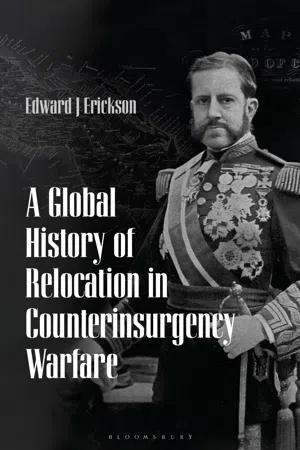
Relocation as a strategy and operational approach in war has reappeared in various forms from the late 18th century to the present day. In A Global History of Relocation in Counterinsurgency Warfare, Edward J Erickson brings together a distinguished cast of contributors to present a chronological survey of the major relocations of people conducted as deliberate operational approaches to modern conflicts.
Each chapter covers a different case study, including the removal of Native Americans in the USA, La Reconcentracion in Cuba, the American internment of Filipinos after the Balangiga Massacre, the deportation of the Boer population in South Africa and the relocation of Ottoman Armenians and Russian Jews. Bringing together the threads of the separate case studies, the conclusion reaffirms relocation as a deliberate operational approach used by major powers in warfare against real or perceived threats.
This is a vital volume for academics and students interested in military history, counterinsurgency and strategic studies.
eBook - ePub
A Global History of Relocation in Counterinsurgency Warfare
- 304 pages
- English
- ePUB (mobile friendly)
- Available on iOS & Android
eBook - ePub
A Global History of Relocation in Counterinsurgency Warfare
About this book
Information
1
Exile without end:
The Acadian expulsion
Major Christine Keating
But Contrary to their expectation the Gate was shut and they confined as Prisoners.1
LIEUTENANT-COLONEL JOHN WINSLOW
Grand Pré, 16 September 1755
Grand Pré, 16 September 1755
Introduction
The small church in the village of Grand Pré sat nestled at the heart of the community. For its Catholic, French Acadian congregants, the church represented the heart and soul of their efforts to make their land productive, to live peacefully with their Mi’kmaq neighbours and to remain free of earthly obligation to foreign rule. But on 5 September 1755, the church would become something else entirely: that symbol of salvation would become the prison in which 418 Acadian men and boys were held captive by British colonial troops. Lured there by the orders of Colonel John Winslow for a proclamation, it was there that the Acadian men would discover that they and their families were to be ripped from their land and deported, dispersed throughout the more southern British colonies in North America. Taking only what they could carry, their homes would be burned, their cattle commandeered, their farms settled by white families from New England.

MAP 2 French Acadia 1755. Acadia was colonized by France in 1604 but was conquered by Britain in 1713. The permanent expulsions in 1755 forcibly emptied Acadia of nearly all of its French inhabitants. The modern Canadian provinces of New Brunswick, Nova Scotia and Prince Edward Island comprise what was Acadia. Many of the exiled Acadians moved to Louisiana where they are today known as Cajuns.
In the surrounding weeks and months, similar scenes would play out across Acadia. Ultimately, nearly 7,000 Acadians would be relocated, scattered throughout the British North American colonies.2 Many wound up forming a new cultural epicentre in what is now Cajun country in Louisiana, and many more lost their community altogether, struggling to find a place in an English-speaking northern colony. Peaceful inhabitants of land that had transferred from French to British control in 1713 as a condition of the Peace of Utrecht that ended the War of Spanish Succession, the Acadians were Catholic and spoke French, anathema to the Protestant British. Although the War of Spanish Succession ended with British victory, the two mother countries continued to fight in Europe and in the Colonies, directly or through proxies, for decades to come. Within the context of this continued strife, the ‘French neutrals’, as the Acadians were known in the colonial press, became an increasing threat to the security of an ill-defined border zone between the French and British colonies. This threat was enhanced by the Acadians’ blunt refusal to swear an oath of allegiance to King George II, preferring to maintain their neutrality. Colonial authorities in Nova Scotia and New England worried that disgruntled Acadians and neighbouring Mi’kmaq indigenous people were passing information and supplies to French troops garrisoned nearby. When British troops discovered Acadians within the captured Fort Beauséjour (later rechristened Fort Cumberland) in 1755, this proved their worst fears of collusion. Lieutenant Governor and Colonel Charles Lawrence decided the only way forward was to rid Nova Scotia of the Acadians entirely.
Throughout June and July 1755, Lawrence and New England Governor William Shirley devised a plan to expunge Nova Scotia of its formerly French inhabitants. This was a political decision, carried out by local colonial regiments and militia purpose-built for the operation. To say that the British expelled the Acadians is inaccurate; it was local colonial governments, charged with their own protection by a distant and disinvested mother country thousands of miles away, that devised and carried out a solution to the perceived Acadian threat. The Acadian expulsion was a military solution to a political problem, with financial and social benefits for Nova Scotia and New England. Decades of careful drainage and cultivation by farmers determined to make the coastal marshlands fruitful, made Acadian farmland particularly desirous. Acquiring that land for Protestant New England settlers became a priority, creating rich, religiously homogenous settlements and simultaneously securing a buffer zone against French attack by sea in the North Atlantic.
Although the political rhetoric surrounding the decision to expel the Acadians focused on the supposed security threat posed by the ‘neutrals’, the concept of military necessity is demonstrated here in a less developed, less distinct way than in later conflicts described in this book. Where later we will see military commanders executing relocations for strategic ends, sometimes predicated on political imperatives, in the case of Acadia, government and military decision making were one and the same. It was not the royal British standing army that marched on Grand Pré; it was local colonial regiments and militias called exclusively for that purpose by colonial governors William Shirley of Massachusetts and Charles Lawrence of Nova Scotia. Colonies were responsible for their own defence, and it was common practice at that time to muster militias for particular threats or campaigns (often against native populations). Thus the political exigencies of the day were the military exigencies of the day, and often vice versa. This was not a case of a military sent to occupy land and subdue a population, where the commander decided that the only way to achieve that end was through relocation; this was a military mission conceived of by political leaders who appointed commanders explicitly for the purpose of expelling the ‘neutral French’.
That distinction would be of little comfort to the scores of Acadians who died offshore in holding ships, or to the thousands who never saw loved ones again following the confusion and haste of the ‘Great Upheaval’. But using the military to achieve political ends in Nova Scotia was also not a new proposal; forcefully ridding the province of its Acadian inhabitants had been suggested as early as 1713, when the Peace of Utrecht offered newly minted Nova Scotians the choice between fealty or flight. Every time a new governor came on board, the question of how to deal with incorrigible Acadian independence, often interpreted as loyalty to France, arose anew. By the time Lawrence actually carried out the relocation in the 1750s, more than two generations of Acadians had lived with the threat of expulsion haunting and defining their relationship with the ruling British colonial leadership. The decision to expel the Acadians was a deliberate colonial project aimed at securing Nova Scotia and New England for British interests and Protestant British settlers. It was a long time in coming and was carried out by colonial militias raised specifically for that endeavour. Unlike other examples in this collection that demonstrate military exigency or a failure to grasp larger political objectives, the Acadian expulsion was the end result of decades of political pressure building up and finally releasing under military execution.
How to measure the success of this British imperial project is another thing altogether. Although Acadian collective identity in Nova Scotia was effectively shattered by Lawrence’s efforts, less than half of the Acadian population was actually removed from the region. Some peripheral communities remained intact; entire families fled into the deep woods surrounding their former homelands and managed to survive; many sought refuge with their Mi’kmaq neighbours or crossed into Canada, where they were welcomed by the French colonial government. Many of those who stayed went on to stage violent resistance to British rule and settlement. What’s more, many of the e xpelled Acadians eventually found their way back to Nova Scotia, much to Lawrence’s personal chagrin. Furthermore, the continued presence of the Mi’kmaq, whose right to live in Nova Scotia was not contested, nevertheless perpetuated the narrative of violent ‘French and Indian’ resistance that the British had hoped to break by expelling the Acadians, the perceived agitators or enablers. Indeed, the French and Indian War would rage on for another eight years following the initial expulsion. Finally, the southern colonies wanted no part of Lawrence’s project, turning a blind eye to Acadian efforts to return or rejecting them outright. Rather than disabling French lines of communication, intelligence and logistical support, the Acadian eviction seems to have simply compounded Nova Scotian security woes, for now they had to deal with damaged political relationships with fellow colonies, a return flow of displaced persons and an internal guerrilla resistance from an armed refugee population in addition to the French threat across the border.
Acadia
On 15 July 1604, the French ship Jonas pulled into port at Canso, on Cape Breton, carrying forty French settlers.3 These men (for they were all men), battered by eight weeks at sea, were the forefathers of those who would come to be known as Acadians. Historian John Mack Faragher suggests two possible origins of the name ‘Acadia’. The first credits Tuscan explorer Giovanni da Verrazano with coining the name after observing the beauty of the northern Atlantic coast in 1524. Verrazano’s ‘Arcadia’ derived its name from a popular 1502 pastoral of the same title, and l’Arcadie became the French cartographic standard name for the region in the sixteenth century. Coincidentally, the local Mi’kmaq suffix – akadie describes places of abundance, which Acadia certainly became for the Jonas’s descendants.4 Whichever story – or combination of the two – is true, the name came to refer to a huge swath of land south of the Gulf of Saint Lawrence. Much of the modern Canadian provinces of Prince Edward Island, Nova Scotia, and New Brunswick, and the American state of Maine, was ‘Acadia’ to these early French settlers. The vastness of l’Acadie, and the absence of defined borders as French settlement expanded, would have repercussions when the land passed into British hands a century later. Defined only by its ‘ancient borders’, Acadia was difficult to pinpoint on a map, and the Acadian descendants of the Jonas’s sailors would suffer in the ensuing contests over the border.
Acadian heritage can still be seen today in the borderland areas of South-eastern Canada and the North-eastern United States. Despite the best efforts of colonial armies conducting the expulsion, the Acadian name and culture survive to this day, calling into question the fullness and effectiveness of the British campaign to eradicate French influence. Local residents on both sides of the border actively claim and celebrate Acadian heritage; ‘Acadia’ and ‘Acadie’ feature prominently on signage throughout the region. The beautiful drive up the north-eastern seaboard of the United States takes travellers through Acadia National Park, and once across the border into Canada, extant French speakers remain a living reminder of former French colonial aspirations and of Acadian presence.5 Similarly, Mi’kmaq native culture still thrives in the region, forming part of the fabric of Nova Scotian daily life in a way that would be unimaginable in Puritan New England, long since stripped of its native inhabitants. Many of the heritage sites and museums that mark the Acadian story in Nova Scotia have trilingual signage, explaining the historical significance of the site in English, French and Mi’kmaq. This is not to downplay in any way the betrayals and brutality endured by the Mi’kmaq at the hands of the British. It simply emphasizes the incompleteness of any colonial project to fully Anglicize Acadia.
To those first French settlers, the lands that would one day be the site of so much bit...
Table of contents
- Cover
- Half-Title
- Title
- The Cover Image
- Contents
- List of maps
- List of contributors
- Introduction
- 1 Exile without end: The Acadian expulsion
- 2 The Long Walk of the Navajo: Relocation in the American Southwest
- 3 War answered with war: The Spanish in Cuba
- 4 A howling wilderness: America in the Philippines
- 5 Methods of barbarism: The Boer War
- 6 Uneven repression: The Ottoman state and its Armenians
- 7 From the Pale: The Russians and the Jews
- 8 They are our enemies: The Japanese-American internment
- 9 A collective measure: Population resettlement in the Malayan Emergency
- 10 Centres de Regroupement: The French in Algeria
- 11 Counterinsurgency at the ‘rice roots’ level: South Vietnam’s Strategic Hamlet Campaign
- 12 Resettlement in the Portuguese Colonial Wars: Africa, 1961–75
- Conclusions: Relocation in counterinsurgency warfare
- Appendix: Relocation statistics
- Index
- Copyright
Trusted by 375,005 students
Access to over 1.5 million titles for a fair monthly price.
Study more efficiently using our study tools.
Frequently asked questions
Yes, you can cancel anytime from the Subscription tab in your account settings on the Perlego website. Your subscription will stay active until the end of your current billing period. Learn how to cancel your subscription
No, books cannot be downloaded as external files, such as PDFs, for use outside of Perlego. However, you can download books within the Perlego app for offline reading on mobile or tablet. Learn how to download books offline
Perlego offers two plans: Essential and Complete
- Essential is ideal for learners and professionals who enjoy exploring a wide range of subjects. Access the Essential Library with 800,000+ trusted titles and best-sellers across business, personal growth, and the humanities. Includes unlimited reading time and Standard Read Aloud voice.
- Complete: Perfect for advanced learners and researchers needing full, unrestricted access. Unlock 1.5M+ books across hundreds of subjects, including academic and specialized titles. The Complete Plan also includes advanced features like Premium Read Aloud and Research Assistant.
We are an online textbook subscription service, where you can get access to an entire online library for less than the price of a single book per month. With over 1.5 million books across 990+ topics, we’ve got you covered! Learn about our mission
Look out for the read-aloud symbol on your next book to see if you can listen to it. The read-aloud tool reads text aloud for you, highlighting the text as it is being read. You can pause it, speed it up and slow it down. Learn more about Read Aloud
Yes! You can use the Perlego app on both iOS and Android devices to read anytime, anywhere — even offline. Perfect for commutes or when you’re on the go.
Please note we cannot support devices running on iOS 13 and Android 7 or earlier. Learn more about using the app
Please note we cannot support devices running on iOS 13 and Android 7 or earlier. Learn more about using the app
Yes, you can access A Global History of Relocation in Counterinsurgency Warfare by Edward J. Erickson, Edward J Erickson in PDF and/or ePUB format, as well as other popular books in History & Military & Maritime History. We have over 1.5 million books available in our catalogue for you to explore.