Whether you are a young actor seeking to land your first screen role or a workshop leader looking for relevant exercises that won't involve vast technical support, this book belongs on your shelf. Many screen actors begin their careers lacking the appropriate pre-shoot preparation and knowledge of studio protocols. This book helps actors new to screen performance to be fully prepared artistically - and technically. Screen Acting Skills augments existing theoretical and academic studies by offering practical, focused exercises that can be explored in low-tech workshop situations.
Written in an accessible, jargon-free and often humorous style, Screen Acting Skills enables creativity on the workshop floor, allowing young - and older! - actors to access their own talent, and to hone their skills. This book offers students and tutors a straightforward approach to acting for the screen and how to prepare for studio work.
The book is published alongside online videos of workshops with screen acting students.
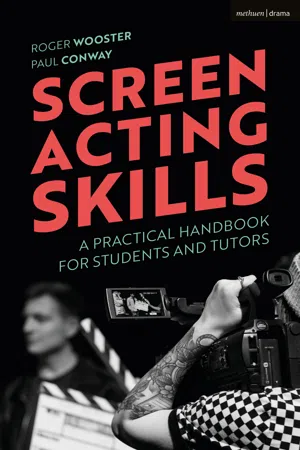
eBook - ePub
Screen Acting Skills
A Practical Handbook for Students and Tutors
- 240 pages
- English
- ePUB (mobile friendly)
- Available on iOS & Android
eBook - ePub
About this book
Information
1 DON’T ACT, BE!
Working in theatre is like doing surgery with a scalpel. Working in film is like surgery with a laser.
Michael Caine1
To the actor
The sooner the stage people who have come into pictures get out, the better for the pictures. (Marshall Neilan, actor/director/screenwriter (1891–1958), quoted in Brownlow 1973: 400)
Rather cruel, but it refers to the process that existed before sound recording was invented. During the silent cinema era, c.1891–1927, actors did actually speak on screen. It’s just that without mics you can’t hear them. Vocalizing helped them find the action. (In the same way, radio actors will often physicalize their studio performance in order to find the tone and colour of the text.) Emotions were presented physically, usually through a flurry of, at times, desperate pantomime:
In 1908 the film producers and their audience derived the frame of reference primarily from their knowledge of theatrical conventions that were associated with the melodrama. (Pearson 1992: 7)
The beginning of film acting
When film acting first came into the picture (!) at the end of the nineteenth century, there were no dedicated drama schools in existence to help train actors for silent screen performance. Instead, seasoned professional stage performers were employed by the film studios and plonked in front of the newly invented motion picture camera. Some results appear disastrous, as the acting techniques seem to the modern eye manic and uncontrolled.
To help elicit passionate performances, directors resorted to various methods including the employment of professional musicians to create ‘mood music’. This musical accompaniment was blasted out whilst the actors were in full-flight performance mode, for the days of post-production sound were still far away.
There were some advantages for the director, of course: they could direct loudly in conjunction with a wild mimicking of the gestures and emotions they were seeking from their actors. A recreation of this can be seen in Scorsese’s Hugo. Such a process would not be tolerated today as it would completely ruin the actors’ carefully built emotional interactions. Imagine Baz Luhrmann directing Romeo + Juliet (1996), screaming ‘now kiss her!’ whilst Leo DiCaprio holds Claire Danes in a sensitive passionate embrace. Probably not conducive to the carefully paced atmosphere of the scene.
To help narrate the story, silent film often used a title card: a printed piece of dialogue momentarily interspersed throughout the film to help the audience make sense of the visual images. To see a send-up of this style, a useful source is the classic 1952 Singin’ in the Rain (Stanley Donen and Gene Kelly). One of its plotlines includes the transition from the silent to the newly arrived technique of the ‘talkies’ (ask your great-grandparents). But we should note that not all silent films are unbelievable or unwatchable due to an overcooked performance style – quite the opposite, and it is fascinating to watch the birth of naturalistic acting grow out of these early attempts at visual storytelling.
As an example of excessive acting style, we urge you to view a copy of the highly successful (in its day) The Thief of Bagdad (Raoul Walsh, 1924). Those who fancy a somewhat richer cinematic feast might like to sample Eisenstein’s Ivan the Terrible (1944), an incredible piece of cinema, though out of sympathy with today’s screen acting style. The horror-film monsters of the silent era that generated nightmares for a previous generation seem laughable to us today.
Now consider The Crowd (King Vidor, 1928), a landmark film that moves characterization (and screen performance technique) towards a more realistic representation. Over a twenty-year period, beginning in 1897, several areas of performance exploration and filmmaking converged to move the art of stage and screen acting towards a more real representation of emotions and storytelling. For actors, this began with the introduction of character construction acting techniques linked to the growth of understanding of psychology. These constructs were initially designed for the stage actor and were set out as a series of physical and internal exercises that strove to facilitate a more realistic and natural performance. This is the age of Ibsen and the realists. More natural styles of performance were facilitated by the arrival of electric light in the theatres that precluded the need for flamboyant gestures to penetrate the gaslight gloom. The artistic quest for this new realism would eventually transfer its passion for the clearest, deepest representation of human behaviour to the cinema.
The coming of ‘The Method’
Just a quick dip into the codification of this new naturalism now – in case your stage-acting studies have managed to bypass it or you were thinking about something else at the time. In 1897 two Russian theatre practitioners came together over an eighteen-hour lunch meeting. They were Constantin Stanislavski (1863–1938) and Vladimir Nemirovich-Danchenko (1858–1943). The meeting is of historic significance to performance as both men had a desire to move theatre acting away from the melodramatic style of the period into a more psychologically and naturalistic-driven presentation. The outcome of this conversation was the birth of ‘The Stanislavski System’: a series of techniques designed to help construct believable emotions and actions. (We don’t know who paid for the lunch.)
The System continued to adapt and grow and its influence led directly to the foundation in 1947 of New York’s Actors Studio by Cheryl Crawford, Elia Kazan and Roger Lewis. They created a workshop where actors could discuss and experiment with acting techniques and performance. The American approach to the work of Stanislavski became known as ‘The Method’ and Lee Strasberg (1901–82) became its main figurehead and practitioner. Under his artistic direction, The Method developed into a renowned, fully immersive and intense framework for character creation. It was adopted by young theatre and screen actors such as Julie Harris, Marilyn Monroe, John Garfield, James Dean, Montgomery Clift and Marlon Brando. The Method developed their characterizations to become what we today know as ‘natural acting’. From Stanislavski to Strasberg, plus encouragement by other directors such as Stella Adler and Elia Kazan, screen and stage actors began to understand and shape performance towards the required subtleties of the new medium. Actors, directors, scriptwriters, set designers and cinematographers were all beginning to engage with naturalistic visual storytelling.
The coming of sound
Since the invention of cinema, there had been experimentation with recording and lip-syncing to match the moving image, all with varying degrees of success and failure. In 1926, Don Juan (Alan Crosland) and The Better ’Ole (Charles Reisner) were released. Both had music and sound effects but no talking. Then came The Jazz Singer (Alan Crosland, 1927), the first full-length talking movie (though sound was present for only a quarter of the running time, with musical numbers – and silence – taking up the rest of the time). Films could now talk, and nothing would ever shut them up.
With their arrival, the microphone and recording equipment removed forever the possibility for film directors to direct a performance whilst the camera rolled. Sound capture became an integral and unavoidable working companion to film acting. Actors were suddenly challenged to produce vocal clarity and to act with neither the assistance of mood music, nor shouted instructions, nor audience feedback in the form of laughter or applause. It must have felt extremely lonely after a life on the boards.
Almost overnight, vocal coaching became a sub-industry, especially as the lure of stardom grew and the ‘star system’ became a tangible goal for fame-hungry performers. Countless would-be actors prepared themselves specifically for the ‘talkies’ to be their artistic home base and a few were talented (and lucky) enough to gain entry to this world of movie magic. Unfortunately, quite a few didn’t make it and became, as is still the case, some of the most vocally trained waiters and waitresses in Hollywood.
From stage to screen
Here is something no real celebrity will ever tell you: film acting is not very fun. Doing the same thing over and over again until, in the director’s eyes, you ‘get it right’ does not allow for very much creative freedom … In terms of sheer adrenaline, film has absolutely nothing on theater. (Mara Wilson)2
Overall, the period from stage histrionics to naturalistic cinematic acting is not that long in the grand scheme of things, but it is an important journey to consider because the history of performance is one that you, training for this profession, can draw upon. You will be part of the next generation of innovations. Elements of screen acting require a different working approach from stage acting: a different understanding and modulation of voice and a different understanding and control of the body. Even the smallest gestures need highlighting on the stage lest the audience miss them: on film they are reduced to a minimum as the cine-camera will capture something as little as a throbbing vein. The audience has no choice but to follow the presented imagery. The theatre director has no such control over what the audience looks at. You may be giving a thunderous speech, but we may find that our gaze falls upon the actors receiving it. Moreover, the theatregoer will probably be able to do both: take in your speech whilst simultaneously absorbing the whole gamut of the stage action.
Alongside the microphone, the use of the close-up eliminates the need for many unnecessary physical movements and allows you, the actor, to concentrate instead on the inner life of the character as revealed by facial expressions. The use of the close-up rendered redundant many of the superfluous and ‘actor-y’ physical movements, facilitating instead a concentration on the interior life of the character, which the audience reads as they would read anyone’s facial expressions in their own lives.
To experience the effectiveness of the close-up, consider Al Pacino (playing Michael Corleone) when he makes the discovery in a Havana nightclub of (spoiler alert) his brother’s betrayal (sorry, too late!) in The Godfather: Part 2 (Francis Ford Coppola, 1974). Pacino’s stillness clearly conveys the inner turmoil of his character with minimum movement whilst optimizing dramatically the geography of his face, especially the eyes.
It may be of value to reflect on the characteristics listed below that help define the different working paradigms of stage and film. It is by no means complete and doubtless you will find entries for yourself as you discover the commonalities between the different media and, perhaps more importantly, the differences.
| STAGE ACTING | FILM ACTING |
| Actors love acting on stage and film | Actors love acting on film and stage |
| Actors perform for a live audience | Actors perform for a camera |
| Actors perform in real time | Actors perform over a period of time |
| Actors’ voices require projection | Actors’ voices require natural levels |
| Actors ‘find the light’ on the stage | Actors ‘hit the mark’ on a film set |
| Actors’ mistakes in full view but fleeting | Actors’ mistakes hidden by editing |
| Actors have adequate rehearsal time | Actors have limited rehearsal time |
| Actors seek truth | Actors seek truth |
| Actors portray characters | Actors portray characters |
| Actors listen | Actors listen |
| Actors have control in performance | Actors lose control to director/editor |
Discuss these different characteristics (and any others you may discover) with the rest of the group. The more we discuss performances we have witnessed or taken part in, then the more we can understand each other and the art form we have chosen to study. Extend this to discuss screen performances you admire an...
Table of contents
- Cover
- Halftitle Page
- Title Page
- Dedication Page
- Contents
- Figures
- Website Exercises
- Acknowledgements
- Introduction: Ready For ‘Action!’
- 1 Don’t act, be!
- 2 Backchat: Creating a backstory
- 3 The actor as plumber
- 4 Keeping it real
- 5 This has never happened to me before
- 6 Where am I? When am I?
- 7 Are you listening to me?
- 8 Where were we?
- 9 It’s good to cheat
- 10 Finding the art of You
- 11 Audition peace
- 12 It’s a Wrap!
- Glossary
- Recommended Further Reading
- References
- Imprint
Trusted by 375,005 students
Access to over 1.5 million titles for a fair monthly price.
Study more efficiently using our study tools.
Frequently asked questions
Yes, you can cancel anytime from the Subscription tab in your account settings on the Perlego website. Your subscription will stay active until the end of your current billing period. Learn how to cancel your subscription
No, books cannot be downloaded as external files, such as PDFs, for use outside of Perlego. However, you can download books within the Perlego app for offline reading on mobile or tablet. Learn how to download books offline
Perlego offers two plans: Essential and Complete
- Essential is ideal for learners and professionals who enjoy exploring a wide range of subjects. Access the Essential Library with 800,000+ trusted titles and best-sellers across business, personal growth, and the humanities. Includes unlimited reading time and Standard Read Aloud voice.
- Complete: Perfect for advanced learners and researchers needing full, unrestricted access. Unlock 1.5M+ books across hundreds of subjects, including academic and specialized titles. The Complete Plan also includes advanced features like Premium Read Aloud and Research Assistant.
We are an online textbook subscription service, where you can get access to an entire online library for less than the price of a single book per month. With over 1.5 million books across 990+ topics, we’ve got you covered! Learn about our mission
Look out for the read-aloud symbol on your next book to see if you can listen to it. The read-aloud tool reads text aloud for you, highlighting the text as it is being read. You can pause it, speed it up and slow it down. Learn more about Read Aloud
Yes! You can use the Perlego app on both iOS and Android devices to read anytime, anywhere — even offline. Perfect for commutes or when you’re on the go.
Please note we cannot support devices running on iOS 13 and Android 7 or earlier. Learn more about using the app
Please note we cannot support devices running on iOS 13 and Android 7 or earlier. Learn more about using the app
Yes, you can access Screen Acting Skills by Roger Wooster,Paul Conway in PDF and/or ePUB format, as well as other popular books in Mezzi di comunicazione e arti performative & Recitazione e provini. We have over 1.5 million books available in our catalogue for you to explore.