eBook - ePub
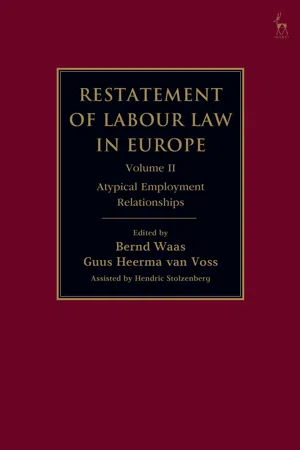
Restatement of Labour Law in Europe
Vol II
- 800 pages
- English
- ePUB (mobile friendly)
- Available on iOS & Android
eBook - ePub
Restatement of Labour Law in Europe
Vol II
About this book
This book is part of a series which sets out a restatement of labour law in Europe. Its second volume looks at atypical employment relationships in Europe. Opening with a restatement, the book provides comparative commentary on the question of how fixed-term employment relationships, part-time employment relationships and temporary agency work is regulated by law in the individual states, which case law of the courts must be observed in this respect and which possibilities exist for shaping such relationships on the basis of collective bargaining agreements. The book goes on to systematically explore the national regulatory framework of: Austria, Belgium, Bulgaria, Croatia, Cyprus, Czech Republic, Denmark, Estonia, Finland, France, Germany, Greece, Hungary, Iceland, Ireland, Italy, Latvia, Lithuania, Luxembourg, Malta, Montenegro, Netherlands, North Macedonia, Norway, Poland, Portugal, Romania, Russia, Serbia, Slovakia, Slovenia, Spain, Sweden, Switzerland, Turkey and the United Kingdom. In this area, which is largely shaped by EU law in many countries, the commonalities and differences with regard to the relevant regulatory issues are examined. This important new project provides the definitive survey of labour law in Europe today.
Information
1
Atypical Employment Relationships: The Position in Austria
I.INTRODUCTION
ALL THREE FORMS of ‘classic’ atypical employment relationships treated in this volume are regulated in Austrian law. The procedure and extent of regulation differs significantly, ranging from recourse to the general notions of civil law with successive fixed-term contracts to a relatively tight regulation of part-time employment as well as temporary agency work in a special Act that originates from 1988. All three forms of atypical employment have benefited from respective EU directives, although the domestic legislation often goes beyond the mere verbatim transposition and includes original approaches like the extra-time bonus for part-time workers or the co-determination rights of the works council of the user undertaking in case of temporary agency work.
The most recent statistics from Eurostat’s Labour Force Survey1 indicate that 27.3 per cent of the workforce in Austria worked part time in 2018, with significant differences between male (ten per cent) and female workers (46.9 per cent). Nine per cent of the workforce are employed on fixed-term contracts. 1.9 per cent of the workforce are employed through employment agencies.2
II.FIXED-TERM WORK
A.Legal Definitions/Formal Requirements
There is no explicit legal definition of the notion of fixed-term work in Austrian law. Long-standing jurisprudence, however, holds that an employment relationship for a definite period (fixed-term work) exists if its duration is defined in terms of the calendar or if the ending of the employment relationship can be objectively established and foreseen in some other way.3 This must be agreed by the parties—otherwise, the employment relationship is deemed indefinite, as this is the statutory default.4
Section 1158(1) of the Civil Code (Allgemeines Bürgerliches Gesetzbuch—ABGB)5 as well as Section 19 of the Act on White Collar Workers (Angestelltengesetz) only deal with the termination of fixed-term contracts, and neither defines it nor points out under which circumstances it is permitted. The existence and legality of fixed-term work is therefore presupposed.6
There are no formal requirements; especially no requirement of a written form. The fixed-term does not even have to be justified, except in the case of temporary agency work—successive fixed-term contracts must be based on justified grounds (see IV.C.(i)).
B.Lawful Stipulation of the Contractual Terms
The employee may experience a number of disadvantages under a fixed-term employment relationship, especially when consecutive fixed-term contracts are concluded. Many employee rights only apply after a certain uninterrupted period of employment, or depend quantitatively on total duration (period of notice, annual leave rights). Above all, there is no job security once the agreed term of employment ends, as only terminations by notice or by summary dismissal may be contested in court. The conclusion of fixed-term employment contracts involves the risk of excluding such workers from statutory job security.
However, there is no explicit statutory provision in general employment law prohibiting the extension of a fixed-term contract or the conclusion of successive fixed-term contracts. Long-standing case law views such practices as a circumvention of protection against dismissal (which only applies to dismissals by notice or summary dismissals) and of the provisions that underlie an employee’s right or entitlement to uninterrupted employment (eg the statutory minimum duration of notice periods or sick leave). It therefore assumes that an employer who concludes successive fixed-term contracts that are not justified on substantiated grounds seeks to circumvent provisions that protect the employee. The employer must therefore justify the conclusion of a successive fixed-term contract—otherwise, the agreement on the fixed term will be deemed void and the contract will be transformed into contract of indefinite duration. The courts consider the following reasons as justifying a successive fixed-term contract: the temporary nature of the work,7 the replacement of an employee,8 seasonal work9 or professional sports where fixed-term contracts are the norm.10 The more often a contract is renewed, the more rigorous the courts apply the test of justification of that fixed-term contract.11 Another issue is the time elapsed between the two fixed-term contracts concluded by the same parties—can they be considered consecutive12 or can the two contracts be assessed independently of each other? The longer the duration between contracts, the stronger the argument against the assumption that the successive contract is a continuation of the first one and in favour of considering the contracts individually. One strong factor in favour of such separate assessment is if the duration of not working significantly exceeds that of working for the employer.13
C.Termination/End of Fixed-Term Contracts
Fixed-term contracts usually end with the expiration of the term or the occurrence of the agreed condition (eg the return of the employee the fixed-term worker was replacing).14 The contract may also be terminated by mutual agreement, by summary dismissal or by the employee for good reason.
In principle, a fixed-term contract cannot be terminated by giving notice. The employee may, however, terminate a contract that has been concluded for a term of more than five years or for life by giving six months’ notice.15 In all other cases, this is only possible if it has been explicitly agreed upon and if this possibility does not contravene the notion of the fixed-term contract, ie automatic termination without protection in exchange for high protection against dismissal during the course of the term. The courts only admit termination of fixed-term employment on notice in case of long terms (usually one year or longer)16 or if the fixed term is justified, eg in the case of state-assisted employment for a limited time.17
Special provisions exist for pregnant employees: a pregnant woman is not obliged to look for a new job once her fixed-term contract lapses, and her employment may thus be extended in accordance with provisions in law18 until the pregnant employee’s so-called ‘protection period’ commences, ie eight weeks before the calculated due date, during which the employee’s wages continue being paid by statutory sickness insurance. This extension is not granted in cases in which the fixed term is fully justified. The Act lists the following justifying reasons: prevailing interests of the employee, replacement of another employee, seasonal work or a probation period that has to be longer than that provided for by statute or collective agreement (usually one month).19
D.Rights and Status of Fixed-Term Worker
(i)Equal Treatment
Section 2b(1) of the Act on the Adaptation of Employment Contract Law (Arbeitsvertragsrechtsanpassungsgesetz—AVRAG) provides that fixed-term workers may not be discriminated against in comparison with permanent workers with a contract of indefinite duration unless differentiated treatment is justified on objective grounds. Prior to the introduction of this provision in 2002, discrimination against fixed-term employees was often deemed indirect discrimination based on gender, as ruled by the European Court of Justice.20
The Act does not explicitly refer to ‘comparable’ permanent employees as does Clause 4 of the ETUC-UNICE-ECCP Framework Agreement on Fixed-term Work. According to the legal literature, the Austrian notion has to be interpreted in line with the definition in Clause 3(2) of the Framework Agreement, ie a worker with an employment contract or relationship of indefinite duration in the same establishment, engaged in the same or a similar work/occupation, due regard being given to qualifications/skills. Where there is no comparable permanent employee in the same establishment, the comparison shall be made by reference to the applicable collective agreement, or where there is no applicable collective agreement, in accordance with national law, collective agreements or practice.21 It has been argued that ‘similar’ work is to be characterised by the field of work, the necessary qualifications, the employment conditions and the applicable collective bargaining agreements (especially the classification o...
Table of contents
- Cover
- Title Page
- Acknowledgements
- Contents
- List of Contributors
- Introduction
- Restatement Text
- Comparative Overview
- 1. Austria
- 2. Belgium
- 3. Bulgaria
- 4. Croatia
- 5. Cyprus
- 6. Czech Republic
- 7. Denmark
- 8. Estonia
- 9. Finland
- 10. France
- 11. Republic of North Macedonia
- 12. Germany
- 13. Greece
- 14. Hungary
- 15. Iceland
- 16. Ireland
- 17. Italy
- 18. Latvia
- 19. Lithuania
- 20. Luxembourg
- 21. Malta
- 22. Montenegro
- 23. Netherlands
- 24. Norway
- 25. Poland
- 26. Portugal
- 27. Romania
- 28. Russia
- 29. Serbia
- 30. Slovakia
- 31. Slovenia
- 32. Spain
- 33. Sweden
- 34. Switzerland
- 35. Turkey
- 36. United Kingdom
- Bibliography
- Index
- Copyright Page
Trusted by 375,005 students
Access to over 1.5 million titles for a fair monthly price.
Study more efficiently using our study tools.
Frequently asked questions
Yes, you can cancel anytime from the Subscription tab in your account settings on the Perlego website. Your subscription will stay active until the end of your current billing period. Learn how to cancel your subscription
No, books cannot be downloaded as external files, such as PDFs, for use outside of Perlego. However, you can download books within the Perlego app for offline reading on mobile or tablet. Learn how to download books offline
Perlego offers two plans: Essential and Complete
- Essential is ideal for learners and professionals who enjoy exploring a wide range of subjects. Access the Essential Library with 800,000+ trusted titles and best-sellers across business, personal growth, and the humanities. Includes unlimited reading time and Standard Read Aloud voice.
- Complete: Perfect for advanced learners and researchers needing full, unrestricted access. Unlock 1.5M+ books across hundreds of subjects, including academic and specialized titles. The Complete Plan also includes advanced features like Premium Read Aloud and Research Assistant.
We are an online textbook subscription service, where you can get access to an entire online library for less than the price of a single book per month. With over 1.5 million books across 990+ topics, we’ve got you covered! Learn about our mission
Look out for the read-aloud symbol on your next book to see if you can listen to it. The read-aloud tool reads text aloud for you, highlighting the text as it is being read. You can pause it, speed it up and slow it down. Learn more about Read Aloud
Yes! You can use the Perlego app on both iOS and Android devices to read anytime, anywhere — even offline. Perfect for commutes or when you’re on the go.
Please note we cannot support devices running on iOS 13 and Android 7 or earlier. Learn more about using the app
Please note we cannot support devices running on iOS 13 and Android 7 or earlier. Learn more about using the app
Yes, you can access Restatement of Labour Law in Europe by Bernd Waas, Guus Heerma van Voss, Bernd Waas,Guus Heerma van Voss in PDF and/or ePUB format, as well as other popular books in Law & Law Theory & Practice. We have over 1.5 million books available in our catalogue for you to explore.