eBook - ePub
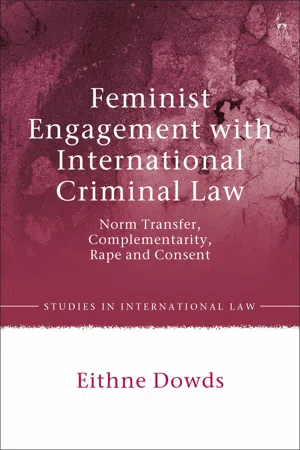
Feminist Engagement with International Criminal Law
Norm Transfer, Complementarity, Rape and Consent
- 280 pages
- English
- ePUB (mobile friendly)
- Available on iOS & Android
eBook - ePub
Feminist Engagement with International Criminal Law
Norm Transfer, Complementarity, Rape and Consent
About this book
This work introduces and further develops the feminist strategy of 'norm transfer': the proposal that feminist informed standards created at the level of international criminal law make their way into domestic contexts. Situating this strategy within the complementarity regime of the International Criminal Court (ICC), it is argued that there is an opportunity for dialogue and debate around the contested aspects of international norms as opposed to uncritical acceptance. The book uses the crime of rape as a case study and offers a new perspective on one of the most contentious debates within international and domestic criminal legal feminism: the relationship between consent and coercion in the definition of rape. In analysing the ICC definition of rape, it is argued that the omission of consent as an explicit element is flawed. Arguing that the definition is in need of revision to explicitly include a context-sensitive notion of consent, the book goes further, setting out draft legislative amendments to the ICC 'Elements of Crimes' definition of rape and its Rules of Procedure and Evidence. Turning its attention to the domestic landscape, the book drafts amendments to the United Kingdom (UK) Sexual Offences Act 2003 and to the Youth Justice and Criminal Evidence Act 1999: thereby showing how the revised version of the ICC definition can be applied in context of the UK.
Information
Part I
The Legal and Theoretical Context
1
Rethinking Feminist Engagement with International Criminal Law: An Introduction
Feminist perspectives on international law have developed into a ‘flourishing discourse’,1 forming part of what Chappell has conceptualised as the ‘international feminist legal project’.2 International criminal law, in particular, has captured the attention of feminist scholars and practitioners with significant efforts being directed towards securing the criminalisation of sexual and gender-based violence perpetrated against women in times of conflict or mass violence.3 Yet, this focus has sparked unease in some feminist circles and concern has been raised over the potential reinforcement of longstanding gender tropes, specifically, women as inescapable victims of war, sexually vulnerable and in need of protection.4 In this regard, international criminal legal feminism has begun to reflect on what feminist intervention has thus far achieved and explore new directions for future engagement.5
The overall purpose of this book is to join these conversations by introducing and further developing the feminist strategy of ‘norm transfer’: the proposal that feminist informed standards created at the level of international criminal law make their way into domestic contexts.6 The book situates the feminist strategy of norm transfer within the complementarity regime of the International Criminal Court (ICC), the first permanent international criminal court with jurisdiction over war crimes, crimes against humanity and, more recently, the crime of aggression,7 sub-dividing this process into a tripartite structure. In paying particular attention to the relationship between positive complementarity and norm transfer it is argued that norm transfer provides the opportunity to reflect upon the norms developed at the ICC and to encourage conversations around the contested aspects of these norms as opposed to uncritical acceptance.
By way of example, the book uses the crime of rape as a case study and offers a new perspective on one of the most contentious debates within international and domestic criminal legal feminism: the relationship between the requirements of lack of consent versus a focus on coercion in the definition of this crime. The element of consent, Hurd has suggested, possesses a type of ‘moral magic’ in which it transforms impermissible sexual activity into permissible sexual activity.8 However, Schomburg and Peterson, amongst others, have argued that while consent may be relevant in the domestic context its relevance fades in the oppressive contexts that trigger international criminal law.9 According to these scholars, a focus on coercion, with consent playing a limited role as a defence, is preferable as it contextualises the act and more readily captures the asymmetry of relations that give rise to rape in the first place.10 Yet, this focus has been criticised for failing to acknowledge the core wrong of rape and female agency in such contexts and for creating a dichotomy between rape in conflict and rape in peace.11 This disagreement, as to the appropriate role of consent, thus speaks directly to debates on the construction of female identity in international criminal law, as well as debates on the relationship between international and domestic law dealing with this crime.
The book has four principled objectives: (i) to introduce the feminist strategy of norm transfer as a new lens to critically explore the treatment of sexual and gender-based crimes, their categorisation and representation, in international and domestic contexts; (ii) to critically analyse the ICC definition of rape, comparing it to the definitions articulated at the International Criminal Tribunal for Rwanda (ICTR) and the International Criminal Tribunal for the former Yugoslavia (ICTY) (together the ad hoc tribunals), as well as the different definitional approaches within international human rights and domestic legal regimes; (iii) to disrupt binary thinking in relation to rape as an international crime and rape as a domestic crime by conducting a theoretical investigation into the individual wrong of rape whatever the circumstances in which it is perpetrated; and (iv) to consider how international and domestic approaches to the role of consent in defining the crime of rape might inform one another and draft legislative amendments to the ICC definition, as well as a domestic example, to bring the arguments on norm transfer and rape into practice.
In applying a norm transfer lens to the ICC definition of rape and the question of consent, the book uncovers a more complex and mutually interactive dimension to norm transfer, with the definition(s) of rape constructed in international criminal law having been informed, to varying degrees, by domestic law and practice. Following a doctrinal and theoretical analysis of the different definitional approaches at the international and domestic level, the core argument of the book is that the omission of the absence of consent as an explicit element of the ICC definition of rape is flawed and should be amended to incorporate a context-sensitive element of consent. Despite the need for this amendment, the book recognises the significance of the language of a ‘coercive environment’ utilised in the ICC definition, and argues that this language could usefully be incorporated into domestic consent-based definitions.
I.KEY TERMS AND SCOPE OF THE STUDY
A number of key terms that will be utilised throughout this study require further explanation. For instance, the reference to a ‘feminist legal project’ in this book is not meant in a singular sense. Rather, it is more appropriate to speak of ‘feminisms’. As noted by Conaghan ‘feminist scholarship […] is expressive of significant diversity of thought and derives from a range of different political, cultural, and philosophical traditions’.12 In this respect, feminism is sometimes described with reference to different genres:13 such as, ‘liberal’ feminism focused on inclusion and equality; ‘radical’ feminism seeking exposure of the structural domination of women by men; ‘cultural’ feminism focused on identifying and rehabilitating qualities associated with women; ‘marxist’ feminism which explores how women are oppressed with attention to economic and reproductive systems; ‘postcolonial’ or ‘critical race’ feminism which pays attention to women’s lived histories and positions sex/gender as only one part of their intersecting identities and oppressions; and ‘queer’ feminism which moves away from dual conceptions of sex and gender, and embraces multiple and fluid sexualities.14 Although the strands of feminism highlighted above represent different approaches and perspectives, a combination of these approaches, as opposed to a strict division, is often found in international feminist legal scholarship.15 As noted by Charlesworth, a feminist analysis of international law can be compared to an ‘archaeological dig’ whereby different feminist theories are appropriate at different levels of analysis.16
The ‘international feminist legal project’ can thus be understood as ‘a continuous goal-orientated activity based on an analysis of some kind … but the goals and analysis are not necessarily internally coherent or consistent overtime’.17 The central focus of this book is on norm transfer as a key goal or strategy within feminist scholarship and practice. While norms can be broadly defined as standards ‘of appropriate behaviour for actors with a given identity’,18 it is specifically criminal legal norms that this book is interested in: that is, ‘formally established norms according to which individuals or groups are adjudged guilty or innocent’.19 In particular this book is concerned with the legal definition of rape, as well as the rules of evidence that are applicable to this crime. There are however a variety of other sexual and gender-based crimes that are noted throughout this book, such as those contained within the Rome Statute of the ICC: sexual slavery, enforced prostitution, forced pregnancy, enforced sterilisation, or any other form of sexual violence of comparable gravity.20
Further to this, while Bassiouni has identified 28 categories of ‘international crimes’, the focus of this book is on three categories of ‘core’ international crimes, namely genocide, crimes against humanity and war crimes.21 These crimes have been categorised as ‘core’ because they are deemed to be ‘the most serious crimes of concern to the international community as a whole’.22 Marcus has sub-divided the content of these crimes into three main groups: the ‘specific element’; the ‘common element’; and the ‘linkage element’.23 The ‘specific element’ refers to the underlying crime, for example rape or murder; the ‘common element’ refers to the conte...
Table of contents
- Cover
- Title Page
- Acknowledgements
- Contents
- List of Abbreviations
- Table of Cases
- PART I: THE LEGAL AND THEORETICAL CONTEXT
- PART II: RAPE AS A CASE STUDY
- PART III: SHAPING FUTURE DIALOGUE ON NORM TRANSFER
- Appendix I: Amendment to the ICC Definition of Rape
- Appendix II: Amendment to the Sexual Offences (UK) 2003 Definition of Rape
- Bibliography
- Index
- Copyright Page
Trusted by 375,005 students
Access to over 1.5 million titles for a fair monthly price.
Study more efficiently using our study tools.
Frequently asked questions
Yes, you can cancel anytime from the Subscription tab in your account settings on the Perlego website. Your subscription will stay active until the end of your current billing period. Learn how to cancel your subscription
No, books cannot be downloaded as external files, such as PDFs, for use outside of Perlego. However, you can download books within the Perlego app for offline reading on mobile or tablet. Learn how to download books offline
Perlego offers two plans: Essential and Complete
- Essential is ideal for learners and professionals who enjoy exploring a wide range of subjects. Access the Essential Library with 800,000+ trusted titles and best-sellers across business, personal growth, and the humanities. Includes unlimited reading time and Standard Read Aloud voice.
- Complete: Perfect for advanced learners and researchers needing full, unrestricted access. Unlock 1.5M+ books across hundreds of subjects, including academic and specialized titles. The Complete Plan also includes advanced features like Premium Read Aloud and Research Assistant.
We are an online textbook subscription service, where you can get access to an entire online library for less than the price of a single book per month. With over 1.5 million books across 990+ topics, we’ve got you covered! Learn about our mission
Look out for the read-aloud symbol on your next book to see if you can listen to it. The read-aloud tool reads text aloud for you, highlighting the text as it is being read. You can pause it, speed it up and slow it down. Learn more about Read Aloud
Yes! You can use the Perlego app on both iOS and Android devices to read anytime, anywhere — even offline. Perfect for commutes or when you’re on the go.
Please note we cannot support devices running on iOS 13 and Android 7 or earlier. Learn more about using the app
Please note we cannot support devices running on iOS 13 and Android 7 or earlier. Learn more about using the app
Yes, you can access Feminist Engagement with International Criminal Law by Eithne Dowds in PDF and/or ePUB format, as well as other popular books in Law & International Law. We have over 1.5 million books available in our catalogue for you to explore.