Immigration detention is considered by many states to be a necessary tool in the execution of immigration policy. Despite the apparently key role it plays in immigration enforcement, the law on immigration detention is often vague, especially in relation to determining the circumstances under which prolonged detention remains lawful. As a result, the courts are frequently called upon to adjudicate these matters, with scant legal tools at their disposal. Though there have been some significant judgments on the legality of detention at the constitutional level, the extent to which these judgments have had an impact at the lower end of the judiciary is unclear. Indeed, it is the lower courts which are tasked with judging the legality of detention through habeas corpus or judicial review proceedings.
This book examines the way this has occurred in the lower courts of two jurisdictions, the UK and the US, and contrasts this practice not only in those jurisdictions, but with judgments rendered by the Court of Justice of the European Union, a constitutional court at the other end of the judicial spectrum whose judgments are applied by courts and tribunals in the EU Member States. Although these three jurisdictions use similar tests to evaluate the legality of detention, case outcomes significantly differ. Many factors contribute to this divergence, but key among them is the role that fundamental rights protection plays in each jurisdiction. Through a forensic evaluation of 191 judgments, this book compares the laws on detention in the UK, US and EU, and makes recommendations to these jurisdictions for improvement.
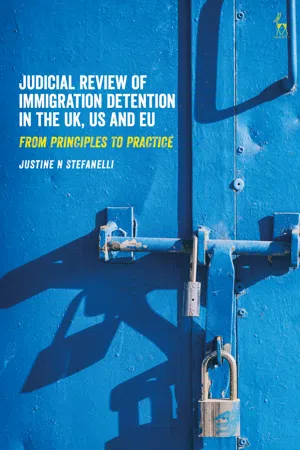
eBook - ePub
Judicial Review of Immigration Detention in the UK, US and EU
From Principles to Practice
- 248 pages
- English
- ePUB (mobile friendly)
- Available on iOS & Android
eBook - ePub
Judicial Review of Immigration Detention in the UK, US and EU
From Principles to Practice
About this book
Information
1
Introduction
I.THE DETENTION MACHINE
Immigration has topped the political and legislative agendas in the UK, USA and EU in recent years. Economic austerity, political upheaval, terrorism and increased flows of migration due to globalisation have forced these jurisdictions to struggle with providing for and protecting their citizens while simultaneously accommodating thousands of new entrants each year. The standard response to these problems has been to implement restrictive immigration policies via laws that both prevent entry and increase deportation, ultimately resulting in more detention. With the rise of immigration detention, civil society and the international community have moved to support policies in favour of the use of alternatives to detention over physical custody in detention centres. Rather than scale back on restrictive policies and embrace a more integrative approach to immigration, many states have expanded their detention capacity and view detention as an integral part of deportation policy, even where there has been no empirical evidence that the use of detention deters irregular migration.1
Statistics on detention in the USA are not regularly maintained by the state. The last ‘official’ release of statistics by the government was in 2015, when US Immigration and Customs Enforcement (ICE) reported that 307,310 people were detained across the 111 immigration detention centres. The report notes that, though this is the total for the year, the average daily population is much lower, around the 29,000 mark.2 Additional statistics were obtained from ICE through a Freedom of Information Act request by the National Immigrant Justice Center, which revealed that the average daily population in detention centres for fiscal year 2018 was 39,322.3 Early on in his presidency, Donald Trump expressed his preference for detention by signing an executive order increasing detention space near the border with Mexico,4 and stating that detention is the most efficient way to enforce immigration law at the borders to the USA.5 Since then, he has engaged in a policy of prosecuting all unlawful border crossings, which has resulted in the separation of migrant families and the detention of thousands of children, and has continued despite global criticism. He has also altered the detainee risk assessment process by removing the option of a recommendation for release from the digital risk assessment tool used by ICE.6 Finally, at the time of writing, it was revealed by the American Immigration Council that the administration had increased its detention bed capacity to 48,000 despite having funding for only 40,500 beds.7
In the UK, the number of people being detained has decreased. In 2017, 27,300 people were detained across 11 detention centres, compared to 28,900 in 2016.8 Detention has been the subject of a number of official inquiries over recent years, examining all aspects of detention, including the process by which detention determinations are made, the conditions of detention and whether an expedited appeals process should be applied to people in detention.9 Despite the existence of so many inquiries and consultations, little legislative and policy change has resulted from their recommendations.10 However, at the time of writing, the Parliament’s Joint Committee on Human Rights had published a report on immigration detention that recommended ending the practice of indefinite detention and replacing it with a 28-day limit.11
Figures from the EU as a whole are more difficult to obtain. A 2014 study gave a figure of 92,575 for 23 EU Member States in 2013.12 However, there are signs that the use of detention in Europe is beginning to decrease in some Member States, such as Malta13 and the Netherlands.14 Although it is not clear exactly what has contributed to the decreased use of detention in these Member States, one commentator has suggested that the Return Directive has played a role.15 This is significant in light of statistics from the EU indicating that 533,395 irregular migrants were ordered to leave the EU in 2015.16
Several factors have contributed to the rise in use of detention for immigration enforcement purposes in the modern day. For example, an expansion of the legal grounds for detention, including an increase in the use of mandatory detention, has contributed to making the use of detention the norm rather than the exception it once was, most markedly in the USA. Indeed, Bosworth and Kaufman argue that ‘the non-citizen … is the next and newest “enemy” in an American war on crime’,17 and Demleitner writes of mass arrests of non-citizens in the context of fighting the war on terrorism.18 Linking immigration with security has impacted the way in which the state considers whether detention is justified. This is so in relation to policies of automatic detention and deportation of non-citizen ex-offenders, but also in relation to the way that decision makers evaluate whether release is legitimate: criminal history plays a large role in this regard.
Indeed, it is clear that immigration and security are linked in the minds of policymakers in the three jurisdictions under evaluation here. The recent actions by the US Government discussed above indicate that immigration is viewed as a national security issue. This perspective was confirmed by President Trump in his 2019 State of the Union address, when he said ‘The lawless state of our southern border is a threat to the safety, security, and financial well-being of all Americans’ and continued to push for ‘a strong security wall’.19 In the UK, a White Paper published by the Home Secretary at the end of 2018 pledges to deliver an immigration system that will ‘enhance the security and safety’ of the British people and features a section on strengthening border security. Similarly, the EU Commission has expressed its desire to achieve a Europe that is ‘open and secure’, a feat that is partially realised through the continued development of a common migration policy.20 The goal of a secure Europe has been complicated by a substantial influx of migrants and refugees, largely from Syria, Iraq and Afghanistan, into EU territory since 2015. Framing immigration issues as related to security encourages states to view detention as an obvious solution to the immigration security problem. It may also serve as a basis for states to enact sweeping laws with minimal due process guarantees. This makes judicial review all the more important.21
In addition, a number of practical and strategic factors play a role in the perpetuation of immigration detention, such as the lobbying power of private prison operators,22 the perceived need of the state to restore credibility to the immigration system and fundamental difficulties surrounding the capability of immigration officials to make informed decisions about who should be detained.23 In fact, in late 2016, the Department of Homeland Security (DHS) announced new contracts with private suppliers for nearly 3,000 additional beds in detention facilities.24 This is in stark contrast to the trends in Europe noted above.
In the meantime, repeated efforts have been made by the state legislatures to reduce the opportunities available to detainees to challenge their detention and obtain release. Effectively, detainees are faced with applying for immigration bail, which does not result in a finding of illegality but does allow temporary release, or challenging the lawfulness of detention through judicial review (including applications for a writ of habeas corpus). These latter options can be time-consuming and costly.
However, in the absence of meaningful legislative reform, the importance of judicial review cannot be overstated. Judicial review of state action is a key principle of the rule of law, which aims to hold the government to account. Deeks refers to this as the ‘observer effect’ – that is, the idea that judicial oversight and the threat of judicial intervention keeps policy and law in line.25 Though in many cases judicial discretion has been removed or reduced through increased use of mandatory detention and legislative provisions which explicitly strip the courts of their jurisdiction, where their jurisdiction remains, there is room for the judiciary to take a ‘rights-protecting’ stance.26 As national law and policy become more restrictive in this regard, it is for the courts to fill the gaps left by the law and act, where possible, to preserve and protect detainees’ right to liberty. Though there have been landmark cases on detention in recent years in all three jurisdictions, the impact of those cases in practice has remained largely unexamined until now.
The use of detention as a tool of immigration enforcement is a manifestation of the growing tendency of states to criminalise immigration law. This phenomenon, now known as ‘crimmigration’27 among immigration and criminal law scholars writing in this field, features an array of legal provisions ultimately aimed at ensuring that undesirable non-citizens can be removed from the territory. Bosworth and Guild suggest that shifting motivations behind criminal legal theory account for the new model of criminalisation in the context of immigration.28 They argue that the move away from rehabilitation to deterrence and incapacitation in the criminal law context can also be seen in the context of immigration law.29 Based on this new understanding of immigration regulation, they highlight a number of examples of criminalisation in the immigration context, including an increased use of detention.30
A number of scholars, predominantly from the USA, have written prolifically on the subject of criminalisation, and have identified a number of characteristics of the phenomenon, including the following, which are relevant to this book.31 First, there is an overlap in the substance of the law, for example by creating immigration consequences for crimes, su...
Table of contents
- Cover
- Dedication
- Title Page
- Foreword
- Acknowledgements
- Contents
- List of Abbreviations
- Table of Pool Cases
- Additional Cases
- Table of Legislation
- 1. Introduction
- 2. Liberty and the Historic Context of Immigration Detention
- 3. Current Legal Frameworks
- 4. Judicial Intervention into Detention
- 5. Balancing Factors
- 6. Using the Law
- 7. The Business of Judging
- 8. Conclusion
- Bibliography
- Other Documents
- Index
- Copyright Page
Trusted by 375,005 students
Access to over 1.5 million titles for a fair monthly price.
Study more efficiently using our study tools.
Frequently asked questions
Yes, you can cancel anytime from the Subscription tab in your account settings on the Perlego website. Your subscription will stay active until the end of your current billing period. Learn how to cancel your subscription
No, books cannot be downloaded as external files, such as PDFs, for use outside of Perlego. However, you can download books within the Perlego app for offline reading on mobile or tablet. Learn how to download books offline
Perlego offers two plans: Essential and Complete
- Essential is ideal for learners and professionals who enjoy exploring a wide range of subjects. Access the Essential Library with 800,000+ trusted titles and best-sellers across business, personal growth, and the humanities. Includes unlimited reading time and Standard Read Aloud voice.
- Complete: Perfect for advanced learners and researchers needing full, unrestricted access. Unlock 1.5M+ books across hundreds of subjects, including academic and specialized titles. The Complete Plan also includes advanced features like Premium Read Aloud and Research Assistant.
We are an online textbook subscription service, where you can get access to an entire online library for less than the price of a single book per month. With over 1.5 million books across 990+ topics, we’ve got you covered! Learn about our mission
Look out for the read-aloud symbol on your next book to see if you can listen to it. The read-aloud tool reads text aloud for you, highlighting the text as it is being read. You can pause it, speed it up and slow it down. Learn more about Read Aloud
Yes! You can use the Perlego app on both iOS and Android devices to read anytime, anywhere — even offline. Perfect for commutes or when you’re on the go.
Please note we cannot support devices running on iOS 13 and Android 7 or earlier. Learn more about using the app
Please note we cannot support devices running on iOS 13 and Android 7 or earlier. Learn more about using the app
Yes, you can access Judicial Review of Immigration Detention in the UK, US and EU by Justine N Stefanelli in PDF and/or ePUB format, as well as other popular books in Law & International Law. We have over 1.5 million books available in our catalogue for you to explore.