The gospel of Luke presents an ecological symphony that reveals a Jesus connected to Earth. His ministry touches all aspects of creation, human and non-human, and invites disciples into an ecological asceticism. This same spirit continues in the Acts of the Apostles. In this Earth Bible Commentary on Acts, Michael Trainor allows our environmental concerns to shape his interpretative approach, and thus ecological nuances emerge.
Luke's household of disciples, imbued with the spirit of the risen Jesus, to embrace the world and bring to it a word of reconciliation, embark on this mission. This formally begins at Pentecost with their reception of God's creative and renewing Spirit that empowers them as Earth's children. From this moment an explosion of activity moves them over Earth's lands, beginning in Jerusalem, Earth's navel (Acts 1.1-8.1), into Samaria, the space in-between that navel and Galilee, the garden of God's earthly delights (Acts 8.2-11.17), to the ends of Earth, Rome (Acts 11.18-28.33). As we trace Luke's vast geographical journey around the Mediterranean, key moments highlight fresh environmental insights that offer new hope for contemporary disciples seeking ecological affirmation at this particular time in world history.
eBook - ePub
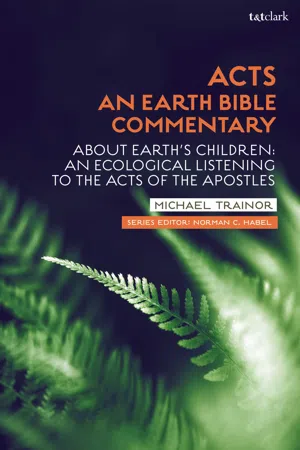
Acts: An Earth Bible Commentary
About Earth's Children: An Ecological Listening to the Acts of the Apostles
- 208 pages
- English
- ePUB (mobile friendly)
- Available on iOS & Android
eBook - ePub
Acts: An Earth Bible Commentary
About Earth's Children: An Ecological Listening to the Acts of the Apostles
About this book
Information
1
Acts 1.1-5. An Ecological Orientation
The opening verses of Acts (1.1-5) are a prologue and summary.1 Its author recalls what are essential memories from Luke’s first volume, the gospel, and link to what is about to unfold in the evangelist’s second major piece of writing. These verses also provide an ecological orientation for what will occur in the rest of Acts.
In the first word, Theophilus, I dealt with everything which, in the beginning, Jesus did and taught up until the day, after having given commandment through the Holy Spirit to his apostles whom he had chosen, he was taken up.
1.1-2
Acts’ Prologue (1.1-5)
Looking back, Luke offers a fresh summary of the gospel which he calls ‘the first word’ (1.1a). These verses concern the story of Jesus’ words and deeds ‘from the beginning’ and conclude with his ascension after his spirit-inspired instructions to the apostles (Lk. 24.50-53). Then, in an expansion on the gospel story, which listeners would not have known until now, Luke tells how Jesus appeared for forty days after his death and resurrection speaking about God’s ‘reign’ (basileia – and sometimes translated as ‘kingdom’) (1.3). In his final instruction he encourages his disciples to remain in Jerusalem, to await the Father’s promise of baptism by the Holy Spirit (1.4-5). Finally, note that these introductory verses are addressed to Theophilus (1.1a), the same addressee of Luke’s gospel (Lk. 1.3).
The mention of Theophilus and the designation which Luke gives him in the gospel’s prologue (Lk. 1.3) as ‘most excellent’ indicates a person of elite social status. The presumption is that this is the same character addressed here in Acts and, perhaps, to whom Luke dedicates the volume. Though the gospel (and now Acts) is addressed to him explicitly, it is not intended for one person, but an audience of Jesus followers in the late-first-century Greco-Roman world.2 This might also be supported by the thought that ‘Theophilus’ might be a symbolic designation as it refers to one who is a ‘lover of God’, presumably all within the Lukan household.
While perhaps Luke might have in mind a group of elite Jesus followers – and it is to these that Acts, like the gospel, is addressed – Acts is not exclusive of other social and cultural groups present in Luke’s audience. As indicated in the previous chapter, they would have various attitudes to Earth’s gifts.3 Some members of the Lukan community would identify with Theophilus, given a similar social status and their collateral relationship with him. These, as in the gospel, would also be the primary addressees of Acts. They would influence the social context in which Luke pens this second volume written in a Greco-Roman world of social status and hierarchy. The growth of the Jesus movement beyond Judaism, Jerusalem and Judea would be dependent on their support, their ability to let go of a status dependent on wealth and influence, allow their wealth to be available for the use of the wider Jesus gathering and its mission (this is the background for Luke’s story of Ananias and Sapphira in 5.1-11), and join in communion with all those members of the Jesus movement from other social contexts and on different rungs of the Greco-Roman social ladder (Figure 1). Issues of wealth, social communion and the encouragement to move beyond what is familiar and comfortable become a strong focus in the early chapters of Acts. These reach their highpoint at Act’s narrative midway point when the Jerusalem leaders need to consider the future direction of the Jesus movement beyond Judaism and its potential embrace of the non-Jewish world (Acts 15).
These opening verses situate what is about to take place in the context of Luke’s story of Jesus. They also anticipate the next moment in the story that will unfold with the earthly Jesus’ return to the Father (1.9-11) and the coming of the Spirit upon Jesus’ chosen ones at Pentecost (2.1-13). Luke looks back and looks forward.
At a first hearing, these verses concern Jesus and the disciples who will appear as central characters in Acts. At a deeper level of listening, at an ecological level characterized by the mode of intertextual listening summarized in the previous chapter, these opening verses offer the beginning of an environmental orientation that continue in Acts. They offer reminders of Luke’s central gospel truths that have ecological resonances often shrouded by an anthropocentric focus.
Luke’s Gospel Remembered
As mentioned earlier in the summary of Luke, the gospel concerns Jesus. He is Earth’s Child. He acts with sensitivity to all creation, including humanity. Here, in these opening verses of Acts, the contemporary audience, approaching Luke’s story with an ecological hermeneutic, hears other undertones, ecological memories from the gospel that need recalling. These establish listening perspectives that will guide the present commentary as I follow how Jesus’ disciples, Earth’s Children, become agents of his message to the whole Earth. There are four that are key.
The ‘Word’
First, Luke describes the earlier writing, the gospel, as a ‘first word’ (protos logos). This is often translated as ‘first book’ (NRSV) and there are Hellenistic precedents to confirm the author’s thinking in this way.4 Luke is referring to the gospel as a ‘first word’ or ‘book’. This suggests to Theophilus that the present is a ‘second’ word or book. However, at another level of inference, ‘word’ has other connections in the gospel. ‘Word’ is a primary linguistic root-metaphor for communication. Without it, we would be locked into a world of silence, solitariness and disengaged vitality. In the ancient and Lukan thought-world, ‘word’ is a dynamic reality that brings about meaning, change and life. For Luke, the communicator of this ‘word’ is Jesus who acts, enacts and enables its receptor, the listener, to come to a deeper sense of meaning and encounter with the sacred. The receptor of Jesus’ word, though, is not only human. As seen in the Lukan study, Jesus speaks to and about human and non-human beings. His word effects creation. He speaks with authority, which surprises his audience and his disciples. His word also heals.
The ‘Word’ creates. So rather than only being a defined cognitive or noetic element of human communication, Luke’s ‘word’ also acts.5 It has a powerful agential dimension that brings about change, communion and healing. Luke’s description of the gospel as the ‘first word’ refers to the whole story of Jesus from the ‘beginning’, to the gospel’s last scene when Jesus ascends to God on the day of Easter (Lk. 24.50-53). Luke refers to this ‘beginning’ explicitly in the gospel’s prologue, acknowledging that the gospel narrative is the fruit of the evangelist’s ‘following everything closely from the very beginning’ (Lk. 1.3).
For ears attuned to the Torah, the ‘beginning’ thematically echoes the early chapters of Genesis and its stories of creation. These are the Torah’s ‘beginning’. Luke’s ‘beginning’ may not be controlled only by the logical narrative commencement of Jesus’ ‘beginning’, his birth and his early moments in his Galilean ministry. It might also embrace all the elements of creation implied in ‘the beginning’ from Genesis 1.1.
In whatever way the contemporary listener hears ‘beginning’, its repetition in the opening verse of Acts centres on the ‘beginning’ of Luke’s story of Jesus that slowly reveals the gospel’s Christology. This story is about God’s Spirit-filled agent who is in love with Earth and its creatures, and seeks to bring them into communion with God. Luke’s implied ‘second word’, the Book of Acts, will demonstrate how this ‘first word’ finds its continuity in the story of Jesus’ followers and in their engagement with Earth and its inhabitants.
God’s ‘Reign’ as ‘Basileia-Ecotopia’
Second, as Luke summarizes the ‘first word’, the evangelist anticipates a second ascension scene which will be recounted soon. The author tells listeners that Jesus appeared forty days after his passion with various proofs speaking about the ‘reign (basileia) of God’ (1.3c). If Jesus has already ascended once (in Lk. 24.50-53) in an event on Easter day that consummates Jesus’ resurrection, it is clear now that his return to the Father will also take place forty days later as a forecast of the Christological presence in Acts. The Acts ascension clearly offers a constant witness to the way Jesus will manifest himself throughout Luke’s ‘second word’. Essential for what follows is the emphasis which Luke places on Jesus’ final Earth-centred communication in terms of the ‘reign of God’.
The gospel reveals how the ‘reign’ manifests itself. It is a central theological reality for Luke who mentions it in the gospel over forty times. Luke presents Jesus’ revelation of God’s basileia as an inclusive encounter with the divine presence culturally, socially and ecologically manifest in the particularity of ...
Table of contents
- Cover
- Series Text
- Title Page
- Dedication
- Contents
- Abbreviations
- List of Figures
- List of Illustrations
- Introduction: Situating the Acts of the Apostles
- Part One
- 1 Acts 1.1-5. An Ecological Orientation
- 2 Acts 1.6-11. The Ecological Mission
- 3 Acts 1.12–2.47. The Ecologically Renewed Household
- 4 Acts 3.1–6.7. The Fruitfulness of Earth’s Children
- 5 Acts 6.8–8.1a. Earth’s Presence in Stephen’s Story of Israel
- Part Two
- 6 Acts 8.1b–9.31. Water and Earth
- 7 Acts 9.32–11.18. Earth’s Linen Sheet
- 8 Acts 11.19–14.28. Earth’s Interconnectivity and the God of Creation
- 9 Acts 15.1–16.40. Earth Acts at Philippi
- 10 Acts 17.1–18.1. The God of Life and Breath
- 11 Acts 18.2–20.12. The Artisan, Artemis and the Lord’s Supper
- 12 Acts 20.13–26.32. Earth’s Child Identifies with Earth’s Children
- Part Three
- 13 Acts 27.1–28.31. The Final Voyage towards Rome and Earth’s ‘End’
- Part Four
- Conclusion. Luke’s Ecological Resonances in Acts
- Bibliography
- Index of Authors
- Index of References
- Copyright
Trusted by 375,005 students
Access to over 1.5 million titles for a fair monthly price.
Study more efficiently using our study tools.
Frequently asked questions
Yes, you can cancel anytime from the Subscription tab in your account settings on the Perlego website. Your subscription will stay active until the end of your current billing period. Learn how to cancel your subscription
No, books cannot be downloaded as external files, such as PDFs, for use outside of Perlego. However, you can download books within the Perlego app for offline reading on mobile or tablet. Learn how to download books offline
Perlego offers two plans: Essential and Complete
- Essential is ideal for learners and professionals who enjoy exploring a wide range of subjects. Access the Essential Library with 800,000+ trusted titles and best-sellers across business, personal growth, and the humanities. Includes unlimited reading time and Standard Read Aloud voice.
- Complete: Perfect for advanced learners and researchers needing full, unrestricted access. Unlock 1.5M+ books across hundreds of subjects, including academic and specialized titles. The Complete Plan also includes advanced features like Premium Read Aloud and Research Assistant.
We are an online textbook subscription service, where you can get access to an entire online library for less than the price of a single book per month. With over 1.5 million books across 990+ topics, we’ve got you covered! Learn about our mission
Look out for the read-aloud symbol on your next book to see if you can listen to it. The read-aloud tool reads text aloud for you, highlighting the text as it is being read. You can pause it, speed it up and slow it down. Learn more about Read Aloud
Yes! You can use the Perlego app on both iOS and Android devices to read anytime, anywhere — even offline. Perfect for commutes or when you’re on the go.
Please note we cannot support devices running on iOS 13 and Android 7 or earlier. Learn more about using the app
Please note we cannot support devices running on iOS 13 and Android 7 or earlier. Learn more about using the app
Yes, you can access Acts: An Earth Bible Commentary by Michael Trainor in PDF and/or ePUB format, as well as other popular books in Theology & Religion & Ecology. We have over 1.5 million books available in our catalogue for you to explore.