Scott S. Elliott reconsiders the autobiographical statements Paul makes throughout his letters (particularly Philippians 3:4b-6; Romans 7:14-25; 1 Corinthians 9:19-23 and 2 Corinthians 12:1-10) in light of the theoretical work of Roland Barthes.
Elliott draws particularly on Barthes' later poststructuralist writings, many of which touch either directly or indirectly on self-narration (e.g., Roland Barthes by Roland Barthes, Mourning Diary, Camera Lucida, and A Lover's Discourse: Fragments). These provide fruitful dialogue partners with which Elliott can interrogate and examine Paul's own writings and consider the ways in which Paul saw himself and how the application of this theory can yield a greater understanding of Paul's letters.
eBook - ePub
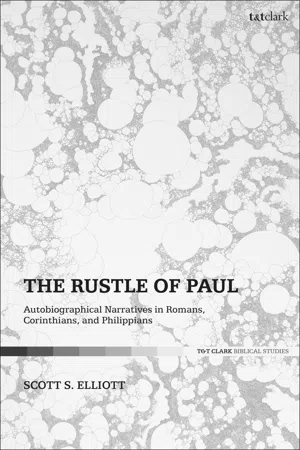
The Rustle of Paul
Autobiographical Narratives in Romans, Corinthians, and Philippians
- 168 pages
- English
- ePUB (mobile friendly)
- Available on iOS & Android
eBook - ePub
The Rustle of Paul
Autobiographical Narratives in Romans, Corinthians, and Philippians
About this book
Information
1
The Novelistic Self
The August–September 2011 edition of Peloton magazine featured an article by John Madruga titled “Roland Barthes on the Tour” in which the author turns to Barthes’s essay “The Tour de France as Epic”1 to illustrate how the French, “informed by a more philosophical influence,” view the race as “something far greater than an extreme physical undertaking.”2 That “something far greater” is, according to Madruga, “a complex combination of expression/intention, form/essence, man/nature, attacking/waiting, and natural/artificial [whereby] the Tour de France is a language unto itself, a chain of signification, ever evolving, ever changing, taking shape, like a novel, toward a final conclusion, sentence and period.”3 Andy Stafford describes Mythologies as “a form of social psychoanalysis that looked at the way in which our minds—in a bid to give ourselves some kind of meaning, purpose and even disalienation—actively participated in self-delusions.”4 Barthes sought to unravel, in these fifty-three short reflections on various randomly and arbitrarily selected “figures of rhetoric” drawn from everyday French life, the conflation and confusion of “Nature” and “History” by exposing “in the decorative display of what-goes-without-saying the ideological abuse [he] believed was hidden there.”5 He describes the Tour de France as a total and ambiguous myth that is simultaneously expression and projection, realistic and utopian.6 Madruga, on the other hand, unwittingly reinscribes the mythology of Le Tour, taking the clarity and assurance proffered by so many narratives of the race, always varied and nuanced but fundamentally the same, as being indicative of what the race really is, or what it actually does, as if for its own sake or, in other words, by its very nature. Whereas Barthes tells the story of the story, Madruga merely repeats, recasts, and reaffirms the story.7
Despite the fact that so many professional bicycle races contain the word “tour” in their title, the Tour de France is the only one that is regularly referred to as, simply, “the Tour.” It is not merely an abbreviation but a metonymy. And, interestingly enough, “The Tour de France as Epic” focuses on how the proper names of the racers so familiar to followers of both the sport and the event function as metonymies in their own right. Barthes describes how the Tour, as “a world of characterial essences . . . posited by a sovereign nominalism which makes the racer’s name the stable depository of an eternal value . . . is an uncertain conflict of certain essences,” and “nature, customs, literature, and rules successively relate these essences to each other . . . and it is from this interplay that the epic is born.”8 Similarly, the name Paul functions metonymically in the discourse of professional biblical interpreters as well as in that of many ordinary readers, both of which imbue the name, the author’s identity, the authenticity of the writing subject, with a certain validity, authority, power. “Paul” is a cipher, shorthand not only for an historical figure, a character, a writer, a system of thought, a body of work, and so on. It also, and more importantly, serves as the encodement of a special blend encompassing all these things, as well as ideologies of the self, the individual, identity, authorship, and more. Paul and his letters are merged into a fraught and overwrought mythology, an overdetermined narrative that, like Le Tour, is a curious amalgamation of the “realistic and utopian at the same time.” The perfectly ordinary, occasional, and practical nature of Paul’s letters, by virtue of their collectivity and canonicity, come to embody something that apparently transcends the mundane. Meanwhile, in the name Paul, figure and fantasy are conjoined and become one, as the writer of letters is transmogrified from phenomenon to myth.9
Like all of Barthes’s mythologies, “The Tour of France as Epic” occupies and ponders the intersection of history and narrative, implicitly considering what it is that transforms fictions into discourses, how it does so, and to what end. Barthes also considered the texts of history and modes of historical writing vis-à-vis fiction in his essay, “The Discourse of History,”10 which, among other things, is concerned with the conundrum of how to situate writers in relation to their own time. This is a critical issue given the understandable, sometimes necessary, often justified, but never any less problematic dependence on and drive toward “historical context” that characterizes the work of biblical scholars. The “phenomenon” of which Barthes speaks is what we so often imagine ourselves to be concerned with and in pursuit of, while the “myth” is, in part, the story of its reception. There is, then, an inherent and nearly (if not altogether) inescapable paradox: any attempt to access and to speak of the phenomenon is inevitably to participate (or at least to risk participating) in the ongoing construction and perpetuation of the myth. To take notice of the historical figure is to do so because it is already lost, its existence now only maintained by the myth that supplements and supplants it. It is, therefore, fitting that Barthes would say elsewhere, “All biography is a novel which does not dare say its name.”11
Stafford appeals to Barthes’s “belief in the Brechtian idea that we should think through other people’s minds and they through ours” in order to recognize the “dialogue” that “emphasises the circulation (rather than ownership) of ideas.”12 The end result is not comprehensive, much less exhaustive, which itself is an effort to sidestep the sweep toward myth because “there is no more powerful constructor of ‘myth’ than a posthumous account, if only because there is no chance for the subject to reply.”13 What we might possibly find in the fragmentary and unsystematizable “biographemes,” and between the phenomenon and myth, is “an existence ultimately as a ‘trace,’ contradictory but none the less tangible.”14 Once we consider that Paul never appears to have written anything resembling a formal or intentional, much less extended, autobiography but instead scattered pieces and versions and postures of himself throughout his letters, which are incomplete and often fragmentary in their own right, Paul, his letters, and treatments of both by New Testament scholars become exemplary texts for the sort of exploration I aim to undertake in this book. The relevance and utility of Barthes’s writing for thinking about “Paul’s” autobiographical fragments is not so much that Paul thought of himself specifically, or the self generally, in the same manner (though, perhaps he did), but rather that it resonates with, and is better suited to, how we as readers actually encounter and experience “Paul” in Romans, Corinthians, and Philippians wherein we find “no novel (though a great deal of the fictive).”15
Barthes seemed to hold a “(utopian) belief in the possibility of not being socially determined, or ‘classified’ in social terms”16 that I think resonates with the writer of texts like 1 Corinthians 9 and Philippians 3. Moreover, just as for Barthes, the writer of these letters sought this transience and liberty through writing: “To write the same things to you is not troublesome to me” (Phil. 3:1a).17 To be sure, it was not literary writing on literature, as in the case of Barthes, but it was writing all the same. For the one we call Paul, writing was the very mark of the self (1 Cor. 16:21). For him, even Moses was a writer (Rom. 10:5). In the scratching and grazing that is writing, whereby marks are etched upon the palimpsestic surface of the page, the grain of the self18 takes shape.
This is an eclectic book. I mean that both as the word is understood in common usage (with my emphasis being not only a diversity of ideas, but especially a variety of sources and tastes) and in the more classical philosophical sense (i.e., not belonging to or representative of any school of thought but characterized by pastiche and bricolage reflective of my own inclinations). My aim is not to apply Barthes to Paul, or Barthes’s work to Paul’s letters, nor is it to make a sustained argument concerning how one should read self-narrative statements in the New Testament letters of Paul, much less to make any claims concerning who the “real” Paul was vis-à-vis either his ideas or the history and historical context of earliest Christianity. If anything, I aim to imitate Barthes: largely forgoing thesis, argument, proof, demonstration in favor of illustration, gloss, gesture toward, reading and writing with. The reason for this is that I think it is actually well suited to both the way we encounter the writer of these letters (fragmented and composite) and to certain aspects of the way this writer seemed to envision himself and others, at times. But this is not what Barthes referred to as “Neither/Nor criticism.”19 Instead, by imitating, experimenting, thinking and reading with and in the light of these diverse intertexts that come to mind and resonate,20 I hope to follow Barthes’s lead in forgoing a “science of literature” in favor of writing wherein “all language deployed by the critic [is] now part of the problem of the language used in the (literary) text under consideration.”21
Neil Badmington writes in The Afterlives of Roland Barthes that his book “reads Barthes and it puts Barthes to work in the analysis of a text.”22 Similarly, this book reads the writer of the letters to the Romans, the Corinthians, and the Philippians, in conversation with Barthes, in order to analyze the writer as a text. Hence, the “texts” here are not only various works reconceived and read as such, but the writer of those works, one named, written as, “Paul.” I agree with Marie Gil that Barthes’s own writings “raised the possibility of reading a life ‘as a text’ and therefore of writing it,”23 and I would suggest that the writer of letters later readers named “Romans,” “1 and 2 Corinthians,” and “Philippians” did likewise. In fact, part of the impetus for this book is that we too often read against the writer of these letters in our very efforts to understand him as an Author by molding the things he writes here and there to fit a body of work and a system of thought.24
Reading the aforementioned texts necessitates reading the readings of others. However, my goal when selecting secondary literature on these writings and their writer has not been to read exhaustively everything that has been said by interpreters of these materials, primarily because my interest is not to exegete them, to determine what they “really” meant or mean, to ascertain their Author’s intention. Hence, my secondaries have been selected somewhat at random as, more often than not, they serve as arbitrary conversation partners, representative samples, illustrations of consensus, or of what Barthes referred to as the Doxa, by which he meant opinion, “nature,” that which...
Table of contents
- Cover
- Half-Title
- Dedication
- Title
- Contents
- Acknowledgments
- List of Abbreviations
- 1 The Novelistic Self
- 2 The Rustle of Paul
- 3 The Myth of Paul
- 4 The Disease of Paul
- 5 The Death of Paul
- Postscript: Writer Paul
- Works Cited
- Index
- Copyright
Trusted by 375,005 students
Access to over 1.5 million titles for a fair monthly price.
Study more efficiently using our study tools.
Frequently asked questions
Yes, you can cancel anytime from the Subscription tab in your account settings on the Perlego website. Your subscription will stay active until the end of your current billing period. Learn how to cancel your subscription
No, books cannot be downloaded as external files, such as PDFs, for use outside of Perlego. However, you can download books within the Perlego app for offline reading on mobile or tablet. Learn how to download books offline
Perlego offers two plans: Essential and Complete
- Essential is ideal for learners and professionals who enjoy exploring a wide range of subjects. Access the Essential Library with 800,000+ trusted titles and best-sellers across business, personal growth, and the humanities. Includes unlimited reading time and Standard Read Aloud voice.
- Complete: Perfect for advanced learners and researchers needing full, unrestricted access. Unlock 1.5M+ books across hundreds of subjects, including academic and specialized titles. The Complete Plan also includes advanced features like Premium Read Aloud and Research Assistant.
We are an online textbook subscription service, where you can get access to an entire online library for less than the price of a single book per month. With over 1.5 million books across 990+ topics, we’ve got you covered! Learn about our mission
Look out for the read-aloud symbol on your next book to see if you can listen to it. The read-aloud tool reads text aloud for you, highlighting the text as it is being read. You can pause it, speed it up and slow it down. Learn more about Read Aloud
Yes! You can use the Perlego app on both iOS and Android devices to read anytime, anywhere — even offline. Perfect for commutes or when you’re on the go.
Please note we cannot support devices running on iOS 13 and Android 7 or earlier. Learn more about using the app
Please note we cannot support devices running on iOS 13 and Android 7 or earlier. Learn more about using the app
Yes, you can access The Rustle of Paul by Scott S. Elliott in PDF and/or ePUB format, as well as other popular books in Theologie & Religion & Bibelkritik & -auslegung. We have over 1.5 million books available in our catalogue for you to explore.