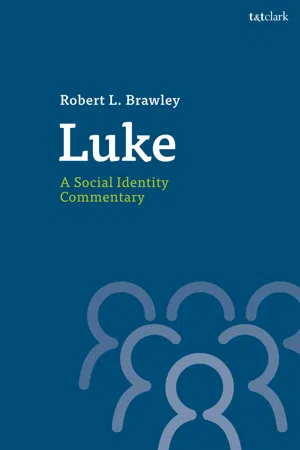
In this commentary, Robert L. Brawley provides comprehensive coverage of issues and concerns related to Luke from the perspective of social identity. He argues that the Gospel of Luke is strongly concerned with the formation of identity from the very start of the text, which aims at the creation of a socially responsible community in continuity with that community's collective past.
Brawley establishes a theoretical framework that focuses his interpretation - ranging from the narrative world and sociological issues to postcolonialism and hierarchies of dominance - and uses these perspectives to provide a clear overview of historical and critical issues related to an understanding of Luke. He then provides a thorough outline of and commentary on the text of the Gospel. Brawley's engagement with the text serves as an invaluable resource for scholars, students, clergy, and others interested in their own discoveries of the resources of Luke.
- 248 pages
- English
- ePUB (mobile friendly)
- Available on iOS & Android
eBook - ePub
Luke: A Social Identity Commentary
About this book
Information
Part 1
Introduction: Methods and Contexts
Fictive qualities of narratives
The agenda for this commentary begins with what renowned historian Hayden White (1997) refers to as a “fictive” element in all attempts to express an understanding of any aspect of reality in language. The emphasis in the previous sentence on all attempts and any aspect should relieve any anxiety that the use of “fictive” infers that authorial functions are reduced to imagination alone or that aspects of reality are likewise purely imaginary. Further, the reference to all attempts necessarily holds also for both Luke and me in that each of us attempts to express aspects of reality in language. To reiterate, “fictive” here is not to be confused with any notion of fiction that implies a construct derived purely from imagination. Rather, the term recognizes that writers have to provide a structure and select elements from a set of possibilities, highlighting certain features even to the point of exaggeration while neglecting others, not to mention their own flourishes. In other words, writers have an interactive relationship with that which they are attempting to make understandable. Again not to be confused with fiction engendered purely by imagination, even so-called facts or evidence also possesses this “fictive quality.” That is, “statements of facts are always particular interpretations of circumstances, in which certain aspects are illuminated or selected” (Lorenz 1997, 29, author’s translation). It is even possible to add that “brute facts” do not in fact (pun intentional) exist. “Truth is always the product of some man or woman” in a historical context (Irigaray 1993, 203–204). Furthermore, what we refer to as facts and truth are also products of rhetorical forms that have a capacity to persuade others to agree. This capacity to persuade others is a sine qua non if something is to acquire a social affirmation that it is true.
This is patently true of narratives, and in the first place it involves what White terms “emplotment.” This includes a framework of elements such as sequence or cause and effect that are put together in one specific way that has its own coherence and that depends on the perspective from which the emplotment arises, as well as rhetorical and poetic enhancements (White 1997, 392–96).1 In fact (again the pun is intentional), “the historical past exists only in the form of a creative concatenation of evidence produced by the historian from sources” (Schröter 1997, 10–11, author’s translation). In so many words, history is not a mere reconstruction of the past but a way of being related to the past by means of a historian’s reconstruction.
Working with what he terms a philosophy of history, Alex Callinicos (1995, 3–4) refers to White’s perspective as “antirealism,”2 over against which he advocates a reality that exists independently from the way it is represented in language. In my view Callinicos is misled by the use of “fictive,” which as indicated above does not mean that the discourse is produced by pure imagination. Callinicos (1995, 48) persuasively points to the intention of the natural sciences and history to refer to a reality beyond itself. But the sheer existence of reality is not in dispute. Rather, the fictive nature of representations means that all reality must be construed by a human mind. So when Callinicos uses the assured results of the natural sciences in the production of technology as evidence against what is actually his own construal of positions such as White’s, he fails to recognize the degree to which scientists have been rhetorically successful in convincing others to construe reality in the same way that they do, Galileo’s lack of success in doing so notwithstanding. On the other hand, Callinicos (1995, 8) stipulates that what he describes as “historical knowledge” is possible under certain conditions, to which I notice that the power of persuasion to produce consensus is one such condition. Ironically, nothing less than this is also the burden of Callinicos’s own discourse with respect to his way of construing reality. How successful is the linguistic representation of reality in persuading others to construe reality in a similar way? Indeed, even under the condition of consensus, natural scientists constantly revise their linguistic expressions of physical reality. As we will see, this is all the more true when the discourse is concerned with sociology in its attempts to function as an empirical science.
Renowned philosopher Paul Ricoeur (1975b, 201–15) speaks of a similar issue in his understanding of narratives. Narratives present their own world with fictive qualities such as those described by White. This world of the text is always shaped in such a way that it must be distinguished from an alleged ontic reality, and therefore what the text presents lacks direct repercussions either for the traditional search in biblical exegesis for the historical world behind the text or for the more recent attempts to speak of the world in front of the text, both of which are products of the way readers/hearers construe narratives.
Likewise, renowned New Testament scholar Jean Zumstein approximates Ricoeur’s approach with his consideration of the Gospel of John as a “poetic narrative” because of the configuration of its narrative world. Zumstein’s construal of the poetic narrative of the Fourth Gospel is pertinent for a project that highlights social identity in Luke, because like the Gospel of John, Luke reflects the self-understanding of a particular group of humans (Zumstein 2004, 1–14). This is in agreement with literary critic Wayne Booth (1984, xiii–xxvii, xx, xxiv–xxv) who points out persuasively that authors produce views of reality that, from the perspective of the narrative, take precedence over “all other views.” In other words, the text presents its own view of reality from an author’s point of view, and this point of view is “laden with values.”
Luke’s passion narrative easily demonstrates the perspectivalism of such an emplotment that has the type of fictive quality with which this discussion is concerned. Luke’s emplotment prese nts Jesus as an actor in a divine story that competes with a carnivalesque mockery from opponents who portray him as utterly absurd. It is even possible to demonstrate Luke’s own grasp of some of these qualities that I am describing as fictive from the beginning of his prologue. The Gospel presents itself as a narrative (διήγησις, 1:1) that is encased in a decisive structure, which it develops in a particular manner (ἀκριβῶς, καθηξῆς, 1:3). To this it is relatively easy to add aspects of time, space, affections, cultural presuppositions, actions, speech, perspectives, characters, evaluations, sequence, relationships of cause and effect, and so on.
Just as this commentary can be patently distinguished from the text upon which it is based, so narrative worlds are necessarily distanced from an alleged ontic reality because they portray their own particular view of reality not as a precise reflection of ontic reality but as authors perceive that it should be or might be in light of their perspectives. “The goal of historical research is not to reconstruct the past, but to construct history” (Schröter 2007, 108, author’s translation, emphasis added).
Although he understands Luke to have dealt with the Jesus movement as subversive, Itumeleng Mosala (1989, 174–75) perceives in the “orderly account” (1:1) a concern for “law and order” that subjugates subordinate social classes. Whereas I have strong personal convictions akin to Mosala’s with respect to social struggles like those in South Africa, I move Luke closer to what I perceive to be a similar struggle. This commentary demonstrates copiously ways in which dominance is subverted, and major concerns for law and order that belong to the ruling classes, who constitute an outgroup, are likewise subverted. Take, for example, Lk. 22:37: “He was counted among the lawless.” In this text, Jesus interprets his arrest before it occurs at the hands of a group of local rulers, namely, the high priestly party, officers of the temple police, and elders.3 When it does take place, Jesus again interprets it as the action of the high priestly rulers against him “as if [he] were a brigand” (22:52). At one level, their dominance wins the day with the crucifixion, but in Luke, God’s act to raise Jesus from the dead is an enormous inversion of those very systems of dominance.
On the other hand, in spite of its unavoidable fictive qualities, Luke’s Gospel displays a way in which its story and personages are remembered—yes, remembered! Traditions about Jesus are a “phenomenon of remembering,” which in spite of understanding Jesus’s earthly activities through the perspective of the resurrection, does not mean that there is a break between the past experience of them and their later interpretation (Schröter 1997, IX, 118). Every access to the past rests on an association of an event through its depiction (ibid., 121, 144). Significantly, historical memory in Luke is collective. It follows trajectories of tradition (Lk. 1:2), but this tradition is mediated through a process that Jeffrey Olick (2006, 5) identifies as collective imaging. At the same time it is also construed through individual perspectives in the context of a social environment (Duling 2006, 2). Collective memory is embodied in the “particular circumstances of a localized life” (Harvey 2000, 85). Therefore, when Luke undertakes to narrate “the things that have happened among us” (1:1), he becomes part of dynamic activities in which the memory of the past is repeatedly and creatively processed anew (Olick 2006, 12). In the case of this commentary Luke’s collective memory of the story and personages is not something to be recovered in an objective sense but to be experienced as it were in and by means of the way it is narrated (Schröter 1997, 108–10).
As with any act of remembering, collective memory is not static, even when it is reduced to written words. Remembering is a process that is in flux. The human brain does not call something to mind as if it were digital data of a file on a hard disc. Quite to the contrary, each act of remembering is a process in which the mind connects aspects of memory in new configurations. Consequently, repetition does not merely transmit something that is unchanging. Rather, as with all memory, collective memory is a generative process that renews itself in distinct ways. Such a collective memory is renewed in relation to different times and places, and for others who come to belong to the collective group. To be sure, this is crucial for identity, because identity takes shape for both groups and their members in a relationship between past and present (Olick 2006, 8), with the “interaction between salient pasts and exigencies of current social realities” (Kelber 2006, 21, citing Alan Kirk and Tom Thatcher). On the one hand, this commentary focuses on the way groups and their members in Luke’s narrative engage their social identity. On the other hand, in the minds of readers/hearers of Luke’s narrative the dynamic process of remembering continues as a generative force for their social identity.
Although collective memory is based on experiences of the past, these experiences are something viewed not in a sense that they can be either reified or represented as a complete picture of ultimate reality (Olick 2006, 7–8). To reiterate, narratives present a world that they envision, and therefore attempts to reverse the process and recover a supposedly ontic reality from the narrative are in vain. This is quite apparent when Luke recounts two incidents when Jesus resuscitates someone from the dead, the son of the widow of Nain (7:11-17) and Jairus’s daughter (8:40-56). Curious though interpreters may be, they cannot reconstruct what may be considered ontic reality, perhaps something like arousing someone from a coma. Nevertheless, these resuscitations occur in Luke’s narrative world. One of the consequences of the character of the Gospel of Luke as a fictive narrative means that its interpreters should be interested less in what biblical scholarship has referred to as introductory matters behind the Gospel such as the place and time of the composition or the identity of the addressees in their environment than in the Lukan narrative world itself. At the same ti me, this brief discussion on fictive qualities and collective memory stands at the beginning of this commentary precisely as an introductory matter, and with this I turn to customary introductory issues.
Author, audience, composition
Traditional among introductory matters are of course author and audience. The only allusion the author makes to himself is in a participle in the prologue that accompanies the dative first-person pronoun μοί, which enables us to know that the author genders himself as male (1:3). But inasmuch as the author does not give his name, as Paul does in his epistles for example, he presents himself unambiguously to readers/hearers as anonymous (Wolter 2008, 4). To be sure, Paul refers to one of his companions under the name of Luke in Philemon 24, and this is picked up in Col. 4:14 and 2 Tim. 4:11, and whether Colossians and 2 Timothy come from the hand of Paul or not, they obviously represent one way in which Paul’s co-workers are remembered.
The earliest New Testament manuscript that ascribes the Third Gospel to a certain Luke is P75, which is dated to the early third century. The manuscript contains most of the Gospel of Luke, although the beginning, which presumably contains a title, is missing. Nevertheless, an ascription to someone named Luke appears in a title at the end of the Gospel in the phrase ΕΥΑΓΓΕΛΙΟΝ ΚΑΤΑ ΛΟΥΚΑΝ. Significantly, the beginning of the Fourth Gospel in P75 follows immediately with the same formulaic ΕΥΑΓΓΕΌΛΙΟΝ ΚΑΤΑ ΙΩΑΝΗΝ. The evidence is strong here that these titles are produced at a time when the Gospels have been collected and given standard titles that conform to stock designations for each of the four Gospels. In other words, these can hardly be the or...
Table of contents
- Cover
- Series
- Dedication
- Title
- Contents
- Series Preface
- Preface and Acknowledgments
- Part 1 Introduction: Methods and Contexts
- Part 2 The Gospel of Luke: An Outline
- Part 3 Commentary
- Bibliography
- Index of Authors
- Index of Subjects
- Index of References
- Copyright
Trusted by 375,005 students
Access to over 1.5 million titles for a fair monthly price.
Study more efficiently using our study tools.
Frequently asked questions
Yes, you can cancel anytime from the Subscription tab in your account settings on the Perlego website. Your subscription will stay active until the end of your current billing period. Learn how to cancel your subscription
No, books cannot be downloaded as external files, such as PDFs, for use outside of Perlego. However, you can download books within the Perlego app for offline reading on mobile or tablet. Learn how to download books offline
Perlego offers two plans: Essential and Complete
- Essential is ideal for learners and professionals who enjoy exploring a wide range of subjects. Access the Essential Library with 800,000+ trusted titles and best-sellers across business, personal growth, and the humanities. Includes unlimited reading time and Standard Read Aloud voice.
- Complete: Perfect for advanced learners and researchers needing full, unrestricted access. Unlock 1.5M+ books across hundreds of subjects, including academic and specialized titles. The Complete Plan also includes advanced features like Premium Read Aloud and Research Assistant.
We are an online textbook subscription service, where you can get access to an entire online library for less than the price of a single book per month. With over 1.5 million books across 990+ topics, we’ve got you covered! Learn about our mission
Look out for the read-aloud symbol on your next book to see if you can listen to it. The read-aloud tool reads text aloud for you, highlighting the text as it is being read. You can pause it, speed it up and slow it down. Learn more about Read Aloud
Yes! You can use the Perlego app on both iOS and Android devices to read anytime, anywhere — even offline. Perfect for commutes or when you’re on the go.
Please note we cannot support devices running on iOS 13 and Android 7 or earlier. Learn more about using the app
Please note we cannot support devices running on iOS 13 and Android 7 or earlier. Learn more about using the app
Yes, you can access Luke: A Social Identity Commentary by Robert L. Brawley in PDF and/or ePUB format, as well as other popular books in Theology & Religion & Biblical Studies. We have over 1.5 million books available in our catalogue for you to explore.