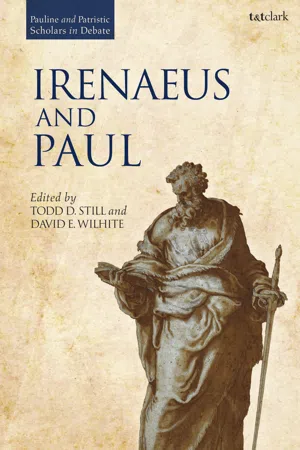
Building on the work of Tertullian and Paul and The Apostolic Fathers and Paul, this volume continues a series of specially commissioned studies by leading voices in New Testament/early Christianity and patristics studies to consider how Paul was read, interpreted and received by the early Church Fathers.
In this volume the use of Paul's writings is examined within the writings of Irenaeus of Lyon. Issues of influence, reception, theology and history are examined to show how Paul's work influenced the developing theology of the early Church. The literary style of Paul's output is also examined. The contributors to the volume represent leading lights in the study of Irenaeus, as well as respected names from the field of New Testament studies.
- 328 pages
- English
- ePUB (mobile friendly)
- Available on iOS & Android
eBook - ePub
Irenaeus and Paul
About this book
Information
Chapter 1
IRENAEUS AND PAUL: AN INTRODUCTION
David E. Wilhite
Irenaeus of Lyons had to debate his opponents about the true legacy and the correct understanding of Paul. The present collection of chapters sets out to explore the second-century bishop’s understanding of the apostle, and so it will prove helpful to begin with a brief introduction to Irenaeus himself. In what follows, Irenaeus’s life, writings, and influence will be surveyed, followed by a review of the current state of scholarship and a preview of the chapters in this volume.
Although he is one of the most influential writers from early Christianity, relatively little is known about Irenaeus’s life and background. He was from Smyrna, where he learned from Polycarp’s teaching,1 and he spent time in Rome before moving to the ancient Gallic city of Lugdunum (= Lyon, France),2 to serve as a presbyter under Bishop Pothinus. He returned to Rome in 177 as an emissary sent to appeal to the Roman bishop Eleutherius, who had rejected the “Montanists” in Phrygia.3 There, Irenaeus successfully pleaded for tolerance. In 190 Irenaeus visited Rome once again, this time to address the Quartodeciman controversy. Some in Rome had claimed that the church’s use of the Roman calendar for celebrating Easter should be normative, in opposition to those in Asia Minor who used the Jewish calendar to mark this holy day. Irenaeus appealed—again, successfully—to the Roman bishop to allow for diversity on this issue. His name, which means “Irenic” or even “Peacemaker,” may even be a nickname, or at least it was noted to be apt, given his work to reconcile the bishops of Rome and other parties.4 Between these two controversies, Pothinus died during a local outbreak of persecution.5 Following this, Irenaeus was appointed as the bishop of Lugdunum. Little else is known of his life or even how he died. Jerome knows of a tradition claiming Irenaeus became a martyr, but with other writers like Eusebius remaining silent on this subject the validity of Jerome’s claim is highly problematic.6
Irenaeus’s Works and Teachings
Irenaeus’s known oeuvre is relatively small, and its extant form is problematic. Because he wrote against specific opponents, his works became unnecessary and unused in their entirety. However, even though these works fell into disuse, Irenaeus’s influence can still be seen in the innumerable quotations found in works by later writers.
Only two of Irenaeus’s works survive.7 The first is entitled A Refutation and Overthrow of the Knowledge Falsely So-Called (Ἐλέγχος καὶ ἀνατροπὴ τῆς ψευδωνύμου γνώσεως). The importance of this title as paradigmatic for the work should be noted for this present study, given its explicit indebtedness to the Pauline statement from 1 Tim 5:20.8 In modern studies, this work is more commonly and concisely called Against Heresies (Adversus haereses). A critical edition of this work is available,9 but since the surviving manuscripts of the work are all in Latin and derive from a translation likely made around the end of the fourth century, all citations of Irenaeus remain somewhat tenuous in their reliability. Fortunately, the large number of Greek fragments have enabled scholars to reconstruct the original Greek to a considerable degree. This likely explains why until recently the only English translation available was from the Ante-Nicene Fathers series. The new English edition10 will possibly enhance Irenaean studies in that this text will be more accessible to students earlier in their careers, and it will help nonspecialists have an easier entrée to reading Irenaeus.
Irenaeus’s only other extant work is his Demonstration of Apostolic Teaching (Εἰς ἐπίδειξιν τὸν Αποστολικον Κηρύγματος), which survives only in an Armenian translation rediscovered in 1904.11 This text counters the “Gnostics,” but without the detailed review of their positions found in Against Heresies. Instead, it is a summary of essential Christian teaching, which attempts to support those key doctrines by reading what later Christians would call the Old Testament and the New Testament in harmony with one another.
Despite the problematic reception and survival of his writings, Irenaeus significantly impacted later Christian writers. In terms of his teachings, Irenaeus is arguably one of the most influential thinkers in all of Christian history. Because he wrote against the “Gnostics” (a problematic category, to be sure), he established several guiding principles for what became “Orthodoxy” (no less problematic, in historical terms).12 Irenaeus demonstrated that what one teaches about a certain doctrine, such as protology, inevitably affects other doctrines, such as Christology and thereby soteriology. While not offering his own systematic theology per se, Irenaeus does operate with the assumption that theology is systematic—a coherent, consistent, and comprehensive faith.
Along these same lines, and of clear import for our present volume, Irenaeus attempted to read scripture in what could be called a systematic fashion as well. He aimed for consistency of meaning and plot when it came to all the works of the “prophets and the apostles” taken together. He thus gives the first clear instance of what could be called a canonical approach (although his notion of “canon” has more to do with the Canon of Truth, or Rule of Faith, that guides one’s readings of inspired texts than with a fixed set of texts deemed to be inspired).
Through his commitment to doctrinal consistency and intertextual coherence, Irenaeus offers posterity a few axioms for proper Christianity. For example, Irenaeus operates with a clear Creator/creature distinction: God creates; everything else is created.13 This comes to the forefront in the debate with certain groups who think in terms of a chain of being spanning from God through various emanations of God, such as the numerous “aeons” in the pleroma and even below them some human spirits who have been trapped in material bodies within the cosmos. This view of certain spirits as droplets of God or sparks of divinity, according to Irenaeus, conflates the Creator/creature distinction. Whether or not any of this is a fair description of what Irenaeus’s opponents actually taught is another matter altogether, and one that is addressed at multiple points in the present volume and in virtually any modern discussion of Irenaeus. Here, it should be noted that Irenaeus’s opponents would not even concede to these categories: they (at least, many of them) view the “Creator” or “Demiurge” as a lower being made to bring order out of the chaos of the material realm, a necessary evil as it were. Furthermore, Irenaeus’s opponents by and large readily accepted that divinity and humanity were not distinct categories but were instead in continuity with one another, only at different levels of participating in pure Being (in Platonic terms) or in proximity to the highest Being (in mythic terms). Even so, Irenaeus’s Creator/creature distinction is one that will become a litmus test for later teachers in terms of what is accepted as orthodoxy or unorthodoxy.
In addition to the distinction between the Creator and the creation, another Irenaean teaching that becomes axiomatic for later Christians is the relationship between the Creator and creation. While Irenaeus insists on keeping a clear distinction between the two, he does not divide the two or place any gap between them. He depicts his interlocutors as opposing divinity to materiality, and with this opposition God could not (and would not) be contaminated by participating in the material order. Even the aeons who allegedly emanated from and still participate in the highest/Father God would not (or could not?) interact and intermingle with the material world. Such action would constitute a fall, as famously was the case with Sophia in certain “Gnostic” cosmogonies. In other words, only those emanations that were so low down in the chain of being and thus distant from God could (or would) intermingle with and be contaminated by matter. Within this framework, human spirits, as droplets of God but merely so, have been trapped in material bodies and need to be liberated so they can return to the divine state. In sum, creation is divided from the divine and the two should not mix. For Irenaeus, the Creator/creature distinction in no way requires a gap. Instead, the creature can participate in the divine, even materially, as he thinks is proven with the sacraments and as occurred in the incarnation of the Word. While the Creator and the creation always remain distinct, they nevertheless can (and should) remain in an ontologically participatory relationship. For later Christians, this Irenaean axiom proves crucial in determining proper teaching, as can be seen in the Manichaean and Priscillianist controversies, and of course the implication for Christology is clearly evident in the debates leading up to and following Chalcedon. More importantly for the current volume, Irenaeus believes that this doctrinal orthodoxy is based on the clear meaning of the scriptures. Where things really get interesting is in evaluating Irenaeus’s reading of Paul in particular, for before the clear dividing lines between “Orthodoxy” and “heresy” were established in Irenaean terms, all parties were reading Paul to find support for their views.
One other axiomatic teaching from Irenaeus pertains to Christology. The various genealogies of aeons in his opponents’ schemes prompted Irenaeus to attack their claim of belief in “one Christ,” since they in fact spoke of many. For example, Irenaeus’s opponents, allegedly, can distinguish the Only-Begotten from the Savior, who in turn is distinct from Christ, who is still different from Jesus (e.g., Haer. 3.16). For Irenaeus, the oneness of Christ is a shibboleth for true, orthodox Christianity. Even though the bishop of Lyon explicitly speaks of Christ’s two natures, he emphatically avoids any form of adoptionism wherein a heavenly being possesses or speaks through the earthly Jesus. Instead, Irenaeus insists that Jesus is “one and the same” as the Word of God. This phrase will be paradigmatic at key points in later doctrinal debates, as when Nestorius—who has no apparent indebtedness to “Gnosticism” of any kind—will be heard as dividing the human Jesus from the divine Word. This Irenaean axiom is paradigmatic for many later Christians, and the oneness of Christ is even paradigmatic for Irenaeus for much of his own ideas, as can be seen in his view of scripture.
Irenaeus’s emphasis on the unity of Christ guides or at least correlates with his understanding of the unity of the scriptures. His understanding of the scriptures’ nature is complex, as is his hermeneutic.14 In short, the various scriptures form a mystical unity, which allows for various forms of interpretation, but all of these are clearly set within the bounds of the church’s teaching. Although certain passages and books may ...
Table of contents
- Cover
- Half-title Page
- Series Page
- Title Page
- Contents
- Contributors
- Chapter 1 Irenaeus and Paul: An Introduction
- Chapter 2 Irenaeus and his Opponents on Creator, Creation, and the Apostle
- Response
- Chapter 3 The Use of Paul in Irenaeus’s Christology
- Response
- Chapter 4 The Personal/Substantial Spirit of Prophecy: Irenaeus’s Use of Paul against the Heresies
- Response
- Chapter 5 On Sin: Irenaeus’s Appropriation of Paul
- Response
- Chapter 6 The Covenant of Promise: Abraham in Irenaeus
- Response
- Chapter 7 Teaching the Rule of Faith in Love: Irenaeus on 1 Corinthians 8:1
- Response
- Chapter 8 Irenaeus and Paul: Sexuality, Virginity, and Women
- Response
- Chapter 9 Paul and the Jerusalem Church in Irenaeus’s Against Heresies
- Response
- Chapter 10 Paul in Irenaeus on the Last Things
- Response
- Bibliography
- Index of Ancient Sources
- Scripture Index
- Subject Index
- Copyright Page
Trusted by 375,005 students
Access to over 1.5 million titles for a fair monthly price.
Study more efficiently using our study tools.
Frequently asked questions
Yes, you can cancel anytime from the Subscription tab in your account settings on the Perlego website. Your subscription will stay active until the end of your current billing period. Learn how to cancel your subscription
No, books cannot be downloaded as external files, such as PDFs, for use outside of Perlego. However, you can download books within the Perlego app for offline reading on mobile or tablet. Learn how to download books offline
Perlego offers two plans: Essential and Complete
- Essential is ideal for learners and professionals who enjoy exploring a wide range of subjects. Access the Essential Library with 800,000+ trusted titles and best-sellers across business, personal growth, and the humanities. Includes unlimited reading time and Standard Read Aloud voice.
- Complete: Perfect for advanced learners and researchers needing full, unrestricted access. Unlock 1.5M+ books across hundreds of subjects, including academic and specialized titles. The Complete Plan also includes advanced features like Premium Read Aloud and Research Assistant.
We are an online textbook subscription service, where you can get access to an entire online library for less than the price of a single book per month. With over 1.5 million books across 990+ topics, we’ve got you covered! Learn about our mission
Look out for the read-aloud symbol on your next book to see if you can listen to it. The read-aloud tool reads text aloud for you, highlighting the text as it is being read. You can pause it, speed it up and slow it down. Learn more about Read Aloud
Yes! You can use the Perlego app on both iOS and Android devices to read anytime, anywhere — even offline. Perfect for commutes or when you’re on the go.
Please note we cannot support devices running on iOS 13 and Android 7 or earlier. Learn more about using the app
Please note we cannot support devices running on iOS 13 and Android 7 or earlier. Learn more about using the app
Yes, you can access Irenaeus and Paul by Todd D. Still, David E. Wilhite, Todd D. Still,David E. Wilhite in PDF and/or ePUB format, as well as other popular books in Theologie & Religion & Biblische Studien. We have over 1.5 million books available in our catalogue for you to explore.