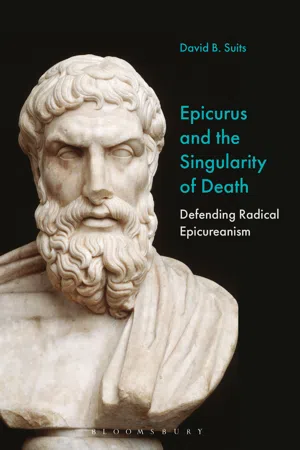
In his Letter to Menoeceus, the ancient Greek philosopher Epicurus states that 'death is nothing to us'. Few philosophers then or since have agreed with his controversial argument, upholding instead that death constitutes a deprivation and is therefore to be feared. Diverging from the current trend and sparking fresh debate, this book provides an imaginative defense of the Epicurean view of death.
Drawing on Epicurus's Principal Doctrines, Lucretius's De Rerum Natura and Philodemus's De Morte, David Suits argues that the usual concepts of harm, loss and suffering no longer apply in death, thus showing how the deprivation view is flawed. He also applies Epicurean reasoning to key issues in applied ethics in order to dispute the claim that there can be a right to life, to defend egoistic friendship, and to consider how Epicureanism might handle wills and life insurance.
By championing the Epicurean perspective, this book makes a valuable contribution to the contemporary philosophical debate about death.
- 231 pages
- English
- PDF
- Available on iOS & Android
eBook - PDF
About this book
Information
Table of contents
- Title Page
- Copyright Page
- Contents
- Acknowledgments
- Chapter 1: The Epicurean View of Death
- Chapter 2: Radical Epicureanism
- Chapter 3: Premature Death and the Complete Life
- Chapter 4: Counterfactual Comments
- Chapter 5: Death and Deprivation
- Chapter 6: A Critique in Four Dimensions
- Chapter 7: Killing
- Chapter 8: Immortality
- Chapter 9: Will He Nill He
- Chapter 10: Suicide
- Bibliography
- Index
Trusted by 375,005 students
Access to over 1.5 million titles for a fair monthly price.
Study more efficiently using our study tools.
Frequently asked questions
Yes, you can cancel anytime from the Subscription tab in your account settings on the Perlego website. Your subscription will stay active until the end of your current billing period. Learn how to cancel your subscription
No, books cannot be downloaded as external files, such as PDFs, for use outside of Perlego. However, you can download books within the Perlego app for offline reading on mobile or tablet. Learn how to download books offline
Perlego offers two plans: Essential and Complete
- Essential is ideal for learners and professionals who enjoy exploring a wide range of subjects. Access the Essential Library with 800,000+ trusted titles and best-sellers across business, personal growth, and the humanities. Includes unlimited reading time and Standard Read Aloud voice.
- Complete: Perfect for advanced learners and researchers needing full, unrestricted access. Unlock 1.5M+ books across hundreds of subjects, including academic and specialized titles. The Complete Plan also includes advanced features like Premium Read Aloud and Research Assistant.
We are an online textbook subscription service, where you can get access to an entire online library for less than the price of a single book per month. With over 1.5 million books across 990+ topics, we’ve got you covered! Learn about our mission
Look out for the read-aloud symbol on your next book to see if you can listen to it. The read-aloud tool reads text aloud for you, highlighting the text as it is being read. You can pause it, speed it up and slow it down. Learn more about Read Aloud
Yes! You can use the Perlego app on both iOS and Android devices to read anytime, anywhere — even offline. Perfect for commutes or when you’re on the go.
Please note we cannot support devices running on iOS 13 and Android 7 or earlier. Learn more about using the app
Please note we cannot support devices running on iOS 13 and Android 7 or earlier. Learn more about using the app
Yes, you can access Epicurus and the Singularity of Death by David B. Suits in PDF and/or ePUB format, as well as other popular books in Philosophy & Ancient & Classical Philosophy. We have over 1.5 million books available in our catalogue for you to explore.