eBook - ePub
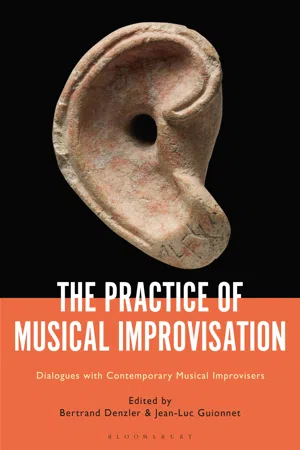
The Practice of Musical Improvisation
Dialogues with Contemporary Musical Improvisers
- 224 pages
- English
- ePUB (mobile friendly)
- Available on iOS & Android
eBook - ePub
The Practice of Musical Improvisation
Dialogues with Contemporary Musical Improvisers
About this book
Over several years, Bertrand Denzler and Jean-Luc Guionnet have interviewed approximately 50 musicians from various backgrounds about their practice of musical improvisation. Musicians include both the very experienced such as Sophie Agnel, Burkhard Beins, John Butcher, Rhodri Davies, Bill Dixon, Phil Durrant, Axel Dörner, Annette Krebs, Daunik Lazro, Mattin, Seijiro Murayama, Andrea Neumann, Jérôme Noetinger, Evan Parker, Eddie Prévost and Taku Unami, as well as those newer to the field. Asked questions on topics such as the mental processes behind a collective improvisation, the importance of the human factor in improvisation, the strategies used and the way musical decisions are made, the interviewees highlight the habits and customs of a practice, as experienced by those who invent it on a daily basis. The interviews were carefully edited in order to produce a sort of grand discussion that draws an incomplete map of the blurred territory of contemporary improvised music.
Information
1
Starting an improvisation
Often, I decide before a concert that I’m going to play this or that area of material at the beginning. But I bend how I play it depending on what the other musicians are doing. For example, today I decided to concentrate on noise. So no matter what you were doing, I was going to stick with my material but bend it so that hopefully it would work with what you were doing. I think I made that decision earlier because I don’t like it when a group starts and there’s one person who starts and you’re thinking: ‘What do I do with this?’ It’s an inevitable, slow process – the group getting into gear. In order to overcome that, I always have an idea of what I’m going to do. Sometimes though I change my mind completely … . [04B]
I think a crucial moment is the beginning of a piece. You don’t know if and how the other musicians will start and how this will relate to how you start. You can either make a decision (‘now I’m going to start’) and then you’ll see how it comes together with what the others do – maybe you’re alone or somebody else starts at the same time and it’s unpredictable how these two sounds come together – or wait until somebody else starts and you can connect to something that’s already there. I try to vary it deliberately. Sometimes, a few minutes before the concert starts, I think: ‘Tonight I should start with this’, and sometimes I actually play that sound. But if I’m walking on stage and have had no thoughts about it a couple of minutes before, I try not to think about those things at that point. On stage, however, concentrating, just before starting, there are so many aspects of the actual situation that come to me that I might recognize that what I thought beforehand is not a good idea. So I skip the initial idea and start in another way. Or I alter my initial idea.
Quite often, during the day of the concert, I’m more or less already kind of working myself towards the moment of starting to play. Sometimes it’s very conscious, sometimes it’s rather subconscious. I’m already concentrating. Thinking about the group we’re going to play with in the evening, I try to make myself aware of the elements that are relevant in this group context and, even more, what is not relevant, what I should leave out or which preparations and objects I shouldn’t bring with me. It’s about coming to the concert with an awareness of what that group is for me or the fields we are working in, the sound of the group, the range of structures, the energy and so on. But if it becomes too specific, if you have too many clear elements, this can be a disadvantage for the concert. So I try not to do that too much. It’s kind of unavoidable to think about these things but I don’t force it. I don’t want to anticipate the music too much. [44]
The first sound, of course, is important. And in a group situation, who makes that first sound is very important. What can that first sound be? It can be anything, of course. We’re interested in the chance, the arbitrary, almost, because we feel confident that we can make sense of anything. And that’s what we try to do. Sometimes it works, sometimes it doesn’t. Sometimes it’s a bit sticky – or you put your foot down and there’s no solid ground there. You thought: ‘At least we can make this step and we’ll know where we are’ but – no! The foot goes into a hole, puddle, mud – that wasn’t a good idea. Those first decisions are almost a religious moment because they set such a train of events in motion – even if it goes wrong a little bit at the beginning it can still come right later. But it’s much better if you get the understanding from the beginning. You could say it’s like a serve in tennis or something: a nice return and then we have a rally. That’s obviously a great way to start. But if I serve an ace, and then another ace, it’s not great tennis to watch – even if it’s great for the guy serving aces. But I don’t plan my first sound hours in advance. [16]
Once, Derek Bailey was asked how he started an improvisation and he said: ‘I usually start on a D.’ So you can do that; you can just make any sound. I quite like that with groups I’ve worked on for a long time, where nobody plays a full idea at the beginning, somebody makes some suggestion and then you pick up on a suggestion and slowly the suggestions become a piece. [14]
During a soundcheck, it occurred to me to say to myself: ‘Hey I wouldn’t mind starting with that particular sound.’ But once I’d done that once or twice, I came to realize that this was the worst thing to do, that it completely blocked me. So I never do that anymore. This means that at the beginning of a concert, things go very fast.
If I don’t know the musician I’m going to play with, I’m interested in knowing who it is, so I’ll try to listen to them beforehand. Out of curiosity, to find out something about what they do. To listen to them and choose what set-up I’m going to use. Especially if it’s someone who also plays electronics. You can find yourself in some kind of ridiculous mirroring so it’s good to have something that places you somewhere else. But I’ve also turned up saying to myself: ‘I don’t know who the person is but I’ll see at the time.’
If I bring my Revox, that’s a strategy in itself. Reworking things using another musician’s sounds is a type of strategy. There’s a strategy in how you build your set-up. Deciding how you’re going to position yourself in relation to the speakers, in relation to the feedback, how you’re going to do it, are strategies, but more of a technical nature.
At the same time, I often think many different things beforehand so that I can forget them afterwards. I come with lots of ideas that I have thought about, consciously or unconsciously, so that way I don’t have to think while playing. I try to do the thinking beforehand. I prepare and then I forget. It’s enough that you’ve thought about it. [36]
I don’t know if what we call the first sound is really the first sound or if it hasn’t actually started beforehand, in the period of concentration that there is between us when we’re about to make it. That’s what I like to believe: that the silence that precedes a concert is actually the first sound. [12]
I often start a concert saying to myself: ‘I’m going to do something I’ve never done before’, deliberately starting with a sound that I know almost never works, the riskiest sound possible, just to make sure that I’m attentive to what might happen right from the beginning. Sometimes this doesn’t work, and if it doesn’t work three times in a row, I end up falling back on things I’ve worked on. [13]
Once, I recorded a loop before the concert, but without listening to it. I asked someone to press play before the audience came in and I came in last. Then I discovered the loop myself. It was a way of planning without knowing. [02]
If I know the people I’m playing with, if I have an idea of what they are going to play, I could have a strategy before playing. [28]
I choose the first sound of the concert in the same way as the second, the seven
th or the fifteenth: either arbitrarily, I look at my stopwatch and say: ‘I’ll play on minute X’, or in a more felt way, because I feel that I’m relaxed enough physically and that in any case I’m going to have to start playing at some point. All the ceremony of the beginning of a concert often annoys me. [25]
I play different instruments. But I wouldn’t decide which instrument I want to play five minutes before leaving the house, it would be a conscious choice. [06B]
The only real decision is about technical equipment. So, for instance, in the second concert the other night, I played amplified. That was my decision. For the first concert, I decided to play acoustically. Other concerts I decide to play with a computer. Things like that. What is decided is more or less the technical set-up, not the music. There are no musical decisions beforehand. Sometimes, of course, I have a ‘pre-imagination’ of how it will be, but things could turn out to be different too. And, in a way, I’m prepared for change, of course. [17]
Before playing, I think about lots of things, but I think less during and after. [41]
2
The mental state during an improvisation
I don’t think things through at all while I’m playing. Somehow, I sort of short-circuit. If I do any reflecting, it happens beforehand, or afterwards, but not during. Sometimes, while I’m producing a sound, I hear another sound produced by another musician, and sometimes I can respond to that sound, find the same granulation. How does that happen? I can’t say how. There’s a kind of state, but I don’t know how it happens, how the desire to make a sound, the desire to change sound, is born. Each sound has a beginning and an end, and sometimes I start a sound before abandoning it and making another one. Often, it’s in the actual playing itself that this happens. I mean I make a sound and after a while I start thinking … not thinking but … my attention, my eyes focus on other objects I have brought with me with which I can make another sound. [02]
I don’t know what is going on in my brain when I play. Very complex processes. I can tell you about my memories or my imaginings, what might happen. I kind of have a picture of the music. So in some ways it’s visual but, in other ways, it isn’t at all. It’s a multidimensional picture. It wouldn’t be possible to paint it but I can see it. It’s like a space or something – I could conceive of a graphic approach but it would be very incomplete. For me, music is a very interesting way of being in time because nobody knows what time is. Music is a way to be in the present. So I’m completely in the present and I also have this picture, this image in my mind. Sometimes I have associations too. Like the associations you have when you listen to music. Sometimes it reminds me of a ventilation system or a fridge or insects – it could be any sound, a car … . Or I’m reminded of other music, from history. A history of music, which I have in my head, comes to the fore and my memories, all I know about music history, come into this … . Suddenly, if I lose my consciousness of the present and I drift away, I might think suddenly about washing the dishes but that rarely happens. It can happen if I find the concert uninteresting; then I fade away. But that rarely happens either. There are a lot of different levels. What happens in the brain is very complex. There are so many different levels. Sometimes, because I never play with my eyes closed, I might see somebody coming into the room or somebody leaving, and I might become aware of it during the concert. Or somebody might be looking really intense, for example. My eyes are open but I’m not looking at anything in particular. I’m concentrating. I look to a certain point but not consciously. I fix my eyes on emptiness. It might happen that I’m suddenly looking around when something happens. It wasn’t a decision I made, it just happened that way. I don’t think I ever close my eyes to play. [17]
I don’t know what’s happening in my brain while I perform and that’s what’s really exciting. I think what goes on is outrageously complex, far more complex than we know. And improvisation has the possibility to access some of this complexity, beyond the current social, historical, scientific tools that exist for analysing how the brain works. I feel that some physical things happen as well. Sometimes it happens without me knowing.
When you’re improvising and you hear something, depending on how you hear it and how that resonates with what you’ve heard before and what you think, it influences your decision-making process. But everything is going on very quickly.
I’ve always felt suspicious if I go into a trance while playing with musicians. On one level I really love it, it’s beautiful to feel lost, but the critical part of me thinks: ‘What are you doing, what’s this about, was that predictable?’
The way you interpret or hear a sound is very ambiguous. When you improvise with ‘noise’, you become aware that what you listen to is quite subjective. You can listen to the timbre, the volume, the envelope and so on. It’s actually getting to the roots of your listening systems and bending your notion of how you assume sounds to be or what you expect to hear. There is also some super-realist type of awareness of the physicality and the implication of what your fellow improvisers are doing. Because what you are doing will connote in a number of systems, it connotes simultaneously. It connotes in terms of your understanding of musical structures, real-time composition and the sonic potentials of a particular instrument. [21]
I trust sound. I go with the sound. Sounds feed vibrations back into the body, the vibrations of the instrument back to my ears or my body and the vibrations of the instrument back into my hand, something very primitive. When the sound is there, I’m confident. It’s more difficult when the acoustics are dry because the sound isn’t really there, and you really have to create the metaphor of resonance inside yourself.
Everything is constantly oscillating. We find ourselves in the oscillation and our sole job is to make sure we’re right there in the place where it’s oscillating. In the Western world, we’re a bit binary and this artistic work makes it possible to see that there aren’t only two poles, but a multitude of them. And that’s what affords us the wonderful happiness of contradicting ourselves, in actions themselves, because they’re something and its opposite, a variation and its opposite. It’s an extraordinary journey. [15]
I’m interested in following sounds. Maybe you could liken it to when you repeat a word over and over. After a while it acquires a different meaning. It’s the same with sound as well. If it’s played long enough, it starts to be something different to what it was at the beginning. At the moment, I’m interested in finding another voice that comes in, to make the sound a bit more complex than it first appears to be, but in a subtle way, not in an obvious way. It sounds as if I only do ‘long sounds’ but I also work on how they exist in silence as well. Silence before, during or after has an effect on the whole thing as well. [10]
I certainly can’t remove myself, but when I perform I consider myself to be more in the service of the sound, rather than the sound being in my service. [03]
Limitation is really important. Sometimes, though, you just do what you feel like doing. [04A]
Two recurrent images come to mind when I’m playing. In the first there’s the feeling of really setting the piano in motion so that it becomes a sort of sound machine that I just stoke up. And I feel that there’s a moment when the piano kind of takes off from the ground and exists on its own, without me doing anything. From the outside, it looks like I’m hyperactive, but from the inside I feel like I’m not doing anything and I’m just listening to this kind of brouhaha, this machine, and just adding a few bits inside it. Pushing a little in one direction, and then in the other, holding it but without really giving anything. I just give the initial impetus, but it happens on its own. The instrument and I vibrate together. The other image is that at some point, my body … but in fact, it’s related to listening. Listening is so much focused on space, that the piano extends to the whole space, to the room, to the air, and I feel as if I’m inflating. It feels as if the act of listening and my body encompass the whole room, people, everything. It feels as if ...
Table of contents
- Cover
- Half-Title
- Title
- Contents
- Acknowledgements
- Preface
- 1 Starting an improvisation
- 2 The mental state during an improvisation
- 3 Listening to the other musicians, the human factor, the strategies
- 4 Memory and form
- 5 Process versus aesthetic result, improvisation as a tool to make music versus music as a tool to improvise, improvisation versus composition
- 6 Talking about improvisation and music in general
- 7 Non-idiomatic improvisation, experimental music, genre labels
- 8 Silence and dynamics
- 9 Sounds as material
- 10 Instrument and technique
- 11 Solo improvisation
- 12 The concert situation, the audience, the published recordings
- 13 Some political issues
- 14 How I came to play this music
- 15 How I listen to music, the music I listen to, some hidden gardens
- 16 Miscellaneous
- List of the musicians interviewed
- An ear for discord: Improvise, they say
- Diagrams
- Copyright
Trusted by 375,005 students
Access to over 1.5 million titles for a fair monthly price.
Study more efficiently using our study tools.
Frequently asked questions
Yes, you can cancel anytime from the Subscription tab in your account settings on the Perlego website. Your subscription will stay active until the end of your current billing period. Learn how to cancel your subscription
No, books cannot be downloaded as external files, such as PDFs, for use outside of Perlego. However, you can download books within the Perlego app for offline reading on mobile or tablet. Learn how to download books offline
Perlego offers two plans: Essential and Complete
- Essential is ideal for learners and professionals who enjoy exploring a wide range of subjects. Access the Essential Library with 800,000+ trusted titles and best-sellers across business, personal growth, and the humanities. Includes unlimited reading time and Standard Read Aloud voice.
- Complete: Perfect for advanced learners and researchers needing full, unrestricted access. Unlock 1.5M+ books across hundreds of subjects, including academic and specialized titles. The Complete Plan also includes advanced features like Premium Read Aloud and Research Assistant.
We are an online textbook subscription service, where you can get access to an entire online library for less than the price of a single book per month. With over 1.5 million books across 990+ topics, we’ve got you covered! Learn about our mission
Look out for the read-aloud symbol on your next book to see if you can listen to it. The read-aloud tool reads text aloud for you, highlighting the text as it is being read. You can pause it, speed it up and slow it down. Learn more about Read Aloud
Yes! You can use the Perlego app on both iOS and Android devices to read anytime, anywhere — even offline. Perfect for commutes or when you’re on the go.
Please note we cannot support devices running on iOS 13 and Android 7 or earlier. Learn more about using the app
Please note we cannot support devices running on iOS 13 and Android 7 or earlier. Learn more about using the app
Yes, you can access The Practice of Musical Improvisation by Bertrand Denzler, Jean-Luc Guionnet, Bertrand Denzler,Jean-Luc Guionnet in PDF and/or ePUB format, as well as other popular books in Medios de comunicación y artes escénicas & Historia y crítica de la música. We have over 1.5 million books available in our catalogue for you to explore.