A major new history of how democracy became the dominant political force in Europe in the second half of the twentieth century
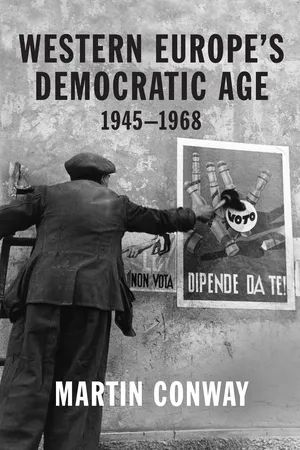
What happened in the years following World War II to create a democratic revolution in the western half of Europe? In Western Europe's Democratic Age, Martin Conway provides an innovative new account of how a stable, durable, and remarkably uniform model of parliamentary democracy emerged in Western Europe—and how this democratic ascendancy held fast until the latter decades of the twentieth century.
Drawing on a wide range of sources, Conway describes how Western Europe's postwar democratic order was built by elite, intellectual, and popular forces. Much more than the consequence of the defeat of fascism and the rejection of Communism, this democratic order rested on universal male and female suffrage, but also on new forms of state authority and new political forces—primarily Christian and social democratic—that espoused democratic values. Above all, it gained the support of the people, for whom democracy provided a new model of citizenship that reflected the aspirations of a more prosperous society.
This democratic order did not, however, endure. Its hierarchies of class, gender, and race, which initially gave it its strength, as well as the strains of decolonization and social change, led to an explosion of demands for greater democratic freedoms in the 1960s, and to the much more contested democratic politics of Europe in the late twentieth century.
Western Europe's Democratic Age is a compelling history that sheds new light not only on the past of European democracy but also on the unresolved question of its future.
- English
- ePUB (mobile friendly)
- Available on iOS & Android
eBook - ePub
About this book
Information
Publisher
Princeton University PressYear
2020Print ISBN
9780691204598
9780691203485
eBook ISBN
9780691204604
CHAPTER ONE
Making Democracy
THE CONSTRUCTION OF A POST-WAR DEMOCRATIC ORDER IN WESTERN EUROPE
THE DEFEAT OF THE THIRD REICH did not provide the basis for the establishment of democracy as the dominant political regime in Europe. Indeed, the final extirpation of the Nazi regime in the bombed-out ruins of Berlin in the first days of May 1945 seemed to be anything but a victory for European self-government. The fiercely contested conquest of Europe undertaken over the course of the previous two years primarily by three powers (the Soviet Union, the United States, and Britain) from the edges of Europe appeared to mark the demise of Europe’s sovereignty. The peoples of Europe might indeed have been liberated—albeit quite a number of them at the expense of their lives—but their political regimes had been among the principal victims of that process of liberation. If one exempts those states that had remained rather uncertainly neutral throughout the conflict (Ireland, Portugal, Spain, Sweden, and Switzerland), almost all of the regimes of Europe, with the exceptions of those of Britain and Finland, had been overthrown, defeated, or occupied over the course of the previous years. Moreover, as the wartime conferences of the Allied powers held in exotic locations such as Casablanca, Cairo, Teheran, and Yalta seemed to indicate, Europe’s future would be decided not by the peoples or the governments of Europe but by the imperially minded powers that had brought about their liberation.
There was therefore no straightforward path from war, through liberation, to democracy. Indeed, in the Iberian peninsula, such a transition never began; while in most of those areas of central and eastern Europe liberated (or conquered) by the Red Army, its terminus proved to be not democracy but regimes of state socialism. However, in a large swathe of northern, central, and western Europe, military liberation set in motion a wide-ranging process of constitutional, political, and social change that culminated a few years later in a new democratic order. This outcome was very much less than inevitable, but also something more than chance. Instead, as this chapter will show, Western Europe’s post-war transition to democracy arose from the interplay of four dominant forces: the actions of the powers who liberated and, subsequently, occupied Europe; the successful refoundation of national state structures; the consequent demobilization and marginalization of other, more locally based or informal political authorities; and the re-emergence of a structure of political parties that, along with a range of other social associations, became the principal intermediaries between rulers and ruled. Taken together, these factors brought into existence a resilient democratic order, but one which through its limitations betrayed the determining influences on its creation.
At the beginning, however, there was confusion. Some communities had been destroyed by the arbitrary violence of war, while others had been left almost entirely unscathed; some had experienced bitter political or ethnic conflicts that had verged on civil war, but in others the adversities of war had reinforced social solidarity. In many urban centres, shortages of the basic needs of food, heat, and housing had reduced millions to destitution, while others, notably in rural areas away from the front lines, had proved able to maintain a life of relative ease. These differences were not national, but highly localized, coexisting often starkly within or between neighbouring communities.1 Indeed, the principal consequence of the vast mobile military campaigns waged on land and in the air in Europe during the final years of the Second World War had been to shatter, rather in the manner of the destruction of a set of venerable crockery, any coherent pattern of national government. With the rare exception of Denmark, which emerged from under the cloak of German occupation in May 1945 with its constitutional institutions largely intact,2 government was notable at the moment of liberation mainly by its absence. The combined impact of Nazi and Allied occupations during the final years of the war destroyed much of the conventional framework of public administration, replacing it with haphazard regimes of military occupation that coexisted, often somewhat awkwardly, with a wide range of self-proclaimed or improvised committees of liberation, Resistance movements, and groupings of social notables.3
The dominant reality almost everywhere was local. Difficulties of communication and the collapse of the hierarchies of bureaucratic administration had liberated many communities effectively to themselves. Across large areas of Italy between 1943 and 1945, in France in the summer of 1944, in the Low Countries in the winter of 1944–45, and across the territories of the defeated Third Reich in the summer of 1945 millions of Europeans experienced an enforced break from their role as citizens of their nation-state.4 The consequence was certainly not anarchy. Even as Europeans found themselves without a government, they for the most part continued to behave much as if one existed. Habits of obedient citizenship and respect for law were for most Europeans, especially in western and central Europe, difficult to unlearn. But much of the distinctiveness of liberation, and a strong reason why the period has remained subsequently an emotional reference point in European memories, lay in its sense of being an exceptional moment, when the normal frameworks of daily life had ceased to exist. The consequences could be arbitrary, unpredictable, and dangerous. The general settling of accounts—what in Italy became known as the resa dei conti—that followed liberation was an unscripted process that took place beyond or alongside more legal patterns of justice.5 Throughout liberated and Allied-occupied Europe, power was at times exercised through the barrel of a gun, and all of Europe was provided with an unprecedented number of guns, many of which had fallen into ill-trained or ill-intentioned hands. Authority in these circumstances, as in cities such as Marseille or Florence in the summer of 1944, tended to reside in the hands of whoever acted most swiftly in occupying public buildings and issuing decrees to the population.6 But it could also be empowering, as communities at the level of the factory, the village, or indeed the refugee or prisoner-of-war camp, took matters into their own hands. The inhabitants of a village in the Auvergne decided in the summer of 1944, long before the arrival of any liberation from outside, to set up a sign at the boundary of their commune announcing “Ici commence la France libre.” This was less a partisan statement as to who should rule France than a reassertion of the sovereignty of the local community.7
As that sign indicated, the nation was very much present in people’s minds at the war’s end: as a badge of personal and collective identity, an ethnic label, or a project for the future. What was absent was its modern corollary of effective state power. Unsurprisingly, this created fears that the nation-state itself was broken beyond repair, and that the bonds of political and legal authority that had developed across Europe over roughly the previous hundred years would not be restored.8 The reality, however, was more complex: the nation migrated from the hierarchical structures of the state to the more local level of community and neighbourhood, creating simultaneously a sense that the nation was a more present reality—as expressed through the patriotic trappings of liberation—and also more distant. The changes that this brought about in the varied political cultures of Europe were subtle, and durable. Most obviously, the absence of effective state authority served as an education in the possibility of self-government. Europeans began to do democracy for themselves. Men and, more especially, women organized the provisioning of their own communities, improvised forms of collective welfare, and set up neighbourhood committees and councils.9 In some cases, these practices drew on semi-submerged pre-existing forms of direct democracy. Workplace or town-square meetings, the establishment of local militias, and, more strikingly, the “unofficial” purges carried out of those who had transgressed social norms by engaging in collaboration with the occupiers during the war years were all aspects of the politics of the liberation era that reached back to the era of the French Revolution, or indeed to the urban cultures of the early modern era.10
In other ways, however, the impact of the liberation period proved to be depoliticizing. The chaos caused by the sustained and rather indiscriminate aerial bombing of the final years of the war was destructive of more than buildings. It destroyed governance and social norms, encouraging an intense and at times amoral individualism evident in the endemic small-scale criminality of the era, but also in an obsessive preoccupation with one’s own welfare and—for women especially—that of one’s family.11 Confronted by a daily struggle to obtain food, fuel, and money, many Europeans had little time for, or interest in, notions of community, and still less political engagement. As two British Members of Parliament reported on their visit to Austria in early 1946: “The main daily task of the Viennese is to creep quietly about the city, providing … necessities for themselves and their families.”12 The impact of the war had often been atomizing, and this was especially so in t...
Table of contents
- Cover Page
- Title Page
- Copyright Page
- Contents
- List of Illustrations
- Preface and Acknowledgements
- List of Abbreviations
- Introduction: A Democratic Age
- Chapter 1. Making Democracy: The Construction of a Post-war Democratic Order in Western Europe
- Chapter 2. Thinking Democracy: The New Model of a Stable Democracy
- Chapter 3. Debating Democracy: The Dialectic of Christian Democrat and Socialist Variants of Democracy
- Chapter 4. Living Democracy: State Power, Class, Gender, and the Consumption of Democracy
- Chapter 5. Contesting Democracy: The Democratic Critique of Democracy
- Conclusion: Unmaking Democratic Europe: Democracy and Post-democracy
- Bibliography
- Index
Trusted by 375,005 students
Access to over 1.5 million titles for a fair monthly price.
Study more efficiently using our study tools.
Frequently asked questions
Yes, you can cancel anytime from the Subscription tab in your account settings on the Perlego website. Your subscription will stay active until the end of your current billing period. Learn how to cancel your subscription
No, books cannot be downloaded as external files, such as PDFs, for use outside of Perlego. However, you can download books within the Perlego app for offline reading on mobile or tablet. Learn how to download books offline
Perlego offers two plans: Essential and Complete
- Essential is ideal for learners and professionals who enjoy exploring a wide range of subjects. Access the Essential Library with 800,000+ trusted titles and best-sellers across business, personal growth, and the humanities. Includes unlimited reading time and Standard Read Aloud voice.
- Complete: Perfect for advanced learners and researchers needing full, unrestricted access. Unlock 1.5M+ books across hundreds of subjects, including academic and specialized titles. The Complete Plan also includes advanced features like Premium Read Aloud and Research Assistant.
We are an online textbook subscription service, where you can get access to an entire online library for less than the price of a single book per month. With over 1.5 million books across 990+ topics, we’ve got you covered! Learn about our mission
Look out for the read-aloud symbol on your next book to see if you can listen to it. The read-aloud tool reads text aloud for you, highlighting the text as it is being read. You can pause it, speed it up and slow it down. Learn more about Read Aloud
Yes! You can use the Perlego app on both iOS and Android devices to read anytime, anywhere — even offline. Perfect for commutes or when you’re on the go.
Please note we cannot support devices running on iOS 13 and Android 7 or earlier. Learn more about using the app
Please note we cannot support devices running on iOS 13 and Android 7 or earlier. Learn more about using the app
Yes, you can access Western Europe’s Democratic Age by Martin Conway in PDF and/or ePUB format, as well as other popular books in History & 20th Century History. We have over 1.5 million books available in our catalogue for you to explore.