The food supply chain needs to reassure consumers and businesses about the safety and standards of food. Global estimates of the cost of food fraud to economies run into billions of dollars hence a huge surge in interest in food authenticity and means of detecting and preventing food fraud and food crime. Approaches targeting DNA markers have assumed a pre-eminence.
This book is the most comprehensive and timely collection of material from those working at the forefront of DNA techniques applied to food authenticity. Addressing the new field of analytical molecular biology as it combines the quality assurance rigour of analytical chemistry with DNA techniques, it introduces the science behind DNA as a target analyte, its extraction, amplification, detection and quantitation as applied to the detection of food fraud and food crime. Making the link with traditional forensic DNA profiling and describing emerging and cutting-edge techniques such as next generation sequencing, this book presents real-world case studies from a wide perspective including from analytical service providers, industry, enforcement agencies and academics. It will appeal to food testing laboratories worldwide, who are just starting to use these techniques and students of molecular biology, food science and food integrity. Food policy professionals and regulatory organisations who will be using these techniques to back up legislation and regulation will find the text invaluable. Those in the food industry in regulatory and technical roles will want to have this book on their desks.
eBook - ePub
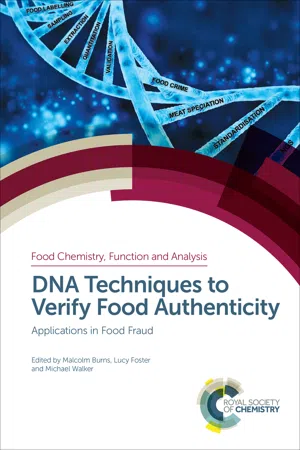
DNA Techniques to Verify Food Authenticity
Applications in Food Fraud
- 325 pages
- English
- ePUB (mobile friendly)
- Available on iOS & Android
eBook - ePub
DNA Techniques to Verify Food Authenticity
Applications in Food Fraud
About this book
Information
Publisher
Royal Society of ChemistryYear
2019Print ISBN
9781788016025
9781788011785
Edition
1eBook ISBN
9781788018975
CHAPTER 1
The Role of DNA Analysis in the Determination of Food Authenticity
21 Amersham Road, High Wycombe, Buckinghamshire HP13 6QS, United Kingdom,
*E-mail: [email protected]
*E-mail: [email protected]
1.1 A Brief History of Food Adulteration
Friedrich Accum was a German chemist who came to London in 1793 and established himself as an analyst. His interests included keeping processed food free from dangerous additives. In 1820 he published a best-selling book entitled ‘A Treatise on Adulterations of Food and Culinary Poisons’.1 In this book he describes practices such as colouring red cheese and confectionary with red lead and mercuric sulphide, using strychnine instead of hops in the production of beer, whitening bread flour with alum and chalk and extending bread loaves with plaster of Paris and sawdust. Other practices included boiling spent tea leaves with Prussian Blue (ferric ferrocyanide) and sheep dung, which were dried and re-sold.
Arthur Hill Hassall (a London physician) began a major investigation into food adulteration in the 1850s. One of his early successes used microscopy to demonstrate the adulteration of coffee with chicory. Hassall's work, together with Henry Letheby, the Medical Officer of Health for London, led to the introduction of the Adulteration of Food and Drugs Act of 1860. This Act was revised in 1872 and again in 1875. The Sale of Food and Drugs Act 1875 is widely regarded as a turning point in the regulation of food, introducing key concepts such as that food must be of the ‘nature’ or ‘substance’ or ‘quality’ demanded by the purchaser. It included, as a duty of local government, the appointment of a certain type of scientist, the Public Analyst – a key Hassall recommendation – to provide the underpinning analytical data and its interpretation for the enforcement of the provisions of the Act. The Society of Public Analysts was formed (now known as the Association of Public Analysts). Today, one of the key tasks of public analysts in the UK and Ireland is to ensure the safety and correct description of food by testing for compliance with legislation.
As described in Chapter 10, legislation that relates to the authenticity of food remains in place today. In the UK, the Food Safety Act 1990 prohibits ‘falsely or misleadingly describing or presenting food’. Regulation (EU) No.1169/2011 of the European Parliament and of the Council of 25 October 2011 on the provision of food information to consumers, (implemented in the UK as the Food Information Regulations 2014, No.1855) as amended and with devolved equivalents specifies what information must be given with marketed food. For pre-packed food the required information includes a list of the individual components, the amounts present (quantitative declaration of ingredients or QUID) and, where appropriate, the country of origin of key ingredients. Inherent within this regulation is that, with very limited exceptions, pre-packed food should not include any undeclared ingredients. Despite this legislation, food adulteration and other forms of food fraud continues to exist. INTERPOL and Europol have undertaken joint operations targeting counterfeit and sub-standard foodstuff and beverages. For example, operation OPSON V in 2015, involving 57 countries, where the operation seized over 10 000 tonnes of food and one million litres of drink which was either counterfeit or sub-standard.
1.2 Food Fraud in the 21st Century
Consumers expect that the food they buy is labelled correctly but, as the example above shows, food fraud is prevalent despite the existence of relevant legislation. Food fraud can broadly take three forms: adulteration, substitution and mis-description.
Adulteration includes the addition of undeclared ingredients. Examples include adding horsemeat or offal to beef in processed foods, adding illegal colourants to improve the appearance of food and adding water to frozen food to increase its weight. Other examples of food adulteration are given in Box 1.1.
Box 1.1 Some examples of food adulteration.
- Mixing long-grain rice with Basmati rice
- Mixing cow's milk with buffalo milk before producing buffalo mozzarella cheese
- Adding common wheat to durum wheat pasta labelled as 100% durum wheat
- Extracting soluble coffee from beans mixed with skins and husks
- Adding cheaper vegetable oils to named higher-value vegetable oils
- Adding glycerol to wine to extend body
- Adding mandarin or tangerine juice to orange juice to improve colour
- Painting green olives with copper sulphate to improve colour
Substitution involves replacement of one ingredient by a similar or cheaper one. Examples include using whiting or pollack in place of cod, bonito in place of tuna or sea trout to replace salmon. A survey by Oceana found this type of fraud to be widespread in restaurants in the USA and Europe.2 Similar studies aimed specifically at sushi restaurants found substitution varying from 10% in the UK to 47% in the USA.3,4
Misdescription of food takes several forms and usually relates to the method of production, the geographical origin of the food or the amounts of key ingredients used. Some representative examples are given in Table 1.1.
Table 1.1 Examples of misdescription of food
| Type of Misdescription | Examples |
| Non-declaration or false declaration of processes |
|
| Over-declaration of a quantitative ingredient |
|
| False claims regarding geographical origin or method of production |
|
In the USA, food fraud is treated primarily as a food safety issue. In contrast, in Europe food fraud is viewed as a breach of food labelling law with food safety being covered by separate legislation. Nevertheless, there is a clear link between food fraud and food safety. Examples include the US Oceana surveys, 2 where most of the fish labelled as tuna was in fact escolar, which can cause digestive problems. Another example of a safety issue related to adulteration is the use of known carcinogens (illegal dyes), such as Sudan 1, to improve food colouration and increase the price of spices such as chilli powder.
There are a number of drivers of food fraud. Two key ones are price pressures on food suppliers and criminal activity. Low profit margins for food manufacturers create cost pressures if raw materials or utilities increase in price. This can potentially create opportunities for food fraud by reducing costs via adulteration or substitution of key ingredients. Criminal involvement usually is associated with high value or premium products where huge profits can be made by passing off a cheaply produced or inferior quality product as a superior version. Such criminal activity operates at all levels of food production; and is attractive due to its perceived low penalties, for example, compared with drugs trafficking. Further discussion on food fraud is provided in Chapter 14.
1.3 Challenges in Detecting Food Misdescription and Fraud
There are five main challenges in developing methods to determine the authenticity of food. Each generates a requirement that the methods are fit for purpose. The first challenge is the choice of analytical method. The range of misdescription and fraud described in the previous section means that no single methodology will suffice. As discussed elsewhere in this book, it may be necessary to use multiple methods.
The second challenge is finding a marker or markers that characterises the food, one of its ingredients, the adulterants in question, or its processing, production or geographical origin. The marker has to be specific, its natural variation must be limited and well-characterised and be measured accurately.
The third challenge relates to the variety of matrices that exist in foods. No two processed foods contain exactly the same ingredients. A method developed for one food may not be suitable for use with another. If processed foods are cooked, any markers of interest may be degraded or destroyed completely.
The fourth challenge is that most investigations of food adulteration are linked to a legal requirement, standard or guidance. As such, the interpretation of the results must be made in the light of analytical uncertainty, natural variation and any tolerance permitted by the requirements. That is, the conclusion reached must be beyond reasonable doubt.
The final challenge relates to the requirement for authentic samples and/or certified reference materials for the development and evaluation of the method. The difficulties in obtaining authentic samples cannot be over-emphasised. Often, once sourced, there is no central repository for their maintenance and supply to analysts. Further discussion on drivers and challenges for food fraud adulteration and its determination is provided in Chapter 6.
1.4 The Role of DNA in Food Authenticity Determination
All cellular organisms contain DNA. The differences between organisms i.e. anatomical, physiological etc. ultimately resides in their DNA sequence. The more evolutionarily distant two species are, the greater will be the differences in their DNA sequences. However, even when two individuals are closely related, e.g. family members, there are sufficient differences at the DNA sequence level for each individual to be recognised. This is the basis of DNA profiling used in police and paternity investigations and which came to prominence in the 1980s.
In the early 1990s the UK Ministry of Agriculture, Fisheries and Food (MAFF) began funding research to develop analytical methods to detect food fraud, which included the application of forensic DNA profiling to determine the authenticity of food. DNA analysis is particularly suited to qualitative analysis to answer yes/no questions e.g. has there been substitution of one species with another, which formed the focus of much of the early DNA-based methods work. As explored in Chapters 6 and 7, public analysts were not overly familiar with the diversity of emerging new DNA techniques for food testing. This issue was resolved when the Agilent lab-on-a-chip analyser became available resulting in the conversion of these DNA techniques to this easier to use format (Chapter 6).
More recently, qualitative analysis has been facilitated by the development of DNA barcoding (www.barcodeoflife.org). Barcoding provided a way of distinguishing and identifying species with a short, standardized gene sequence. 5 A ...
Table of contents
- Cover
- Title
- Copyright
- Contents
- Chapter 1 The Role of DNA Analysis in the Determination of Food Authenticity
- Chapter 2 Forensic DNA – Criminal and Paternity Methods and Applications – How Can This Help in Verifying Food Authenticity?
- Chapter 3 DNA Extraction from Food Matrices
- Chapter 4 “DNA Techniques” Case Study: Isothermal Approaches
- Chapter 5 Digital Polymerase Chain Reaction (dPCR) – General Aspects and Applications
- Chapter 6 UK Food Authenticity Programme – The Analytical Tool Box
- Chapter 7 Fitness for Purpose of DNA-based Analytical Methods
- Chapter 8 GMO Detection and Identification Using Next-generation Sequencing
- Chapter 9 A Perspective on Quantitative DNA Approaches
- Chapter 10 DNA in Food and Feed Law
- Chapter 11 Harmonising DNA Methods – The GMO Story
- Chapter 12 Metrology of DNA Approaches
- Chapter 13 The Almond and Mahaleb Allergen Story – PCR Resolution of Live Incident Investigations
- Chapter 14 Food Fraud Prevention – Selecting the Right Test, Method, and Sampling Plan
- Chapter 15 Meat Speciation
- Chapter 16 The Horse Meat Scandal – The European Analytical Response
- Chapter 17 Horse Meat: Technical Appeals and Court Action
- Chapter 18 Durum Wheat and Pasta Authenticity
- Chapter 19 The Authenticity of Basmati Rice – A Case Study
- Chapter 20 Horse Meat: The International Collaborative Trial of the Real-time PCR Method for the Quantitation of Horse DNA
- Chapter 21 Standardization of DNA-based Methods for Food Authenticity Testing
- Chapter 22 Authentication of Chinese Traditional Medicine by DNA Analysis
- Chapter 23 DNA Point of Use Applications
- Chapter 24 Commercial DNA Testing
- Chapter 25 EU Food Integrity and Joining up the Landscape (EU Perspective)
- Chapter 26 The Food Authenticity Network
- Chapter 27 A Vision for the Future
Trusted by 375,005 students
Access to over 1.5 million titles for a fair monthly price.
Study more efficiently using our study tools.
Frequently asked questions
Yes, you can cancel anytime from the Subscription tab in your account settings on the Perlego website. Your subscription will stay active until the end of your current billing period. Learn how to cancel your subscription
No, books cannot be downloaded as external files, such as PDFs, for use outside of Perlego. However, you can download books within the Perlego app for offline reading on mobile or tablet. Learn how to download books offline
Perlego offers two plans: Essential and Complete
- Essential is ideal for learners and professionals who enjoy exploring a wide range of subjects. Access the Essential Library with 800,000+ trusted titles and best-sellers across business, personal growth, and the humanities. Includes unlimited reading time and Standard Read Aloud voice.
- Complete: Perfect for advanced learners and researchers needing full, unrestricted access. Unlock 1.5M+ books across hundreds of subjects, including academic and specialized titles. The Complete Plan also includes advanced features like Premium Read Aloud and Research Assistant.
We are an online textbook subscription service, where you can get access to an entire online library for less than the price of a single book per month. With over 1.5 million books across 990+ topics, we’ve got you covered! Learn about our mission
Look out for the read-aloud symbol on your next book to see if you can listen to it. The read-aloud tool reads text aloud for you, highlighting the text as it is being read. You can pause it, speed it up and slow it down. Learn more about Read Aloud
Yes! You can use the Perlego app on both iOS and Android devices to read anytime, anywhere — even offline. Perfect for commutes or when you’re on the go.
Please note we cannot support devices running on iOS 13 and Android 7 or earlier. Learn more about using the app
Please note we cannot support devices running on iOS 13 and Android 7 or earlier. Learn more about using the app
Yes, you can access DNA Techniques to Verify Food Authenticity by Malcolm Burns, Lucy Foster, Michael Walker, Malcolm Burns,Lucy Foster,Michael Walker, Gary Williamson,Alejandro G Marangoni,Juliet A. Gerrard in PDF and/or ePUB format, as well as other popular books in Technology & Engineering & Analytic Chemistry. We have over 1.5 million books available in our catalogue for you to explore.