eBook - ePub
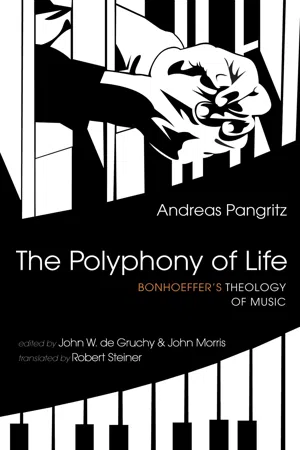
The Polyphony of Life
Bonhoeffer’s Theology of Music
- 92 pages
- English
- ePUB (mobile friendly)
- Available on iOS & Android
eBook - ePub
The Polyphony of Life
Bonhoeffer’s Theology of Music
About this book
This fascinating book, which explores an intriguing idea formulated by Dietrich Bonhoeffer in the very last months of his life, has up until now been available only to German readers. Since Polyphonie des Lebens first appeared twenty-five years ago, a whole new generation of scholars has come into contact, in English as well as in the original German, with the entire collection of his works, as well as with a huge body of Bonhoeffer studies that have provided an exhaustive assessment of the man and his theology. But now with this brand new English edition of a book that explores a neglected but significant aspect of his life, readers may be surprised to discover how Bonhoeffer's interest in music influenced him--he seriously considered becoming a professional musician as a teenager, but chose the path of theology instead--and that not only did music provide him with a rich inner world of solace during his daily life while confined in Tegel Prison during 1943 and 1944, but music also lent him a remarkable metaphor for the fragmentary nature of life itself. In Polyphony of Life Andreas Pangritz explores Bonhoeffer's musical development and its impact on his theology and so fills in an important gap in the record of Bonhoeffer's life and thought.
Information
Topic
Theology & ReligionSubtopic
Music Theory & Appreciation1
Bonhoeffer’s Musical Biography

There are numerous speculative statements about music in Dietrich Bonhoeffer’s Letters and Papers from Tegel prison, occasionally supported by musical notations. Most occur prior to Bonhoeffer’s discussion of what Eberhard Bethge called his “new theology,”1 which developed in response to his question, “what is Christianity, or who is Christ actually for us today?”2 But the references are revealing, for they prelude and provide a commentary on Bonhoeffer’s final theological thought which, Bethge noted, was frequently regarded as shocking by those who read it after the Second World War. That Bonhoeffer’s last specifically theological reflections were preceded by those on musical terms is, however, no coincidence.
Bonhoeffer was already musically educated in the classical-romantic tradition before his interest in theology developed.3 In this respect he was typical of his social class, for “making music” at home was an integral part of bourgeois culture. Bonhoeffer was “playing Mozart sonatas at the age of ten,” writes Bethge, and “on Saturday evenings he skilfully accompanied his mother and his sister Ursula, who had a good voice, in songs by Schubert, Schumann, Brahms and Hugo Wolf.” At an early age, Bethge goes on to say, Bonhoeffer was accustomed “to performing without shyness or embarrassment.”4
This nineteenth-century musical legacy or “romantic heritage”5 was imparted to Bonhoeffer by his mother, whose own mother (née Kalckreuth) had enjoyed singing and had taken piano lessons with Clara Schumann and Franz Liszt.6 In this way a “treasure chest of songs” was handed down to the Bonhoeffer siblings, something Dietrich later recalled in his prison letters. According to Bethge, the young Bonhoeffer had played a “small selection” of the songs of Hugo Wolf with his sister, and later, before his imprisonment, Bethge and Bonhoeffer bought a large quantity of these songs and tried them.7 It seems that among the siblings it was especially Dietrich to whom the “Kalckreuthian family musicality” was passed on. In addition to the piano, Bonhoeffer appears to have tried the lute and even attempted his own compositions, and he “made such musical and technical progress at the piano that, for a time, both he and his parents thought that he might become a professional musician.”8
Bonhoeffer’s turn to theology never displaced music. Throughout his life he kept his skill as a pianist, especially his ability as an accompanist. He applied both skills during his parish work in Barcelona (1928),9 and in London (1933–1935),10 as well as when playing chamber music at home, often with his brother-in-law Rüdiger Schleicher on the violin and his brother Klaus on the cello.11 But a shift in his musical outlook becomes evident after Bonhoeffer increasingly came under the influence of Karl Barth’s “Dialectical Theology.”12 The influence of Barth’s criticism of religion in his commentary on the Epistle to the Romans (second edition 1922),13 for example, can be seen in Bonhoeffer’s critical comment about Beethoven’s “quartets and symphonies” in a sermon preached in Barcelona in March 1928 on Rom 11:6:
There is in the soul of human beings, as truly as they are human beings, something that makes them restless, something that points them toward the infinite, eternal . . . this notion of something eternal, something infinite, makes the soul anxious in its own transitoriness . . . It wants to acquire power over the eternal so that it can rid itself of anxiety and restlessness . . . From this restlessness of the soul the colossal works of philosophy and art emerged.14
This “restlessness of soul” is “religion,” says Bonhoeffer, but “the sum total of Christianity is not religion, but rather revelation.”15
Together with his theologically motivated preference for Bach, even though Barth loved Mozart more,16 Bonhoeffer developed a reservation for the classical-romantic tradition, at least as far as its liturgical use was concern...
Table of contents
- Title Page
- Preface to the English Translation
- Editors’ Introduction
- Bonhoeffer’s Little Invention
- Abbreviations
- Chapter 1: Bonhoeffer’s Musical Biography
- Chapter 2: Christological Concentration
- Chapter 3: The Lutheran Chorales
- Chapter 4: Heinrich Schütz and the “Recapitulation of All Things”
- Chapter 5: The Art of Fugue and the Conspiracy
- Chapter 6: The Music of the Deaf Beethoven and the “New Body”
- Chapter 7: Cantus Firmus and Counterpoint
- Bibliography
Trusted by 375,005 students
Access to over 1.5 million titles for a fair monthly price.
Study more efficiently using our study tools.
Frequently asked questions
Yes, you can cancel anytime from the Subscription tab in your account settings on the Perlego website. Your subscription will stay active until the end of your current billing period. Learn how to cancel your subscription
No, books cannot be downloaded as external files, such as PDFs, for use outside of Perlego. However, you can download books within the Perlego app for offline reading on mobile or tablet. Learn how to download books offline
Perlego offers two plans: Essential and Complete
- Essential is ideal for learners and professionals who enjoy exploring a wide range of subjects. Access the Essential Library with 800,000+ trusted titles and best-sellers across business, personal growth, and the humanities. Includes unlimited reading time and Standard Read Aloud voice.
- Complete: Perfect for advanced learners and researchers needing full, unrestricted access. Unlock 1.5M+ books across hundreds of subjects, including academic and specialized titles. The Complete Plan also includes advanced features like Premium Read Aloud and Research Assistant.
We are an online textbook subscription service, where you can get access to an entire online library for less than the price of a single book per month. With over 1.5 million books across 990+ topics, we’ve got you covered! Learn about our mission
Look out for the read-aloud symbol on your next book to see if you can listen to it. The read-aloud tool reads text aloud for you, highlighting the text as it is being read. You can pause it, speed it up and slow it down. Learn more about Read Aloud
Yes! You can use the Perlego app on both iOS and Android devices to read anytime, anywhere — even offline. Perfect for commutes or when you’re on the go.
Please note we cannot support devices running on iOS 13 and Android 7 or earlier. Learn more about using the app
Please note we cannot support devices running on iOS 13 and Android 7 or earlier. Learn more about using the app
Yes, you can access The Polyphony of Life by Andreas Pangritz, John W. de Gruchy,John Morris, Robert Steiner in PDF and/or ePUB format, as well as other popular books in Theology & Religion & Music Theory & Appreciation. We have over 1.5 million books available in our catalogue for you to explore.