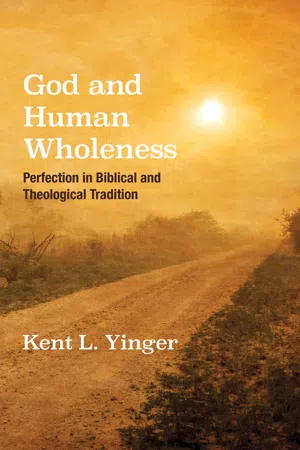
- 228 pages
- English
- ePUB (mobile friendly)
- Available on iOS & Android
eBook - ePub
About this book
The language of perfection crops up regularly in the Bible, from Noah ("a just man and perfect in his generations," KJV) to Jesus ("be perfect, therefore, as your heavenly father is perfect," NRSV). Is flawless behavior what God expects, the only standard of righteousness that can satisfy him? Jewish tradition has long questioned this Christian assumption. Since Sanders and the New Perspective on Paul, it has come under increasing challenge from many directions. In Reclaiming Human Wholeness, Kent Yinger provides an in-depth examination of what the Bible intends with this perfection-wholeness language and of its impact on theology and spiritual life. Rather than calling to an unreachable perfection, the God of the Bible desires our flourishing and wholeness.
Information
Chapter 1
Introduction and Definition
Spare me perfection. Give me instead the wholeness that comes from embracing the full reality of who I am, just as I am. Paradoxically, it is this whole self that is most perfect. As it turns out, wholeness, not perfection, is the route to the actualization of our deepest humanity.1
“What in the world does God want? What do I have to do for him to be satisfied?” Such questions will be heard in many a pastor’s or counselor’s office. If we’re honest, most of us wonder from time to time what God thinks of us. Are we doing OK? Is he satisfied, happy, bothered? Traditionally, the church’s answer has been tied to the idea of perfection. Christ has lived a perfect life of obedience and offers it to God in place of one’s paltry behavior. However, that still leaves us with a nagging question about our own lives. But what about my life and behavior? I know by faith he accepts Christ’s work on my behalf, but “is he satisfied with me?” This book tries to answer that question. What is God after with his human creation? What sort of person will satisfy him? After creating the world, he said “it’s good.” What sort of person would get the same “that’s good” from God? Is perfection the only acceptable standard, or is he after something else?
The greatest problem in writing a book about perfection in biblical and theological tradition is the need to use the English word “perfect.” If I had my druthers, I’d have avoided it altogether . . . and this for one simple reason: The Bible nowhere uses “perfect” in the sense we English-speakers normally assume (flawless conformity to a norm, sinless). It nowhere advances the notion that such flawless obedience is expected or required of human beings at any time. Nevertheless, this book will have to use the word for at least two reasons. First, readers may miss the connection to specific Bible verses if we don’t use “perfect.” For instance, when I discuss Jesus’s call to be whole, readers will likely fail to hear Matt 5:48 (“be therefore perfect”) unless I use the traditional word. And second, it would be impossible to discuss any number of related theological and historical developments without using this word. Just imagine discussing Wesleyan distinctives without referring to “perfect love,” or Roman Catholic spirituality without the “counsels of perfection.”
The English adjective (perfect) and noun (perfection), along with the associated concept of human perfection, occupy an often overlooked but central role in the Christian biblical and theological tradition. From Noah who is called perfect (Gen 6:9, KJV) to Jesus (“be perfect,” Matt 5:48)2 the term crops up more than the casual reader of the Bible might suspect. Protestant thought on salvation pivots on the Old Testament’s supposedly impossible demand for perfection, as every Lutheran child knows from the catechism.
Question: “What was the original design of the law?”
Answer: “To secure perfect obedience to all its precepts, and thus confer eternal life.”
Question: “Can any man be saved by the law?”
Answer: “He cannot; because no man has perfectly obeyed.”3
John Wesley’s movement was both renowned and reviled for its insistence on Christian perfection, and Roman Catholic spirituality wrestles with the attainment of spiritual perfection, whether via the monastic counsels of perfection (chastity, poverty, and obedience) or the ascetic quest for perfection via elimination of the bodily passions. These are only the more well-known tips of the perfectionist iceberg. As we will see in subsequent chapters, there are many more.
As fascinated as humans seem always to have been with making themselves perfect, it is a deeply problematic endeavor. On the one hand, reaching for it would seem to be mandated in Scripture.
• Walk before me, and be thou perfect. (Gen 17:1, KJV)
• Be perfect, therefore, as your heavenly Father is perfect. (Matt 5:48, NRSV)
Yet the Bible seems equally clear-eyed that humans are incapable of reaching perfection.
• The LORD saw that the wickedness of humankind was great in the earth, and that every inclination of the thoughts of their hearts was only evil continually. (Gen 6:5)
• There is no one who does good, no, not one. (Ps 14:3)
With or without the Bible, we all know that “nobody’s perfect” and that being a “perfectionist” is usually not healthy.4
But that leaves a nagging question: What will we do with all those verses that seem to take human perfection seriously? Answering that question will occupy our attention in subsequent chapters. For the moment, let me simply suggest that a good deal of the problem lies in the very use of the word “perfect” in these contexts. What if God’s expectation of his human creation is not, in fact, that they be perfect, but something else . . . something he created these lumps of clay to be able to attain? Suddenly, that which was so deeply problematic—be perfect/nobody can be perfect—may turn out to contain a call to a form of human living that is within our grasp. His call to Abraham to “walk before me, and be tamim,” or Jesus’s call to disciples to “be teleios,” could become a key to a realistic vision of the human life envisioned by the creator himself, rather than simply an impossibly high bar. Perhaps we have been missing the best while focusing on the perfect.
Definition (Engl.) of Perfect/Perfection
Since we will be talking much about perfection, one of our first tasks is to figure out just what we English-speakers mean when we use this word, and, thus, what we think biblical texts mean when they use this word in translation. An easy place to start is with a truism common to all of us who have grown up speaking English: “nobody’s perfect.” That is, everyone messes up, makes mistakes, fails to live without sin or error.
Roy Williams, coach of the North Carolina 2017 NCAA basketball championship team, was asked during the tournament if he was ever satisfied with his teams’ performances. In one sense, he replied, the answer is “Of course. We just won the national championship for heaven’s sake!” But in another sense the answer is “No. We are always looking for that elusive perfect game . . . that game with not a single mistake.”
This street-level understanding of perfection sits well with Webster’s “being without fault or defect.”5 The queen of English dictionaries, the Oxford English Dictionary, expands, “In the state of complete excellence; free from any flaw or imperfection of quality; faultless.”6 Growth, addition, or improvement is ruled out; the person or thing is at the pinnacle or end-point of all possible development.7 When applied to persons and their moral performance, such are “of supreme moral excellence; righteous, holy; immaculate.”8 This is why readers of “be perfect” in the Sermon on the Mount predictably respond, “that’s impossible.”
Some may object that there are, in fact, other nuances of perfect that imply something less than this absolutely flawless or error-free perfection.9 Thus, the preamble to the US Constitution speaks of forming “a more perfect Union,” which in that historical context meant a form of federal government more suited to governing the states than the previous Articles of Confederation. A well-mannered little boy can be a “perfect gentleman.” An obnoxious dinner companion can be a “perfect bore,” that is, a complete lout, who in respect to “borishness” truly fits the bill, but it does not imply that they are never nice, kind, etc. Here, perfect functions as an inte...
Table of contents
- Title Page
- Preface
- Acknowledgments
- Abbreviations
- Chapter 1: Introduction and Definition
- PART 1: THE JEWISH FOUNDATION OF WHOLENESS-PERFECTION
- PART 2: THE NEW TESTAMENT AND WHOLENESS-PERFECTION
- PART 3: THE CHURCH’S PURSUIT OF PERFECTION
- Bibliography
Trusted by 375,005 students
Access to over 1.5 million titles for a fair monthly price.
Study more efficiently using our study tools.
Frequently asked questions
Yes, you can cancel anytime from the Subscription tab in your account settings on the Perlego website. Your subscription will stay active until the end of your current billing period. Learn how to cancel your subscription
No, books cannot be downloaded as external files, such as PDFs, for use outside of Perlego. However, you can download books within the Perlego app for offline reading on mobile or tablet. Learn how to download books offline
Perlego offers two plans: Essential and Complete
- Essential is ideal for learners and professionals who enjoy exploring a wide range of subjects. Access the Essential Library with 800,000+ trusted titles and best-sellers across business, personal growth, and the humanities. Includes unlimited reading time and Standard Read Aloud voice.
- Complete: Perfect for advanced learners and researchers needing full, unrestricted access. Unlock 1.5M+ books across hundreds of subjects, including academic and specialized titles. The Complete Plan also includes advanced features like Premium Read Aloud and Research Assistant.
We are an online textbook subscription service, where you can get access to an entire online library for less than the price of a single book per month. With over 1.5 million books across 990+ topics, we’ve got you covered! Learn about our mission
Look out for the read-aloud symbol on your next book to see if you can listen to it. The read-aloud tool reads text aloud for you, highlighting the text as it is being read. You can pause it, speed it up and slow it down. Learn more about Read Aloud
Yes! You can use the Perlego app on both iOS and Android devices to read anytime, anywhere — even offline. Perfect for commutes or when you’re on the go.
Please note we cannot support devices running on iOS 13 and Android 7 or earlier. Learn more about using the app
Please note we cannot support devices running on iOS 13 and Android 7 or earlier. Learn more about using the app
Yes, you can access God and Human Wholeness by Kent L. Yinger in PDF and/or ePUB format, as well as other popular books in Theology & Religion & Biblical Criticism & Interpretation. We have over 1.5 million books available in our catalogue for you to explore.