eBook - ePub
Rendering Divine Names on Coins
Images from Antiquity to Modern Times
- 158 pages
- English
- ePUB (mobile friendly)
- Available on iOS & Android
eBook - ePub
About this book
After Jesus glanced at the temple coin, he said, "Render to Caesar." This book's title and theme are based upon Jesus' command to give allegiance to both the state and God.
Coauthor David Bentley is the historian-theologian who reads and translates the coins' messages. Coauthor Brad Yonaka is the geologist-scientist who finds the copper, silver, and gold coins which are on display in nearly one hundred photo-figures throughout the text.
Our God is represented by the Abrahamic faiths (Judaism, Christianity, and Islam); his divine name has appeared on coins since biblical times.
Even the most theologically astute readers will be surprised by our introduction of Paul, Priscilla, and Aquila as "tabernacle-makers" not "tent-makers."
Greek and Roman gods and goddesses, a few ancient Persian empires, the Islamic caliphs, and Qur'anic messages are present in this book. Each stamped their impressions on civilization. When Lincoln added "In God We Trust" during the Civil War, was it as Jesus commanded, a combination of honoring divine and governmental authorities? Or was it a counterfeit trust in dead presidents or self?
Information
Subtopic
Religion antique1
Monarchs’ Lesser Gods
Pharaoh Akhenaten and Indian Aśoka
An Egyptian pharaoh of the fourteenth century BC and an Indian monarch of the second century BC provide modern models for improvised tweets and gossipy social sound bites. The pharaoh and the Indian Aśoka upended their respective nations’ historical courses to pursue innovative political tactics that would not be reinvigorated until the present day. Pharaoh Akhenaten’s fascination with monotheism and Aśoka’s experimentation with secularism were both on trial during their reigns, leaving many religious and political questions unanswered that puzzle contemporary scholars and laypersons today. The most valid of archaeological markers are coins, but they had not yet been invented in Akhenaten’s reign, a time when the tombs of pharaohs filled the Egyptian landscape. Non-Greek coins in the Aśoka regime were silver, angular, and locally minted. As such, Aśoka’s heraldry symbols in modern India are lions mounted on towers, rather than any similar symbolism on the coins of his time.
The father of Amenhotep IV, Amenhotep III, performed the expected actions of a dominant pharaoh that secured him a place among the eternal-past Egyptians.
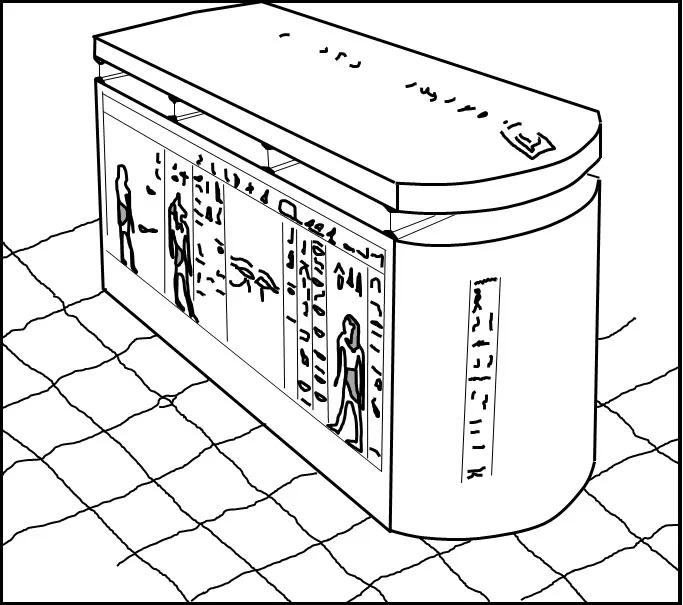
Fig. 01—Amenhotep III Sarcophagus
Egypt’s borders extended from Anatolia in the north to the Nubian gold mines in the south. These rich sources of royal wealth were deftly exploited by pharaohs throughout the New Kingdom period, and Amenhotep III was no exception. To enemies and allies alike, his diplomatic dispatches offered or refused requests for gold and his daughters in marriage as part of Pharaoh Amenhotep’s communication system connecting his expanding empire. Tablets uncovered from the last years of Amenhotep III’s life show exchanges of letters with vassal kings of Western Asia from Gaza through Canaan, Syria, and Babylon. A second form of the pharaoh’s communication with his empire was the distribution of scarabs throughout the region and islands of the Eastern Mediterranean Sea.1 These oversized commemorative scarabs served as empire sound bites and a gazette of the often mundane undertakings of the pharaoh, including news of his hunting expeditions and four marriages. Both the scarabs and the Amarna letters were written in Babylonian cuneiform script.
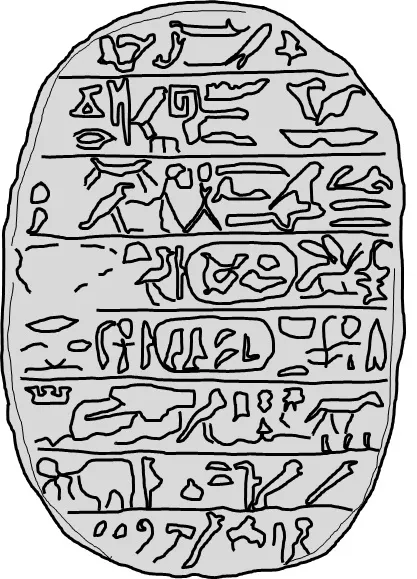
Fig. 02—Scarab Hieroglyphic Script
A third method of communication involves the Hymn to Aton which was discovered in an Amarna tomb excavated in 1891. The hymn, dedicated to Aton, or Aten, the Sun-disc god, was written in Egyptian hieroglyphics and contains some verses from Amenhotep III’s reign (pre–1390 BC). Biblical scholar James Pritchard compares some Egyptian proverbs in the Hymn to Aton2 with Hebrew and Greek Scriptures including this one from Proverbs 22:24–25:
Make no friendship with a man given to anger, nor go with a wrathful man, lest you learn his ways and entangle yourself in a snare.3
Aton Hymn xi: Preserve thy tongue from answering thy superior,/And guard thyself against reviling him./Do not make him cast his speech to lasso thee.4
The Hebrew scholar Edgar J. Young writes that Proverbs 22 and 23 reveal close parallels with the Hymn of Aton: “Be not one of those who give pledges,/who become surety for debts./If you have nothing with which to pay,/why should your bed be taken from under you?”5 Young claims that the Proverbs material was written prior to the Aton Hymn during Amenhotep III’s reign. He translates two citations from the Aton Hymn:
If thou findest a large debt against a poor man,/make it into three parts,/Forgive two, and let one stand./Thou wilt find it like the ways of life;/Thou will lie down and sleep (soundly).6 Control your temper, save your life./Do not steer your life with your tongue alone./Make your tongue the rudder of your boat./But make Amon-Ra its pilot.7
The Book of James offers:
Look at the ships also; though they are so great and are driven by strong winds, they are guided by a very small rudder. . . So the tongue is a little member and boasts of great things. . . 8
The Aton Hymn calls for just weights.
Do not lean on the scales nor falsify weights/Nor damage the fractions of a measure./Do not wish for a (common) measure.9
And Proverbs affirms:
A just balance and scales are the Lord’s; all the weights in the bag are his work.10 Diverse weights are an abomination to the Lord, and false scales are not good.11
Amenhotep IV changed his name to Akhenaten after the god, Aten, when he moved his capital from Thebes to the new Amarna site, about 100 miles south of Cairo. During his early years of an eighteen-year reign, a cartouche revealed his attachment to the god Aten.
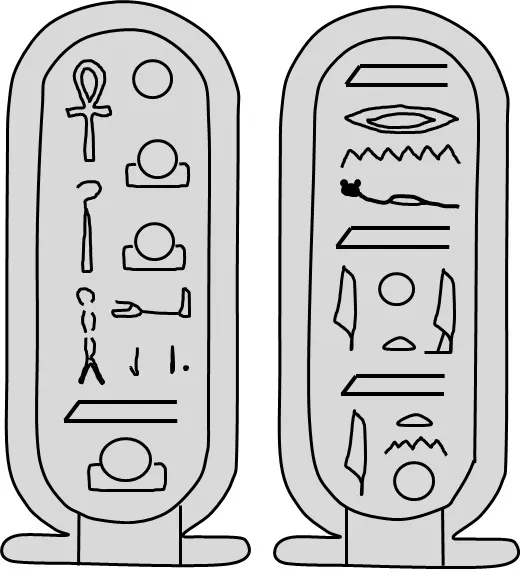
Fig. 03—Cartouche Akhenaten
Pharaoh Akhenaten never rejected his own god-king divine names when he maneuvered to divert attention away from the pri...
Table of contents
- Title Page
- Foreword
- Preface and Acknowledgments
- Abbreviations
- Photo and Figure Permissions
- Chapter 1: Monarchs’ Lesser Gods
- Chapter 2: Hebrew Divine Names
- Chapter 3: Gospels of Jesus Christ
- Chapter 4: Greet the New Smiths
- Chapter 5: Gnosticism
- Chapter 6: Saints of the Orthodox East
- Chapter 7: Zoroaster and Ahuramazda
- Chapter 8: Muhammad, Prophet of Allah
- Chapter 9: Abbasid Rise and Fall
- Chapter 10: Manichaeism
- Chapter 11: Turks, Crusaders, Mongols
- Chapter 12: Antiquity in US Coins
- Appendix A
- Appendix B
- Bibliography
Trusted by 375,005 students
Access to over 1.5 million titles for a fair monthly price.
Study more efficiently using our study tools.
Frequently asked questions
Yes, you can cancel anytime from the Subscription tab in your account settings on the Perlego website. Your subscription will stay active until the end of your current billing period. Learn how to cancel your subscription
No, books cannot be downloaded as external files, such as PDFs, for use outside of Perlego. However, you can download books within the Perlego app for offline reading on mobile or tablet. Learn how to download books offline
Perlego offers two plans: Essential and Complete
- Essential is ideal for learners and professionals who enjoy exploring a wide range of subjects. Access the Essential Library with 800,000+ trusted titles and best-sellers across business, personal growth, and the humanities. Includes unlimited reading time and Standard Read Aloud voice.
- Complete: Perfect for advanced learners and researchers needing full, unrestricted access. Unlock 1.5M+ books across hundreds of subjects, including academic and specialized titles. The Complete Plan also includes advanced features like Premium Read Aloud and Research Assistant.
We are an online textbook subscription service, where you can get access to an entire online library for less than the price of a single book per month. With over 1.5 million books across 990+ topics, we’ve got you covered! Learn about our mission
Look out for the read-aloud symbol on your next book to see if you can listen to it. The read-aloud tool reads text aloud for you, highlighting the text as it is being read. You can pause it, speed it up and slow it down. Learn more about Read Aloud
Yes! You can use the Perlego app on both iOS and Android devices to read anytime, anywhere — even offline. Perfect for commutes or when you’re on the go.
Please note we cannot support devices running on iOS 13 and Android 7 or earlier. Learn more about using the app
Please note we cannot support devices running on iOS 13 and Android 7 or earlier. Learn more about using the app
Yes, you can access Rendering Divine Names on Coins by David Bentley,Brad Yonaka in PDF and/or ePUB format, as well as other popular books in Théologie et religion & Religion antique. We have over 1.5 million books available in our catalogue for you to explore.