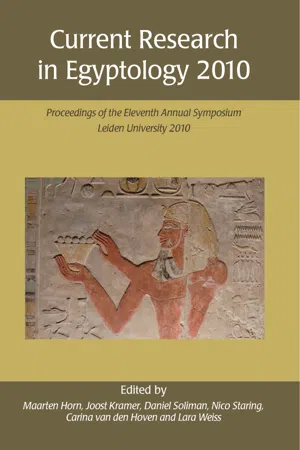
Current Research in Egyptology 2010
eBook - ePub

Current Research in Egyptology 2010

Proceedings of the Eleventh Annual Symposium

  1. 216 pages
  2. English
  3. ePUB (mobile friendly)
  4. Available on iOS & Android
eBook - ePub

Current Research in Egyptology 2010

Proceedings of the Eleventh Annual Symposium

About this book

After having been held in the UK for the past 10 years, the 11th edition of the annual Current Research in Egyptology (CRE) graduate conference was held at Leiden University, The Netherlands in January 2010. As always, the main aim of the conference was to provide graduate and postgraduate students of Egyptology and Egyptian archaeology with the opportunity to present their research. The proceedings of this year's conference cover a wide range of topics from the Predynastic Period to modern Egypt. The papers reflect a similar variety in areas of research and scientific approach, for example, by applying the linguistic prototype theory to ancient Egyptian texts or by using an ethnoarchaeological approach for the study of modern mud-brick architecture. The topics covered include Egyptian religion, ranging from the Coffin Texts to the decoration of temple walls in Ptolemaic times, as well as sociological issues in the Middle and New Kingdom. Other contributions focus on the study of the chronology of the Middle Kingdom with the help of lunar ephemerides or well-stratified radiocarbon data versus pottery data. In summary, Proceedings of Current Research in Egyptology XI includes 19 selected papers on artefact studies, burial practices and provisioning for the afterlife, economy and sociology, history and chronological studies, linguistics, philology and religion.

Trusted by 375,005 students

Access to over 1 million titles for a fair monthly price.

Study more efficiently using our study tools.

Information

Rage like an Egyptian: the conceptualization of anger

Ines Köhler

Introduction and theoretical framework
The influence of language as part of human complexity and therefore as a kind of cultural science in semantic studies may not be ignored.
Every language is the linguistic result of our perception of the world. Our perception as well as knowledge of our world depend on a culturally formed framework which is entitled to understanding and intersubjective virtue – that means reality. In this way, a world represents a (meaningful) social construct. We perceive all entities of the world, sort them into categories and give them meaning and names – so we can deal with and talk about the things in the world (cf. Berger and Luckmann 2007). In other words:
“The world is a perceived world and not a metaphysical world without a knower. Categories as we understand them exist ‘in the eye of the human beholder.’ Categorization is a cognitive human phenomenon that allows us to minimize cognitive efforts and avoids approaching dangers. Theoretically, different people or societies could divide the world into widely different categories. [...] In short, categories are anthropocentrically biased, and do not ‘exist in the world’ as such” (Goldwasser 2002, 27 – 28).

Categorization and cognitive linguistics

Categorization is attractive to linguists because categorizing something often means naming it. Knowing the meaning of a word often is to know the name of the category. Language itself is an object of categorization as well. Linguistic expressions get categorized as examples of lexical or syntactic categories, like noun, verb, etc. (cf. Taylor 2005, xi–xii).

Categorization

Perception, thinking, speaking and storage of meaning are topics the ancient Greek philosophers already reflected about. The presumption that the meaning of a word results from a conjunction of adequate quantity of common features traces back to Aristotle. The Aristotelian classical model of conceptual categories defines a category in terms of a set of necessary and sufficient features (cf. Taylor 2005, 20–23; Kleiber 1993, 12).
No entity that does not possess the full set of features can be a member of the related category. In short, a category is defined by the following:
1. Sufficient, for example possession of all features guarantees membership.
2. Membership of a category is based upon present or absent features.
3. Each member of a category has the same categorical status.
4. Categories are entities with clear-cut and rigid boundaries.
Examples such as the platypus demonstrate, however, that this rigidly defined structure of category exhibits very real structural problems. Eco (1999, 58) describes this phenomenon:
“The platypus is a strange animal. It seems to have been conceived to foil all classification, be it scientific or popular [...] its flat body is covered with a dark brown coat; it has no neck and a tail like a beaver’s; it has a duck’s beak [...] no outer ears, and the four feet have five webbed toes, bit with claws; it stays under water (and eats there) enough to be considered a fish or an amphibian. The female lays eggs but ‘breasts-feeds’ her young”.
Due to such discoveries and to the so-called black-box phenomena, the focus of human behaviour and research in general has changed: primarily, it has focussed on observable, measurable human behaviour and now it has switched to cognitive processes as part of human complexity (cf. Schwarz 1996, 13). In the course of this so-called cognitive-turn, following ethnosemantical, psychological, biological and anthropological studies were able to prove that categorization is to understand in a broad way but with fuzzy boundaries. This, however, makes it impossible to form a definite opinion about categorization (e.g. Berlin and Kay 1969; Rosch 1972a, 1972b, 1973a, 1973b).

Cognitive linguistics

Within this new approach, the most influential theory is the prototype theory which is part of the broad field of cognitive linguistics (Taylor 2005, 41). Cognitive linguistics is a conglomerate of central points of linguistic research that are clo...

Table of contents

  1. Cover
  2. Title Page
  3. Copyright
  4. Contents
  5. Symposium papers not included in this volume
  6. Introduction (Maarten Horn, Joost Kramer, Daniel Soliman, Nico Staring, Carina van den Hoven and Lara Weiss
  7. “Out of bounds – priests’ property.” The status of the Ptolemaic kings at Memphis Heba Abd El Gawad
  8. Protecting personhood: the role of the Sacred Eye in ensuring the continuing identity of the deceased Nathalie Andrews
  9. Egyptian mud dwellings: an ethnoarchaeological perspective Maria Correas-Amador
  10. Reconstructing and re-editing the archive of Bishop Pesynthios of Koptos/Keft (7th century)Renate Dekker
  11. Models from Predynastic daily life: a view from Naqada Grazia Antonella Di Pietro
  12. Lunar and Sothic data from the archive of el-Lahun revisited: chronology of the Middle Kingdom Rita Gautschy
  13. Egyptian pots, Aegean chronology and radiocarbon dating: recent research on Egypt and the Aegean early Late Bronze Age Felix Höflmayer
  14. Myth and cosmography: on the union of Re and Osiris in two types of religious discourse Jens Blach JĂžrgensen
  15. Rage like an Egyptian: the conceptualization of anger Ines Köhler
  16. The Persians and Atum worship in Egypt’s 27th dynasty Jared B. Krebsbach
  17. An elite quarter of Avaris/Tell el-Dab‘a Miriam MĂŒller
  18. The increasing emphasis on collateral and female kin in the late Middle Kingdom and Second Intermediate Period: the vivification formula as a case study Melinda G. Nelson-Hurst
  19. Yes dear! Spousal dynamics in the Late Ramesside Letters Kim Ridealgh
  20. The ‘co-regency’ of Hatshepsut and Thutmose III in the light of iconography in the temple of Hatshepsut at Deir el-Bahari Marta Sankiewicz
  21. Interpreting figural graffiti: case studies from a funerary context Nico Staring
  22. The function of metaphor in The Tale of the Eloquent Peasant: preliminary considerations Linda Steynor
  23. The manipulation of human remains in Predynastic Egypt: preliminary observationsVeronica Tamorri
  24. Balancing the gods: planned decoration in the temple of Kalabsha Carina van den Hoven
  25. Some thoughts on the “false doors” at Deir el-Medina Lara Weiss

Frequently asked questions

Yes, you can cancel anytime from the Subscription tab in your account settings on the Perlego website. Your subscription will stay active until the end of your current billing period. Learn how to cancel your subscription
No, books cannot be downloaded as external files, such as PDFs, for use outside of Perlego. However, you can download books within the Perlego app for offline reading on mobile or tablet. Learn how to download books offline
Perlego offers two plans: Essential and Complete
  • Essential is ideal for learners and professionals who enjoy exploring a wide range of subjects. Access the Essential Library with 800,000+ trusted titles and best-sellers across business, personal growth, and the humanities. Includes unlimited reading time and Standard Read Aloud voice.
  • Complete: Perfect for advanced learners and researchers needing full, unrestricted access. Unlock 1.4M+ books across hundreds of subjects, including academic and specialized titles. The Complete Plan also includes advanced features like Premium Read Aloud and Research Assistant.
Both plans are available with monthly, semester, or annual billing cycles.
We are an online textbook subscription service, where you can get access to an entire online library for less than the price of a single book per month. With over 1 million books across 990+ topics, we’ve got you covered! Learn about our mission
Look out for the read-aloud symbol on your next book to see if you can listen to it. The read-aloud tool reads text aloud for you, highlighting the text as it is being read. You can pause it, speed it up and slow it down. Learn more about Read Aloud
Yes! You can use the Perlego app on both iOS and Android devices to read anytime, anywhere — even offline. Perfect for commutes or when you’re on the go.
Please note we cannot support devices running on iOS 13 and Android 7 or earlier. Learn more about using the app
Yes, you can access Current Research in Egyptology 2010 by Maarten Horn, Joost Kramer, Daniel Soliman, Nico Staring, Carina van den Hoven, Lara Weiss, Joost Kramer, Daniel Soliman in PDF and/or ePUB format, as well as other popular books in History & Egyptian Ancient History. We have over one million books available in our catalogue for you to explore.