Essays which aim to create a world of agency and justice
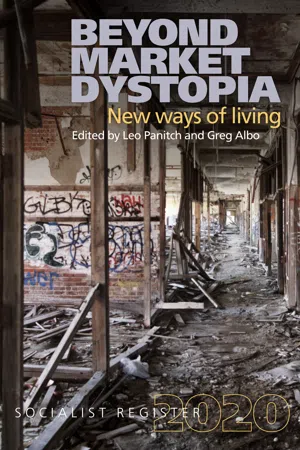
How can we build a future with better health and homes, respecting people and the environment? The 2020 edition of the Socialist Register, Beyond Market Dystopia, contains a wealth of incisive essays that entice readers to do just that: to wake up to the cynical, implicitly market-driven concept of human society we have come to accept as everyday reality. Intellectuals and activists such as Michelle Chin, Nancy Fraser, Arun Gupta, and Jeremy Brecher connect with and go beyond classical socialist themes, to combine an analysis of how we are living now with visions and plans for new strategic, programmatic, manifesto-oriented alternative ways of living.
eBook - ePub
Beyond Market Dystopia: New Ways of Living
Socialist Register 2020
- English
- ePUB (mobile friendly)
- Available on iOS & Android
eBook - ePub
Beyond Market Dystopia: New Ways of Living
Socialist Register 2020
About this book
Information
BEYOND THE ‘BARBED-WIRE LABYRINTH’: MIGRANT SPACES OF RADICAL DEMOCRACY
In 1951 Hannah Arendt famously analyzed the ‘calamity’ of rightlessness that accompanied the crisis of statelessness, within which she included migrants and refugees, as the ‘deprivation of a place in the world which makes opinions significant and actions effective’. The stateless, she argued, are treated as the pawn of politics and are ‘forced to live outside the common world’. She also identified camps – the ‘barbed-wire labyrinth into which events’ had driven those who were stateless – as the ‘routine solution for the problem of domicile of the “displaced persons”’. The stateless were treated everywhere as the ‘scum of the earth’, a condition which would go on, she contended, to threaten politics itself.1
Today, the UNHCR identifies 70.8 million people as ‘forcibly displaced’ in the world, a figure that includes 41.3 million internally displaced people, 25.9 million refugees, and 3.5 million asylum seekers, but not the over 10 million officially stateless persons, most of whom live in the so-called ‘developing world’.2 The only Western country to appear in the top ten list of refugee-hosting countries is Germany. The remainder are, in descending order of number of refugees, Turkey, Jordan, Lebanon, Pakistan, Uganda, Iran, and Ethiopia.3 Yet as in Arendt’s time, we in the West are again fixated on the ‘migration’ or ‘refugee crisis’ on the borders of Europe and now between the US and Mexico.
Despite a ‘Eurocentric’ myopia, however, we certainly are in, if not a migration crisis, then a crisis of borders. These figures, and the lives they indicate that go effectively unlived, are the calamity that we have produced through wars, civil and international – often the results of imperialism today and colonialism yesterday. They are also the disasters that have accompanied climate change, instability, and reverberating violence in states that are not officially at war but are wracked by the consequences of past and present imperial interventions and the brutality of dispossession by accumulation driven by the de-regulated global market. All this has been accompanied by the rise of authoritarian and racist right-wing forces across the globe, much of it fuelled by migration. The impact of these forces, in combination, means that virtually all states and all regional ‘governance’ regimes will have to face the ‘crisis’ of migration and borders for a very long time to come. So far, they have chosen to cope by the externalization of borders, walls, tracking, prolonged detention in appalling conditions, the toleration of death at sea, the closing of ports to rescue ships, the criminalization of those who seek to aid migrants, all connected, of course, to refoulement, the illegal and forcible return of refugees or asylum seekers to a country where they are liable to be subjected to persecution.
This is the dystopian nightmare of dehumanization, the treatment of migrants everywhere as the ‘scum of the earth’ in the twenty-first century. Almost seventy years after Arendt issued her warning on this, the mayor of Lesvos in Greece, Spiros Galinos, echoed her words: ‘Europe’s future is at stake’, pointing to the policies now pursued by the EU, including border closures and deportations to Turkey, which ‘create fear, xenophobia and racism, which in turn leads to fascism’.4 Indeed, what is widely reported erroneously as the ‘refugee crisis’ in Europe today has played out most intensely on its periphery in Greece (and Italy). Confronted with a double crisis – the economic and the ‘refugee’ crises – Greece became the ‘hotspot of Europe’.5 Focusing on the case of Greece starkly illuminates the injustices of the international and regional regimes of refugee law and politics, and the failures of the international human rights system to protect the rights of all persons (just as Arendt recognized). But it also illuminates the complexity of state responses and their reduced room for manoeuvre (as they see it); given the EU’s position, it especially speaks to the inadequacy of relying even on a left political party, such as Syriza, in government to protect migrants and their rights. It has become clear that we cannot expect such a party to develop solidaristic policies aimed to address the fracturing politics of the rightward move that has been fuelled by the continuing presence of immiserated migrants and the right-wing’s electorally opportunistic ‘ugly dog whistle’ that the country is losing its ‘ethnic identity due to migration’.6
This essay will juxtapose the Greek state’s continuation and, indeed, intensification of the dystopian regime of border control and refugee camps to migrant-citizen-solidarian spaces and practices, illustrated by the now-famous City Plaza hotel squat as a ‘Refugee Accommodation and Solidarity Space’ in Athens.7 This provides at least a glimpse of the promise of autonomous, solidarity, prefigurative practices that challenge all the ‘routine solutions’ for mass migration.8 We will argue that solidarity initiatives like City Plaza hotel show that it could be otherwise, thus challenging both the EU’s near imposition of camp life on Greece and also Syriza’s ‘realpolitik’ in the context of migration. It will go on to argue, however, that, to build on transformations achieved through prefigurative practice and achieve systemic change, action is required at the level of the state and therefore of political organisation. This in turn requires a strategy that recognises in practice the importance of supporting, spreading, and sharing power with those engaged in prefigurative transformative initiatives like City Plaza.
GREECE AND THE BORDER CRISIS
In the run up to the election in 2015, Syriza promised to end the ‘deterrence regime’ of migrant detention, ‘to radically overhaul Greece’s immigration policies by providing citizenship to second-generation migrants born in the country’, and to close migrant detention centres.9 After gaining office it opened the borders, in part by ending the illegal pushback of migrants by the coastguard, reduced detention time, and limited police repression. The Greek Coastguard is credited with saving 240 migrants when a boat capsized in fall 2016.10 The government also moved on the promise of citizenship, encouraging the early optimism that Syriza would pursue ‘advanced political experimentations in the field of migration, including a stop to deportations and a steady dismantling of detention structures’.11 Not long after its entering office, however, after more than a million migrants transited through Greece to Northern Europe, and with the impending closure of the Macedonian border,12 Greece invited NATO to patrol the Aegean for the first time on a European ‘migrant mission’, along with Frontex, the EU border control agency, and the German, Greek, and Turkish coastguards, providing intelligence to the latter returning migrants to Turkey. The US defense secretary, Ashton Carter, joined the head of NATO in cynically proclaiming the ‘humanitarian’ nature of this mission to address ‘human trafficking’.13
Since Syriza became the government, Greece has also charged humanitarian workers with human trafficking and other offences for saving migrants, although the courts have pushed back against this.14 It has recently been accused of systematic pushbacks at the Evros River, although here, too, a Greek prosecutor has begun an investigation.15 It has also evicted autonomous solidarity groups, who had been the backbone of support to migrants and refugees up to that time from the ‘hotspots’ and camps in favour of registered NGOs.16 And far from closing refugee and migrant camps, under the pressure of the border crisis, the government has increased the number of camps and the numbers of migrants in them, and their deplorable conditions have become the norm. All this has led one observer to comment that under Syriza there has been a return to the ‘policies of the past right-wing governments who deployed border fences, detention centers, and the coast guard to push back some migrant boats in the Aegean’.17
Several factors can be broadly identified in accounting for these regressive steps. First is the double crisis of the economy and migration which made Greece, the ‘laboratory of neoliberal shock therapy … also Europe’s entrance gate for the millions of people leaving countries devastated by war and poverty’.18 The crippling mandatory public sector cuts required by the EU left the Syriza government initially ill-placed to rapidly prepare for and respond to the dramatic increase of migrants in the ‘long summer of migration’ of 2015-16 when a million people, mostly from Syria, Afghanistan, and Iraq, landed primarily in the Greek islands of Lesvos, Chios, and Samos, seeking to transit on to Northern Europe. Second, it is no secret that the European Union pressured Greece on migration and the borders much as it did on the economy.19 In addition to adding NATO to the ‘deterrence’ scheme, the infamous ‘EU-Turkey’ deal and the establishment of ‘hotspot’ reception centres on the Greek islands were fundamental to Europe’s objectives and the Greek state accepted all of these. Why Syriza gave into Europe’s pressure is murky, but the explanation seems to run parallel to the argument about Syriza’s ‘capitulation’ to the memoranda. With respect to the border crisis, the EU threatened Syriza with removal from the Schengen zone if it did not take a leading role in the deterrence objective to ‘save’ the rest of Europe from the ‘burden’ of the refugees. Just as on the economic front, it was threatened with removal from the eurozone; this additional threat was issued ‘precisely because Greece has been increasingly deemed incapable of fulfilling its role as a premier watchdog at the EU’s border with Turkey.’20 Yet as with the overall trajectory of the Syriza government, a third factor in Syriza’s participation in the EU deterrence objective may have been its succumbing to the limits and contradictions of social democratic politics.
The Greek state under Syriza linked the two crises itself: without European assistance, due to the economic crisis, it could not adequately address the refugee ‘crisis’. But it also used the unprecedented ‘crisis’ – with scenes of desperate migrants attempting to enter Northern Europe – as a negotiating chip with Europe.21 As part of the ‘most expensive humanitarian response in history’, estimates of how much was sent to ‘care’ for and process the migrants in Greece and address the enormous demands of developing an adequate asylum system range from $800 million to 1.6 billion euros, while the actual figures of who received the money, and where it has gone, all remain matters of bitter dispute between the Greek government, on the one hand, and the EU and NGOs, on the other. Furthermore, Greece’s top court has ordered a fraud investigation into the use of EU funds paid to Greece.22 But no matter where the truth lies in these disputes, as one sympathetic Syriza insider on the islands emphasized, the party has treated the refugee camps and the enormous NGO presence in the crisis as bringing in money to the islands, thus stimulating an ‘economy based on the pain of others’.23
The EU-Turkey deal is fundamental to the containment of migrants in the islands where that ‘economy of pain’ is borne by them. Presented by the European Commission in April 2015 as part of its ‘European Agenda on Migration’, the hotspot ‘approach’, according to a brief by the European Parliamentary Research Service, involves the establishment of ‘first reception facilities – [that] aim to better coordinate EU agencies’ and national authorities’ efforts at external borders of the EU, on initial reception, identification, registration and fingerprinting of asylum-seekers and migrants.’24 Hotspots illustrate how the European institutions, namely the European Asylum Support Office (EASO), Frontex, Europol, and others, combine to ‘collaborate’ with ‘frontline’ states. In the Greek case, this involves the return of migrants to Turkey, their containment in Greece as they wait for return, asylum in Greece, or acceptance by another European state. Controlling and fingerprinting any who seek asylum, hotspots are also aimed at ‘safeguarding’ the EU by providing biodata that can be used should they slip into Europe undocumented.25
With the closing of the border between Macedonia and Greece, the EU-Turkey deal announced on 18 March 2016 (with the Greek government well aware it was in the works) was designed to ensure that all new ‘irregular migrants’ who crossed from Turkey to Greece would be returned to Turkey.26 While treating Turkey as a ‘safe third country’ and giving it, initially, six billion euros plus promises of visa-free travel to Europe the deal has, in fact, had the consequence of trapping around 15,000 on the Greek islands.27 Thus was Greece transformed ‘from a space of transit to a space of containment’ with the hotspots and other camps holding many of the migrants.28 According to the European Council, ...
Table of contents
- Cover
- Title Page
- Copyright
- Contents
- Contributors
- Preface
- Class politics, socialist policies, capitalist constraints
- Making the world a better place: restitution and restoration
- Beyond the ‘barbed-wire labyrinth’: migrant spaces of radical democracy
- Beyond the educational dystopia: new ways of learning through remembering
- The future of work in the era of ‘digital capitalism’
- A new world of workers: confronting the gig economy
- All workers are precarious: the ‘dangerous class’ in China’s labour regime
- Social reproduction in twenty-first century capitalism
- Ways of making a living: revaluing the work of social and ecological reproduction
- For a sustainable future: the centrality of public goods
- The affordable housing crisis: its capitalist roots and the socialist alternative
- Communism in the suburbs?
- The retroactive utopia of the socialist city
- What should socialism mean in the twenty-first century?
Trusted by 375,005 students
Access to over 1.5 million titles for a fair monthly price.
Study more efficiently using our study tools.
Frequently asked questions
Yes, you can cancel anytime from the Subscription tab in your account settings on the Perlego website. Your subscription will stay active until the end of your current billing period. Learn how to cancel your subscription
No, books cannot be downloaded as external files, such as PDFs, for use outside of Perlego. However, you can download books within the Perlego app for offline reading on mobile or tablet. Learn how to download books offline
Perlego offers two plans: Essential and Complete
- Essential is ideal for learners and professionals who enjoy exploring a wide range of subjects. Access the Essential Library with 800,000+ trusted titles and best-sellers across business, personal growth, and the humanities. Includes unlimited reading time and Standard Read Aloud voice.
- Complete: Perfect for advanced learners and researchers needing full, unrestricted access. Unlock 1.5M+ books across hundreds of subjects, including academic and specialized titles. The Complete Plan also includes advanced features like Premium Read Aloud and Research Assistant.
We are an online textbook subscription service, where you can get access to an entire online library for less than the price of a single book per month. With over 1.5 million books across 990+ topics, we’ve got you covered! Learn about our mission
Look out for the read-aloud symbol on your next book to see if you can listen to it. The read-aloud tool reads text aloud for you, highlighting the text as it is being read. You can pause it, speed it up and slow it down. Learn more about Read Aloud
Yes! You can use the Perlego app on both iOS and Android devices to read anytime, anywhere — even offline. Perfect for commutes or when you’re on the go.
Please note we cannot support devices running on iOS 13 and Android 7 or earlier. Learn more about using the app
Please note we cannot support devices running on iOS 13 and Android 7 or earlier. Learn more about using the app
Yes, you can access Beyond Market Dystopia: New Ways of Living by Greg Albo,Leo Panitch, Greg Albo, Leo Panitch in PDF and/or ePUB format, as well as other popular books in Politics & International Relations & Communism, Post-Communism & Socialism. We have over 1.5 million books available in our catalogue for you to explore.