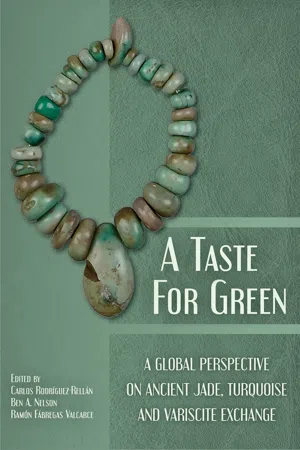
Often along vast expanses, ancient societies traded certain commodities that were considered valuable either for functional or symbolic reasons – or, rather, a mixture of both factors. A Taste for Green addresses latest research into the acquisition of jade, turquoise or variscite, all of which share a characteristic greenish colour and an engaging appearance once they are polished in the shape of axes or assorted adornments. Papers explore how, in addition to constituting economic transactions, the transfess of these materials were also statements of social liaisons, personal capacities, and relation to places or to unseen forces.
The volume centres on two study areas, Western Europe and México/Southwest US, which are far apart not just in geographical terms but also with regard to their chronology and socioeconomic features. While some North and Mesoamerican groups range from relatively complex farming societies up to state-like organisations during the 1st and 2nd millennia AD, the European counterparts are comparatively simpler polities spanning the 5th–3rd millennia BC. By contrasting the archaeological evidence from diverse areas we may gain insights into the role that production/movement of these green stones played in their respective political and ritual economies. Also, we think it useful to compare the scientific approaches applied to this question in different parts of the globe, specially Asia.
eBook - ePub
A Taste for Green
A global perspective on ancient jade, turquoise and variscite exchange
- 208 pages
- English
- ePUB (mobile friendly)
- Available on iOS & Android
eBook - ePub
A Taste for Green
A global perspective on ancient jade, turquoise and variscite exchange
About this book
Information
Subtopic
European HistoryIndex
Social Sciences1
Production marks on turquoise objects and lapidary technology at Chaco Canyon (New Mexico, USA): an experimental archaeology approach
Emiliano Ricardo Melgar Tísoc and Frances Joan Mathien
Thousands of turquoise objects have been excavated from different sites of the American Southwest; and Chaco Canyon, New Mexico, is well known as one of the principal areas where large concentrations were recovered. For example, in Room 33 at Pueblo Bonito two men were buried with the largest number of such artefacts ever found (Judd 1954; Mathien 1984; 1993; 1997a; 1997b; 2001; Neitzel 1995; Pepper 1996; Windes 1993a; 1993b; 2001). Since then, most researchers focused on the symbolic meaning, morphology, provenance, trade and use of turquoise, but very few studied the production marks visible on these artefacts. In this paper, we present a new approach that characterizes and compares production marks on similar types of items made using experimental archaeology techniques with those seen on artefacts. The results from sites in Chaco Canyon are compared with those in a database for artefacts from sites in the Greater Southwest and Mesoamerica.
En el Suroeste de los Estados Unidos los arqueólogos han recuperado decenas de miles de piezas de turquesa, la mayoría de ellas cuentas e incrustaciones que formaban parte de collares o mosaicos. De todos ellos, el Cañón del Chaco en Nuevo México destaca por la gran concentración de objetos de turquesa que presenta; por ejemplo, en el cuarto 33 de Pueblo Bonito fueron enterrados dos hombres con la mayor cantidad de turquesas registradas en el Suroeste en un solo contexto (Judd 1954; Mathien 1984; 1993; 1997a; 1997b; 2001; Neitzel 1995; Pepper 1996; Windes 1993a; 1993b; 2001). Sin embargo, la mayoría de los estudios que se han hecho sobre las turquesas se han centrado en su minería, comercio, uso, simbolismo, morfología y tipología. Por ello, el estudio tecnológico de las huellas de manufactura de las piezas de turquesa en el Cañón del Chaco aporta nueva información sobre su elaboración y distribución, así como permite confirmar o descartar las distintas herramientas de trabajo que se han planteado a partir de los contextos arqueológicos. Los resultados también se compararon con la tecnología identificada en otros sitios del Suroeste de Estados Unidos y Mesoamérica.
Introduction
Very few studies of turquoise artefacts recovered in sites in the American Southwest analyze, in detail, the manufacturing techniques used to produce them. Melgar (2014) developed an experimental archaeological approach that is non-destructive and non-invasive. Using a specialized polymer tape that records production marks at a very high quality, it is now possible to examine patterns recorded on the tapes under a scanning electron microscope and to identify the tools employed for each of the modifications made during the manufacturing process. The morphology and characteristics of the experimental production marks is part of a database on lapidary objects that Melgar (2014) has coordinated since 2004 at the Great Temple of the Aztecs Museum. That database includes more than 500 experiments with different tools and raw materials, allowing us to identify the tools and techniques employed on lapidary pieces; the results can be compared with studies of artefacts from different sites in Mexico, the American Southwest, and Central America. In this study, we applied the technique to 434 turquoise artefacts from 16 sites in Chaco Canyon to confirm, discard, identify and distinguish the tools that have been proposed for use in the production of turquoise objects from the canyon.
Overview of turquoise technology
Since the first excavations at different sites of the American Southwest, especially in Chaco Canyon, archaeologists have found several thousand turquoise inlays assembled into mosaics and beads or pendants included in necklaces and shorter strings. Recently, new instrumental methods, e.g., stable-isotope analysis that can identify the geological sources of archaeological specimens (Hull et al. 2008; Hull 2012; Thibodeau 2012; Thibodeau et al. 2012) have identified a number of turquoise sources that provided the raw material. Where and how finished ornaments were produced, and with what tools, is still debated.
Only a few workshops had been identified, excavated and analyzed, such as those at Alta Vista in Zacatecas (Kelley 1980, 54–55; Weigand 1993, 252–256, 293; Medina and García 2010, 73–167; Melgar 2011; 2014), Casas Grandes in Chihuahua (Di Peso 1974, 383; Di Peso et al. 1974, 8, 187), and Pueblo Bonito and the Spadefoot Toad Site in Chaco Canyon (Judd 1954, 326–328; Mathien 1993, 289; Windes 1993a, 14, 57, 173, 244 and 382–384). It was recognized that the importance of studying these production areas would be enhanced by the characterization of the tools and techniques employed by the lapidary artisans and the identification of the sequence of production of the turquoise objects.
Studies pertaining to the analysis of the manufacturing techniques are scarce (Haury 1931; Judd 1954; Mathien 1997a; Windes 1993a; 1993b), and none of these studies employed microscopes to characterize production marks on artefacts by comparing them with ones resulting from experimental archaeological studies. Therefore, the identification of which tools were employed in the production of the turquoise objects needed a more detailed analysis to distinguish among items made at different turquoise workshop locations and to determine whether finished items were manufactured in one area or were long-distance trade items.
To solve this problem, it was necessary to study the materials from turquoise workshops. To identify which turquoise objects were manufactured in each of the jewellery workshops at the American Southwest, which could be from Northern Mexico, and which could be Mesoamerican productions with imported raw materials, it is necessary to know which tools and techniques were employed in their manufacture. Abrasives of chert powder and reed sticks were mentioned for Aztec stoneworkers by Friar Bernardino de Sahagún (2006, 547 and 675). Raw materials and tools recovered in the archaeological contexts, especially in the lapidary workshops, include sandstone lapidary abraders at Pueblo Bonito and the Spadefoot Toad Site in Chaco Canyon (Judd 1954, 326–328; Windes 1993a, 153–159; 1993b, 213–229), petrified wood from the Spadefoot Toad Site (Cameron 1993), chert polishers from Alta Vista (Melgar 2011), and felsite metates from Paquimé (Di Peso 1974, 579–580). Other researchers proposed production of these pieces by polishing with selenite powder (Windes 1993a, 215, 232, 236, 244 and 257; 1993b, 227 and 229), or drilling with wet canes or wet cacti dipped with sand (McNeil 1986, 114), with cactus spines of Echinocactus wislizini (Mathien 1997a, 1162 and 1204; 1997b, 1227), or with porcupine quills of Erethizon dorsatum (Gillespie 1993, 367; Windes 1993a, 159; Mathien 1997b, 1227).
To know which tools were employed on turquoise objects made in Chaco Canyon, the analysis of their manufacturing technology was conducted as part of a larger project titled “Style and technology of the lapidary objects in Ancient Mesoamerica” by adding assemblages from the American Southwest. Initial studies distinguished among the different technological traditions from several areas in Mexico and identified which pieces came already manufactured from these workshops (Melgar 2010; 2013; 2014; Velázquez et al. 2010; 2012).
Objectives of this study
The main purpose of this research on Chaco Canyon turquoise is to characterize manufacturing patterns, test proposals of other researchers about the technological standardization and homogeneity of the objects and the sharing tools and techniques despite the provenance of the raw material.
Also, with this research, we investigate whether the tools and techniques employed were the same or if they changed through time.
Finally, the technological analysis should confirm or exclude tools proposed by other researchers such as abrading with sandstone, polishing with selenite powder, and drilling with petrified wood, with cactus spines, or with porcupine spines.
The characterization of production marks is carried out using stereoscopic microscopy and scanning electron microscopy. The latter is the technique that has yielded the best results to identify, with considerable precision, the materials and tools employed in turquoise jewellery manufacturing, and to distinguish between different technologies among lapidary assemblages.
Materials analyzed
To evaluate the tools used to produce Chaco turquoise ornaments, a total of 434 turquoise pieces were analyzed (Fig. 1.1). They were selected based on two previous studies. The first group of twelve was selected because we wanted to compare the patterns of manufacture with results obtained by Sharon Hull and Joan Mathien (Hull et al. 2008) regarding the provenance and procurement of turquoise objects (Table 1.1). This might suggest whether lapidary artists from different jewellery workshops used turquoise from different sources.
The criterion for selection of the second group is based on the context of deposits that relate to the production or consumption of turquoise pieces, including materials in different steps of production from diverse sites, chronologies and typological morphologies. The selection of 422 pieces from 13 sites and contexts was done follo...
Table of contents
- Cover
- Title
- Copyright
- Contents
- List of contributors
- Foreword
- 1. Production marks on turquoise objects and lapidary technology at Chaco Canyon (New Mexico, USA): an experimental archaeology approach Emiliano Ricardo Melgar Tísoc and Frances Joan Mathien
- 2. The green stone as a reason for the colonization of the Bolaños Canyon in western Mexico a. Teresa Cabrero García
- 3. Green stone industry in central Jalisco, Mexico Martha Lorenza López Mestas Camberos, Jasinto Robles Camacho and Ricardo Sánchez Hernández
- 4. Green beads during the Late Prehistory in the northeast Iberian Peninsula: social dynamics in a production and consumption context Josep Bosch, Anna Gómez, Silvia Calvo and Miquel Molist
- 5. From the green belt: an appraisal on the circulation of Western Iberian variscite Carlos Rodríguez-Rellán, Ramón Fábregas Valcarce and António Faustino Carvalho
- 6. Fifty shades of green: the irresistible attraction, use and significance of jadeitite and other green Alpine rock types in Neolithic Europe Alison Sheridan, Pierre Pétrequin, Anne-Marie Pétrequin, Serge Cassen, Michel Errera, Estelle Gauthier and Frédéric Prodéo
- 7. Spaces and signs for the transfer of jade and callaïs in the Neolithic of Western Europe Serge Cassen, Pierre Pétrequin, Guirec Querré, Valentin Grimaud and Carlos Rodríguez-Rellán
- 8. Axes from the sky Richard Bradley and Aaron Watson
- 9. The finest green: the Iron Age prase quartz monocrystal from the Palacio III megalithic complex (Seville, Spain) Leonardo García Sanjuán, José Antonio Lozano Rodríguez, Timoteo Rivera Jiménez, Miguel Calvo Rebollar, Francisco Martínez-Sevilla, David W. Wheatley, Carlos Rodríguez-Rellán, Cristobal Verdugo Escamilla and László Halmos
Trusted by 375,005 students
Access to over 1.5 million titles for a fair monthly price.
Study more efficiently using our study tools.
Frequently asked questions
Yes, you can cancel anytime from the Subscription tab in your account settings on the Perlego website. Your subscription will stay active until the end of your current billing period. Learn how to cancel your subscription
No, books cannot be downloaded as external files, such as PDFs, for use outside of Perlego. However, you can download books within the Perlego app for offline reading on mobile or tablet. Learn how to download books offline
Perlego offers two plans: Essential and Complete
- Essential is ideal for learners and professionals who enjoy exploring a wide range of subjects. Access the Essential Library with 800,000+ trusted titles and best-sellers across business, personal growth, and the humanities. Includes unlimited reading time and Standard Read Aloud voice.
- Complete: Perfect for advanced learners and researchers needing full, unrestricted access. Unlock 1.5M+ books across hundreds of subjects, including academic and specialized titles. The Complete Plan also includes advanced features like Premium Read Aloud and Research Assistant.
We are an online textbook subscription service, where you can get access to an entire online library for less than the price of a single book per month. With over 1.5 million books across 990+ topics, we’ve got you covered! Learn about our mission
Look out for the read-aloud symbol on your next book to see if you can listen to it. The read-aloud tool reads text aloud for you, highlighting the text as it is being read. You can pause it, speed it up and slow it down. Learn more about Read Aloud
Yes! You can use the Perlego app on both iOS and Android devices to read anytime, anywhere — even offline. Perfect for commutes or when you’re on the go.
Please note we cannot support devices running on iOS 13 and Android 7 or earlier. Learn more about using the app
Please note we cannot support devices running on iOS 13 and Android 7 or earlier. Learn more about using the app
Yes, you can access A Taste for Green by Carlos Rodríguez-Rellán, Ben A. Nelson, Ramón Fábregas Valcarce, Carlos Rodríguez-Rellán,Ben Nelson,Ramón Fábregas Valcarce,Ben A. Nelson, Carlos Rodríguez-Rellán, Ben Nelson, Ramón Fábregas Valcarce in PDF and/or ePUB format, as well as other popular books in Social Sciences & European History. We have over 1.5 million books available in our catalogue for you to explore.