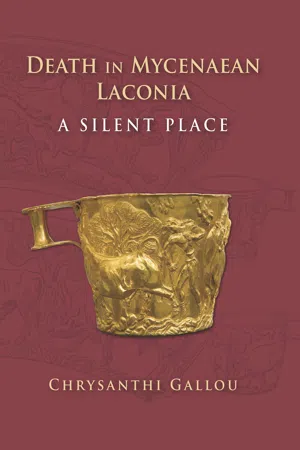
A Silent Place: Death in Mycenaean Lakonia is the first book-length systematic study of the Late Bronze Age (LBA) burial tradition in south-eastern Peloponnese, Greece, and the first to comprehensively present and discuss all Mycenaean tombs and funerary contexts excavated and/or simply reported in the region from the 19th century to present day. The book will discuss and reconstruct the emergence and development of the Mycenaean mortuary tradition in Lakonia by examining the landscape of death, the burial architecture, the funerary and post-funerary customs and rituals, and offering patterns over a longue durée. The author proposes patterns of continuity from the Middle Bronze Age (even the Early Bronze Age in terms of burial architecture) to the LBA and, equally important, from the Late Bronze Age to the Early Iron Age,and reconstructs diachronic processes of invention of tradition and identity in Mycenaean communities, on the basis of tomb types and their material culture. The text highlights the social, political and economic history of Late Bronze Age Lakonia from the evolution of the Mycenaean civilisation and the establishment of palatial administration in the Spartan vale, to the demise of Mycenaean culture and the turbulent post–collapse centuries, as reflected by the burial offerings.
The book also brings to publication the chamber tombs at Epidavros Limera that remained largely unpublished since their excavation in the 1930s and 1950s. Epidavros Limera was one of the most important prehistoric coastal sites in prehistoric southern Greece (early 3rd–late 4th millennium BC), and one of the main harbour towns of the Mycenaean administrative centres of central Lakonia. It is one of very few Mycenaean sites that flourished uninterruptedly from the emergence of the Mycenaean civilisation until after the collapse of the palatial administration and into the transition to the Early Iron Age. The present study of the funerary architecture and of the pottery from the tombs suggests that the site was responsible for the introduction of the chamber tomb type on the Greek mainland in the latest phase of the Middle Bronze Age (definitely no later than the transitional Middle Bronze Age/Late Bronze Age period), and not in the early phase of the Late Bronze Age (Late Helladic I) as previously assumed.
- 288 pages
- English
- ePUB (mobile friendly)
- Available on iOS & Android
eBook - ePub
About this book
Information
Subtopic
Greek Ancient HistoryIndex
Social Sciences1
Graves and burial contexts
Professional archaeology in Laconia was initiated by the Laconian archaeologist Panagiotis Stamatakis, who in 1872 was tasked by the Archaeological Society at Athens with recording the antiquities that lay scattered in private residences in the town of Sparti and the wider region. His systematic, painstaking efforts resulted in the establishment of the Archaeological Museum of Sparta in 1875. The foundations for the prehistoric and classical archaeology of Laconia were subsequently laid by Christos Tsountas in 1888 through his archaeological campaigns at the tholos tomb at Vapheio, the tholos tomb at Arkynes and Amyklai (cf. Cavanagh et al. 2002, 31).
In 1905 the early British trial excavations at Geraki (ancient Geronthrai) brought to light three cist graves on the summit of the acropolis hill. In 1909 Georgios Soteriades explored one more tholos tomb at Arkynes. Sometime between 1909 and 1925 Konstantinos Romaios conducted the first excavations at Pellana where he brought to light one chamber tomb. In 1926, Themistocles Karachalios undertook to explore more chamber tombs at the site. He also explored one chamber tomb at Peristeri (f. Tsasi) in 1935 and four chamber tombs at Epidavros Limera in 1936.
Archaeological investigations in Laconia came to a halt during the Second World War, the only exception being von Vocano’s excavations at Kouphovouno and Tseramio: Ayios Ioannis in 1941, and his explorations in the LN Papagiannakou Cave at Goritsa in 1942. After the end of the Second World War, Nikolaos Drandakis excavated more tombs at Epidavros Limera in 1953, succeeded by Chrysanthos Christou who explored even more tombs at the site in 1956. Christou also excavated a built grave at Krokeai: Karneas and several chamber tombs at Kampos Voion in 1955, and two chamber tombs at Agios Georgios Voion in 1957. The chance discovery of Mycenaean pots at Melathria led to the excavation of a chamber tomb cemetery on the hill of Profitis Ilias by Katie Demakopoulou in 1966. In 1968 Anthony Harding, Gerald Cadogan and Roger Howell of the University of Cambridge, and Angelos Delivorrias, then Ephor of Antiquities in Laconia, surveyed the Bronze Age funerary monuments at Pavlopetri: an extensive rock-cut tomb cemetery on the Pounta shore, a submerged intramural cist grave cemetery and two (possibly three) submerged chamber tombs. In the course of the underwater survey exploration of the site, Delivorrias also carried out a preliminary investigation of the prehistoric cemetery on the shore but never published the results. A new survey of the tombs was undertaken in 2009–2011 by the Pavlopetri Underwater Archaeology Project, a collaboration between the University of Nottingham and the Ephorate of Underwater Antiquities of the Hellenic Ministry of Culture, under the auspices of the British School at Athens.
In 1972–1977 Lord William Taylour of the British School at Athens excavated sixty-two Late Bronze Age burials at Agios Stephanos. In 1973 George Steinhauer began excavations at the Mycenaean cemetery at Sykea and uncovered the first of the chamber tombs at the site, and in 1976–1977 he explored one of the two chamber tombs that were discovered by chance during road works at Peristeri. In the 1980s and 1990s Theodoros Spyropoulos excavated chamber tombs at Amyklai: Spelakia (1981), Pellana: Palaiokastro, Spelies/Pelekete and Tryporrachi (1981–1982, 2002), Peristeri (1981), Angelona (1981), and a tholos tomb at Arna, Arkynes (1982).
In 1998 Eleni Zavvou cleared one of the chamber tombs that Spyropoulos had already explored at Amyklai: Spelakia, and in 1999 she excavated a built chamber tomb at Sparti: Psychiko. In 1997 and 1998 Ioanna Efstathiou resumed Steinhauer’s excavations at the Mycenaean cemetery at Sykea and unearthed three more chamber tombs. In early 2002 Spyropoulos began excavations in a chamber tomb at Pellana. The excavations stopped abruptly a few weeks later because of the excavator’s retirement, and were continued a few days after Spyropoulos’ departure by Athanasios Themos and Eleni Zavvou who completed the excavation of part of the tomb’s dromos; no further excavation has been undertaken since. In spring 2004 Joost Crouwel’s team excavated a cist grave on the acropolis hill at Geraki, and later that year Themos excavated a chamber tomb at Peristeri, which came to light during public road works. In the Archaiologikon Deltion report for 2007–2010 Aphrodite Maltezou reports the excavation of two chamber tombs, a pit grave and two ossuaries at Daphni: Louria, and of a destroyed grave at Bozas: Kryani. In 2009 Adamantia Vasilogamvrou, Christina Kakourou and Georgios Tsiaggouris excavated part of a small mixed cemetery of tholos tombs and simple graves at Sparti: Polydendron. Last but not least, the systematic excavations at Agios Vasileios by Vasilogamvrou under the auspices of the Archaeological Society at Athens have brought to light the ‘North Cemetery’ of cist and pit graves and the remains of a collapsed chamber tomb in Sector II of the archaeological site (2008).
The corpus of Mycenaean graves in Laconia is continuously growing as a result of the extensive and intensive archaeological surveys, fieldwalks and routine archaeological reconnaissances carried out in the region that have included, among others, the extensive surveys carried out by Helen Waterhouse and Richard Hope Simpson of the British School at Athens (1936–1938, 1955, 1956–1958) and by Emilia Banou (early 1990s), and the intensive Laconia Survey in 1983–1989. The reports published by the local Ephorate of Antiquities (f. E’ Ephorate of Prehistoric & Classical Antiquities – E’ EPCA) and by the Ephorate for Paleoanthropology and Speleology of Southern Greece are of paramount significance. From spring 2005 to spring 2008 I travelled in Laconia specifically with a view to carrying out an autopsy of the excavated and reported Mycenaean graves and associated settlements, and gaining a better understanding of the funerary landscape of LH Laconia. These autopsies have resulted not only in the identification of previously known tombs but also in the discovery of more graves and associated settlements on the Malea pensinsula (see below).
Table 1 summarises the excavations of Mycenaean tombs and funerary contexts from the late 19th to the 21st century, drawing information from the Archaeologike Ephemeris, the Archaeologikon Deltion, the Praktika tes en Athenais Archaeologikes Etaireias, Anastasia Panagiotopoulou’s catalogue of the excavations carried out by the Greek Archaeological Service in Laconia from 1871/1872 to 1999 (Panagiotopoulou 2009) and the reports by members of foreign archaeological schools in Greece and by Greek archaeologists in sources other than those compiled by Panagiotopoulou, from 1999 to December 2018. Following Dickinson’s (1992, 109) lead for the creation of a more ‘natural’ Laconia, this study has omitted ‘outlying sites like those of the Lower Mani and Leonidhi region, Analipsis, which might more properly be grouped with Arcadia’. In this respect I have also excluded Vaskina and Palaiochori, and Kythera which was for most of the Bronze Age part of the Minoan cultural sphere. The evidence of the above sites is discussed as appropriate and whenever it is relevant to the Laconian evidence.
Table 1. List of Mycenaean cemeteries and graves in Laconia
| Year | Site | Excavator |
| 1888 | Vapheio | Christos Tsountas |
| 1888 | Arkynes, Arna, Spartias | Christos Tsountas |
| 1905 | Geraki | Alan Wace and F.W. Hasluck |
| 1909 | Arkynes | Georgios Soteriades |
| >1926 | Pellana | Konstantinos Romaios |
| 1926 | Pellana | Themistocles Karachalios |
| 1935 | Peristeri | Themistocles Karachalios |
| 1936 | Epidavros Limera | Themistocles Karachalios |
| 1953 | Epidavros Limera | Nikolaos Drandakis |
| 1955 | Kampos Voion | Chrysanthos Christou |
| 1956 | Epidavros Limera | Chrysanthos Christou |
| 1956 | Krokeai: Karneas | Chrysanthos Christou |
| 1957 | Agios Georgios Voion | Chrysanthos Christou |
| 1966 | Skoura: Melathria | Katie Demakopoulou |
| 1968 | Pavlopetri | Aggelos Delivorias |
| 1972–77 | Agios Stephanos | Lord William Taylour |
| 1973–74 | Sykea | Chrysanthos Christou |
| >1982 | Pellana | Georgios Steinhauer |
| 1981 | Amyklai | Theodoros Spyropoulos |
| 1981 | Angelona | Theodoros Spyropoulos |
| 1981 | Peristeri | Theodoros Spyropoulos |
| 1982 | Arna/Arkynes | Theodoros Spyropoulos |
| 1982 | Pellana | Theodoros Spyropoulos |
| 1996 | Sykea | Ioanna Efstathiou |
| 1997 | Sykea | Ioanna Efstathiou |
| 1998 | Amyklai | Eleni Zavvou |
| 1999 | ...
Table of contents
- Cover
- Title
- Copyright
- Dedication
- Contents
- Preface and acknowledgements
- Abbreviations
- Introduction
- 1. Graves and burial contexts
- 2. Burial architecture
- 3. Burial customs and rites
- 4. Pottery
- Epilogue – Breaking the tomb’s silence
- Bibliography
Trusted by 375,005 students
Access to over 1.5 million titles for a fair monthly price.
Study more efficiently using our study tools.
Frequently asked questions
Yes, you can cancel anytime from the Subscription tab in your account settings on the Perlego website. Your subscription will stay active until the end of your current billing period. Learn how to cancel your subscription
No, books cannot be downloaded as external files, such as PDFs, for use outside of Perlego. However, you can download books within the Perlego app for offline reading on mobile or tablet. Learn how to download books offline
Perlego offers two plans: Essential and Complete
- Essential is ideal for learners and professionals who enjoy exploring a wide range of subjects. Access the Essential Library with 800,000+ trusted titles and best-sellers across business, personal growth, and the humanities. Includes unlimited reading time and Standard Read Aloud voice.
- Complete: Perfect for advanced learners and researchers needing full, unrestricted access. Unlock 1.5M+ books across hundreds of subjects, including academic and specialized titles. The Complete Plan also includes advanced features like Premium Read Aloud and Research Assistant.
We are an online textbook subscription service, where you can get access to an entire online library for less than the price of a single book per month. With over 1.5 million books across 990+ topics, we’ve got you covered! Learn about our mission
Look out for the read-aloud symbol on your next book to see if you can listen to it. The read-aloud tool reads text aloud for you, highlighting the text as it is being read. You can pause it, speed it up and slow it down. Learn more about Read Aloud
Yes! You can use the Perlego app on both iOS and Android devices to read anytime, anywhere — even offline. Perfect for commutes or when you’re on the go.
Please note we cannot support devices running on iOS 13 and Android 7 or earlier. Learn more about using the app
Please note we cannot support devices running on iOS 13 and Android 7 or earlier. Learn more about using the app
Yes, you can access Death in Mycenaean Lakonia (17th to 11th c. BC) by Chrysanthi Gallou in PDF and/or ePUB format, as well as other popular books in Social Sciences & Greek Ancient History. We have over 1.5 million books available in our catalogue for you to explore.